Sunday, 13 January 2013

Guangdong - Stir-fry Beef with Oyster Sauce

I've only been to mainland China once (in Beijing and the North) and one of the things that surprised me most about my trip was the quality of the food!  I guess, like most Westerners, I thought that I already knew Chinese food, thanks to the myriad of Chinese restaurants I've frequented in the UK, Ireland and elsewhere.  I realise now that when we (in the West) think of Chinese food, we're mostly talking about Cantonese-style Chinese food.  A large part of the Chinese diaspora overseas came from Guangdong and brought their cooking traditions with them.

The Four Great Traditions

Whilst 'Western' Chinese cuisine is a fast food - often not very healthy - my experience in China was completely different.  Cooking is something akin to an art form in China and the Chinese expect food which is tasty, fresh and beautifully presented.  It's hardly surprising, in such a big country, that there are many different regional cuisines - the exact number is a subject of debate - but, during my research, I've come across the phrase the Four Great Traditions, time and again and I feel that this is a good starting point to understanding Chinese cuisine. 

Cantonese cuisine is, of course, the most familiar Chinese cuisine outside China.  In the hotter climate of southern China, where ingredients can spoil easily, the Cantonese tradition involves a lot of wok frying at high temperatures.  Cantonese cuisine is also characterised by small bite-sized portions of vegetables, seafood or meat, generally known as dim sum.  An ancient Chinese idiom asserts that 'In Beijing, people talk, in Shanghai, people shop but in Guangzhou, people eat!'

A Northern feast
The other three main traditions are, Sichuan (or Szechuan) - which is spicier than other Chinese cuisines and becoming increasingly popular, both outside China and in the big cities of China's eastern seaboard.  Cuisine from the Yangtze delta, around Zhejiang, Jiangsu and Shanghai is known as Huaiyang and is often seen as the most prestigious of China's four great traditions.  It seems to involve a lot of seafood and steamed dumplings!  The fourth great tradition is the one I experienced, Northern cuisine.  It might surprise many to know that this tradition isn't focused on rice, but much more so on 'bready' products like noodles - closer to Mongolian cuisine and more suitable for a colder climate.

In my very first blog post on Learning about the World, I mentioned Sweet and Sour Pork which I made as part of my research on Hong Kong.  I've also cooked a Mongolian dish called Tsuivan which included making my own noodles!

Choosing a Cantonese dish

Oyster sauce mixed with sugar and water
I was spoilt for choice when it came to Cantonese dishes.  In the end, I plumped for something very straightforward and typical, Stir-fry Beef with Oyster Sauce.  The Chinese seem to love pork and chicken, so I thought it would be nice to do something with beef instead.  Also, I'd never cooked with Oyster sauce before and I was keen to get my hands on a bottle of this curious condensed mixture! 

Like many great ingredients and recipes, Oyster sauce was the result of a culinary accident.  It's probably a good idea if I explain to casual readers, at this point, that I'm no great cook and this blog post is not meant to provide a definitive guide to making this dish but is, rather, a record of my attempts to learn about the cuisine of Guangdong!  I looked at various different recipes before I made this dish, but I was mostly influenced by a recipe on About.com

The ingredients

Stir-fry Beef with Oyster sauce, the ingredients
500g Beef frying steak (cut into thin slices)
A small piece of fresh ginger
Some mushrooms
One small carrot
Oyster sauce
Soft brown sugar
Vegetable oil
Half a cup of water

For the marinade

Dark Soy sauce
Chinese rice wine
Corn flour
Water
Vegetable oil

I haven't put exact quantities on this recipe, as I think it's matter of personal taste - less is more is often a good rule when it comes to strong ingredients, of the type found in Chinese cooking.

How I made Stir-Fry Beef with Oyster sauce

I started by slicing the beef into thin strips about 2 centimetres in length (enough for a forkful).  I mixed together the ingredients of the marinade, in the order given above and popped this in the fridge for twenty minutes or so.

Slices of beef for the stir-fry


With a marinade of rice wine, dark soy sauce, vegetable oil and corn flour

Meanwhile I prepared the ginger, mushrooms and carrot - cutting each of them into equally thin slices.  I also prepared the Oyster sauce by adding soft brown sugar and water (probably a little bit too much water). 

Prepare the ginger, carrot and mushrooms


Once the beef had marinated, I heated up oil in the wok and stir-fried the pieces of ginger, before adding the beef slices and stir-frying these until they had turned a soft brown colour. 

Cantonese cooking involves wok frying at high temperatures
Stir-fry the beef until it browns

Once the beef had fried through, I removed it, wiped down the wok and started again, with fresh vegetable oil.  I started by stir-frying the pieces of carrot, before adding the mushrooms.  Once the carrots and mushrooms had cooked a bit, I added the Oyster sauce mixture and covered the wok to bring everything to the boil.

Stir-fry the pieces of carrot
Add the mushroom
Add the Oyster sauce mixture and bring to the boil
As soon as the mixture reaching boiling point, I added the cooked beef and ginger pieces and let them heat through. 

Add the cooked slices of beef and ginger and heat through

Finally, I served the stir-fried mixture with rice - a very simple, but tasty recipe that I would recommend to anyone who wants to cook an authentic Cantonese dish. 

Stir-fry Beef with Oyster sauce - served with rice


Image credits:

All photos were taken by me, please feel free to reuse, under the Creative Commons license:

Attribution (especially to this blog post)
Share alike
Non-commercial


Saturday, 22 December 2012

Guangdong - The Santa of Shantou

It's that time of the year again when Santa is getting ready for his epic annual journey, delivering toys around the world and I'm sure that his elves are very busy cataloguing, packing and piling gifts onto, what has to be, the biggest sledge in the world! 

Christmas in the 1970's

The expectations that kids have around Christmas time seem to have increased since I was a child in the late 70's and early 80's.  Actually, my generation was already spoiled.  Whilst we listened to our parents tell stories about stockings filled with sweets and the excitement of getting an orange on Christmas day, we would have been very disappointed if we didn't at least get a bike, not to mention the latest action figures, board games and the annuals of our favourite comic books, Beano for boys and Bunty for girls. 

I'm sure many of today's generation would equally be disappointed by board games or annuals, it's all about Xboxes and Kids' tablets! 

Made in the North Pole?

Despite being made in the North Pole, many of the toys delivered by Santa on Christmas Day have stickers saying Made in China.  I was four-years old when Deng Xiaoping undertook his economic reforms, which were to thrust China into the spotlight of globalisation.  Many of those 'Made in China' stickers were applied by Santa's lesser-known 'little helpers' in Guangdong's Special Economic Zones, Shenzhen, Zhuhai and Shantou. 

The Global Toy Market

Toys in the £1 shop by kkalyan
Despite Health and Safety controversies, like the one in 2007, China still dominates the world toy market, with many major brand-names having outsourced production to places like Guangdong.  The Global revenue for toy sales in 2011 was $83 billion dollars, with more than a quarter of toy sales in the North American market, including the US.  An estimated 88% of toys sold in the US were made in China.  Toy imports to Europe show similar statistics, with 86.2% of non-EU-made toys coming from China. 

It's a massive industry, employing more than 645,000 people in China - it's estimated that more than 70% of the world's toys are made in China.  Within China, Guangdong dominates the toy industry, producing 73.9% of the Made in China toys. 

A carnival of consumerism

Far from its humble religious origins (or some might say, pagan - see my earlier blog post), Christmas has escalated into a large scale consumerist carnival, which makes me feel a little bit uncomfortable. It seems especially extravagant in these (as we are constantly being reminded) 'difficult economic times'.  It's also pretty bizarre, when you sit down and think about the fact that this nominally Communist nation has fed the consumerist/capitalist shopping sprees of recent years.  Whilst toys are incredibly important for a child's development, I can't help wondering when they became so expensive!


So which toys do Chinese children play with?

Santa feeding monkeys in Xi'an by vivido
I was curious to find out about the toys that Chinese children play with and, surprise surprise, Xboxes, video games and tablets feature just as highly on a Chinese child's' 'Santa list', as they do anywhere else in the world.  Interestingly, as a result of China's economic reforms and large-scale industrialisation, provinces like Guangdong have developed a middle class which is becoming a consumer of toys, as well as the manufacturer. 

Whilst various factors (the economic crisis, aging populations) have seen the demand for toys drop recently, in traditional markets like the US and Europe, domestic demand for toys in China has been increasingly annually by about 13%.  Astute toy manufacturers and (ahem!) Santa Claus himself will have noticed that, whilst there are more children in the world than ever before, the market for toys is ever-so-slightly shifting from the traditional US and European markets, to the growing markets of countries like Russia, China and India. 

So, as you're opening your gifts on Christmas morning, spare a thought for all of Santi's helpers, in the North Pole of course, but also in Shenzhen, Zhuhai and Shantou!

Image credits:

The image of the soft toys was taken by flickr member kkalyan. a.k.a. Kalyan Kanuri, who is an engineer from Bangalore in India.  You can see more of kkalyan's images on his photostream.  

The photo of a girl in a Santa costume feeding monkeys was taken in Xi'an Qinling national park, by flickr member vivido, who is a web editor from Dublin in Ireland.  You can see more of vivido's images on her photostream

Thanks to kkalyan and vivido for sharing these images with us using the Creative Commons License. 

Saturday, 15 December 2012

Guangdong - Neih sīkm̀hsīk góng gwóngdùngwá a?

Like most people, I commonly use the word Chinese when I'm talking about the language that people speak in China.  Of course, the reality is that there isn't one single language called Chinese, but rather a collection of dialects and topolects that, collectively, make up the Chinese 'family' of languages.  I'm sure that the distinction between a dialect and a language, is every bit as controversial and as equally dependent on the political situation, in China, as it is anywhere in the world.  I like the word topolect, as it suggests something more than a mere dialect.

Pǔtōnghuà and the rest

There's no disputing that Mandarin rules the roost in China - with more than 840 million speakers, Mandarin is, by far, the biggest Chinese topolect.  Its is also politically important, as it is the official language of the Chinese government and power structures.  Mandarin has been adopted as the 'standard' version of Chinese, called Pǔtōnghuà or 'common language'. 

Other major Chinese topolects include Wu which is spoken around Shanghai by about 90 million speakers, Yue (a.k.a. Cantonese) spoken in Guangdong and the south, including Hong Kong, by about 70 million people, Xiang (65 million) spoken in Hunan, Min (60 million) in Fujian, Hainan and parts of Taiwan, Hakka (50 million) spoken in Fujian and Guangxi and Gan (30 million) spoken in Jiangxi, Hubei and Hunan. 

The bigger linguistic picture

The Languages of China
The Chinese languages themselves belong to a wider language family that includes Tibetan and many of the languages of Myanmar (Burma).

As well as the Chinese languages, there are minority languages of hill tribe peoples, as well as Turkic languages in the west and Mongolian and Korean in the north.  The overall picture makes for a greater level of linguistic diversity than you would, at first, imagine.


Mandarin has the largest number of native speakers in the world, followed by Spanish, English, Hindi and Arabic, but Cantonese itself is a substantial language, equivalent in its number of native speakers to languages like Italian or Turkish.  Cantonese is also very much a world language and is spoken in immigrant communities all over Asia, Europe and the Americas.

Trying to learn Cantonese?

I tried to learn some Cantonese before taking a trip to Hong Kong - not so much to speak the language, as to get a sense of its sound and 'feeling'.  Whilst I have learned a tonal language before (Thai) and could, on a very basic level, understand the importance of hearing the different tones of Cantonese, it was the first time that I ever studied a language where there are two tape scripts for every listening exercise; one at the normal speed of a native Cantonese speaker and a second recording, slowed down for the benefit of the Cantonese student.  I think that says it all really! 

Lexical environment analysis

The different dialects of Yue/Yuet (Cantonese)
As part of my research, I did a very rudimentary lexical analysis of Mandarin and Cantonese, to get a sense of how different they are, at least in terms of some basic vocabulary.

I've used a simple test that I call Lexical environment analysis to determine the relationship between words in different languages.  I used a very similar test with Uighur to explore its relationship with other Turkic languages and possible influences from (Mandarin) Chinese. 

The concept is straightforward and is based on my knowledge of the relationship between English, German and French.  I believe there are certain words that are part of the Natural environment of a language - things such as body parts, natural elements, native animals etc. that surely existed in the language before colonisation or influence by another people/language.  Then there are things which are part of a Constructed environment - furniture, inventions and other innovations that were (perhaps) introduced by another people in their own language.

English, French and German

You can see what I mean by the comparison of English, French and German (below):

Natural environment lexicon


English German French
Finger Finger Doigt
Father Vater Père
Moon Mond lune
Rain Regen pluie
Swine Schwein cochon/porc
Earth Erde terre

It's obvious here that English has much more in common with German, which makes sense as English is, fundamentally, a Germannic language.


Constructed environment lexicon


Glove Handschuh gant
Boss Chef chef
Candle Kerze bougie
Umbrella Schirm parapluie
Pork Schweinefleisch  porc
Chair Stuhl chaise

The picture is more complicated here and you can see the influence of French on English words such as pork and chair.

Mandarin and Cantonese

 Natural environment lexicon


English Mandarin Cantonese
Finger shǒuzhǐ sau ji
Father fùqīn foo chan
Moon yuèliàng yuet
Rain yue
Swine zhū jùe
Earth Dìqiú dei kau

At a very basic level, it's clear that Mandarin and Cantonese are incredibly close in terms of their basic natural environment lexicon.  If we look at the constructed environment lexicon however, it's clear that the two 'languages' are in a process of separating and developing lexicons which are unfamiliar to each other's native speakers.


Glove shǒutào sau mat 
Boss lǎobǎn boh si
Candle làzhú laap juk
Umbrella sǎn
Pork zhūròu jue yuk
Chair yǐzi dang

I think it's a process that takes centuries, but you can definitely see a bigger difference with these more 'modern' words.  It's also interesting that, despite the fact that this is such a small sample, I can already see the influence of English on Cantonese, more so than on Mandarin (boss and boh si).

Cantonese Wikipedia

I think Wikipedia can be a good indication of how languages are doing in terms of their online presence, so I did a quick survey of which Chinese languages have their own Wikipedias.

Not surprisingly, Mandarin is right up there and is the 11th biggest Wikipedia in terms of the number of articles, not far behind Portuguese.  Cantonese is currently number 92 - not great in European terms (less articles than Sicilian!) but equivalent to other 'big' languages from outside Europe, eg. Gujarati, which has 49 million native speakers.  Min is also present on Wikipedia - interestingly written in a Romanised script. Wu, Hakka and Gan are also there, but with very small numbers of articles, equivalent to Maltese, Cornish and Corsican, respectively! 

It will be interesting to see how the 'other' Chinese topolects compete with Mandarin in the future - I wonder if they will forever be consigned to 'dialect' status, or whether they will become languages in their own right?

I'm going to leave you with a sample of how Cantonese sounds - you can find almost everything on YouTube, even a recital of Bai Juyi's beautiful poem, Song of Unending Sorrow, here spoken by Cantonese businessman James Chan.  Enjoy!


Image credits:

Both maps were taken from Wikimedia Commons and are in the public domain. 

Saturday, 8 December 2012

Guangdong - Made in China

China is a big country!  Both in terms of its land area (third biggest in the world after Russia and Canada) but, more significantly, in terms of its population, currently more than 1.3 billion people.  I've already skirted around the edges of China, during my blog posts about Hong Kong and Xinjiang/Uyghuristan.  Guangdong 广东 (literally eastern expanse 广) is also a bit like, 'the other China' - the heartland of Cantonese culture and language, as opposed to the official Mandarin.  Guangdong is 'the south', far away from the northern cultures of Beijing and Shanghai.

The capital of Guangdong is Guangzhou, a city of 12.7 million people, bigger than London, Paris or New York.  If Guangzhou doesn't ring any bells, that's probably because it's better known in English as Canton.  A European mispronunciation of the Chinese name, Canton gives us the English word for the language, Cantonese.

Actually, Guangdong has twenty cities with more than one million people, most of which you'll never have heard of.  The next biggest ones are:

Shenzhen, Guangdong's main economic powerhouse: 10.3 million
Dongguan, home to the world's largest shopping mall: 8.2 million
Foshan, famous for its tradition of martial arts: 7.2 million
Zhanjiang, the 'French Hong Kong': 6.9 million
Jieyang, where people speak the Teochow dialect: 5.9 million
Maoming, a diverse city with large minority populations (Yao, Zhuang, Miao): 5.8 million
Shantou, the toy-manufacturing hub: 5.4 million

Guangzhou waterfront by Wilson Loo
Never heard of them? Well neither had I, until I started researching for this blog post!

Guangdong itself has a population of 104 million people!  If it was a country, it would be the 12th biggest country in the world, in terms of population, almost the equivalent of Mexico!  In terms of land area, Guangdong is about the same size as Cambodia

Coming from Ireland, with our meagre population of just over six million (the same as a medium-sized Cantonese city!), it's hard to get my head around the number of people who live in China!

There were approximately 4.6 million people in Ireland when I was born, in 1975 and Ireland's population has increased by about 36% in that time.  China's population has increased by about 47% in the same time period but, as I'm beginning to realise with China, it's all about scale and China's 47% increase means an extra 428 million people, which is twice the population of Indonesia (the world's fourth biggest country) or 1.5 times the population of the United States!

Shenzhen skyline by Wilson Loo
The Chinese government has been trying to deal with population growth via its well-known 'one-child policy', which is especially relevant to people living in one of China's many giant cities.  The government states that a further 400 million births were prevented as a result of the 'one-child policy' between its inception in 1979 and the time of the statement, in 2011.  It's a weird thing to try to calculate, when you think about it, counting 'people who were never born'? 

Approximately 20% of the world's population (1 in 5 people) is Chinese (literally made in China!) Another interesting statistic, and something I didn't realise before now, is that 90% of China's population lives on 1/5 of Chinese territory, mostly in industrial coastal regions like Guangdong and in places like China's most populous city/state, Chongqing.  So there is a whole 4/5 of Chinese territory where a mere 10% of the population lives.  That's still 130 million people though, which is equivalent to the population of Russia or Japan!

Shenzhen modern building by Wilson Loo
Guangdong's second-biggest city, Shenzhen, didn't really exist when I was born - it was established as China's first Special Economic Zone (SEZ) in 1979 and, since then, has seen its population grow to 12 million people.  Admittedly, about half of Shenzhen's population is composed of migrant workers, who return to their villages at the weekend.  Nevertheless, it's interesting to think that, in my life-time, a city of 12 million people can 'suddenly' appear, as if out of nowhere!

It's quite a challenge taking on Guangdong and I'm sure I'll only really manage to scratch the surface of this fascinating Chinese province.  Hopefully my research will help me unlock some of the mystery that is China!

Image credits:

For this blog post, I want to highlight the photography of fellow flickr member, Wilson Loo, who is originally from Kuala Lumpur, in Malaysia, but currently lives in Singapore.  You can see Wilson's Chinese photos on his photostream.  Thanks Wilson for sharing these photos with us, using the Creative commons license. 

Saturday, 24 November 2012

Fiji - the Final Word

It's time to say ni sa moce to Fiji - I've really enjoyed learning about this South Pacific nation and the thoughts of visiting Fiji have kept me warm during a dark European November!

A summary of the themes

During the month or so that I've been blogging about Fiji, I learned about the different parts of Oceania, I learned about the Indo-Fijian minority and the Gods of War.  I learned how to open a coconut and make the Pacific favourite, Palu Sami.  I also did some research into Cannibalism and Obeyesekere's theory on Cannibal Talk.

Tools for research

I used four books during my research about Fiji:


Lonely Planet: Fiji (2006, 7th Edition) which was great for background research.

Some books for research
On Fiji Islands by Ronald Wright (1986) - an amusing travelogue that inspired me to do some research into the Gods of War, amongst other things.  Wright also has a very interesting chapter on the fate of the Banabans (or Ocean Islanders)

Cannibal Talk: The Man-Eating myth and Human sacrifice in the South Seas (2005) by Sri Lankan anthropoplogist, Gananath Obeyesekere - it's an academic book, but very readable and I'm interested in reading more of Obeyesekere's work in the future.

Most interesting of all was Joseph C Veramu's novel Moving Through the Streets (1994) - perhaps the most famous novel to come out of Fiji. I really enjoyed reading it, although it tells an incredibly gritty story of life in the slums of Raiwaqa, the South Pacific's largest housing estate.  It deals with the lives of young Fijian men, who grow up in poverty, surrounded by violence and crime, it's almost impossible for them to achieve their potential.  It reminded me of several books I've read before, namely Trainspotting, Last Exit to Brooklyn, A Clockwork Orange and Angela's Ashes.  I'd highly recommend it, if you want to see life beyond the idyllic picture most of us have of Fiji.

I also watched several movies which were filmed in Fiji, although none of them specifically addressed Fijian life or culture.  Nevertheless, it was nice to get lost in images of Fiji and a chance to dream about the beach and a tropical paradise.

Milla Jovovich in Return to the Blue Lagoon
Innocence is quite a theme in the Lagoon movies, both in The Blue Lagoon (Klieser, 1980) starring Brooke Shields and Christopher Atkins and its sequel, Return to the Blue Lagoon (Graham, 1991) starring Brian Krause and Milla Jovovich.  It's interesting that, whilst teenage nudity was acceptable in the 1980 movie, it had become something of a taboo by 1991!

I really enjoyed Cast Away (Zemeckis, 2000) starring Tom Hanks as the FedEx employee who gets stranded on a Pacific island, filmed in Fiji's Mamanuca Islands.  I didn't really enjoy Savage Islands (Fairfax, 1983) starring Tommy Lee Jones, which seemed derivative and unintelligent.

Other Themes

If I had time to continue blogging about Fiji, I would be interested in the following additional themes:

- Coral reefs
- Starfish
- Honeymoons
- Rugby
- the Sugar trade
- Hairstyles
Still from The Blue Lagoon
- The Lasakau Sea Warriors
- the University of the South Pacific
- the traditions of drinking Kava a.k.a. grog
- Survivor-type TV programmes
- the Japanese in the Pacific
- the cultivation of Beches-de-Mer (Sea cucumbers)
- the orange dove of Taveuni
- the Banabans of Ocean Island
- Methodism
- the people of Vaitupa in Tuvalu

Dinner Party Trivia

As usual I learned some trivia about Fiji which will come in handy for dinner party small talk:


- the word Fiji is a mispronunciation of the native word Viti, which is the name of Fiji's largest island.
- the Kaunitoni migration myth claims that the Fijians and other Pacific islanders originally came from Lake Tanganyika in East Africa
- some shipwrecked Europeans, like the Swede known as 'Charles Savage', gained a lot of power and influence over Fiji's chiefs.
- an outbreak of measles wiped out a third of Fiji's population in the late 19th century

Still from The Blue Lagoon
- Fiji became a British colony on the 10th of October 1874
- Fijians use the word kaivalagi to describe 'foreigners', literally 'people from far away'
- Kerekere is a tradition of 'unconditional giving' - it prevents any one member of a tribe from gaining too much wealth, as they are expected to share everything they own with others
- Toota-phoota is a Hindi phrase which means 'Broken Hindi'
- Bats are the only mammals which are native to Fiji
- Fiji's flag has a coat of arms with three types of food on it (sugar, coconut and bananas!)
- Degai is a Fijian snake-god who causes night and day by opening and closing his eyes
- In the 1850s, Levuka, the first European settlement and capital of Fiji had a global reputation for drunkness, violence and immorality. 
- Fiji's second-biggest island is called Vanua Levu, which means 'big island'

The Final Word

As part of my research, I read about the fire-walking tradition on the Fijian island of Beqa (pronounced Benga).  I find this tradition fascinating and it seems to be a real example of mind over matter.  I'm aware that there are fire-walking traditions in other parts of the world and that it has become quite popular as a work-place 'bonding' activity.  I was curious to see whether or not it would be possible to do some fire-walking here in London and, amazingly, there are opportunities out there, like the fire-walking evening that took place at London Zoo, last week - what a pity I missed it!

Dancing off to a not-so-traditional meke

And, of course, I've been listening to lots of Fijian music.  It's hard not to smile and feel happy, when you hear the sunny vibes of groups like Mokosoi ni delai deyo and Seru Serevi, but I really fell in love with a band called Black Rose, who are incredibly popular throughout the Pacific and combine more traditional music with pop beats and rap!  I loved their second album, Voices of Nature and I want to leave you with one of their most famous songs, Raude.  Enjoy!  And up next month, G . . .


Image credits:

The image of the books was taken by me.

The other images are stills from the Blue Lagoon and Return to the Blue Lagoon and are from photos taken by me. These images are being used to illustrate this blog post and promote the films. By publishing these images, I'm not condoning or encouraging reproduction of these images on the Internet or anywhere else. These images are not meant to bring the actors into disrepute or suggest their endorsement of this blog post, but are meant to highlight the performances of these actors in these movies.

Friday, 16 November 2012

Fiji - Cannibalism or just a misunderstanding?

I didn’t realise, until I started researching for this blog, that Fiji once had the nickname ‘the Cannibal Islands’ or that Fiji and the islands of the South Pacific had such a terrible reputation for cannibalism.

I’d come across the origins of the word cannibal before, when I was blogging about JamaicaCannibal is a corrupt form of Carib, the people Columbus first came in contact with as his ship reached, what is now, the Caribbean.  It’s quite telling that the word has its origins in Europe’s first contact with the New World and came into use at a time when Europeans wanted to de-humanise the peoples that stood in the way of New World colonisation.

In his book, Cannibal Talk : The Man-Eating Myth and Human Sacrifice in the South Seas (2005), anthropologist Gananath Obeyesekere talks about how our taboo around ‘eating the flesh of other people’ is one of the things that has been used to define us, as humans, but also as a ‘civilised’ society.  Of course, taboo is another interesting word, coming from the Pacific (including Fijian) tapu, which means something sacred.  Spanish conquest of the Americas was quick and ruthless and, before long, accusations of cannibalism shifted to the newly discovered islands of New Zealand and the South Pacific.
Illustration of a Cannibal Feast by de Bry

Building on the work of other anthropologists, such as William Arens (The Man-Eating Myth: Anthropology and Anthropophagy - 1979), the premise of Obeyesekere’s book is that cannibalism wasn’t as widespread a practice in the South Pacific, as is commonly believed.  As well as a cruel justification for ‘civilising’ the wild natives  (totally racist from a 21st century point of view) Obeyesekere goes even further and claims that the perceived cannibal practices of the South Pacific reflected European obsessions about man-eating and, indeed, were inspired by the practice of cannibalism by Europeans themselves

The Pacific is a BIG place – I remember that from my research into Kiribati.  In a place as big as the Pacific, European ships could get hopelessly lost, run into hostile territories, run out of food and water or be taken over by mutinous crews.  It wasn’t unusual for Europeans to find themselves shipwrecked, many miles from civilisation.  Obeyesekere asserts that, whilst hard evidence for cannibalism amongst South Pacific islanders is scant, we do have evidence of shipwrecked Europeans turning to cannibalism, in an attempt to stay alive. 

Perhaps the reality of having to eat a fellow human was too horrific to relate to other Europeans and the very real fear of falling victim to (or engaging in) cannibalistic practices, led Europeans to project their fears onto the savage ‘others’, who already seemed suitably wild enough to eat other people?

Cannibals Papua from a 1910 postcard
Obeyesekere differentiates between cannibalism and anthropophagy.  For Obeyesekere, cannibalism relates to the fear that other people will eat you and anthropophagy is the actual, often ritualistic, consumption of human flesh.  Interestingly, he doesn’t deny that anthropophagic practices existed in Fiji and amongst the Maori of New Zealand, but he denies that cannibalism was widespread in the South Pacific, as contemporary Europeans believed to be the case.  The exaggeration and myth-making around cannibalism gives him the concept which is the title of his book – Cannibal Talk.

By all accounts, European obsession with cannibalism goes back a long way and manifests itself in those staples of European horror movies – Vampires and Zombies.  I share my culture’s sense of taboo regarding cannibalism and I find the topic an unpleasant one to think about!  Nevertheless, people do eat other people, in extreme circumstances, such as the Andes flight disaster (Uruguayan Air Force Flight 571) in 1972, or accounts of human-flesh eating, in recent wars in Liberia and Congo.  Some of the West’s most feared monsters (whether real like Jeffrey Dahmer or fictional like Hannibal Lecter) were made famous by eating parts of their victim’s bodies.
Burne-Jones' The Vampire

Obeyesekere also makes the point that the European belief in South Pacific cannibalism could simply have been a culture or linguistic misunderstanding.  When Europeans arrived in the South Pacific, including New Zealand, they had no language with which to communicate with the native peoples.  Obeyesekere posits the possibility that accounts of native Pacific islanders making gestures that suggested eating human flesh, could just have easily have been mirror gestures to initial European questions.  If Europeans were so obsessed with cannibalism that they made gestures to find out whether the locals engaged in ‘man-eating’, it’s quite possible that the locals thought these strange, white people were asking them for human flesh.  There are accounts of early European contact with the Hawaiian islands, which suggest that the islanders feared that the Europeans might be cannibals.

I guess foreign cultures often frighten us with their weird eating habits – whether it’s Koreans eating dogs, the French eating snails or the Chinese eating everything, we quite happily assume that the rest of the world is constantly gorging on unthinkable ‘delicacies’.  I experienced this myself when I went to Uzbekistan – everything I read about the country indicated that I would regularly be offered sheep eyeballs, as the honoured guest at meals.  I can assure you that I was never once asked to eat a sheep’s eyeballs, brains or any other delicate part!  Perhaps modern travel writers, just as much as their 19th century predecessors, engage in a bit of exaggeration, in a bid to sell more copies of their books?

Image credits:

All images have been taken from Wikimedia Commons and are in the public domain

Saturday, 3 November 2012

Fiji - How I made Palu Sami

I first made palu sami - a staple of Pacific cuisine - in October 2009, when I was blogging about Kiribati.  I wouldn't normally make the same thing twice, but I feel that I didn't do the dish justice last time round - also, it was in the early days of Learning about the World and I hadn't started photographing the stages of the cooking process!

Making such a direct comparison to three years ago, I can see how much my cooking skills have come on - I wouldn't have dreamed of making up my own recipe for a dish like palu sami three years ago, I was so dependent on strictly 'following the recipe', whereas now I feel quite comfortable improvising and, I guess, I'm enjoying the creative process more than ever.

Death by Coconut

I decide to push the boat out this time (forgive the metaphor!) and prepare the coconut from scratch.  One of the problems when I made palu sami last time was that I used coconut milk from a tin, which gave the dish a terribly soggy taste.  I've always loved coconut and buying a real coconut always reminds me of Hallowe'en (not quite sure why), so this is the perfect time of the year to make this dish. 

I'd never opened a coconut before, but various videos I watched on Youtube made it look oh-so-easy!  Unfortunately, I seem to have ended up with the hardest coconut this side of Honiara and, I now realise that opening a coconut is an extremely precarious and dangerous pursuit!!

How to open a coconut . . . I think

I learned (via Youtube) that coconuts have 'eyes'.  Apparently the word coconut comes from the Spanish cocos or grinning face - which is what the Spanish thought a coconut looked like.  Piercing the 'eyes' is the best way to get the milk out.  Actually, this bit wasn't so difficult - using a corkscrew, as the Youtube videos recommended, I pierced the coconut, turned it upside down and drained the coconut milk into a bowl. 

Use a corkscrew to pierce the coconut eyes

Use a sieve to drain the coconut milk into a bowl or cup

Once you've drained the milk from the coconut, you should use a knife or heavy object to crack the nut open.  When I was young we always used a hammer to smash open coconuts, but I don't seem to own a hammer anymore, so I tried different tactics that I'd seen online - tapping it with a knife (unsuccessful), bouncing it off the kitchen floor (also unsuccessful) and smashing it against concrete in my back garden (success at last!)

Is there a more satisfying sight than an open coconut?
Once I'd opened the coconut, I needed to get the soft flesh out - which was also quite hard and involved more smashing (into smaller pieces), wrenching bits of nut apart and prising the fleshy bit out with a sharp knife - needless to say it was an epic struggle, one of the most ancient struggles of human experience - man v coconut!  Anyone who's seen Tom Hanks in Castaway, will feel my pain!

Getting the bits of flesh out - more difficult than one might imagine!

Grating the coconut, I was once more in familiar territory, although it was still quite a labour-intensive task - definitely worth it, for the purposes of this blog and the learning experience, but I'm not convinced I'll be smashing, wrenching apart or grating coconut again anytime soon!

After all that effort, a lovely saucer of freshly grated coconut!

Palu Sami - the Ingredients

Palu Sami ingredients
A saucer full of grated coconut
A glass of fresh coconut milk
1/2 kilo of minced beef
Cinnamon
1 onion (chopped)
A bunch of spinach leaves (actually Fijians use taro leaves, but spinach is a good substitute)
2 tomatoes

How I made Palu Sami

Making palu sami is actually quite straight forward.  I didn't follow any particular recipe this time - I know which ingredients need to be there, so I made it my own by adding a little bit of cinnamon (a nod towards Indo-Fijian culture) and tomato, otherwise it would have been a little bit bland with just meat, spinach and coconut! 

First I fried the onion, adding some cinnamon when it softened and the cup of coconut milk to give the base a Pacific flavour!  Next I added the minced beef and fried it until it had turned brown.  In Kiribati they eat a lot of corned beef (from a tin), but I thought I'd allow myself the luxury of meat that hadn't come from a tin!  Once the beef was ready, I mixed in the grated coconut. 

Chop the onion

Fry the onion with cinnamon and coconut milk

Fry the beef and add in the freshly grated coconut

Whilst I was frying the onions and meat, I put some water in a metallic dish and heated it in the oven.  I think that, traditionally, palu sami is baked in natural underground ovens, which are dug into the earth, so I wanted to create some steam and moistness in my European oven, as it's not quite hot enough in England in October to bake anything in the ground (plus the squirrels would eat it!). 

Creating a steamy effect in the oven

I washed the spinach leaves and laid them out, three at time, on tinfoil, putting a couple of spoonfuls of the fried onion/meat and a handful of chopped tomatoes on top.  I then created small tinfoil 'packages', which I put in the oven and baked for about forty minutes at a medium temperature. 

Wash the spinach (or taro) leaves

Prepare palu sami packages on tinfoil

Tin foil packages ready for the oven
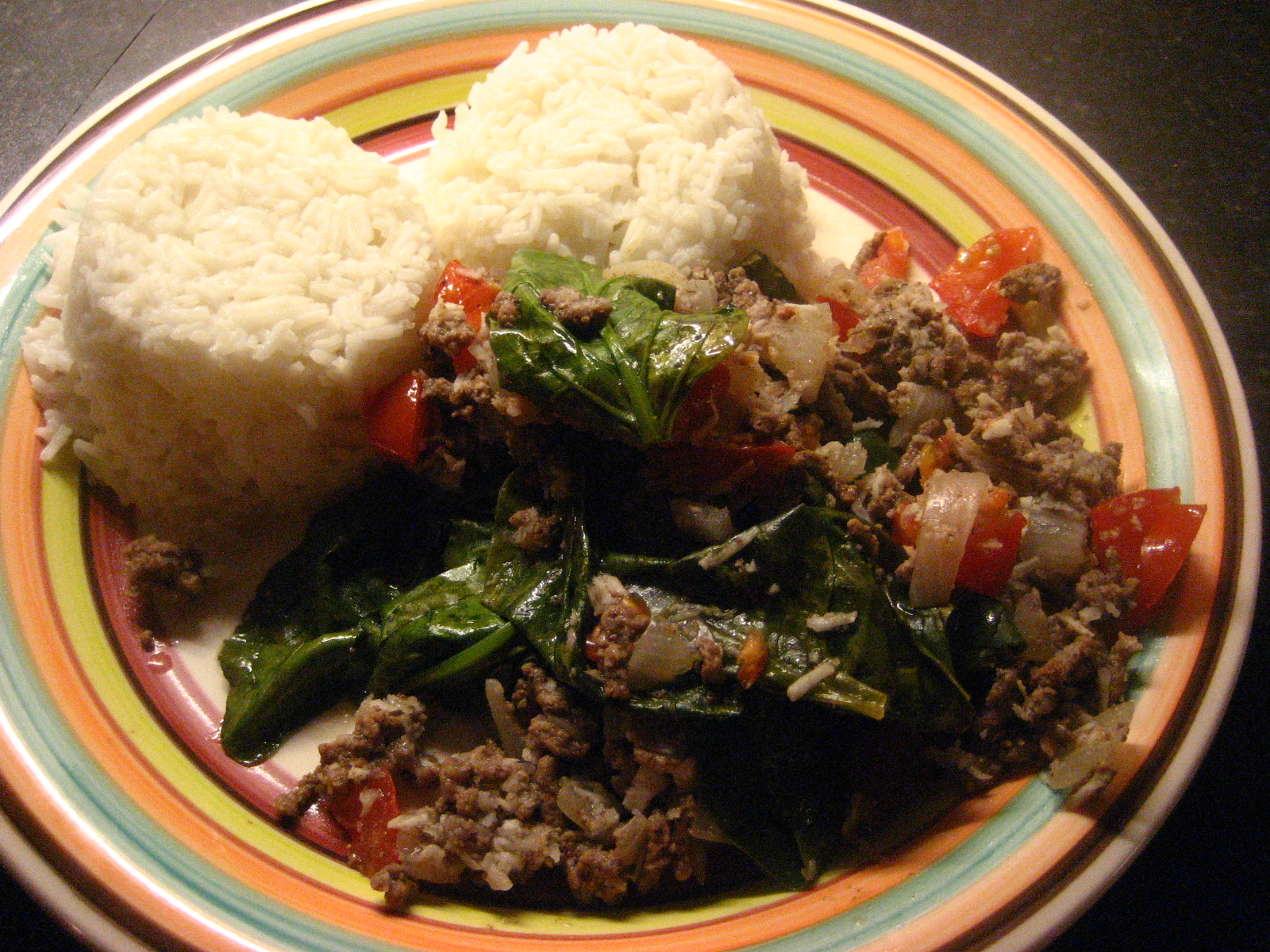
Once baked, I served the palu sami with rice.  My partner actually enjoyed it this time round, so that's a measure of success in itself!  The packages that I opened straight away, sort of fell apart on opening, which was fine, but not very aesthetically pleasing.  Other packages that I chilled over night in the fridge kept their shape really well, as you can see in the photos below:

Palu Sami with rice

Lithuanian rye bread with 'chilled' Palu Sami packets
Image credits:

All photos were taken by me, please feel free to reuse, under the Creative Commons license:

Attribution (especially to this blog post)
Share alike
Non-commercial