Showing posts with label Liberia. Show all posts

Sunday, 15 December 2013

Liberia - The Final Word

I've been blogging about Liberia for over two months - probably my longest time ever on one place, but I have been incredibly busy with real-life travel during this period.  Having done no less than 12 trips in 7 different countries, it's surprising I found time to do my research and blog at all!

It's been a great learning experience - not only about Liberia, but about West Africa and I've read lots of books and watched several movies set in or somehow connected to Liberia.  I learned about the history of Liberia and explored three of the most popular questions about Liberia on online search engines.  I learned about the importance of masks in West Africa and I read about Graham Greene's walk through Liberia in the 1930's.  I learned about international measuring systems and I learned how to cook palava, a popular West African dish.  I also blogged about ten random facts that I learned about Liberia. 

Kolahun by ChrysteleC
As usual, even with a long period of research, there were topics that I would have liked to explore further, but didn't have enough time.  If you wish to continue researching into Liberia, I would suggest the following topic areas:

- The difference between freedom and liberation
- Mangroves
- African airlines
- Polygamy
- FGM (ie. female genital mutilation)
- the flags of Liberian counties
- the role of the Blacksmith in traditional African ceremonies
- Firestone's presence in Liberia

The Final Word on Press Freedom

Monrovia Market by ChrysteleC
Blogging about Liberia, which was symbolically named after the concept of liberation, has made me think about the question - How do we measure how free/liberated a country is?

There are several (predominantly Western) indices which attempt to define how 'free' a country is.  One of the most well-known indices is The Press Freedom Index - which is compiled by the French-based Reporters without borders (Reporters Sans Frontières). 

Reporters without borders is a non-profit organisation which monitors attacks on press freedom worldwide.  Each year they publish the Press Freedom Index, which tries to measure press freedom of speech around the world.  70 journalists were killed in 2013, the highest number being 10 in Syria, followed by 8 each in India and the Philippines. 


Lofa by ChrysteleC
In 2013, Eritrea came bottom of the list of countries ranked by the Press Freedom Index, as they had done in 2012, when I was blogging about this country.  North Korea frequently takes second-last place, when it comes to press freedom.  Liberia came 97th on the list of 173 countries and is considered to be in a 'satisfactory' situation. 

The West African country with the best record is, perhaps not surprisingly, Cape Verde - which came 25th on the list, ahead of both the UK and the US.  Gambia has the lowest ranking of all West African countries, coming 152nd and is considered to be in a 'difficult situation'.  Although it's only one way of measuring 'freedom', I think the importance of independent reporting is a good indicator of how comfortable a government feels with internal criticism. 

There are other indices, which attempt to measure freedom and I had a lot of fun playing around with Freedom Meta-Index - this allows you to define your own criteria, eg. 'freedom of expression' and 'drugs rights', to see how free different countries are. 

The Music

I must admit, I didn't spend a lot of time listening to Liberian music - Liberia doesn't seem to have the 'big stars' that exist elsewhere in West Africa, although I could sense that music is as important to Liberia, as to any other nation in the region. 

I did quite like a musician called Shadow and he seems to be very popular with Liberians, so I'm going to leave you with one of his latest videos, from YouTube.
Image credits:

There are a limited number of photographers who have shared images on Flickr which were taken in Liberia but, nevertheless, I've managed to find some really beautiful images to illustrate my blog posts. 

For this final blog post I wanted to highlight the work of a relatively new member of the Flickr community, ChrysteleC - who joined Flickr in 2013, although I think the photos were taken in 2006.  You can see more of ChrysteleC's work on her photo stream.  Thanks ChrysteleC for sharing these images with us, using the Creative Commons License. 

Friday, 6 December 2013

Liberia - Ten random facts

As usual, I learned more interesting things about Liberia than I have had time to blog about – so I’m going to leave you with some interesting facts about this small West African country, to give you a taste of my wider learning experience.

1. In 1968, Liberia overtook the UK as the country with the highest number of registered ships in the world. This might seem a little bit strange until you find out more about the murky business of ‘flags of convenience’. First used by US companies, who starting registering their ships in Panama in the 1920’s, in an effort to keep costs down, there are now quite a few countries around the world that allow foreign companies to register ships in their country and fly their national flag. Liberia, Panama and the Marshall Islands are the top three countries of this type – other countries that are seen to operate ‘flags of convenience’ are the Bahamas, Barbados, Cyprus, Honduras, Mongolia (despite the fact that it’s a landlocked country), North Korea and Sri Lanka


Downtown Monrovia by David Sasaki
2. Liberia is sub-divided into fifteen counties and each county has its own flag. The newest county is Gbarpolu, created in 2001, it has a diamond on its flag, no doubt due to Gbarpolu’s proximity to Sierra Leone

3. Before its foundation in the early 19th century, the area which is now Liberia was known as the ‘Pepper coast’ and also as the ‘Grain coast’, in reference to the melegueta pepper which grows there. As a spice, melegueta pepper was also known as ‘grains of paradise’

4. Liberia adopted the British West African pound as its national currency, in 1907. The British West African pound was originally used by Liberia’s English-speaking neighbours in Nigeria, Sierra Leone, Gambia and Ghana. Liberia switched to the US dollar in 1943 and this was the country’s main currency until 1982. Liberians now use their own currency and one US dollar currently buys around 80 Liberian dollars

The Mamba Point motorcycle shot by David Sasaki
5. The US company, Firestone, crops up again and again in Liberia’s history. A source of employment for local people, Firestone could also potentially be seen as a source of exploitation of local resources and labour and may have been somehow involved in the Liberian slavery/forced labour scandal, investigated by the League of Nations in the 1930’s. At one point, Firestone owned 4,000 km2 of Liberia, which they had hoped to turn into the world’s largest rubber plantation.

6. Although I read a lot about the Liberian ex-pat community in Staten Island, I learned that there are also substantial Liberian diasporas in Minneapolis and Providence, Rhode Island.

7. Charles Taylor’s son was nicknamed ‘Chuckie’ Taylor and lived in Florida until he was seventeen. He developed a fearsome reputation as a commander in his father’s 'anti-terrorist unit' and is currently serving a jail sentence in the US, for his role in human rights violations

Liberian fisherman by David Sasaki
8. The border area between Liberia and Sierra Leone is a notorious ‘hotspot’ for Lassa fever. One of the world’s deadliest diseases, it kills around 5,000 people every year and, like Ebola, it’s a haemorrhagic fever, which basically means that victims bleed to death

9. The Liberian constitution still discriminates on the basis of race, in that, only ‘black’ African inhabitants can claim Liberian citizenship – people from other races, including the 4,000 or so people of Lebanese descent, cannot claim Liberian citizenship or exercise the right to vote, even if they were born in Liberia or come from generations of Liberian-born immigrants 

10. Sanniquellie, in Nimba county, is often referred to as ‘the birthplace of the Organisation of African Unity (OAU)’. In 1959, the political leaders of Liberia, Guinea and Ghana met to discuss the different paths to African unity. The talks later moved to Addis Ababa, where the organisation was officially founded in 1963

Image credits:

For this blog post, I wanted to highlight the photography of Flickr member oso, a.k.a. David Sasaki.  Originally from Seattle, David is now based in San Diego.  You can see more of his work on his photo stream.  Thanks David for sharing these images with us using the Creative Commons license. 

Saturday, 30 November 2013

Liberia - Reading List

I found quite a bit of reading material on Liberia - travelogues, fiction by Western authors, as well as fiction by Liberian authors. 

Here is a summary of the books I read:

Chasing the Devil: On Foot through Africa's Killing Fields - Tim Butcher, 2010

Journey without Maps - Graham Greene, 1936

I've blogged about these two books already and you can read my blog post here

Lonely Planet West Africa - 2009 edition.  I like reading old copies of guidebooks, such as the Lonely Planet series, as they are quite often a rich source of ideas and point me in the direction of resources which help me understand the place I'm blogging about.

There are very few guidebooks specifically about Liberia, but Lonely Planet West Africa has a lot of general information about the region and I made lots of notes and learned about other West African countries, such as Guinea-Bissau, Nigeria and Cameroon.  No doubt these notes will help, whenever I blog about these other countries, at some point in the future. 

The Rain and the Night - William Sankawulo, 1979.  As well as being a writer, William Sankowulo served as Liberia's leader, during the interim government of 1995-96.  He seems to have been somewhat of a political survivor, having been part of the old regime under Tolbert, as well as the new regime under Samuel Doe. 

The Rain and the Night is an interesting novel which deals with the challenges faced by a new chief, Kortuma, after his father passes away.  A key message of the novel is that, whilst tribes must sometimes go to war to defend their honour, war is generally bad for the country and the tribes must unite and work together for the general prosperity of their people. 

I found Sankawulo's depiction of women interesting - women are feared and respected by their men and Kortuma has a refreshingly modern view on the importance of understanding and listening to women, particularly in relation to his wives. 

Books I read during my research on Liberia
Murder in the Cassava Patch - Bai T. Moore, 1968.  Liberia's most famous novel, Murder in the Cassava Patch is the first novel I've read completely online.  I'm not at all technophobic, but I am a bit resistant to giving up paper books for electronic ones - however, the ebook was the easiest and quickest way to access Moore's Liberian classic which is, sadly, incredibly difficult to find in paper format. 

It's a great story - more of a novella than a novel.  Like Sankawulo's book, it also deals with the relationship between men and women, although this time, the relationship is a more hostile one.  In Moore's Cassava Patch, the men are hard-working and innocent, the women are conniving and manipulative.  In the words of one of the male characters:

The secrets of a woman are deeper than the bottom of hell.

Despite the undercurrent of 'gender war', I really enjoyed reading Murder in the Cassava Patch - the story is well-told and I learned a lot about Liberia and the everyday lives of the people who live there.

Liberian Women attending Math and Literacy class by UN photo
Little Liberia: An African Odyssey in New York City - Jonny Steinberg, 2012.  Steinberg has written a lot about his native South Africa, but a fellowship from the Open Society Institute (who I also once worked for) allowed him to do the necessary research for Little Liberia, which picks up the Liberian story in the ex-pat community of Park Hill Avenue on Staten Island. 

I read a lot about the various civil wars in Liberia but Steinberg's book, telling the stories of two Liberian immigrants, helped me contextualise the bigger picture and see a more real, perhaps more personal, version of events.  The book was well-researched and well-written, although I wasn't tearing through the pages, as I usually do and I can't help feeling there was something missing.

The Darling - Russell Banks, 2005.  I absolutely loved this novel and I'm quite interested in reading more of Russell Banks books, as this was the first time I'd ever heard of him.  Written from a 'western' perspective, the novel follows the story of a young (white) US woman - a radical, on the FBI's most-wanted list because of her anti-government activities, as part of the Weathermen underground movement of the 1970's - as she flees to Liberia, marries a Minister in Samuel Doe's government and raises three boys, who later become child soldiers. 

I found the story thrilling, sad, enlightening and engaging in equal measure and, whilst the political background of the novel wasn't new to me, I enjoyed seeing a fictionalised account, both of the civil wars in Liberia and the changing nature of the radical left in the United States.  Highly recommended!

And the ones that got away!

As usual, I didn't have time to read everything that I would like to have read in relation to Liberia.  In case you have more time than me to explore Liberia, here is a list of the other books I would like to have read. 

View inside Liberian Magisterial Court by UN photo
Too late to turn back - Barbara Greene, 1938 - the missing 'third' version of the Greene's Sierra Leone to Liberia trek.  I would love to have read Barbara's version of the journey with her cousin Graham, but time-constraints apart, copies of her book are relatively expensive, although republished by Penguin in 1990.

The Mask of Anarchy: Roots of Liberia's Civil War: The Destruction of Liberia and the Religious Dimension of an African Civil War - Stephen Ellis, 1999.

The House at Sugar Beach: In Search of a Lost African Childhood - Helene Cooper, 2009.

This Child will be Great: Memoir of a Remarkable Life by Africa's First Woman President - Ellen Johnson Sirleaf and Kim McLarin, 2010 - although I can't help feeling a little bit cynical about this type of political (auto)biography. 

Image credits:

These images have been shared by UN photo on their flickr account - the UN has shared these images using the Creative Commons license, so they can foster a public understanding of the UN's work and goals. You can see more UN photos (and learn more about their work) on their photo stream

Saturday, 23 November 2013

Liberia - The Movies

I watched four movies that were set in, or somehow connected to Liberia. 

Lord of War (2005) directed by Andrew Niccol (New Zealand) and starring Nicholas Cage and Jared Leto.  I'd seen this movie before, but wanted to watch it again, paying more attention to how they depicted Liberia in the movie. 

It's an interesting film and raises some important points about the global arms trade and the destruction it causes in many parts of the world.  I'm not a big fan of Nicholas Cage - there's something slightly irritating about him and he always seems to play really awful, morally corrupt characters, which doesn't help! 

Also, it seems as though not a lot of thought was put into depicting Liberia - the Liberian scenes were mostly shot in South Africa, including the famous scene on the mountain ridge, supposedly on the border between Liberia and Sierra Leone, which was actually shot in an arid area of South Africa that in no way represents the lush jungle that Liberia is famous for. 

The writers also didn't pay much attention to the facts, eg. when Cage's character refuses to sleep with the prostitutes in Monrovia, he tells us it's because West Africa is 'the most AIDS-infested region of the globe'.  Actually rates of HIV infection are relatively low in West Africa and an estimated 1% of Liberia's population is infected with the HIV virus, compared to 23% in a southern African country like Lesotho

Finally, the soundtrack of the movie had a random collection of West African music, artists like Issa Bagayogo from Mali and Cheikh Lô from Senegal.  Whilst it's great to see these artists getting some exposure, it felt a bit like 'any West African artist will do' and there's no direct connection between these artists and Liberia/Sierra Leone.  I find that approach a bit lazy. 


Blood Diamond (2006) directed by Edward Zwick (USA) and starring Leonardo Di Caprio and Jennifer Connelly. 

I'd also seen this movie before and on a purely 'entertainment' level it's quite good but, as with Lord of War - I tried to watch it from a more critical perspective, with an 'African eye' and I can see how it's really just a Western interpretation of life in Africa.  I'm also no big fan of Leonardo Di Caprio, which didn't help (although I love Jennifer Connelly!)

The main African character was played by Djimon Hounsou, who was born in Benin and, whilst I admired Hounsou's acting, I thought the character was very two-dimensional - there was no 'depth' to the portrayal of Africa and Africans and I was left feeling that the political background of the movie was just a romantic backdrop for the love story between Di Caprio and Connelly.  I don't think this movie tackled the serious issues as well as Lord of War did.

Again, the movie was shot in South Africa and Mozambique, so I was disappointed not to see Liberia or Sierre Leone (where most of the story takes place) on the big screen, although I realise that it would have been almost impossible to film in Liberia in 2006 and I'm sure the movie-makers weren't prepared to risk Di Caprio's life! 

At least the music choice was more authentic for Blood Diamond and included a track performed by Sierra Leone's Refugee All-stars.  All-in-all, this movie is a very Western story, which just happens to be set in West Africa. 


Johnny Mad Dog (2008) directed by Jean-Stéphane Sauvaire (France) and starring child actors, Christopher Minie and Daisy Victoria Vandy. 

Based on the novel, Johnny Chien Méchant by Congolese writer Emmanuel Dongala - this was by far the best movie I watched about Liberia.  Set during the upheaval of the second Civil War in 2003, Sauvaire directed former child-soldiers to create a movie that is brutally honest, horrific to watch and incredibly informative for a Western viewer.

It's hard not to see this movie as a product of the West, as it was directed by a European, but I think there is a big difference between a movie like Johnny Mad Dog and a movie like Blood Diamond, in that, Johnny Mad Dog definitely tells an African story, as opposed to 'a Western story set in Africa'. 

The movie was shot in Liberia and it was thrilling to finally see Liberia on the big screen, including iconic shots of the 'Broken bridge' in Monrovia.  Everything about the production felt authentic and this is probably the closest we could get (or would want to get) to the conflict in Liberia, which only ended ten years ago. 

The movie has been criticised for not having a proper 'plot' and, whilst the violence perpetrated by the child soldiers was pretty relentless, I didn't feel like it was gratuitous or that a structured/romantic plot (like the one in Blood Diamond) would have made a better movie.  A stronger plot would, no doubt, have appealed more to a Western audience.  I'd highly recommend watching this movie, if you want to learn about the conflict in Liberia. 


Pray the Devil Back to Hell (2008) directed by Gini Reticker (USA) and produced by Abigail Disney. 

A perfect antidote to the hard-hitting Johnny Mad Dog is Reticker's Pray the Devil Back to Hell, a documentary about the Liberian women's peace movement, which was known as the Women of Liberia Mass Action for Peace.  It's an incredibly uplifting story that explains the role Liberian women played in restoring peace to their country.

I hadn't really heard about this women's peace movement before, but I think it's a story that everyone should learn about/watch, as it can really restore your faith in a world that seems to be dominated by male violence, aggression and corruption.

The women of Liberia suffered immensely during the years of political upheaval - rape, murder, enslavement - women always seem to be on the receiving end of societal breakdown.  It's quite apt then, that Liberian women were also in the position to create an atmosphere of peace and bring the (generally male) warlords to the negotiating table. 

It's believed that the current (female) President of Liberia, Ellen Sirleaf-Johnson, was elected because of the strength of the women's movement.  Her presidency has recently been rocked by scandals, criticism and allegations of corruption, but I'd like to hope that Liberia's peace movement is a sustainable one, that will continue to influence Liberian politics for many years to come.

Saturday, 16 November 2013

Liberia - How I made Palava

Palava is a dish that is quite common across West Africa and combines some of the most typical ingredients available in this part of the world.  The Liberian version is very similar to the palava made in other countries. And it's not at all unlike Chakalaka, which I made when blogging about Lesotho. 

I've come across the word palava or palaver already during my research, as the name of the meeting houses in Liberian villages, where elders make important decisions about community issues.

We use the word palaver in English, in quite a negative way, to describe an unnecessary fuss, eg. What a palaver!  It's thought that the origin of the word might be from Portuguese palavra which means word - although the palava dish is so spicy, I couldn't talk much as I was eating!

Liberia is the 32nd place that I've blogged about and the fifth African one - for each place that I've blogged about, I've tried to cook one of their national or regional dishes.  I have to stress at this point that this is a blog about culture, not a blog about food (although the food posts are always very popular!). 

If you want to see a proper food blog about palava have a look at Celtnet.org where I got my recipe - this is a great resource for any interested in 'world food' and I've used this website many times.  I also found a really cool foodie blog called Kayotic Kitchen which has a great chicken palava recipe.

My intention when blogging about food for Learning about the World is to understand the food culture in the places I blog about, by comparing the ingredients and trying to recreate these national/regional dishes with what I have available in my local shops in London.  I quite often have to (or even want to) substitute some of the ingredients in the original recipes and this process, in itself, is part of my learning experience.

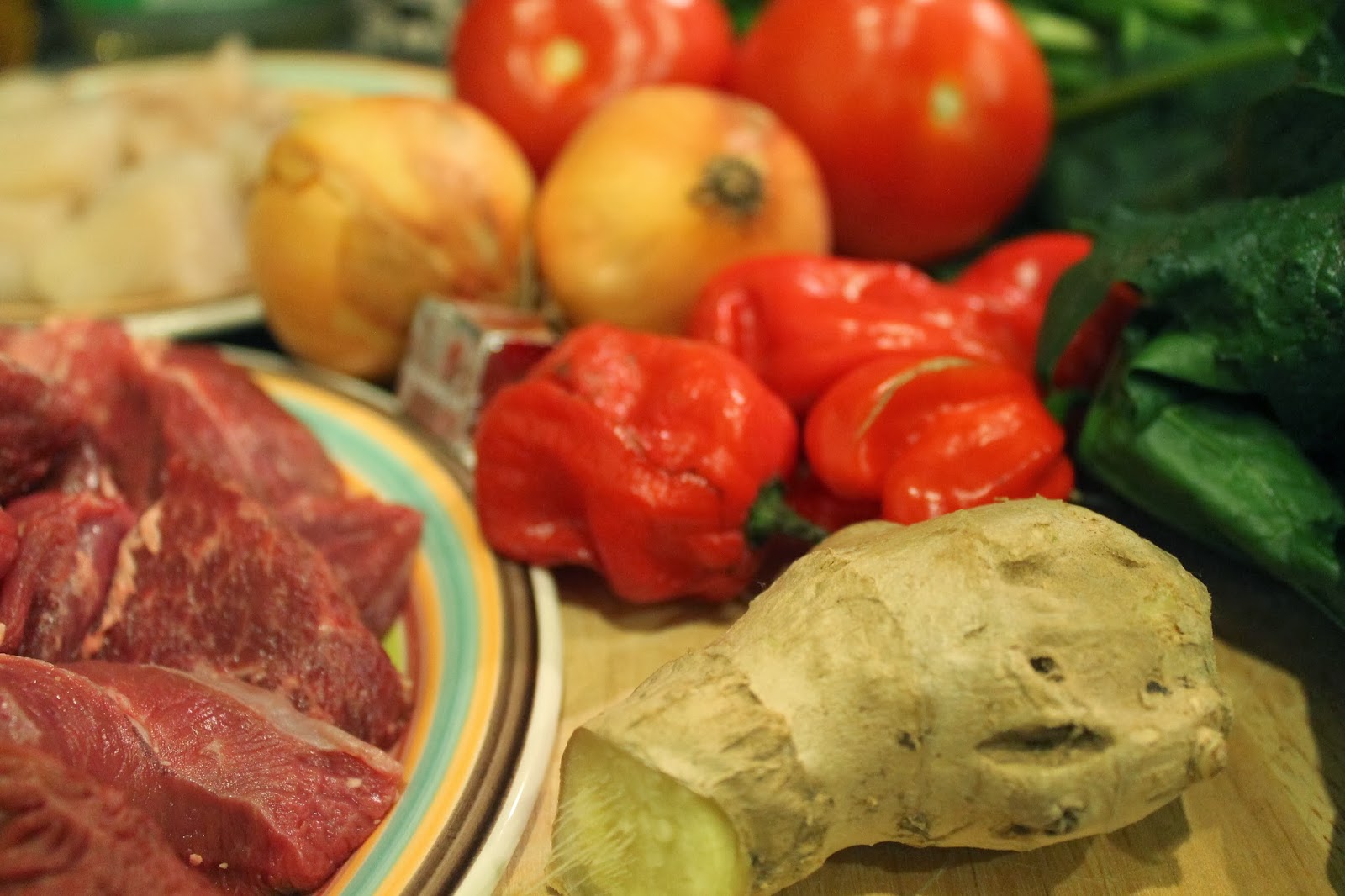
The ingredients:

Ingredients for Liberian palava
500g goat meat - the original recipe had beef, actually, but goat meat is popular across West Africa and, as I had never cooked goat meat before, or even tasted it, I want to see what it was like.

300g dried fish - except I used fresh fish!  I can picture the stalls full of dried fish in Waterside Market in Monrovia, a clever way to preserve fish in the hot weather, but finding dried fish in London isn't that easy - when we eat dried fish in the West, it's usually a snack with beer, not part of a meal. 

It was also very weird cooking meat and fish together in one dish - I checked a few palava recipes and most of them seemed to have this option.  I'm not sure why cooking meat and fish together is weird for me, perhaps it's a cultural thing?  I realise that many people in Liberia would be happy to have either meat or fish, so perhaps adding both is an extravagance that makes the meal something special?

20g fresh ginger (grated) - Liberians love their ginger and so do I!  Palava is actually the name of the sauce that is used in this dish and ginger is a key ingredient.

4 Scotch Bonnets - Scotch bonnets are incredibly hot chilli peppers and I've only cooked with them once before, when I made chakalaka.  I must admit, I chickened out this time round and only added three of them, not four, as recommended by the recipe - the dish was still pretty hot with three Scotch bonnets in it!

2 small onions - one to form the basis of the palava sauce and the other one for cooking with the meat, sauce and fish

I used spinach/palak instead of bitterleaf
2 tomatoes - also to make the sauce

A bunch of spinach - the original recipe recommends bitterleaf, but this is something which isn't to find in Europe.  I guess I could have sourced some dandelion leaves, if I'd gone to a health food store, but spinach seemed like a good, leafy substitute, even if it doesn't have the same level of bitterness.

1 stock cube - I used beef

How I made Liberian palava

I started by preparing the palava sauce - the recipe suggests pounding the onions, chillies and tomatoes in a pestle and mortar, but I'm not a big fan of pounding, so I blitzed everything in my food processor instead. 

Put the onion, ginger and chilli in a food processor - or pound them with a pestle and mortar, if you prefer!

Add the two chopped tomatoes

Palava sauce, which is much hotter than it looks!

Next I prepared the meat.  Goat's meat is quite tough and could be chewy, so it should be boiled for about an hour to soften it up a bit.  I mixed the beef stock cube with 200ml of water, then put it in a saucepan with the goat's meat, brought the whole to a boil, then reduced the heat and simmered it for one hour.

Prepare some stock - I don't know if there is such a thing as a goat stock cube?  I used beef

Simmer the goat's meat for about an hour to tenderise

Lovely chunks of goat's meat!

Whilst I was simmering my goat's meat, I prepared some rice, to accompany the meal.  Actually, fufu would be more traditional and I've made fufu before when I was blogging about Togo, but the reality is that many people in West Africa have rice with their main meal, so I wanted to do the same.  

After an hour of cooking the meat, I took it off the heat - drained the stock into a jug and put the meat pieces to one side.  I then fried the second onion, the palava sauce and the fish pieces, until the fish had cooked through.

Fry the onion and palava sauce, then add the fish pieces

Fry until the fish pieces are fully cooked

After this, I added the goat meat and spinach leaves, pouring the stock and some water on top, until the spinach was covered and I let meat, fish and vegetables stew for about fifteen minutes, until the spinach had cooked and the whole thing had taken on a fiery, soupy look!

Add the goat's meat pieces

Then the spinach

Then the stock and water

It was dead easy to make - I'm not sure goat's meat is my favourite thing in the world and I think I would have enjoyed this dish more with either meat or fish, perhaps not both.  Nevertheless, another world food dish to add to my growing recipe book! 

Liberian palava served with rice

Image credits:

All photos were taken by me, please feel free to reuse them, under the Creative Commons license:

Attribution (especially to this blog post)
Share alike
Non-commercial  
 

Saturday, 9 November 2013

Liberia - Measuring the future

One of the 'facts' about Liberia that I've come across time and again is that it's one of only three countries in the world that haven't officially adopted the International System of Units or SI (often referred to as the 'Metric' system) for measurements - the other two countries being the United States and Burma/Myanmar. 

Investigating a bit further, it would seem as though the reality is more complex than that - Liberia is surrounded by countries, such as Guinea and the Cote D'Ivoire, which were part of French West Africa and have used the metric system since colonial times.  Although Liberia hasn't yet officially adopted the SI - it would seem as though this system is being used more and more in every day life, as a result of influence from neighbouring countries.

Global measures

Pera Anona for sale in Sicilian food store at 4 euros per kilo
The French have lost a lot of ground in recent centuries, whether it's the decline of the French language as an international means of communication (except in aviation and the Eurovision!) or the smaller role that France now has in world affairs.  But at least they've left us with a really logical system of measurement! 

The result of many years of negotiation and standardisation, the International System of Units, that was adopted by most of the world in 1960, is largely based on the Metric system of measurement which Napoleon popularised during his conquest of Europe in the early 1800's. 

There was a time when every country/culture had its own measurement system - these systems often varied from one town to another - which, understandably, hampered a more global recognition of measurement standards, important to carrying out trade.  I think it was inevitable that either the French (metric) system or the British (Imperial) system would prevail - but there is a good reason why the metric system became more popular in the end. 

A revolution in measurement

The beauty of the SI or metric system is that it uses a basic measurement unit, eg. a metre (US spelling, meter) or a gram and all bigger and smaller amounts are given affixes, such as kilo- or milli- which are calculated to the power of 10 - eg. 100 times bigger, or 1000 times smaller.  Put quite simply, 1 kilometre = 1000 metres, as kilo means 1000.  Likewise, 1 kilogram = 1000 grams - perfect!

The Imperial system and US customary measurements

Signpost in Russia showing distances in kilometres
If you compare this to the Imperial system, once favoured by the UK and the British Empire, and the very similar US customary measurements still used in the United States and Liberia - 1 foot = 12 inches, 1 mile = 1760 yards, 1 pound = 16 ounces and 1 stone = 14 pounds!  You can see that it's a bewildering array of terminology, not to mention the seemingly random conversion ratios!  I fully understand why the world prefers metric!

My experience of measurement

I was born in Ireland in the 1970's, at a time when the Imperial system of measurements was alive and well.  Then, sometime during the 1980's, we started changing to the metric system and now I'm pretty confused and, like many people in the UK and Ireland, I use a mixture of both.  I've got no idea what an ounce is - but I could probably measure 250g of flour quite easily!  I've got no real concept of a yard, but I do still think in miles, although I have a vague awareness of kilometres!

Anyone who's read my other blog, Walking the Chesters, will know that I'm very fond of hiking - it's a hobby I picked up in Slovakia, which I then continued when I moved to France, about twelve years ago.  Funnily enough, I first started walking in kilometres and I got used to this - so when I returned to Ireland/UK, I had to relearn the distances in miles and now I feel much more comfortable using miles again, as this is what I've used most of my life.

Metric-phobia

Weighing three ounces of butter
British and Irish people (in common with our fellow English-speakers across the Atlantic) seem to have an innate fear of 'converting to metric'!  Distances seem longer in kilometres - we seem to get less food for our money in kilograms and, despite government efforts, it's been a bit of a battle to get people in the UK (and, to a lesser extent, in Ireland) to truly convert to SI.  As with Liberia, we have a mixed reality of measurement that doesn't necessarily reflect official policy. 

But it's only a matter of time - the UK and Ireland have already officially adopted SI, even though the UK still uses some imperial measures.  Liberia seems to have retained US customary measurements, out of some bizarre deference to US-Liberian relations, but this is already changing.  The days of the Burmese maik, peittha and hkwet are surely numbered, as they open up trade with their metric neighbours.  Even the US has made some concessions to the metric world, although I'd be surprised if the US or UK completely abandoned measurement in miles - there would be too much of an uproar!

It's a fascinating subject to have touched upon and I'd like to explore the concept of measurement again, in future blog posts. 

Image credits:

All photos on this blog post were taken by me- please feel free to reuse them, using the Creative Commons license:

Attribution (especially to this blog post)
Share-alike
Non-commercial

Saturday, 26 October 2013

Liberia - The Way to Africa

As well as reading literature that comes from the place I'm blogging about, I also quite often read travel books by adventurers, mostly European or US citizens, who have ventured out into the great unknown! 

For Liberia, I've read two travel books - the first was Chasing the Devil: On Foot through Africa's Killing Fields (2010) by Tim Butcher, a former correspondent for The Daily Telegraph, who reported from Liberia in 2003, during some of her darkest hours - the second Journey without Maps (1936) by Graham Greene, the famous writer, adventurer and MI5 operative, who travelled to Sierra Leone and Liberia, during his first trip outside Europe. 

I really loved Butcher's first book, Blood River: A Journey into Africa's Broken Heart (2007), which records his journey through Congo-Kinshasa, following in the footsteps of the explorer, Henry Morton StanleyChasing the Devil is Butcher's second book and I also really enjoyed his depiction of Sierra Leone and Liberia, as he walked on foot through both countries, following a journey made by Graham Greene and his cousin Barbara. 

Scenes around Liberia by Tweefur
I find Graham Greene a fascinating character and I've read one of his novels, The Quiet American (1955) set in Vietnam.  He seemed to travel everywhere and I have a feeling I'll be running into the work of Graham Greene (and perhaps, Tim Butcher) as I research for future blog posts.  It was interesting comparing the two works following the same route, to see how much or little had changed in Liberia in the seventy years that separated Greene and Butcher's journeys.  Here are a few of the things that I've noted:

Sierra Leone - a country in reverse?

One of the greatest symbols of 'modernity' and the Industrial revolution is the train.  I was fascinated to learn that, whilst Graham Greene travelled by train to Pendembu - the start of his walk in Sierra Leone - seventy years later, Butcher couldn't do this journey by train, as the train system in Sierra Leone no longer functions. 

As a symbol of 'progress', the disappearance of the train system makes me wonder whether or not Sierra Leone is going backwards, instead of forwards?  Mind you, we also ditched much of the regional rail network in Ireland, once the British left - it doesn't necessarily mean we went backwards or stopped progressing, we just did what we could afford and I guess, for the government of Sierra Leone, it must be the same reason?

When the Greenes visited Sierra Leone, it was still a British colony, with all the trappings of 'civilisation' and a European-style infrastructure, as unsustainable as that may have been.  In the 1930's, Liberia was one of Africa's least explored countries, a real 'Heart of Darkness' and Butcher suspects that Greenes' trip may have been funded by an anti-slavery organisation, back in England, who wanted to find out what was really happening in Liberia's hinterland.  I'm sure the British government was also quite interested in this country neighbouring one of their colonies. 

The joys of travelling light

As well as 26 porters, three personal servants and a chef, the Greenes travelled with; six boxes of food, two beds and chairs and mosquito nets, three suitcases, a tent, two boxes of miscellaneous things, a bath, a bundle of blankets, a folding table, a money-box, a hammock.  I guess it wasn't easy to travel light in Africa in the 1930's, although I do think the bath was taking things a bit too far!  I'd also love to know what was in the boxes of miscellaneous things - no doubt a good deal of whiskey, if the rest of Greene's account is to be believed! 

By contrast, Butcher travelled with a voluntary companion, as well as a paid guide and driver and as much stuff as they could all carry between them.  In fairness to Graham Greene though, for most of the journey, he flouted the expectations of that time by walking through the jungle, rather than being carried by the native porters in a hammock, as most other Europeans would have done. 

Barbara who?

Scenes around Liberia by Tweefur
Butcher does a really good job at including Barbara Greene in Graham's story - considering that Graham barely mentions her at all in his book and you sometimes wonder what she was doing, whilst he was philosophising, admiring the breasts of native women and getting drunk?  Barbara wrote her own account of their journey, Too late to turn back which, if the title is anything to go by, suggests that she found the whole thing quite hard going! 

Having initially accepted Graham's proposal to accompany him to Africa, after a few too many glasses of champagne at a  wedding, Barbara eventually rose to the challenge and even took over the management of the trip, when Graham fell ill. 

Alarming digressions

Having finished Butchers incredibly readable and informative book, I was slightly apprehensive about tackling the eccentric and chaotic world of Greene.  It really struck me how awareness of the reader/audience is much more important nowadays, than it was in the time of Graham Greene.  Greene's book was well-written, because he was a great writer, but it was also rambling, full of anecdotes and digresses often enough to alarm the modern reader. 

By contrast, Butchers writing was 'tight' and on topic, cleverly blending several different strands of the story, to meet the expectations of a modern audience.  I guess the modern commercialisation of the Arts and literature means that the days of eccentricity and digression are over - the reader needs to be wholly involved at every moment, or else a book won't sell.  I can't help feeling that we've lost some of the disorder of a previous age, when writers were less focused on the market!

The Way to Africa

Scenes around Liberia by Tweefur
In total contrast to Butcher, who wanted to follow Greene's journey as closely as possible, Greene himself had no idea where his journey was going to end.  His original visa only allowed him to travel to the capital, Monrovia, through the western part of Liberia.  Instead, perhaps because he had a hidden agenda, he meandered through Lofa province, (French) Guinea and Nimba, eventually reaching the coast at Grand Bassa, now called Buchanan. 

Greene had the vague intention of finishing his journey on the coast at Sinoe (now called Greenville) in eastern Liberia, which was believed to be the centre of an illegal slave trade.  He cut his journey short because he couldn't bear the monotony of travelling through the jungle and because he was running out of money (not to mention whiskey!).  Butcher, on the other hand, obsessively followed Greene's original journey and knew exactly where he was going and how he intended to get there. 

For Greene, this wasn't just his 'way to Africa' but, in many regards, his way to the world.  Anyone who has lived abroad will recognise the importance of that first 'seminal' experience - when you're disorganised, miserable, experiencing culture shock - hopefully you learn from it and do a better job at planning the next trip!  The experience certainly toughened Greene up for later journeys, including his time spent in Sierra Leone, during the Second World War, as a British intelligence officer.  It also helped him cut his teeth, in terms of writing and he went on to write many, many more books and novels, which have informed and entertained countless millions ever since!

I look forward to Butcher's next book and I'm curious to see if he will follow the pattern set by his previous two works.  For Greene, alas, the way to Africa is no more!

Image credits:

For this blog post, I wanted to highlight the photography of Flickr member, tweefur aka Teri Weefur, who is originally from Monrovia, but now lives in Silver Spring, USA.  She has created an interesting set of photos called, Scenes around Liberia and she also has a website

Thanks Teri for sharing these images of Liberia, using the Creative Commons License. 

Saturday, 19 October 2013

Liberia - The Land behind the Mask

Like many West African nations, Liberia is well-known for its masks.  Used in traditional rituals and tribal ceremonies, the mask plays a very important role in concealing the identity of the main actors in a ceremony - it could be your next-door neighbour or your grandfather - masks facilitate an illusion, a mystery or a private space where human identity is hidden from public knowledge.

African masks are usually made from wood, leather, tin, glass beads or natural materials.  However, they are endowed with their own power and become something more than pieces of wood or leather.  In West Africa, masks weren't traditionally made as decorative objects, but rather fetishes with significant spiritual value, independent of the mask's creator or bearers. 

African masks can represent idealised human forms (anthropomorphic) or animal forms (zoomorphic) - they can cover the face, the whole head or even the upper body.

It got me thinking about the importance of masks to human culture, so I've made a list of different ways that masks are used across the world.

Concealing identity - one of the most important uses of a mask is to conceal someone's identity.  Whether it's a Poro devil carrying out an initiation ceremony in the Liberian jungle, someone robbing a bank in Basingstoke or Michael Jackson concealing the identity of his kids - the main purpose of a mask is to take away the real identity of the wearer, so they can remain anonymous, for any number of reasons.

African figures, Horniman museum
Violence - masks are often used to hide the face of someone committing an act of violence.  The mask I'm most familiar with from my childhood is probably the balaclava - a favourite fashion item of the IRA!  I guess, by putting on a mask, the wearer is removing themselves from the responsibility of a violent situation or, at the very least, concealing their identity, so they won't be legally prosecuted afterwards. 

Let's be honest - masks scare us - at Hallowe'en, or any other time of the year - seeing another human being with their identity removed taps into a sense of fear that runs deep in the human psyche.  Perhaps this fear or phobia also extends to the debate around niqabs and burqas?  Certainly a lot of the debate in the UK has focused on veils as a barrier to communication, something which stops us from interpreting facial expressions. 

Eroticism - somehow connected to fear, is the erotic aspect of masks.  By giving people anonymity, masks can also remove normal societal restrictions on sexuality.  I suspect that a lot of traditional ceremonies use masks for this reason, although the secretive nature of initiation rites means that we may never find out the truth. 

African mask, Horniman museum
An obvious example of using masks in this way is the Masquerade Balls of 15th and 16th century Europe, thinly disguised orgies for the upper classes.  A toned down version of this tradition is kept alive by the Venice carnivale and Venetian masks are famous the world over.  Anyone who's seen the movie Eyes Wide Shut (dir. Stanley Kubrick, 1999) will understand the power and sensuality of masks and masquerade balls!

Hygiene - a much more mundane, but universal, use of masks is related to hygiene.  Surgeons all over the world wear masks, as do dentists and other health professionals.  Surgical masks have become very popular in the heavily polluted cities of East Asia and I remember seeing TV news footage of people in China wearing masks during the SARS outbreak in 2002. 

Masks can be used as a form of punishment - I'm thinking here of a 15th century tradition in the UK where women who gossiped a lot were forced to wear a contraption called a scold's bridle, which preventing them from talking.  I'm also thinking of the 'man in the iron mask' of 17th century France - an unidentified prisoner who was forced to wear a mask to conceal his identity - possibly because he was an illegitimate (or legitimate?) heir to the throne.  And I can't help but think of Hannibal Lecter, the character played by Anthony Hopkins in the film, Silence of the Lambs (dir. Jonathan Demme, 1991)

Actor getting ready, Beijing Opera
In Korean, Chinese and Japanese traditions, masks are used to establish the characters of a story - in Peking Operas, both masks and make-up are used to identify characters and let the audience know if they are goodies (the red and black ones) or baddies (the yellow and white ones). 

Masks can be used to hide scars or other facial deformities.  I'm thinking Darth Vader from the Star Wars series of movies.  Or the Phantom of the Opera, or The Elephant Man (dir. David Lynch, 1980)

In our magic-less, scientific age, it's more likely that you will see masks being sold as souvenirs - whether you're in Venice, Kuta, Bamako or Iqaluit - I'm pretty sure you will be able to pick up a mask as a souvenir.  Work of art, retainer of magic, vessel of illusions - masks are certainly a vital part of human culture. 

Image credits:

All photos were taken by me - please feel free to re-use them with attribution to this blog. 

Saturday, 12 October 2013

Liberia - Three Questions

In keeping with my new 'strand' of research, I have done a quick Google Instant test on Liberia - to see what kind of questions people are asking about this West African country.  The questions people ask are sometimes quite predictable, to be honest, although I guess the following questions are probably quite relevant to anyone who is learning about Liberia for the first time.

Do Liberians speak English?

This seems to be one of the most popular questions generally, if you type Do (nationality) . . . into Google.  We seem to be a bit of obsessed about whether or not the rest of the world speaks English and I guess this type of question reveals a deep-rooted awareness (or even phobia?) of our own monolingualism. 

The Vai script of Liberia
There is a psychological condition called xenoglossophobia or Foreign Language Anxiety - which I'd imagine is a pretty genuine condition for many people trolling the Internet!  I think I have the opposite condition - xenoglossophilia - ie. love of foreign languages. 

I've lost count of how many languages I've started to learn and I'd like to think I can speak four languages reasonably well (my native language is English, but I also speak/know Irish, French and Russian)

And in answer to the question - well . . . kind of - English is the official language of Liberia although many people, especially outside the capital, speak English as a kind of creole, which might be difficult for non-Liberian English speakers to understand. 

Actually, there are more than 30 languages spoken in Liberia - including Mande languages like Kpelle and Vai (which has its own script) and some of the main Kru languages, like Bassa and Grebo.  To learn more about African linguistics, have a look at my blog post about Togo

Does Liberia have oil?

Protest sign by Toban Black
Another Western obsession!  Well, there are many oil-producing countries in the world, but Liberia isn't one of them.  In fact, West African countries in general aren't big producers of oil, with the exception of Nigeria and Cameroon. 

Nigeria produces more oil than Norway or Azerbaijan, which I found surprising, until I remembered having read about the environmental and human rights issues between Shell and the people who live in the Niger Delta. 

It's probably better not to have oil, as oil seems to bring trouble and, given Liberia's recent past, trouble is something the Liberian people could do without!

Are Liberians American citizens?

I was a little bit surprised by this question and why so many people might think that Liberians are American (I presume they mean US) citizens?  Liberians are not US citizens, although they do have a long history with the United States and, as I mentioned in my first blog post, Liberia was established by an American society to repatriate freed black (African) slaves from the United States. 

You might have noticed that the Liberian flag looks remarkably like the flag of the United States - also, Liberia is one of only two countries in the world whose capital is named after a US President (James Monroe - Monrovia).  And the other country is?  You guessed it . . . the United States (George Washington - Washington D.C.)

Flag of the United States of America
I think it's fair to say their relationship with the US is still important to Liberians today.  Until fairly recently, the US was by far the biggest donor of aid to Liberia, although this has now changed and the EU and UK have given most aid to Liberia in recent years.  I wrote quite a bit about 'Aid' when I was blogging about Togo - if you want to read more, just click here

Despite their close relationship, the United States government refused to recognise Liberia as a country during its first 15 years as an independent nation.  And the reason?  Well, according to Tim Butcher in his marvellous book Chasing the Devil: The Search for Africa’s Fighting Spirit (2011) - the thought of having to accept a 'coloured' Liberian diplomat in Washington D.C. was too much for a racially-charged nation that was soon to tear itself apart over the issue of slavery, during the American Civil War. 

Image credits: 

The image of Vai script is from Wikimedia commons and in the public domain, as is the image of the United States flag.

The picture of the protest placard is from flickr user Toban Black who is from Canada.  You can see more of Toban's work on his blog

Saturday, 5 October 2013

Liberia - The Love of Liberty Brought Us Here

West Africa is a fascinating place.  With a population of around 300 million people - living right next door to Europe, I can't help thinking that West Africa will be a true test of Europe's commitment to the world, if not a major partner in Europe's future prosperity.  We tend to overlook West Africa and think about markets across the Atlantic or in Far East Asia - but our ties to West African countries go back a long way - a chequered history of repression, blame and guilt.

I've blogged about West Africa before - when I researched Togo, exactly three years ago and I'm really looking forward to my next virtual journey to this part of the world, as I blog about Liberia over the coming weeks.  With a population of about 4 million, Liberia is a small fish in a big pond, but it holds an important symbolic place in the hearts and minds of all West Africans, as the first West African 'nation' to rule itself.  Liberia became an independent nation in 1847 - 110 years before Ghana became the second West African nation to gain independence. 

Liberian school girl by Ken Harper
Ten years ago this month, Liberia emerged from years of civil war that bankrupted the economy, killed a quarter of a million people and left the country's infrastructure in ruins.  Whilst a lot has been done to rebuild the country, Liberia still has the second-lowest per capita income in West Africa, being slightly ahead of Niger.  The current government faces a whole host of challenges, as it draws international criticism for its failure to address corruption and restore social services to the Liberian people. 

I've already had my first 'myth' about Liberia exploded - ie. the idea that Liberia was established as some kind of benevolent act of charity, funded by the United States.  It's true that many supporters of the American Colonisation society had a genuine desire to do the right thing, by establishing (what was then) a colony for freed slaves back in the 'homeland', on the West African coast. 

The reality is that the freed slaves were born in North America and were ill-prepared to survive in the tropical jungles of West Africa.  Was the establishment of Liberia really an act of kindness in the pursuit of Liberty, or an attempt to 'cleanse' the United States of freed blacks, who could unsettle the slave population of the Southern states?

Local radio station by Ken Harper
The survivors of this attempt at (re)colonisation must have been a tough bunch and, until modern times, Monrovia has remained the centre of Americo-Liberian culture. 

The country's motto is quite revealing - The Love of Liberty Brought Us Here - which means, 'we' are not from 'here', but from 'elsewhere'.  Liberia found itself in the unusual position of an African nation colonised by North American Africans.  Apart from the population that was 'brought here' - like most West African nations, Liberia already had a complex ethnic make-up - the addition of Americo-Liberians was another layer on top of an existing tapestry of cultures, languages and traditions that had been there for centuries.

The Americo-Liberians of Monrovia dominated Liberian history until 1980, when the tribal people of the hinterland rose up in a bloody revolution that saw Samuel Doe, of the Krahn tribe, take control of the country.  Doe unleashed an ethnically motivated campaign against the Mano and Gio tribes of Nimba county and was ousted in an equally bloody take-over by Charles Taylor, who got a lot of his support from the restless north-eastern part of the country.  A civil war ensued, which lasted until the mid-90's before settling into an uneasy 'peace' as Taylor held firm to the reins of control.

Figure in stairwell by Ken Harper
Just last week convicted of war crimes in relation to his meddling with Sierra Leone, Taylor was forced into exile in Nigeria in 2003 and was later extradited to the Hague to await sentencing for the murders, rapes and acts of terrorism that he has been found guilty of aiding and abetting. 

Liberia's current leader, Ellen Johnson Sirleaf, is one of only 17 women in the world who currently lead national governments.  She is one of the two female leaders in Africa - the other one being Joyce Banda of Malawi.  President Johnson-Sirleaf very much represents the emergence of civil society in Liberia, especially in relation to the peace movements, mostly led by women, that emerged in the early years of the 21st century.  Tasked with rebuilding a country in ruins, Liberians have managed to sustain the mood for peace and make the first steps in the direction of economic recovery. 

Image credits:

A quick search for Liberia on Flickr currently brings up the photos of Ken Harper, a college professor at Syracuse university - originally from Indiana!  I wanted to highlight some of Ken's photos.  All photos were taken as part of the Together Liberia project.

Thanks to Ken for sharing them with us using the Creative Commons License