Showing posts with label Africa. Show all posts

Saturday, 16 November 2013

Liberia - How I made Palava

Palava is a dish that is quite common across West Africa and combines some of the most typical ingredients available in this part of the world.  The Liberian version is very similar to the palava made in other countries. And it's not at all unlike Chakalaka, which I made when blogging about Lesotho. 

I've come across the word palava or palaver already during my research, as the name of the meeting houses in Liberian villages, where elders make important decisions about community issues.

We use the word palaver in English, in quite a negative way, to describe an unnecessary fuss, eg. What a palaver!  It's thought that the origin of the word might be from Portuguese palavra which means word - although the palava dish is so spicy, I couldn't talk much as I was eating!

Liberia is the 32nd place that I've blogged about and the fifth African one - for each place that I've blogged about, I've tried to cook one of their national or regional dishes.  I have to stress at this point that this is a blog about culture, not a blog about food (although the food posts are always very popular!). 

If you want to see a proper food blog about palava have a look at Celtnet.org where I got my recipe - this is a great resource for any interested in 'world food' and I've used this website many times.  I also found a really cool foodie blog called Kayotic Kitchen which has a great chicken palava recipe.

My intention when blogging about food for Learning about the World is to understand the food culture in the places I blog about, by comparing the ingredients and trying to recreate these national/regional dishes with what I have available in my local shops in London.  I quite often have to (or even want to) substitute some of the ingredients in the original recipes and this process, in itself, is part of my learning experience.

The ingredients:

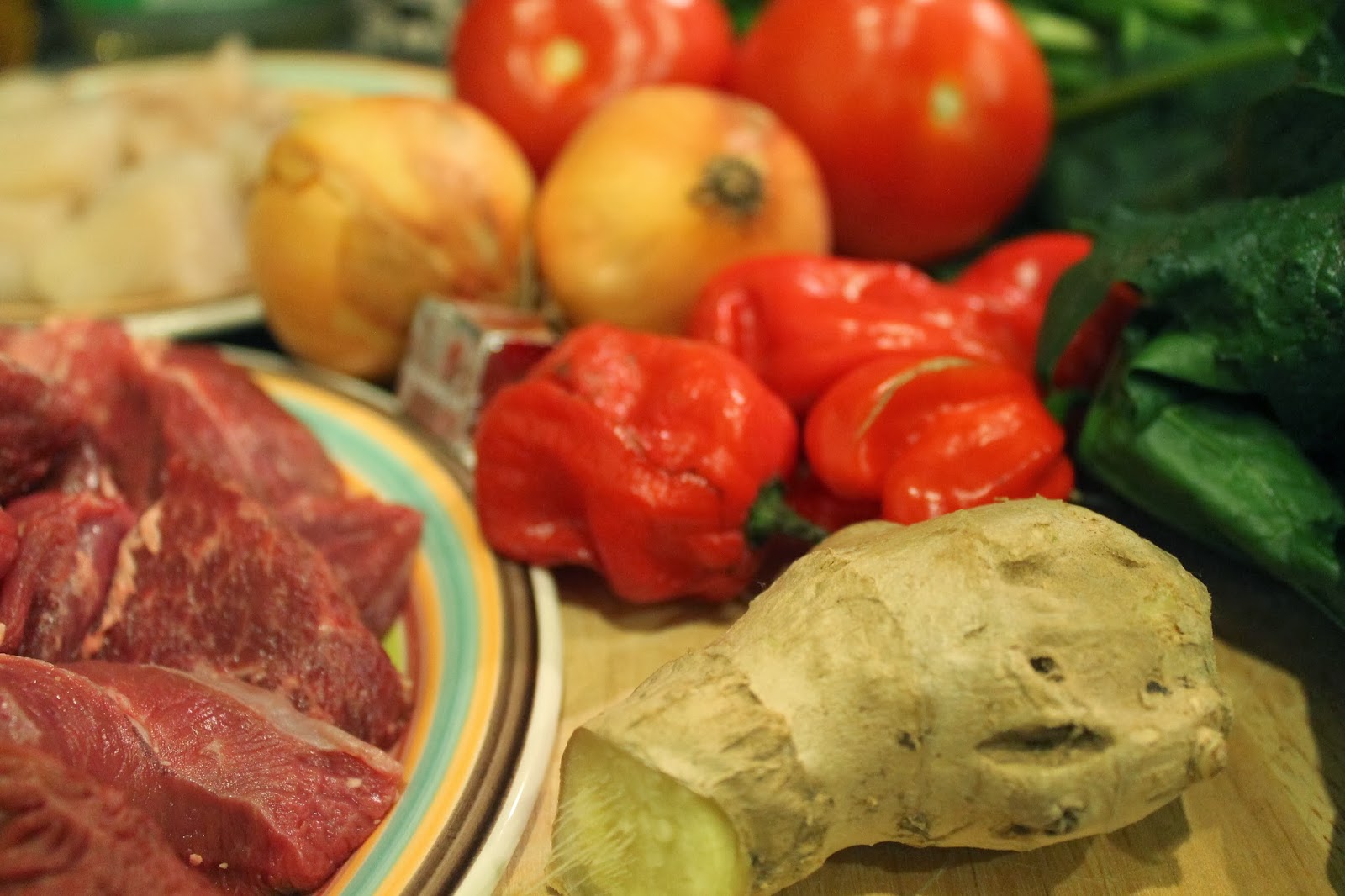
Ingredients for Liberian palava
500g goat meat - the original recipe had beef, actually, but goat meat is popular across West Africa and, as I had never cooked goat meat before, or even tasted it, I want to see what it was like.

300g dried fish - except I used fresh fish!  I can picture the stalls full of dried fish in Waterside Market in Monrovia, a clever way to preserve fish in the hot weather, but finding dried fish in London isn't that easy - when we eat dried fish in the West, it's usually a snack with beer, not part of a meal. 

It was also very weird cooking meat and fish together in one dish - I checked a few palava recipes and most of them seemed to have this option.  I'm not sure why cooking meat and fish together is weird for me, perhaps it's a cultural thing?  I realise that many people in Liberia would be happy to have either meat or fish, so perhaps adding both is an extravagance that makes the meal something special?

20g fresh ginger (grated) - Liberians love their ginger and so do I!  Palava is actually the name of the sauce that is used in this dish and ginger is a key ingredient.

4 Scotch Bonnets - Scotch bonnets are incredibly hot chilli peppers and I've only cooked with them once before, when I made chakalaka.  I must admit, I chickened out this time round and only added three of them, not four, as recommended by the recipe - the dish was still pretty hot with three Scotch bonnets in it!

2 small onions - one to form the basis of the palava sauce and the other one for cooking with the meat, sauce and fish

I used spinach/palak instead of bitterleaf
2 tomatoes - also to make the sauce

A bunch of spinach - the original recipe recommends bitterleaf, but this is something which isn't to find in Europe.  I guess I could have sourced some dandelion leaves, if I'd gone to a health food store, but spinach seemed like a good, leafy substitute, even if it doesn't have the same level of bitterness.

1 stock cube - I used beef

How I made Liberian palava

I started by preparing the palava sauce - the recipe suggests pounding the onions, chillies and tomatoes in a pestle and mortar, but I'm not a big fan of pounding, so I blitzed everything in my food processor instead. 

Put the onion, ginger and chilli in a food processor - or pound them with a pestle and mortar, if you prefer!

Add the two chopped tomatoes

Palava sauce, which is much hotter than it looks!

Next I prepared the meat.  Goat's meat is quite tough and could be chewy, so it should be boiled for about an hour to soften it up a bit.  I mixed the beef stock cube with 200ml of water, then put it in a saucepan with the goat's meat, brought the whole to a boil, then reduced the heat and simmered it for one hour.

Prepare some stock - I don't know if there is such a thing as a goat stock cube?  I used beef

Simmer the goat's meat for about an hour to tenderise

Lovely chunks of goat's meat!

Whilst I was simmering my goat's meat, I prepared some rice, to accompany the meal.  Actually, fufu would be more traditional and I've made fufu before when I was blogging about Togo, but the reality is that many people in West Africa have rice with their main meal, so I wanted to do the same.  

After an hour of cooking the meat, I took it off the heat - drained the stock into a jug and put the meat pieces to one side.  I then fried the second onion, the palava sauce and the fish pieces, until the fish had cooked through.

Fry the onion and palava sauce, then add the fish pieces

Fry until the fish pieces are fully cooked

After this, I added the goat meat and spinach leaves, pouring the stock and some water on top, until the spinach was covered and I let meat, fish and vegetables stew for about fifteen minutes, until the spinach had cooked and the whole thing had taken on a fiery, soupy look!

Add the goat's meat pieces

Then the spinach

Then the stock and water

It was dead easy to make - I'm not sure goat's meat is my favourite thing in the world and I think I would have enjoyed this dish more with either meat or fish, perhaps not both.  Nevertheless, another world food dish to add to my growing recipe book! 

Liberian palava served with rice

Image credits:

All photos were taken by me, please feel free to reuse them, under the Creative Commons license:

Attribution (especially to this blog post)
Share alike
Non-commercial  
 

Saturday, 26 October 2013

Liberia - The Way to Africa

As well as reading literature that comes from the place I'm blogging about, I also quite often read travel books by adventurers, mostly European or US citizens, who have ventured out into the great unknown! 

For Liberia, I've read two travel books - the first was Chasing the Devil: On Foot through Africa's Killing Fields (2010) by Tim Butcher, a former correspondent for The Daily Telegraph, who reported from Liberia in 2003, during some of her darkest hours - the second Journey without Maps (1936) by Graham Greene, the famous writer, adventurer and MI5 operative, who travelled to Sierra Leone and Liberia, during his first trip outside Europe. 

I really loved Butcher's first book, Blood River: A Journey into Africa's Broken Heart (2007), which records his journey through Congo-Kinshasa, following in the footsteps of the explorer, Henry Morton StanleyChasing the Devil is Butcher's second book and I also really enjoyed his depiction of Sierra Leone and Liberia, as he walked on foot through both countries, following a journey made by Graham Greene and his cousin Barbara. 

Scenes around Liberia by Tweefur
I find Graham Greene a fascinating character and I've read one of his novels, The Quiet American (1955) set in Vietnam.  He seemed to travel everywhere and I have a feeling I'll be running into the work of Graham Greene (and perhaps, Tim Butcher) as I research for future blog posts.  It was interesting comparing the two works following the same route, to see how much or little had changed in Liberia in the seventy years that separated Greene and Butcher's journeys.  Here are a few of the things that I've noted:

Sierra Leone - a country in reverse?

One of the greatest symbols of 'modernity' and the Industrial revolution is the train.  I was fascinated to learn that, whilst Graham Greene travelled by train to Pendembu - the start of his walk in Sierra Leone - seventy years later, Butcher couldn't do this journey by train, as the train system in Sierra Leone no longer functions. 

As a symbol of 'progress', the disappearance of the train system makes me wonder whether or not Sierra Leone is going backwards, instead of forwards?  Mind you, we also ditched much of the regional rail network in Ireland, once the British left - it doesn't necessarily mean we went backwards or stopped progressing, we just did what we could afford and I guess, for the government of Sierra Leone, it must be the same reason?

When the Greenes visited Sierra Leone, it was still a British colony, with all the trappings of 'civilisation' and a European-style infrastructure, as unsustainable as that may have been.  In the 1930's, Liberia was one of Africa's least explored countries, a real 'Heart of Darkness' and Butcher suspects that Greenes' trip may have been funded by an anti-slavery organisation, back in England, who wanted to find out what was really happening in Liberia's hinterland.  I'm sure the British government was also quite interested in this country neighbouring one of their colonies. 

The joys of travelling light

As well as 26 porters, three personal servants and a chef, the Greenes travelled with; six boxes of food, two beds and chairs and mosquito nets, three suitcases, a tent, two boxes of miscellaneous things, a bath, a bundle of blankets, a folding table, a money-box, a hammock.  I guess it wasn't easy to travel light in Africa in the 1930's, although I do think the bath was taking things a bit too far!  I'd also love to know what was in the boxes of miscellaneous things - no doubt a good deal of whiskey, if the rest of Greene's account is to be believed! 

By contrast, Butcher travelled with a voluntary companion, as well as a paid guide and driver and as much stuff as they could all carry between them.  In fairness to Graham Greene though, for most of the journey, he flouted the expectations of that time by walking through the jungle, rather than being carried by the native porters in a hammock, as most other Europeans would have done. 

Barbara who?

Scenes around Liberia by Tweefur
Butcher does a really good job at including Barbara Greene in Graham's story - considering that Graham barely mentions her at all in his book and you sometimes wonder what she was doing, whilst he was philosophising, admiring the breasts of native women and getting drunk?  Barbara wrote her own account of their journey, Too late to turn back which, if the title is anything to go by, suggests that she found the whole thing quite hard going! 

Having initially accepted Graham's proposal to accompany him to Africa, after a few too many glasses of champagne at a  wedding, Barbara eventually rose to the challenge and even took over the management of the trip, when Graham fell ill. 

Alarming digressions

Having finished Butchers incredibly readable and informative book, I was slightly apprehensive about tackling the eccentric and chaotic world of Greene.  It really struck me how awareness of the reader/audience is much more important nowadays, than it was in the time of Graham Greene.  Greene's book was well-written, because he was a great writer, but it was also rambling, full of anecdotes and digresses often enough to alarm the modern reader. 

By contrast, Butchers writing was 'tight' and on topic, cleverly blending several different strands of the story, to meet the expectations of a modern audience.  I guess the modern commercialisation of the Arts and literature means that the days of eccentricity and digression are over - the reader needs to be wholly involved at every moment, or else a book won't sell.  I can't help feeling that we've lost some of the disorder of a previous age, when writers were less focused on the market!

The Way to Africa

Scenes around Liberia by Tweefur
In total contrast to Butcher, who wanted to follow Greene's journey as closely as possible, Greene himself had no idea where his journey was going to end.  His original visa only allowed him to travel to the capital, Monrovia, through the western part of Liberia.  Instead, perhaps because he had a hidden agenda, he meandered through Lofa province, (French) Guinea and Nimba, eventually reaching the coast at Grand Bassa, now called Buchanan. 

Greene had the vague intention of finishing his journey on the coast at Sinoe (now called Greenville) in eastern Liberia, which was believed to be the centre of an illegal slave trade.  He cut his journey short because he couldn't bear the monotony of travelling through the jungle and because he was running out of money (not to mention whiskey!).  Butcher, on the other hand, obsessively followed Greene's original journey and knew exactly where he was going and how he intended to get there. 

For Greene, this wasn't just his 'way to Africa' but, in many regards, his way to the world.  Anyone who has lived abroad will recognise the importance of that first 'seminal' experience - when you're disorganised, miserable, experiencing culture shock - hopefully you learn from it and do a better job at planning the next trip!  The experience certainly toughened Greene up for later journeys, including his time spent in Sierra Leone, during the Second World War, as a British intelligence officer.  It also helped him cut his teeth, in terms of writing and he went on to write many, many more books and novels, which have informed and entertained countless millions ever since!

I look forward to Butcher's next book and I'm curious to see if he will follow the pattern set by his previous two works.  For Greene, alas, the way to Africa is no more!

Image credits:

For this blog post, I wanted to highlight the photography of Flickr member, tweefur aka Teri Weefur, who is originally from Monrovia, but now lives in Silver Spring, USA.  She has created an interesting set of photos called, Scenes around Liberia and she also has a website

Thanks Teri for sharing these images of Liberia, using the Creative Commons License. 

Saturday, 22 September 2012

Eritrea - Welcome to the Red Sea Riviera!

As it will soon be World Tourism day, on the 27th of September, I thought this would be the perfect opportunity to have a look at how tourism works in an African country like Eritrea.  One of the main reasons I got interested in Eritrea is because my Best Aussie Mate (BAM, of Walking the Chesters fame) went there for her holidays last year.  And she absolutely loved it! 

Visit Eritrea

As a tourist destination, Eritrea has a lot to offer - fantastic mountain scenery, friendly people, great food, diving in the Red Sea, the Art Deco glamour of Asmara, the list goes on . . .  Yet it's still an unusual tourist destination for your average European - a lot of Eritrea's tourism is made up of 'returnees', the generations of Eritreans who left during the war and grew up in Sweden, the United States or Canada.  Unfortunately, the visa system and money conversion is overly bureaucratic and it's still relatively expensive to get there. 

The age-old lure of the 'Land on the Red Sea'

View of Keren by 10b travelling
The name 'Eritrea' is believed to come from the Greek word ερυθρός (erythros) meaning 'red' or 'vermilion'.  This could be due to the reddish coloured 'sea sawdust' in the Red Sea.  I guess, Eritrea literally means 'the land on the Red Sea.'  Even before the Greeks, travellers were lured to this part of Africa, as exotic a destination in ancient times as it is today.  Many people believe that Eritrea was the location of the mythical Land of Punt, a country of great wealth and splendour. 

Tourism in the 21st century

It's difficult to ignore the pervasive influence of tourism in our globalised societies of the early 21st century.  I've experienced quite different attitudes to the importance of tourism in the various countries I've lived in: Thailand, where tourism is an important source of income, embraced mass tourism at a very early stage - Uzbekistan has a small, but growing tourism industry, focusing on the Silk Road that runs through Khiva, Bukhara and Samarkand - Russia, which is probably one of the most exciting tourist destinations in the world, barely seems to capitalise on its potential income from tourism, spending a paltry amount of money promoting itself, something equivalent to that spent by much smaller countries, like Slovenia.  By contrast, England, with all of its history, idyllic villages and high-quality offer in terms of accommodation and dining, understands the value of tourism and makes a great effort to sustain its reputation as a tourist destination. 

So where are the tourist hotspots?

Women returning from market by 10b travelling
As part of my research for this blog, I spent some time exploring the wealth of information on the (UNWTO) World Tourism Organisation's website.  They publish really interesting reports, the most accessible of which is the UNWTO Tourism Highlights 2012 report (which actually reports on 2011). The overall stats are pretty staggering - despite all of the natural disasters, wars and revolutions, a record 983 million people travelled as international tourists in 2011.  It's expected that the number of tourists will pass the 1 billion mark in 2012.

Perhaps not surprisingly, France tops the list, as a tourist destination with almost 80 million visitors in 2011.  The second most popular tourist destination was the United States, followed by China, Spain and Italy.  Europe dominates the world travel stats with 51% of the world pie in 2011, compared to 22% of tourists visiting Asia and the Pacific and a mere 5% of tourists visiting Africa.  In money terms, there is also a big difference between tourist revenue in Europe ($463 billion in 2011) and Africa ($33 billion in 2011). 

Tourism in Africa

Pot of Shiro by 10b travelling
Not all data for Africa had been collected when this report was published, but looking at the 2010 stats, it's clear to see that Morocco, South Africa and Tunisia are the key players in terms of African tourism (Egypt is included in the Middle East region by UNWTO).   Eritrea had around 80,000 foreign tourists in 2010, which is better than a lot of Africa countries, but still quite low and the equivalent to the number of tourists who visited Belarus in that same year, not to mention 1/1000th of the figure that visited France!  Of course, it helps that the main 'consumers' of tourism are from Europe, China or the United States and the number of Africans travelling as tourists is relatively low. 

One of Africa's main success stories is Cape Verde which saw a 27% growth in tourist numbers in 2011.  Algeria and Madagascar are also experiencing tourist growth, but countries like Tunisia have suffered because of political instability - Tunisia experienced a 31% drop in the number of arrivals in 2011.

Popular destinations

If you're interested, the other 'growing' destinations around the world are: San Marino and the Former Yugoslav Republic of Macedonia (Europe), Myanmar, Cambodia and Thailand (Asia and the Pacific), Panama, Cuba and Barbados (the Americas).  The picture in the Middle East has been pretty grim for the tourism industry, with most countries experiencing a significant drop in numbers: Syria (-41%), Egypt (-32%), Lebanon (-24%).  Even peaceful countries like Jordan experienced a drop (-13%).  On the other hand, Saudi Arabia experienced a 60% growth in tourist numbers during 2011!

Is global tourism sustainable?

Despite the challenges posed by political instability, it feels as though the world's tourist industry is struggling to cope with the steadily increasing numbers of tourists.  Countries like Russia, China and India have seen a significant amount of their citizens holidaying abroad and the tourist infrastructure in some popular destinations is creaking at the seams.  The UNWTO does a lot of work on making tourism sustainable.  I guess, by its very nature, tourism is not incredibly eco-friendly; long-haul flights, food and water wastage - nevertheless, sustainable tourism is becoming very popular, certainly amongst a travelling public that is increasingly eco-conscious

Are we right to travel?

Massawa architecture by 10b travelling
Despite the many ills of the tourist industry, it's undeniable that tourism provides employment (235 million jobs worldwide) and revenue (1,030 billion per annum) that is more likely to end up in the local economy, than in the pockets of the state.  One of UNWTO's aims is to 'advance tourism's contribution to poverty reduction and development'. 

Although, I'm travelling from the safety of my armchair, for the purposes of this blog, I do, occasionally, appreciate the benefits of actual travel.  I've visited countries my parents would never dream of going to and my grandparents would have never even heard of.  Despite concerns about the environment and the impact of unfettered tourist development, I recognise that having had the opportunity to travel and, more importantly, to live abroad, has changed me as a person and given me a much wider world-view than the one I grew up with. 

And, of course, I'd love to visit Eritrea some day - I hope Eritrea (and Africa generally) opens up more as a tourist destination, so Eritreans can claim a bigger slice of the international tourist revenue pie!

Image credits:

For this blog post, I'd like to highlight the work of flickr member 10b travelling aka Carsten ten Brink.   Carsten is a painter, print-maker, photographer and part-time architect!  He has a wonderful collection of photographs from around the world, which you can see on his flickr photostream or on his website. Thanks to Carsten for sharing these images with us using the Creative Commons license!

Sunday, 26 August 2012

Eritrea - How to Speak Eritrean?

Slightly smaller than England, but with the population of Ireland, or roughly the same size of Ohio, but with the population of Wisconsin - Eritrea is one of Africa's (and the world's) 'newest' countries, officially gaining its independence in 1993, after a long and bitter struggle against neighbouring Ethiopia.  I've put the word 'new' in inverted commas as, arguably, Eritrea has been a nation for quite some time.  For most people of my generation, Eritrea didn't exist as a nation, so I'm really interested to start at the beginning with this fascinating country and find out what Eritrea is all about.  Like a lot of you out there, my knowledge of Eritrea is pretty minimal!

A good news story?

So I've got some books, I'm listening to the Asmara All-Stars and Faytinga and trawling the Internet for information about this relatively unknown country.  What I've found on the Internet, thus far, paints a pretty dismal picture of a politically isolated nation, with an autocratic ruler and an appallingly bad record of press freedom - a far cry from the optimism of Eritreans, when their country achieved independence, almost twenty years ago.  I feel like I did when I was researching Saudi Arabia and (to a certain extent) Cambodia - it's hard to get the 'good news' story.  But I want to go beyond the more negative aspects of Eritrea, portrayed in the media and find out more about Eritrean culture, music, food and people.

Unity in Diversity

Eritrea independence day by thecomeupshow
One of the first things I've learned about Eritrea is that it is a nation with nine main ethnicities.  I think Eritreans can be proud of the fact that the ethnic diversity of their country has become one of its defining characteristics.  Not to mention the fact that Islam and Christianity peacefully co-exist in Eritrea, without any of the tensions that these two religions experience in many other countries around the world.  When I asked the question How to Speak Eritrean? the answer is that there is no such language as Eritrean.  People in Eritrea speak a variety of languages which represent three of Africa's major language families, Semitic, Cushitic and Nilotic.  (For my previous blog post on African linguistics, click on this link.)

So who are the nine nationalities of Eritrea?  Well, I've grouped them in my own way below:

The Majority

The Tigrinya and Tigre peoples are ethnically related and make up the majority of Eritrea's population.  They live in the heartlands of Eritrea, mostly in the north around Asmara, the Eritrean capital.  The Tigrinya and Tigre languages are both descended from the Ancient Ge'ez and are related to Amharic and (more distantly) Arabic and Hebrew.

Orthodox Christian church by thecomeupshow
Whilst closely related, these two languages are not mutually intelligible and, although commonly confused, the Tigrinya and Tigre peoples have very distinct cultures.  Most Tigrinya are Orthodox Christians, with a minority Muslim Tigrinya, know as Jeberti.  The Tigre, by contrast, are almost exclusively Muslim and, whilst Tigrinya has a long written tradition, using the ancient Ge'ez script (a version of which is also used to write Amharic), Tigre has a strong oral tradition and, despite the fact that the Eritrean government uses Ge'ez script to in Tigre publications, a lot of Tigre people prefer to use Arabic or Latin scripts to write their language.

With more than half of Eritrea's population being Tigrinya, it's hardly surprising that Tigrinya language and culture is the one that's most associated with Eritrea.  I've seen some lively debates on Twitter, with Eritrea ex-pats, now based in the US, reminding the world that Eritrea has more languages and cultures than Tigrinya.  Although they make up the majority of Eritrea's population, there are more Tigrinya people living in Ethiopia than in Eritrea.  By contrast, the majority of Tigre people live in Eritrea, with a smaller number across the border in Sudan.

The Cushites

Forming much smaller minorities are the Cushite tribes of Saho, Afar, Hedareb and Bilen.  It's believed that the Cushites (and the Saho in particular) may have been the original inhabitants of this region.  Their languages are more closely related to Somali than to Tigrinya or Amharic and they live right across Eritrea, from the Hedereb on the northern border with Sudan, to the Afar tribe, who live in southern Eritrea and are close to their kinsmen who live in the Afar state in Ethiopia.  The Afars have a particularly fierce reputation and were known as a warrior tribe, when Europeans first colonised the region in the 19th century. The Bilen people mostly live around one city, Keren, about 60 miles north-west of Asmara.  Most of the Cushitic tribes practice Islam, except the Bilen people, who are a mixture of Christian and Muslims.

The Nilotics

Eritrean Highlands by thecomeupshow
The Kunama and Nara (also known as Baria) are two small tribes who speak rare Nilotic languages and live in the north of Eritrea, on the borders with Sudan and Ethiopia.  Their languages seem to have been pushed aside by the more dominant African language families and, nowadays, Nilotic speakers are scattered in small pockets all over eastern and northern Africa, as far apart as the Maasai people of Kenya to the Songhay people of Mali and Burkina Faso.

Not surprisingly, Nilotic languages are very much in decline across Africa and Nara, in particular, is being replaced by Arabic or Tigrinya.  Interestingly, the Kunama still hold many animists beliefs and their supreme deity is called Anna. They're amongst the most ancient peoples of Africa but together, they make up less than 4% of Eritrea's population.

The Newcomers

The newest ethnic group to arrive in Eritrea (apart from the Italians!) are the coastal Rashaida people, who arrived in Eritrea in the mid-19th century, fleeing war in their native Arabia.  They make up less then 1% of Eritrea's population, speak Arabic and practise Islam.

Image credits:

To illustrate this blogpost I have used images taken by Flickr member thecomeupshow aka Adulis 'Chedo' Mokanan, a hip-hop and R&B DJ who is based in London, Ontario!  Adulis took a trip to Eritrea in 2011 and has shared his photos with us, using the Creative Commons license - you can see the whole album on his photostream and you can listen to his music on his website.

Sunday, 30 October 2011

Zanzibar - Gurnah's Paradise

One of my main motivations for starting this blog was because I was interested in discovering literary gems from other countries and cultures that I might otherwise have missed. 

It's been such a pleasure to read Paradise by Abdulrazak Gurnah.  The novel is quite well-known in the West, having been shortlisted for the Booker prize in 1994.  Gurnah was born in Zanzibar but has made a career for himself in the UK.  He currently lectures at the University of Kent.  Paradise didn't win the Booker prize - this was awarded to James Kelman's, How late it was, how late - a controversial decision that led one of the judges (Julia Neuberger) to resign from the judging panel. 

Themes

Paradise is set in Tanganyika (now Tanzania) during the period of German colonisation.  The main character is a young man called Yusuf who is taken away from his parents at a young age and sent to live with his 'Uncle' Aziz, a relatively affluent merchant, who spends a lot of his time journeying into Africa's dark interior to trade with distant tribes who live beside the lakes of the Great Rift valley. 

Paradise by Abdulrazak Gurnah
The urge to trade

One of the biggest themes of the book is the importance of trade and the great lengths that Uncle Aziz will go to trade with distant tribes and make a profit on his return home.  Not all of the trade is legal and it's revealed that Aziz is stock-piling rhinocerous horn, in a village at the end of the train line, where it can easily be transported to the coast and sold off to Indian merchants, when times are tough. 

A lot of the action of the novel centres on a disastrous trading expedition to visit a tribe on the far side of the lakes.  The journey itself is horrendous, with Aziz paying a fortune in 'gifts' to the tribal villages they pass through, some of his porters die in the jungle before they even reach their destination.  When they get to the village of the faraway tribe, they are held hostage and have all of their goods taken from them by force.  They eventually negotiate themselves out of the situation and leave with most of their goods, selling everything off at a cut-down rate as they make their way home.

Yusuf reflects on the human desire to trade 'it made him wonder what it was that people wanted so much that they could overcome that terror in search of trade'  Trade is certainly an interesting human impulse - wars have been fought over trade, societies have been corrupted and ruined in search of profit, and yet, it's an impulse that has driven forward progress and opened the world up to (what we consider to be) civilisation.  Uncle Aziz only seems happy when a trading expedition is in progress - it's as though it's the trade itself that gives his life meaning and not the settled life he comes back to and invests most of his profits into.

Zanzibar was at the heart of the East African and Indian ocean trade routes.  The wealth of Zanzibar was built on the trade of cloves and other spices and the trade in slaves from the African interior to the Arab world and beyond.

The pain of movement

Despite Uncle Aziz's desire to trade and travel into the interior, the language of the novel depicts the movement as frightening and unnatural.  When they are travelling to the jungle, the wheels of the train screech in high-pitched protests and the homesteads they pass hug the surface of the hurtling earth.  After the heavy rains in the jungle, the earth seems alive with movement, which scares the men, as they move further and further away from the civilised world. 

A new kind of slavery - Rehani and Magendo

Dhow at dusk by Caneles
Although slavery had been abolished by their European overlords, a kind of slavery persists in the novel and Yusuf finds out that Uncle Aziz isn't really his uncle and that he (Yusuf) has been given to Aziz by his parents as a type of rehani or 'bond', until Yusuf's father pays back a debt that he owes to the merchant.  When Yusuf arrives at Uncle Aziz's house, he is befriended by another young man, called Khalil, who is Uncle Aziz's shopkeeper and also bound to him as a result of a debt. 

As the novel progresses,Yusuf falls in love with Amina, Uncle Aziz's young wife and servant to 'the Mistress', the widow Uncle Aziz married because of her fortune.  Amina's case is even more deplorable, as she is megendo or 'stolen' and was sold to the merchant by Khalil's father, also to pay off a debt. 

Yusuf becomes fascinated by the old man, Mzee Hamdani, who tends to the Mistress's garden. He is a freed slave, who decided to stay with the family, even after slavery had been abolished.  He only speaks once during the novel and his words fascinate Yusuf when he says 'They offered me freedom as a gift.  She did [the Mistress]. Who told her she had it to offer?'  It raises an interesting point about whether or not one person can really own another person and that, somehow, freedom is not something that can be given or taken away. 

The Garden and the Jungle - desire and brutality

The novel is infused with a powerful and threatening sense of sexuality.  Yusuf is considered to be extremely handsome and arouses the interest of the various adults he comes into contact with .  He is the subject of unwelcome teasing by Ma Ajuza, one of the customers in the shop where he works with Khalil.  He is an object of desire for the men, as they deal with the hardships of the jungle.  He becomes an obsession for the Mistress, who convinces herself that she can only be cured of her mysterious illness, if she allows Yusuf to have sex with her. 

Brutality and romance are interwoven throughout the novel, a good example being the behaviour of Bachus, the Greek-Indian lorry driver, who constantly sings love songs, only pausing to unleash a string of obscenities, directed at the various porters.  Mohammed Abdalla, the mnyapara who manages the porters, is feared because of his great physical strength and his reputation for sexually abusing the men. 

Paradise, the title of the book, is ironic, in the sense that it describes 'hell on earth'.  The jungle is hell and paradise, at one and the same time - paradise because of the freedom Yusuf experiences there and the wonderful sights that he sees whilst travelling.  The garden is a sensual paradise, nurtured by Uncle Aziz's profits.  But it's also where Yusuf is watched by the Mistress - it is a prison and the walls are high. 

Reaching out by Caneles
Scavenging dogs and the fear of Wolf men

Dogs feature frequently in the book.  Yusuf associates them with his move to Uncle Aziz's home.  He and Khalil are forced to sleep outside and the dogs attack them, causing Yusuf recurring nightmares that haunt him throughout the rest of the novel.  One of their greatest fears in the jungle is of meeting the Wolf men - the product of interbreeding between the wolves of the jungle and the savage tribes.  Kalasingh is the Sikh driver who wants to translate the Qu'ran into Swahili, so the native Africans will understand the intolerance of their God.  He points out that Muslims are afraid of dogs, just as the Prophet Muhammad feared them.  As I've highlighted in previous blogs, dogs often herald death in art and literature and death pervades the novel Paradise.  When Khalil first meets Yusuf he nicknames him, kifa urongo which means 'the living death'.

In one of the key scenes at the end of the novel, Yusuf overcomes his fear, when he sees the dogs feasting on piles of excrement and they growl at him, warning him not to come near.  He realises that, like the dogs, he will be forced to 'eat shit' for his entire life, unless he does something drastic to change things.

Europeans and Indians - Gog and Magog

There is a real sense of fear in the descriptions of Europeans in the novel and hatred for the Indians who act as intermediaries between the Europeans and the native Africans.  The Africans believe that the Europeans have supernatural powers.  That they can eat iron and that they breathe fire!  They live in fear of the Germans and the brutal way that they make war.  The Germans bring an inflexible approach to punishment that fails to respect local traditions of retribution and being able to buy your way out of a hanging or whipping.  It is the Germans who rescue Uncle Aziz's property from the jungle tribe and it is the Germans who come searching for young men, at the end of the novel, so they can make war on their European enemies, the British.

The characters seem resigned to their fate and unable to counter the strength of European domination.  When Yusuf sees the German officer at the end of the novel, he thinks that the officer is smiling and, therefore, kind.  It's only when he sees the German officer up close that he realises the smile is a grimace, created by a physical deformity, it exposes the Germans rotting teeth and gums, prompting Yusuf to think of him as a living corpse. 

There are several references to Gog and Magog in the novel - the savage tribes that come from the north of the known world.  In the end, Yusuf decides to take his chances in the service of the Europeans, leaving his 'paradise' far behind him. 

Other themes

To Paradise Island by Caneles
Paradise is quite commonly compared to Joseph Conrad's Heart of Darkness, but I also see elements of Charlotte Bronte's Jane Eyre (the madwoman in the attic) and Joseph, the son of Jacob in the Old Testament.  Like Joseph, Yusuf is abandoned by those who should take care of him and has to find his own way in a world that is incredibly hostile. 

The theme of language is an important one - especially the use of Kiswahili and Arabic and how this decides the nature of some of the relationships between the main characters.  When they are in the jungle, Nyundo the translator, ultimately holds the balance of power in the discussions between Uncle Aziz and the tribal leader. Yusuf is totally dependent on Khalil to translate between himself and the Mistress.  When Khalil refuses to translate any more, Amina takes over and the way she translates opens up a whole new conversation, which made me think about the different language used by men and women in the novel. 

The novel also has a lot to say about gender - although there are very few female characters, the world they inhabit is every bit as cruel as the world inhabited by the men. 

I see a lot of similarities with the last novel I read for this blog, Zayd Mutee' Dammaj's The Hostage (see my blog post about Yemen) - they both deal with young men who are removed from their families and kept as slaves/servants in a rich household.  They both deal with repressed sexuality and the exploitation of young people.  Both books have opened up a whole new world of Arabian and East African fiction for me, that I didn't previously know existed. 

Gurnah uses a lot of Swahili words throughout the novel and this has introduced me to a whole new language.  I'm pasting some of the new words I've learned below:

kanzu, tajiri mkubwa, washenzi, vibarua, mnyapara, kipande, maandazi, mahamri, nahodha, buibui, qasida, mganga, pombe, askari

Image credits:

The image of the book cover was taken by me.  I read the 1995 Penguin (2nd) edition of the book (no doubt published by Penguin, as a result of the novel's literary success)

For this blog post, I wanted to highlight the photography of flickrmember caneles, who is originally from Amsterdam.  You can see more of his work at his photostream - thanks caneles for sharing these images with us, using the Creative Commons license. 

Wednesday, 17 November 2010

Togo - Mia do go!

It's time to say goodbye to Togo!  I've just realised that I've spent the past two months blogging about Togo, which is an incredibly long time (note to self - blog a bit faster in future!!)

Anyway, it's been an interesting journey and I've learned a lot about Africa, languages, Dead Aid and phosphorus.  As usual with my final blog I want to highlight some of the other things I learned along the way, but didn't have time to blog about.  I learned that:

The largest religious belief in Togo is indigenous beliefs, unlike other African countries, Christians and Muslims are both minorities. 

Often in Togolese villages there are no doors to knock on, so people usually clap to let you know that they've come to visit.

Blacksmiths are revered in West African societies and masks play an important part in traditional rituals.

The Ewe people worship the female-male moon twins Mawu-lisa and they are also famous for their 'talking drums' the vu gbe.

Togo was one of the first Allied victories in World War One. 

Lome wasn't the capital of Togo during the colonial period, as the capital of German Togoland was at Aneho.  Togo's second largest city is Sokode. 

I learned about the stilt dancers of Atakpame and the Taberma people of Northern Togo and Benin who are famous for their fortified dwellings.  When a son gets old enough he shoots an arrow from his father's house and wherever it lands, he will construct his own house, known as a tata

I learned that children in West Africa are often named after the day of the week on which they were born.  Kofi is a popular boys' name and means 'Friday'.

I learned about Le Mouvement Togolais pour la Democratie which is Togo's exiled opposition movement. 

I learned that the Pope John Paul II visited Togo in the early 80's.

I learned that in some traditions a stillborn baby's hand is cut off, to stop it from returning to the womb and creating another cycle of miscarriage.

I learned about mianta-mianta, a fern that reacts quickly to the human touch.  

I learned about the monster Ague and how reptiles are believed by the Mina tribe to be the 'children of the earth' because they touch the earth with their whole bodies when they move.

I learned that France is called Yovode, literally 'white man's country'. 

Most of all I learned that I have still got a lot to learn about West Africa and the countries there - I look forward to my next 'journey' to that part of the world. 

Image credits:

The image of the young boys playing on a street in Lome was taken by flickruser * hiro008 aka Dietmar Temps.  Dietmar is from Cologne in Germany and works in the communication media.  He also has experience working as a photographer for film crews and television. 

You can find out more about Dietmar's work at his website http://www.dietmartemps.de/  Thanks to Dietmar for sharing this wonderful image with us, using the Creative Commons License. 

Saturday, 6 November 2010

Togo - Moyo's theory on the failure of Aid to Africa

Not specifically related to Togo, but rather a text that deals with Africa as a whole continent, I was told about Dambisa Moyo's book Dead Aid by a Kenyan economist I met at a writer's day here in London back in July.  I've been itching for an excuse to read this book, so I'm using Togo as my platform for the issue of Aid, which is one that practically every African nation has been affected by. 

The culture of giving Aid

I must admit, I was pretty sceptical at first, when I understood that Moyo's main argument was to stop all Aid payments to Africa and throw African nations into the maelstrom of a capitalistic, market-based economy.  I guess, culturally, as a Westerner, I've never really questioned the logic behind aid to Africa - it's always just seemed to be the 'right thing' to do.  Especially being Irish, with all of the charity work that Irish aid agencies have got involved in, through (I believe) a genuine desire to improve the lives of people who are worse off than ourselves - the culture of aid-giving is something I was brought up and never thought to question, before I read Moyo's book. 

In some ways it's reassuring to think, no matter how much I have distilled the leftist political beliefs I developed in my teenage years, that I am still open to learning something new about the world, to looking at things from a different angle and questioning things that I would never have thought to question before.

African economists

Perhaps one of the most attractive things about this book is that it was written by an African woman from Zambia.  The debates about African economics and the future of the continent have been so dominated by the theories of white politicians, white economists and white celebs, it's refreshing to read something by a black economist and I genuinely believe that Africa's 'problems' will only ever be solved by African people.  The West and white Europeans have dominated African history for far too long! 

Having said that, I don't think Moyo's arguments are inherently African.  She is Oxford-university educated and, perhaps, her views are merely a product of her education.  Her arguments have evolved from a very Western way of thinking and I'm a little bit weary of the idea that she might be used by (Western) free-market economists, to pursue sinister right-wing solutions to the situation Africa finds itself in today.  I guess what I'm saying is that it would be much harder for a white, Western economist to put forward the solutions that Moyo does - in our very liberal way, we might accept her right to do this, as a leading African economist and a black woman, whereas her arguments should be analysed for what they are, without reference to the colour of her skin. 

Statistics

Moyo's book is peppered with statistics, most of them incredibly alarming and the bottom line is that despite the estimated $300 billion that has been given to African nations since the 1970's, the reality of life in Africa is that it has gone from bad to worse during that period and levels of poverty in most countries is much higher than it was 40 years ago!  Moyo believes that, not only has aid to Africa not worked, it's made things much worse.  There is definitely a lot of logic in the argument that Africa has become aid-dependent and the whole continent is like one big welfare state.  I also share Moyo's belief that aid has discouraged entrepreneurship and stifled economic growth, led to an increase in despotism and made little difference to the lives of the average African. 

Different types of Aid

Moyo divides aid into three categories:

Charity aid - ie. non-governmental donations from ordinary people - the type of aid most of us will be familiar with.

Disaster relief - eg. charitable donations given to Haiti or South East Asia, after the tsunami. 

Systematic aid - ie. direct cash transfers from a Western government to one or more African governments.

Moyo's main focus is systematic aid and I was really surprised to learn that this makes up the majority of aid that is given to African nations.  She does criticise the other two forms of aid as well and I was really upset to learn about the Bush administration's President's Emergency Plan for Aids Relief which pledged $15 billion to Aids/HIV relief over a five year period (2003-2008), but with the proviso that at least 1/3 of this went to organisations that promoted 'abstinence' and that none of this went to clinics that advised women on abortion.  It's absolutely outrageous that aid could be qualified in this way and I can't believe the blatant moral colonialism of the PEPFAR programme! 

Also, the whole Haiti thing makes me feel incredibly uncomfortable - I read a book about eight years ago that opened my eyes to the desperate situation that Haiti is in, so I've been very aware of the issues Haiti is faced with and the lack of interest or concern that the West had shown about Haiti prior to the horrible earthquake earlier this year.  All of a sudden, concern about Haiti became very fashionable and I know people mean well, but this sudden concern really bugged me and seemed incredibly superficial.  Almost a year later and the world has moved on and the challenges that Haiti faces are more serious than ever. 

The origins of Aid

Moyo gives a very concise overview of the origins of Aid in a Europe devastated by the Second World War.  She talks about the significance of the Marshall Aid programme and how instrumental it was in ensuring that European nations got on their feet again and rebuilt their shattered economies.  Moyo makes some pertinent comparisons between the Marshall Aid programme and current Aid to Africa, namely that the Marshall Aid programme was timebound (5 years) and had a very tangible purpose (restructuring), whereas Aid to Africa has had no timeframe and been confused in its purpose.  She also highlights the fact that most government to government aid in the 70's and 80's was in the form of loans, with interest rates so that, by the 90's debt repayments ended up dwarfing grants in aid from the West.  Ironically, we now have the absurd situation where vast sums of money are flowing south to north and from the poorest nations to the richest ones. 

Live Aid and the work of Western celebrities

Moyo's book is called Dead Aid for a very important reason and, although she acknowledges the well-meaning involvement of Western popstars and celebrities in African affairs, she slates their contribution as ignorant and damaging.  Of course, she's incredibly aware of the fact that Africa has an image problem which can only ever scare away potential investors and she feels that the interference of Western celebs in the Aid debate only highlights the unattractiveness of Africa as a place to invest money and reinforces the negative perceptions westerners have, which over-simplifies the economic reality faced by the continent.  She also believes that they don't really know what they're talking about and I share her concerns that people in the West are more willing to listen to someone like Bob Geldof or Bono, than listen to the opinions of African economist like Moyo. 

Again, I grew up in the 80's and remember the Live Aid concerts and all the charity-work in relation to the famine in Ethiopia.  Ireland in the 80's was hardly the richest country in the world and, I guess, it felt strangely reassuring to know that there were people out there that were worse off than yourself.  Often the poorest people in western societies are the ones who will give most and, rather than be cynical about it, I would like to think that there was a genuine empathy in Ireland during the 1980's, where people understood that we were suffering as a nation, but that there was still enough money around to ensure that others weren't going to starve to death, especially at Christmas time!  It's no coincidence that both Geldof and Bono are Irish and I think there's something deep in our mentality that makes us feel strongly about aid-giving, especially famine relief.  I'm sure there are direct parallels to the Great Famine that wiped out 2 million Irish people in the 1840's and sent another 2 million overseas in search of a better life. 

Democracy and economic growth

There is no doubt that stable democracies are more likely to experience economic growth and Moyo also deals with Africa's colonial past, the Berlin conference that randomly threw competing tribes into European-style nations and how decades of ethnic rivalry, civil wars and (in the extreme case of Rwanda) genocide have only made things much worse.  When most African nations were gaining independence in the 1960's, Nigeria, with its rich oil deposits, was heralded as a future African success story.  Whilst Nigeria is still in a strong position economically, its history is one that is typical of the failures of African nationhood - in many ways, civil war or inter-tribal wrangling is one of the biggest obstacles that an African nation faces. 

Quite controversially (from a Western perspective) Moyo states that democracy isn't always the best thing for an African nation and that democracy, especially in nations that have precarious ethnic divisions, can slow down economic growth and led to a lack of clear decision making.  I think I understand what she means and, unlike some of her critics, I don't believe she was espousing benign dictatorship as a political model, but that she recognised the need for stronger political leadership in African nations.  Moyo also believes that a functioning democracy is an ideal partner for economic growth, as politicians will be held accountable to the public who vote them into office.  The reality for a lot of African nations, of course, is far removed from the democratic 'ideal' that exists in the West. 

Western dependency on aid-giving

Moyo also points out that an estimated 500 million Western jobs are tied up in the aid 'industry', including the very existence of institutions like the World Bank.  There is a strong argument that the West has become dependent on the idea of giving aid to Africa and I guess it's undeniable that anyone who works for the World Bank, or even an aid-giving charity, will automatically refute Moyo's arguments, because it's in their best interests to do so.  Whilst I was reading her arguments around this, I had some even more sinister thoughts that Western governments are somehow using aid to get rid of excess cash from our taxes, to keep a low baseline of earnings in western countries and maintain the rich/poor divide that keeps the whole capitalist wheel spinning in perpetuity.  I'm weary of right-wing arguments on the subject, but you do have to wonder, during this time of austerity and cutbacks to important social services, especially here in the UK, why the development aid budget has been so strongly protected by our current government. 

Moyo's proposals for African economic growth

Importantly, Moyo's book isn't just about the failure of aid in Africa.  She has also come up with a plan to stimulate economic growth in African nations, which is divided into four main strands:

1. International bonds  I'm not an economist, but I did manage to get my head around the concept of International bonds and how a country can raise capital against its very existence.  Moyo promotes the raising of international bonds as a good alternative to Aid, as it is time-bound and has conditions that are meant to ensure that the capital is used wisely.  Moyo's argument is that when aid is given again and again to African nations, with no end in sight, then it's more likely to be spent foolishly by the nation's elite (eg on shopping trips to Paris!), as they have no real motivation to invest in the country's infrastructure, or improve the conditions of their poorer compatriots.  Moyo's critics have said that she is overly-optimistic in putting this forward as a solution to Africa's economic woes and, indeed, since her book was published last year, the international bonds market seems to have fallen through somewhat and the global economy is even more mistrustful of Africa's ability to fulfill its commitment to such bonds.  Only three African nations have ever issued bonds - South Africa, Ghana and Gabon. 

2. Direct investment.  I agree with Moyo that direct investment is a win-win situation for African nations and the nations that choose to invest in Africa.  With around 1 billion people, Africa has a large chunk of the world's population and (potentially) the world's consumers.  Geographically, Africa is at the centre of the world, much closer to European markets than countries in Asia or the Americas, but Africa lacks the infrastructure that is necessary to compete in a global economy.  Rapid transport, hi-speed internet and an educated workforce are the things that will drag the African economy into the 21st century global market. 

Moyo gives an interesting analysis of China's ongoing investment in African infrastructure and I think she's right to be optimistic about Chinese interests in the African economy and how this can have a much more positive impact on the lives of African people, than 40 years of Western aid-giving has had.  I think it's quite easy for people in the West to turn their noses up at Chinese investment (in Africa and elsewhere) and fall back on our practised mantras of Chinese self-interest and lack of commitment to human rights, but the reality is that whilst the 21st century global economy is being driven forward by countries like China and India, Europe and the West is in danger of being left far behind.  Moyo points out that any investment in Africa over the past ten years has reaped impressive returns and I share her optimism that the African economy isn't doomed to an endless cycle of corruption and economic stagnation.  The future for Africa could be very bright indeed!

3. Free trade - I touched on this before, when I was blogging about Lesotho, but what Africa needs much more than billions of dollars in handouts is the chance to sell its products in western markets on an equal footing with local producers.  I'm a great believer in European unity, but economic measures such as the Common Agricultural Policy are crippling Africa's future which, like it or not, will have an effect on Europe's political and economic stability.  It's hard to understand the world we live in, where an average European cow is subsidised to the tune of $2.50 per day, whereas most Africans live on less than a dollar a day!  Which are more important, cows or people? 

In fairness, she also apportions part of the blame on African countries themselves, that are perpetuating outdated colonial bureaucracy around import and export duties and trade between African nations.  In a bid to make a quick buck, African governments are shooting themselves in the foot.  Moyo quotes an interesting statistic to illustrate this, in that it's cheaper to ship a car from Japan to Abidjan, Cote D'Ivoire ($1500), than from Abidjan to Addis Ababa, Ethiopia ($5000).  African nations need a common market just as much as European nations do. 

4.  Microfinancing - One of the most interesting of Moyo's solutions is the growing industry of microfinancing.  Again, not being an economist, I'm still trying to get my head around this, but I guess it's a bit like a credit union.  Rather than rely on world-famous banks, who are nervous about investing in small African businesses and don't wish to deal with small sums of money, which is less profitable to a big corporation, Moyo suggests the development of microfinancing corporations, that raise money from donors in the west, or even from Western governments, then lend this locally, enabling African entrepreneurs to get a foot on the ladder of industry.  It's an interesting concept and Moyo cites several examples from around the world, notably the Grameen Bank in Bangladesh and points to the success of this type of financing.

Ironically, one of the outcomes of reading Moyo's book is that I've started seriously looking into the idea of financing an entrepreneur, in Africa or somewhere else.  There is an online microfinancing website called Kiva.org that, despite criticisms about the interest the local microbanks charge, does seem to work surprisingly well.  The idea is that someone in the west can lend $25 to a small community bank in the developing world, they will lend this to a local entrepreneur who will (hopefully) pay this back and then you can get your money back or, as most people will do, reinvest in another entreprise.  I think it's important not to be naive about initiatives like Kiva.org and I still have reservations about how this money is used and whether or not the 'real' person at the other end is being exploited.  Still, it's better to be an optimist than a cynic! 

The impact of Dead Aid

Love it or hate it, I think Moyo's book is an important one and one that you should read, if you're interested in aid-giving and the future of Africa.  I'm going to remain optimistic and share Moyo's view that things can and will change for Africa.  Whilst her suggestion of cutting off all aid to Africa within 5 years might be a bit extreme, I think she has verbalised concerns that a lot of people in the west have been too distracted to take seriously.  She has also convinced me that this endless flow of aid to Africa isn't going to solve Africa's problems and I hope that other African economists and community leaders can take some inspiration from Moyo's words and find a solution that will make the world a better place for the majority of Africa's 1 billion-strong population. 

Image credits:

The photo of the Dead Aid bookcover was taken by me - I read the Penguin edition published in 2010 (Dead Aid was originally published in 2009 by Allen Lane)

The image of the Live Aid ticket is by flickuser Chim Chim, a.k.a. Mark Couvillion, who is a web designer and photographer from Austin, Texas.  You can see more of Mark's photos at http://www.flickr.com/people/chimchim/

The image of the Chinese man in Ghana was taken by flickruser oneVillage Initiative which is all about Holistic ICT for Ecoliving - you can find out more at their website

Thanks to Chim Chim and oneVillage Initiative for sharing their images with the world using the Creative Commons license.