Showing posts with label African Linguistics. Show all posts

Sunday, 26 August 2012

Eritrea - How to Speak Eritrean?

Slightly smaller than England, but with the population of Ireland, or roughly the same size of Ohio, but with the population of Wisconsin - Eritrea is one of Africa's (and the world's) 'newest' countries, officially gaining its independence in 1993, after a long and bitter struggle against neighbouring Ethiopia.  I've put the word 'new' in inverted commas as, arguably, Eritrea has been a nation for quite some time.  For most people of my generation, Eritrea didn't exist as a nation, so I'm really interested to start at the beginning with this fascinating country and find out what Eritrea is all about.  Like a lot of you out there, my knowledge of Eritrea is pretty minimal!

A good news story?

So I've got some books, I'm listening to the Asmara All-Stars and Faytinga and trawling the Internet for information about this relatively unknown country.  What I've found on the Internet, thus far, paints a pretty dismal picture of a politically isolated nation, with an autocratic ruler and an appallingly bad record of press freedom - a far cry from the optimism of Eritreans, when their country achieved independence, almost twenty years ago.  I feel like I did when I was researching Saudi Arabia and (to a certain extent) Cambodia - it's hard to get the 'good news' story.  But I want to go beyond the more negative aspects of Eritrea, portrayed in the media and find out more about Eritrean culture, music, food and people.

Unity in Diversity

Eritrea independence day by thecomeupshow
One of the first things I've learned about Eritrea is that it is a nation with nine main ethnicities.  I think Eritreans can be proud of the fact that the ethnic diversity of their country has become one of its defining characteristics.  Not to mention the fact that Islam and Christianity peacefully co-exist in Eritrea, without any of the tensions that these two religions experience in many other countries around the world.  When I asked the question How to Speak Eritrean? the answer is that there is no such language as Eritrean.  People in Eritrea speak a variety of languages which represent three of Africa's major language families, Semitic, Cushitic and Nilotic.  (For my previous blog post on African linguistics, click on this link.)

So who are the nine nationalities of Eritrea?  Well, I've grouped them in my own way below:

The Majority

The Tigrinya and Tigre peoples are ethnically related and make up the majority of Eritrea's population.  They live in the heartlands of Eritrea, mostly in the north around Asmara, the Eritrean capital.  The Tigrinya and Tigre languages are both descended from the Ancient Ge'ez and are related to Amharic and (more distantly) Arabic and Hebrew.

Orthodox Christian church by thecomeupshow
Whilst closely related, these two languages are not mutually intelligible and, although commonly confused, the Tigrinya and Tigre peoples have very distinct cultures.  Most Tigrinya are Orthodox Christians, with a minority Muslim Tigrinya, know as Jeberti.  The Tigre, by contrast, are almost exclusively Muslim and, whilst Tigrinya has a long written tradition, using the ancient Ge'ez script (a version of which is also used to write Amharic), Tigre has a strong oral tradition and, despite the fact that the Eritrean government uses Ge'ez script to in Tigre publications, a lot of Tigre people prefer to use Arabic or Latin scripts to write their language.

With more than half of Eritrea's population being Tigrinya, it's hardly surprising that Tigrinya language and culture is the one that's most associated with Eritrea.  I've seen some lively debates on Twitter, with Eritrea ex-pats, now based in the US, reminding the world that Eritrea has more languages and cultures than Tigrinya.  Although they make up the majority of Eritrea's population, there are more Tigrinya people living in Ethiopia than in Eritrea.  By contrast, the majority of Tigre people live in Eritrea, with a smaller number across the border in Sudan.

The Cushites

Forming much smaller minorities are the Cushite tribes of Saho, Afar, Hedareb and Bilen.  It's believed that the Cushites (and the Saho in particular) may have been the original inhabitants of this region.  Their languages are more closely related to Somali than to Tigrinya or Amharic and they live right across Eritrea, from the Hedereb on the northern border with Sudan, to the Afar tribe, who live in southern Eritrea and are close to their kinsmen who live in the Afar state in Ethiopia.  The Afars have a particularly fierce reputation and were known as a warrior tribe, when Europeans first colonised the region in the 19th century. The Bilen people mostly live around one city, Keren, about 60 miles north-west of Asmara.  Most of the Cushitic tribes practice Islam, except the Bilen people, who are a mixture of Christian and Muslims.

The Nilotics

Eritrean Highlands by thecomeupshow
The Kunama and Nara (also known as Baria) are two small tribes who speak rare Nilotic languages and live in the north of Eritrea, on the borders with Sudan and Ethiopia.  Their languages seem to have been pushed aside by the more dominant African language families and, nowadays, Nilotic speakers are scattered in small pockets all over eastern and northern Africa, as far apart as the Maasai people of Kenya to the Songhay people of Mali and Burkina Faso.

Not surprisingly, Nilotic languages are very much in decline across Africa and Nara, in particular, is being replaced by Arabic or Tigrinya.  Interestingly, the Kunama still hold many animists beliefs and their supreme deity is called Anna. They're amongst the most ancient peoples of Africa but together, they make up less than 4% of Eritrea's population.

The Newcomers

The newest ethnic group to arrive in Eritrea (apart from the Italians!) are the coastal Rashaida people, who arrived in Eritrea in the mid-19th century, fleeing war in their native Arabia.  They make up less then 1% of Eritrea's population, speak Arabic and practise Islam.

Image credits:

To illustrate this blogpost I have used images taken by Flickr member thecomeupshow aka Adulis 'Chedo' Mokanan, a hip-hop and R&B DJ who is based in London, Ontario!  Adulis took a trip to Eritrea in 2011 and has shared his photos with us, using the Creative Commons license - you can see the whole album on his photostream and you can listen to his music on his website.

Sunday, 23 October 2011

Zanzibar - the home of Swahili

Spoken or understood by an estimated 100 million people, Swahili or, to give the language its official name, Kiswahili,  ranks as one of the world's major languages.  It's spoken by many people as a second or third language and the number of native speakers is much smaller, at around 5 million people.  It was the language of trade along the East African coast and, although it's a Bantu language, Swahili has many borrowings from Arabic, including the name of the language, which comes from the Arabic word for 'coast' ساحل sawahil.

The Home of Swahili

I think it's fair to say that Zanzibar is the home of Swahili language and culture.  The dialect of Unguja, Kiunguja has been adopted as the standard for all Swahili dialects.  The name Zanzibar is connected to Zanj (black), the name used by medieval Arabs for the East African coast. As the language of trade, Swahili also has native speakers in the coastal areas of Tanzania, Kenya and Somalia, as well as in the Comoros islands and, due to inland trade, there are more obscure versions of Swahili, such as Kingwana, spoken by small tribal groups in the eastern provinces of the Democratic Republic of the Congo.  It's a lingua franca in all of these countries, except Somalia and is becoming increasingly popular in neighbouring countries like Uganda.

Swahili on the web

Zanzibar street sign by Al Stevens
The BBC has its own Swahili language pages and there is a Google search engine in Swahili.  I often think Wikipedia is a good indicator of a language's web presence, as it is created by ordinary people, as opposed to a government body or initiative.  Swahili has a presence on Wikipedia, but it's fairly low for a language of its size.  Perhaps this is because people are less likely to use the Internet in places where Swahili is spoken as a native language?  There are currently less articles on the Swahili Wikipedia than on the Icelandic one and Swahili ranks 74th in terms of size, amongst the different language Wikipedias.  Having said that, it's still one of the biggest African languages on Wikipedia, only Yoruba has more articles, from the Niger-Congo language family (and, of course, Arabic, which is Afro-Asiatic).

The use of Noun Classes

Like most of the other Bantu languages, Swahili employs noun cases to categorise nouns.  These are usually indicated by prefixes, eg. m-/wa- (denoting nouns connected to people) or ki-/vi- (denoting things which are man-made, including languages).  Linguists have identified up to 16 of noun cases in Swahili, although this is a bit controversial, as it is based on the Meinhof system, which counts singular and plural noun cases separately.

For Example

There are some very good examples of Swahili noun cases on Wikipedia, one of which I'm summarising here, as I thought it was quite interesting.  It relates to the Bantu noun classes 3 m- (singular) and 4 mi- (plural), which are often called the 'tree' classes and are mostly used with things that occur naturally, but are neither human nor animal, things like . . . well, trees!  This group includes words like, mwitu (forest) and mtama (millet), but also things which are usually made from plants, eg. mkeka (mat - although these are probably made from plastic nowadays!).
Zanzibar beach by Al Stevens

This group also includes natural and supernatural forces, such as mwezi (moon), mlima (mountain) and mto (river).  The group is also extended to include 'things that spread', like the branches of a tree, so we get words like mwavuli for umbrella and moshi for smoke.  This group also includes more abstract words like mpaka (border) and mwendo (journey).  Of course, the noun class doesn't just affect the noun, but also influences the form of the adjective and verb which, I guess, means you really need to know your noun classes in order to speak Swahili properly!

Noun Classes around the world

I think it's fair to say that noun classes are a fairly unfamiliar concept to speakers of Indo-European languages (like English), although I think we do differentiate between animate and inanimate objects, to a degree.  It's interesting that noun classes tend to exist in societies that live in closer harmony with the natural world - they can be found in Native American languages, the Bantu languages of Africa and Aboriginal languages of Australia, like Dyirbal and Ngangikurrunggurr.  They're also found in a handful of Causcasian languages, notably Bats which is spoken by a small number of people in a remote mountain village in the north-east of Georgia.  I wonder if the death of animist traditions and beliefs, led to the death of noun classes in other world languages?

Noun Class v Gender

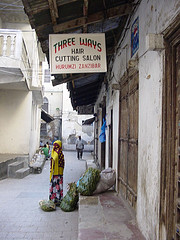
Three Ways Salon by Al Stevens
Some linguists consider the use of gender in many European languages, as a type of Noun Class.  I don't really understand what the difference is and it's worth noting that, whilst we usually think of Gender as meaning masculine, feminine or (in languages like German) neuter, actually gender comes from the Latin word genus meaning 'type' or 'class', unrelated to male/female aspects of the noun.  If you've ever studied French, I'm sure you'll have wondered why some words are considered to be masculine and others feminine!  In Russian, many of the nouns describing men use the feminine gender and I think there is enough evidence around to understand that the use of this term has been corrupted by the male/female dichotomy.

Perhaps then gender, in European languages, is a vestige of earlier, more complex, noun classes?  English has almost completely got rid of gender, each phase of 'modernisation' of the language has used gender distinctions less and less.  Perhaps the trend in language development is away from the use of noun classes?  There are certainly more nouns (or things) to talk about these days, than there were in the eras of our grand-parents and ancestors and, perhaps, this makes the categorisation of nouns too complex to even bother with?  I wonder how Swahili deals with modern inventions, such as computers or iPhones?

I'm going to leave you with a video from YouTube, which was posted by www.bookbox.com - a project which helps children learn languages through story-telling.  The story is called The First Well and is spoken in the Kenyan dialect of Kiswahili.

Image credits:

For this blogpost I wanted to highlight the work of flickrmember almacaw aka Al Stevens, who lives in a small village in Sussex.  You can see more of Al's images at his photostream and find out more about his approach to web design on his website.  

Thanks Al for sharing these images of Zanzibar using the Creative Commons license. 

Saturday, 16 October 2010

Togo - An Introduction to African Linguistics

Apologies to regular readers of this blog, as I walked the West Highland Way in Scotland this month and didn't have any time to blog about Togo.  I thought I would kick off again with one of my favourite subject areas, Linguistics.  I have a degree in Linguistics and find the subject fascinating, although it's been many years since I studied it in a formal way.  As I've been reading about Togo, I've got more and more into the language side of things and the general picture of language in Africa.

The study of Language

I guess Linguistics, like many academic sciences, was born from the great 19th century desire to classify everything and put things, whether species or types of behaviour or languages, into convenient little 'boxes'.  The 20th century seemed to take this to a whole new level, not only wishing to categorise things, but also to minimise the number of categories and draw comparisons between things that are, in my humble opinion, very different.  For example, it still amazes me that we readily accept the term Indo-European and believe that somehow languages such as Icelandic and Hindi belong to the same language family, when it's obvious to anyone that they are incredibly different languages.  If you have a look back on my blogposts about Rajasthan, you'll read about the influence of British Indian orientalists on the concept of an Aryan race that somehow justified the British colonisation of India and I think this can be extended into the field of Linguistics and theory of an Indo-European language family. 

My point is that, far from being a 'black and white' empirical science, the study of Linguistics is very much a product of the culture of the Linguist.  Is an English linguist more likely to gloss over the influence of native British-Celtic languages on the language of the Saxons, Jutes and Angles who made England their home?  Is a Japanese linguist more likely to prefer a theory of Japanese as an 'independent' language, unrelated to Mongolian or the Turkic languages of Siberia and north Asia?  Well, of course they are.  The classification of languages depends a lot on who is classifying them and the culture and generation of the classifier.  It makes Linguistics more exciting in many ways, as I believe each generation needs to make its own contribution to the study of languages, with reference to past theories, but also taking into account historical prejudices.

Greenberg and the classification of African languages

The American linguist, Greenberg, is probably the greatest figure in African linguistics and developed a classification that is, more or less, universally accepted.  He divided African languages into the following sub-categories:

Afro-Asiatic - previously this was called Hamito-Semitic, after Noah's sons, Ham and Sham - Ham being African, Sham being the Middle Eastern one.  Arabic is, by far, the most prominent of the languages in this language 'family', but it also includes Hebrew, Maltese and African languages such as Somali and Hausa.  It's a controversial grouping in many ways, as it links up language speakers who are incredibly diverse in terms of their ethnicity, religions and cultures.  What I like about this grouping is that it recognises a shared history between the Arab world and sub-Saharan Africa.

Chari-Nile languages - this family contains lots of relatively small languages from the Nile valley, reaching into the Sudan, Kenya, Uganda and Chad.  It's the language of the Nubians and the Masai people of Kenya. 

Niger-Congo - this is the biggest language family in Africa and covers most of the African languages that you will be aware of, probably the most famous being Swahili.  The family is further divided into branches, which are pretty much geographical and spread all the way from the Atlantic languages (eg. Wolof, Fulani) in Senegal to the massive Bantu family (eg. Zulu, Sesotho, Xhosa) spreading all the way down to the southern end of Africa. 

Khoi-san - are the languages of the Bush people in southern Africa, which have defied classification by linguists, but have been happily grouped together as a language family.  This family includes Hottentot or Nama and San, which is the language of the bushmen of Namibia and Botswana.  The Khoi-san languages are famous for their clicking sounds, some of which have been 'borrowed' into neighbouring Bantu languages.

Austronesian - interestingly on Madagascar, they speak a language which belongs to the Austronesian family and is much closer to Malay or Bahasa Indonesia, than to anything which is spoken on the African continent.

Indo-European - European languages, such as English and French, are spoken everywhere in Africa, however Afrikaans, which comes from the Dutch settlers on the Cape, is considered to be a 'native' Indo-European language. 

Lazy linguistics?

As far as I can see, lumping the vast majority of African languages into one convenient family 'Niger-Congo' smacks of incredibly lazy linguistics and I call for someone to do a little bit more work on the classification of African languages.  Interestingly, if you compare this to the work that has been done on Native American or Australian languages, there has been no attempt to lump all of these into one language family but, rather, recognition of the diversity of languages and the need for separate classifications.  I think it will take an African-born linguist to open up the subject properly and give us a new classification for the 21st century. 

Linguistic policy in Africa

With over 2,000 languages, Africa is incredibly diverse.  What's more, levels of bi-tri-multilingualism exist on a scale that we in Europe can only ever dream of.  When I lived in Uzbekistan, my students switched from English to Russian to Tajik to Uzbek with relative ease and, in an increasingly competitive global economy, I think proficiency in languages will be something akin to a commodity in this new century.  In Africa, French and English still prevail and are official languages in most African countries.  At another level though, there are many alternative lingua francas and Arabic, Hausa, Swahili, Igbo, Yoruba and Amharic are also spoken by millions of people as a second or third language. 

Language in Togo

Togo is a good example of how language works in Africa and this is partly why I became so aware of the general situation.  A country of five million people, Togo has more than thirty native languages.  French is the official language, the written language and language of education but, since independence, both Ewe and Kabiye have risen to prominence, being the two native languages with most speakers.  There is a real north-south divide in Togo and, although most languages, fall into the Niger-Congo family, the southern languages, including Ewe, are loosely connected to the coastal Kwa languages of Ghana and Benin (eg Akan, Fon and Ga).  The nothern languages, including Kabiye, are related to other inland languages of the Volta river such as More and Gurma, the languages of Burkina Faso.

Of course, when the European colonial powers were dividing up the map of Africa in Berlin in 1884, language didn't always come into it and, to be honest, the complexity of how languages are spread around West Africa would defy any attempts to create nations out of the main languages (something that was enforced, to an extent, in Europe).  Initially, most Ewe speakers ended up in the same country, German Togoland, but the further sub-division of Togoland, means that Ewe speakers are now in two different countries, with approximately 2 million speakers of Ewe in Togo and 2 millon in Ghana. Of course, language is a continuum and doesn't really recognise political boundaries.  I think this is less obvious to a European, where French is spoken in France, Italian in Italy - the reality being that French and Italian are in a continuum of dialects that flow from one country into another and don't just change on the border!

I would love to see the result of having had European languages classified by Africans in the 19th century and whether they would have come to the conclusion that we all basically sound the same, or whether they would have found immense differences and classified European languages in a radically different way. 

Credits:

A lot of my research for this blog was done on the web, through Wikipedia and other sources, however I also referred to Kenneth Katzner's book The Languages of the World (the 2003 edition published by Routledge). 

Both maps are from Wikimedia Commons and are being shared using the Creative Commons License. 

The Linguistic map was uploaded by wikiuser Seb az86556 - you can see the original and other maps by Seb at the following URL http://commons.wikimedia.org/wiki/User:Seb_az86556

The map of the Ewe and other Gbe languages was uploaded by Mark Dingemanse who works for the Max Planck Institute for Psycholinguistics and is based in the Netherlands.  Mark's website and blog are great sources for those of you interested in learning more about African linguistics.  His page on Wikimedia Commons also has some interesting facts about African languages.