Showing posts with label Linguistics. Show all posts

Sunday, 6 April 2014

Nordrhein-Westfalen - Naming your Neighbours

Something that has always interested me about Germany is the fact that there is no single name for this central European country.  Whilst France is called Frankreich (German), France (French), Francie (Czech), An Fhrainc (Irish), Frankrig (Danish), Frankrijk (Dutch), Francija (Latvian) and Prantsusmaa (Estonian), Italy is Italien, Italie, Itálie, Iodáil, Italien, Italië, Itālija, Itaalia and Spain is Spanien, Espagne, Španělsko, An Spáinn, Spanien, Spanje, Spānija, Hispaania - the names for Germany in these languages are; Deutschland, Allemagne, Německo, An Ghearmáin, Tyskland, Duitsland, Vācija and Saksamaa.

I guess it's because of Germany's central position in Europe and also the fact that it didn't become a united nation until 1871 that so many different names still exist for this country.  They do tend to fall into categories and the image below shows roughly how the various names for Germany are distributed around Europe. Most variations are related to ancient tribe names, like the Germani, Alemanni, Saxons and Vagoths.  The Germannic version deutsch/duits/tysk comes from an old word for 'people'.

Name for Germany in European Languages


The Slavic word for Germans, Němci (Czech), немцы/nyemtsi (Russian), Nijemci (Croatian) - originally meant something like 'those who don't speak our language', but sounds a lot to me like 'those who don't (nye) come from this place (mesto)'.  

As I've been researching this topic, I've learned a lot about endonym, ie. the name people give to their own country/the place where they live and exonym the name given to a place by neighbouring tribes or countries.  Many of the names we use for countries in English are exonyms and have been borrowed into English through other cultures that had greater contact with people in that place, eg. the English name for China comes from Persian, our name for Brazil comes via Portuguese.

It's interesting that the endonym theudo/þeodisc/Dutch was used more widely in English in the past to refer to any Germanic people, but it gradually came to mean only those Germanic people who lived closest to England, ie. people in the Netherlands.  That's where we get the strange situation in English where we call Netherlanders Dutch and Deutschlanders German!

German border control in the 1950's by Hellebardius
I first started thinking about the names of Germany when I moved to Bratislava in 1999.  That's when I learned the Slovak name for Germany Nemecko and began to wonder what it all meant.  I was also surprised to learn the Slovak name for its neighbours Austria (Rakúsko) and Hungary (Maďarsko).  To be honest, most country names in our modern world are standardised, especially in the 'New World' - Mexico, Argentina, Australia - it gets more interesting when you look at the names neighbouring countries give to each other.

I tried a few of these and came up with some interesting examples below:

γαλοπούλα (galopoúla) - the Greek name for Turkey which, I guess comes from the place name Gallipoli? Then there is Yunanistan, the Turkish name for Greece, which relates to the Ionian Sea and is also used in languages like Arabic, Hindi and Persian.

Border locked by Morten Oddvik
The Irish name for England is Sasana which related to Saxony in Germany - I guess as far as the ancient Irish were concerned, the English were basically Germans, although I'm sure most 21st century English people would tend to disagree!  Likewise, in the other Celtic languages, England is called Sostyn (Manx), Pow Sows (Cornish) and Sasainn (Scottish Gaelic).  The origin of Lloegr the Welsh name for England is more obscure.  

The word for Egypt in Swahili is Misri, which is an ancient name from Classical Arabic and means 'the two straits' ie. Upper and Lower Egypt.

The Chinese name for Japan is 日本 (riben) which is an approximate pronunciation of the symbols that Japanese use for their country's name, Nippon.  The English name for Japan is believed to come from the Portuguese mispronunciation of Nippon although it could also be from the Cantonese pronunciation of this symbol. The Japanese name for China is 中国 (chugoku) which quite literally means 'the Middle Kingdom' and is exactly the same as the Chinese Zhōngguó.  

Endonyms can be quite different from the internationally accepted name given to a country and I've often wondered what it's like to grow up in a place like Nippon and to later find out that the rest of the world calls your country Japan, Japon, Jaapan etc?  I've put together a list of some of the countries I've already blogged about, in their native languages - click on the links to find out which countries they are:

ኤርትራ

Монгол улс

한국

اليَمَن

Uukuhuúwa

Image credits:

The map with the names for Germany in other European languages is from Wikipedia and you can see more information on the file here.

The image of the German border control is owned by Flickr member Hellebardius - it was taken near Lubeck in the 1950's.

The image of the 'Border locked' signpost was taken by Morten Oddvick, a teacher from Trondheim in Norway.  This photo was taken on the Georgian/Russian border.

Thanks for Hellebardius and Morten for sharing these images with us, using the Creative Commons license.

Saturday, 12 October 2013

Liberia - Three Questions

In keeping with my new 'strand' of research, I have done a quick Google Instant test on Liberia - to see what kind of questions people are asking about this West African country.  The questions people ask are sometimes quite predictable, to be honest, although I guess the following questions are probably quite relevant to anyone who is learning about Liberia for the first time.

Do Liberians speak English?

This seems to be one of the most popular questions generally, if you type Do (nationality) . . . into Google.  We seem to be a bit of obsessed about whether or not the rest of the world speaks English and I guess this type of question reveals a deep-rooted awareness (or even phobia?) of our own monolingualism. 

The Vai script of Liberia
There is a psychological condition called xenoglossophobia or Foreign Language Anxiety - which I'd imagine is a pretty genuine condition for many people trolling the Internet!  I think I have the opposite condition - xenoglossophilia - ie. love of foreign languages. 

I've lost count of how many languages I've started to learn and I'd like to think I can speak four languages reasonably well (my native language is English, but I also speak/know Irish, French and Russian)

And in answer to the question - well . . . kind of - English is the official language of Liberia although many people, especially outside the capital, speak English as a kind of creole, which might be difficult for non-Liberian English speakers to understand. 

Actually, there are more than 30 languages spoken in Liberia - including Mande languages like Kpelle and Vai (which has its own script) and some of the main Kru languages, like Bassa and Grebo.  To learn more about African linguistics, have a look at my blog post about Togo. 

Does Liberia have oil?

Protest sign by Toban Black
Another Western obsession!  Well, there are many oil-producing countries in the world, but Liberia isn't one of them.  In fact, West African countries in general aren't big producers of oil, with the exception of Nigeria and Cameroon. 

Nigeria produces more oil than Norway or Azerbaijan, which I found surprising, until I remembered having read about the environmental and human rights issues between Shell and the people who live in the Niger Delta. 

It's probably better not to have oil, as oil seems to bring trouble and, given Liberia's recent past, trouble is something the Liberian people could do without!

Are Liberians American citizens?

I was a little bit surprised by this question and why so many people might think that Liberians are American (I presume they mean US) citizens?  Liberians are not US citizens, although they do have a long history with the United States and, as I mentioned in my first blog post, Liberia was established by an American society to repatriate freed black (African) slaves from the United States. 

You might have noticed that the Liberian flag looks remarkably like the flag of the United States - also, Liberia is one of only two countries in the world whose capital is named after a US President (James Monroe - Monrovia).  And the other country is?  You guessed it . . . the United States (George Washington - Washington D.C.)

Flag of the United States of America
I think it's fair to say their relationship with the US is still important to Liberians today.  Until fairly recently, the US was by far the biggest donor of aid to Liberia, although this has now changed and the EU and UK have given most aid to Liberia in recent years.  I wrote quite a bit about 'Aid' when I was blogging about Togo - if you want to read more, just click here. 

Despite their close relationship, the United States government refused to recognise Liberia as a country during its first 15 years as an independent nation.  And the reason?  Well, according to Tim Butcher in his marvellous book Chasing the Devil: The Search for Africa’s Fighting Spirit (2011) - the thought of having to accept a 'coloured' Liberian diplomat in Washington D.C. was too much for a racially-charged nation that was soon to tear itself apart over the issue of slavery, during the American Civil War. 

Image credits: 

The image of Vai script is from Wikimedia commons and in the public domain, as is the image of the United States flag.

The picture of the protest placard is from flickr user Toban Black who is from Canada.  You can see more of Toban's work on his blog. 

Saturday, 22 June 2013

Jersey - Pâl'-ou l'Jèrriais?

Something I didn't know about Jersey and, indeed, the other Channel Islands, is that they have their own languages, which are considered to be dialects of Norman French and, therefore, not closely related to English.  In Jersey, the Norman language is known as Jèrriais and this was regularly spoken in Jersey until the 1950's, when the last monolingual speakers died and English finally took over.  It's now estimated that less than 2,000 people speak Jèrriais as a native language - although it still has an important ceremonial role in Jersey's political and legal systems.

The World's 'big' languages

Unfortunately, the experience of Jersey is pretty typical in a constantly globalising world.  The reality of the early 21st century is that more than 50% of the world's population speaks one of the top 24 languages (ie. those with more than 50 million speakers).  We've met some of these already when I blogged about Chinese linguistics in December last year: Mandarin, Wu and Yue (Cantonese) have around 987 million speakers between them.  Then there are the big languages of South Asia: Hindi, Bengali, Lanhda (which I'd never heard of), Telugu, Marathi, Tamil and Urdu.  The other big East Asian languages include: Japanese, Javanese, Vietnamese, Korean, and Malay.  The big languages of the Middle East are: Arabic, Persian and Turkish.  Finally, the big European languages are: Spanish, English, Portuguese, Russian, German and French.

Sign in English and Jèrriais by Man Vyi
Interestingly, not a single language originating in sub-Saharan Africa, Australia/Pacific or the Americas has made it onto this list and I think this says a lot about the role language has to play in colonisation.  The biggest language from sub-Saharan Africa is probably Hausa, which has 40 million native speakers - you can read more about African linguistics in my blog post from 2010.  The biggest American language is Quechua, which has about 7 million native speakers in Peru and Bolivia.  Most Australian languages are endangered or extinct and you'll probably find more Russian or Mandarin speakers in Australia, than speakers of native Australian languages!

Countries with the greatest number of 'endangered' languages

For most other languages, survival into the 21st century and beyond will be something of a challenge.  UNESCO has published an interesting online map of endangered languages including Jèrriais, which you can visit by clicking on the following link.  I looked at the 'hotspots' for endangered languages around the world and it's surely no coincidence that the countries where languages are most in danger of extinction are also those where the 'big' languages listed above are spoken - according to UNESCO's map, the ten countries with most endangered languages are:

India (197)
The United States (191)
Brazil (190)
Indonesia (146)
China (144)
Many sign posts are written in Jèrriais, photo from Man vyi
Mexico (143)
Russian Federation (131)
Australia (108)
Papua New Guinea (98)
Columbia (68)

Exactly how endangered?

UNESCO employs a useful system of categorisation, to describe exactly how endangered a language is considered to be.  They define the following five main categories:


Vulnerable - most children speak the language, but it may be restricted to certain domains (e.g., home)
Definitely endangered - children no longer learn the language as mother tongue in the home
Severely endangered - the language is spoken by grandparents and older generations; while the parent generation may understand it, they do not speak it to children or among themselves
Critically endangered - the youngest speakers are grandparents and older, and they speak the language partially and infrequently
Extinct - there are no native speakers left

Under this categorisation, Jèrriais is considered to be severely endangered, as is the language of Guernsey, Dgernesiais.  Auregnais, the language of Alderney, is already considered to be extinct.

So what can we do about it?

Coming from Ireland, I feel quite passionate about language revitalisation.  There have been some successful attempts to revitalise languages, probably the most famous example being Modern Hebrew as well as the Celtic languages, which are receiving a lot of government-level support.

Unfortunately, despite all of the hard work people having been doing to revive the Irish language, it seems to be constantly in decline and is considered by UNESCO to be definitely endangered, whereas neighbouring Welsh is merely vulnerable and the revitalisation of Welsh in recent years has been fairly successful. 

Losing a language means losing part of the cultural richness of the human experience and it's a real shame to see the world's big languages take over, even if one of them, English, is my mother tongue.  My partner's mother tongue is Russian, but his people speak Kalmyk, which is definitely endangered, just like Irish, so we are very much part of this shift in language use.  I can't help but wonder how many of these languages will be left in 100 years time?

On a more positive note, I'm going to leave you with a link for the Endangered Languages project - it's great to know that there are people out there who are willing to advocate for linguistic diversity in the 21st century.

I'll also leave you with a video of Jersey poet Michael Vaûtchi, reading a poem in his native Jèrriais. 


Image credits:

Both images have been released into the public domain by Man vyi, who has shared lots of images of Jersey on Wikimedia Commons - thanks Man vyi for sharing these images with us. 

Saturday, 15 December 2012

Guangdong - Neih sīkm̀hsīk góng gwóngdùngwá a?

Like most people, I commonly use the word Chinese when I'm talking about the language that people speak in China.  Of course, the reality is that there isn't one single language called Chinese, but rather a collection of dialects and topolects that, collectively, make up the Chinese 'family' of languages.  I'm sure that the distinction between a dialect and a language, is every bit as controversial and as equally dependent on the political situation, in China, as it is anywhere in the world.  I like the word topolect, as it suggests something more than a mere dialect.

Pǔtōnghuà and the rest

There's no disputing that Mandarin rules the roost in China - with more than 840 million speakers, Mandarin is, by far, the biggest Chinese topolect.  Its is also politically important, as it is the official language of the Chinese government and power structures.  Mandarin has been adopted as the 'standard' version of Chinese, called Pǔtōnghuà or 'common language'. 

Other major Chinese topolects include Wu which is spoken around Shanghai by about 90 million speakers, Yue (a.k.a. Cantonese) spoken in Guangdong and the south, including Hong Kong, by about 70 million people, Xiang (65 million) spoken in Hunan, Min (60 million) in Fujian, Hainan and parts of Taiwan, Hakka (50 million) spoken in Fujian and Guangxi and Gan (30 million) spoken in Jiangxi, Hubei and Hunan. 

The bigger linguistic picture

The Languages of China
The Chinese languages themselves belong to a wider language family that includes Tibetan and many of the languages of Myanmar (Burma).

As well as the Chinese languages, there are minority languages of hill tribe peoples, as well as Turkic languages in the west and Mongolian and Korean in the north.  The overall picture makes for a greater level of linguistic diversity than you would, at first, imagine.


Mandarin has the largest number of native speakers in the world, followed by Spanish, English, Hindi and Arabic, but Cantonese itself is a substantial language, equivalent in its number of native speakers to languages like Italian or Turkish.  Cantonese is also very much a world language and is spoken in immigrant communities all over Asia, Europe and the Americas.

Trying to learn Cantonese?

I tried to learn some Cantonese before taking a trip to Hong Kong - not so much to speak the language, as to get a sense of its sound and 'feeling'.  Whilst I have learned a tonal language before (Thai) and could, on a very basic level, understand the importance of hearing the different tones of Cantonese, it was the first time that I ever studied a language where there are two tape scripts for every listening exercise; one at the normal speed of a native Cantonese speaker and a second recording, slowed down for the benefit of the Cantonese student.  I think that says it all really! 

Lexical environment analysis

The different dialects of Yue/Yuet (Cantonese)
As part of my research, I did a very rudimentary lexical analysis of Mandarin and Cantonese, to get a sense of how different they are, at least in terms of some basic vocabulary.

I've used a simple test that I call Lexical environment analysis to determine the relationship between words in different languages.  I used a very similar test with Uighur to explore its relationship with other Turkic languages and possible influences from (Mandarin) Chinese. 

The concept is straightforward and is based on my knowledge of the relationship between English, German and French.  I believe there are certain words that are part of the Natural environment of a language - things such as body parts, natural elements, native animals etc. that surely existed in the language before colonisation or influence by another people/language.  Then there are things which are part of a Constructed environment - furniture, inventions and other innovations that were (perhaps) introduced by another people in their own language.

English, French and German

You can see what I mean by the comparison of English, French and German (below):

Natural environment lexicon


English German French
Finger Finger Doigt
Father Vater Père
Moon Mond lune
Rain Regen pluie
Swine Schwein cochon/porc
Earth Erde terre

It's obvious here that English has much more in common with German, which makes sense as English is, fundamentally, a Germannic language.


Constructed environment lexicon


Glove Handschuh gant
Boss Chef chef
Candle Kerze bougie
Umbrella Schirm parapluie
Pork Schweinefleisch  porc
Chair Stuhl chaise

The picture is more complicated here and you can see the influence of French on English words such as pork and chair.

Mandarin and Cantonese

 Natural environment lexicon


English Mandarin Cantonese
Finger shǒuzhǐ sau ji
Father fùqīn foo chan
Moon yuèliàng yuet
Rain yǔ yue
Swine zhū jùe
Earth Dìqiú dei kau

At a very basic level, it's clear that Mandarin and Cantonese are incredibly close in terms of their basic natural environment lexicon.  If we look at the constructed environment lexicon however, it's clear that the two 'languages' are in a process of separating and developing lexicons which are unfamiliar to each other's native speakers.


Glove shǒutào sau mat 
Boss lǎobǎn boh si
Candle làzhú laap juk
Umbrella sǎn jè
Pork zhūròu jue yuk
Chair yǐzi dang

I think it's a process that takes centuries, but you can definitely see a bigger difference with these more 'modern' words.  It's also interesting that, despite the fact that this is such a small sample, I can already see the influence of English on Cantonese, more so than on Mandarin (boss and boh si).

Cantonese Wikipedia

I think Wikipedia can be a good indication of how languages are doing in terms of their online presence, so I did a quick survey of which Chinese languages have their own Wikipedias.

Not surprisingly, Mandarin is right up there and is the 11th biggest Wikipedia in terms of the number of articles, not far behind Portuguese.  Cantonese is currently number 92 - not great in European terms (less articles than Sicilian!) but equivalent to other 'big' languages from outside Europe, eg. Gujarati, which has 49 million native speakers.  Min is also present on Wikipedia - interestingly written in a Romanised script. Wu, Hakka and Gan are also there, but with very small numbers of articles, equivalent to Maltese, Cornish and Corsican, respectively! 

It will be interesting to see how the 'other' Chinese topolects compete with Mandarin in the future - I wonder if they will forever be consigned to 'dialect' status, or whether they will become languages in their own right?

I'm going to leave you with a sample of how Cantonese sounds - you can find almost everything on YouTube, even a recital of Bai Juyi's beautiful poem, Song of Unending Sorrow, here spoken by Cantonese businessman James Chan.  Enjoy!


Image credits:

Both maps were taken from Wikimedia Commons and are in the public domain. 

Saturday, 5 May 2012

Cambodia - អក្សរខ្មែរ âksâr khmêr


One of the things that most fascinated me on my trips to Cambodia was the Khmer alphabet. Having spent a year in Thailand, I'm quite proud of the fact that I can read Thai script - okay, not fast enough to recognise the destinations of passing buses but, you know, given time to pore over the squiggles and rounded syllables, I can manage okay! Going to Cambodia (and Laos), the script was very familiar looking, but a lot more complicated and squiggly.

A shared heritage - Thai and Khmer

I guess Khmer script is more complicated than Thai because it's the script that Thai, Lao and some other South East Asian scripts derived from. I'd imagine it's retained a lot of it's original complexity which, perhaps, was simplified when the script was used to write Thai, a language that is tonal and couldn't be more different, phonologically, than the Khmer language. I think this paragraph is probably very controversial for Thai readers. Understandably, most people prefer to think of their culture as being unique and not under the influence of neighbouring cultures. As an outsider though, I have to say - that's how it looks!

Khmer writing on book cover
Writing as a tool for technology

Since its invention, writing has been a powerful tool for the advancement of technology. Think of all the things that writing has enabled us to do. The very essence of civilisation, history, science and communication, has been dependent on the technology of writing to help us share our ideas, learn from our mistakes and count the spoils of war or trade. It's hardly a surprise that some of the first examples of 'writing' were connected to accountancy and I have to wonder, yet again, at the power of trade to push forward technological developments.

The sacred nature of writing

In Ancient times writing was something that was sacred. Until the Middle Ages in Europe, only spiritual men (and usually only men), scribes and monks, were taught how to read and write (the two surely go hand-in-hand?). Written text enabled Pharaohs and Kings to create a legacy that would potentially be eternal and could speak for the writers long after they had deceased. In some Ancient societies, written creations had to be approved and stamped by the King, before they could be left behind as records of that society.

The power of the written word


Writing is just as powerful today. I'm sure J.K. Rowling would agree, having seen her Harry Potter series of books take the world by storm, being translated into innumerable languages and read by an audience of millions around the world - millions of people who speak different languages and come from very different cultures than the writer herself. And then there's the Media - newspaper headlines or a scathing review can make or break public figures. There is more power in a well-written text sometimes, than in any spoken words.


Lao script is much rounder and softer than Khmer
The 17th century French mathematician Blaise Pascal once said 'To know how to write well is to know how to think well' and I tend to agree. Perhaps good writing is only rivalled by good music, as a source of inspiration and change for the human mind.

The alphabet revolution

As part of my research for this blog post, I read A Very Short Introduction to Writing and Script by Andrew Robinson (published by Oxford University Press). It gave me a great overview of a topic I find endlessly fascinating. There was so much to learn from this book, but one of the main things I came to understand was how the alphabet revolutionised writing systems. I guess most of us will presume that alphabets have been around forever, but they're a much more recent invention and were pre-dated by other forms of writing, such as hieroglyphs, cuneiform writing and pictographs.

Thai script and other scripts like Khmer, Lao and Tamil are kind of like an alphabet (unlike Chinese or Japanese, where you need to learn thousands of characters before you can read). Having said that, they're not like any alphabet I'd met before and are actually somewhere between a true alphabet, where each individual sound (or phoneme) is represented by a single letter, and a syllabary, where each letter represents a syllable. Khmer, Thai and the others are like a hybrid between a syllabic system and more phonetic alphabet. I guess this type of 'alphabet' is probably better described as an Abugida..

Of course, it's all well and good to try to define everything and put things into boxes, but the reality is always a lot more complicated and even the English alphabet is a bewildering combination of letters and sounds.

Where do you put the vowels?


Chinese script
What I found really different about Thai and Khmer is that the vowels can appear in front of, behind, on top of or even under the consonant. There are rules of course and certain vowels tend to stand alone, whilst others are dependent on their partner consonant. Vowels have always been an issue and the first alphabets didn't contain any - some modern alphabets, like Arabic, Hebrew and Hindi generally leave them out. The existence of vowels in European scripts is mostly down to the Greeks and linguists speculate as to the influence Greek poetry had on the addition of vowels to a script.

Apart from that, learning to read a script like Thai or Khmer isn't all that difficult. The letters don't morph or change, as they might in Arabic or Hindi and, once you get over the initial culture shock of a completely different writing system, it all falls into place somehow and you will be able to make out words in other Brahmic scripts (which all have their origins in India).

The world's biggest and smallest alphabets

If Khmer is considered to be an alphabet, then it's probably the largest alphabet in the world, with 74 different signs (again, some of these are quite obscure and have disappeared in neighbouring scripts like Thai).

By all accounts, the world's smallest alphabet is the one used for the Rotokas language in Papua New Guinea - it only uses 12 letters (all from the Roman alphabet) - a e g i k o p r s t u v - there's definitely something to be said for keeping things simple!

Image credits:

All images were taken by me.  Please feel free to re-use them under the Creative Commons License:

Attribution
Non-commercial
Share alike

Sunday, 23 October 2011

Zanzibar - the home of Swahili

Spoken or understood by an estimated 100 million people, Swahili or, to give the language its official name, Kiswahili,  ranks as one of the world's major languages.  It's spoken by many people as a second or third language and the number of native speakers is much smaller, at around 5 million people.  It was the language of trade along the East African coast and, although it's a Bantu language, Swahili has many borrowings from Arabic, including the name of the language, which comes from the Arabic word for 'coast' ساحل sawahil.

The Home of Swahili

I think it's fair to say that Zanzibar is the home of Swahili language and culture.  The dialect of Unguja, Kiunguja has been adopted as the standard for all Swahili dialects.  The name Zanzibar is connected to Zanj (black), the name used by medieval Arabs for the East African coast. As the language of trade, Swahili also has native speakers in the coastal areas of Tanzania, Kenya and Somalia, as well as in the Comoros islands and, due to inland trade, there are more obscure versions of Swahili, such as Kingwana, spoken by small tribal groups in the eastern provinces of the Democratic Republic of the Congo.  It's a lingua franca in all of these countries, except Somalia and is becoming increasingly popular in neighbouring countries like Uganda.

Swahili on the web

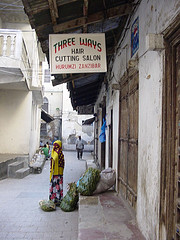
Zanzibar street sign by Al Stevens
The BBC has its own Swahili language pages and there is a Google search engine in Swahili.  I often think Wikipedia is a good indicator of a language's web presence, as it is created by ordinary people, as opposed to a government body or initiative.  Swahili has a presence on Wikipedia, but it's fairly low for a language of its size.  Perhaps this is because people are less likely to use the Internet in places where Swahili is spoken as a native language?  There are currently less articles on the Swahili Wikipedia than on the Icelandic one and Swahili ranks 74th in terms of size, amongst the different language Wikipedias.  Having said that, it's still one of the biggest African languages on Wikipedia, only Yoruba has more articles, from the Niger-Congo language family (and, of course, Arabic, which is Afro-Asiatic).

The use of Noun Classes

Like most of the other Bantu languages, Swahili employs noun cases to categorise nouns.  These are usually indicated by prefixes, eg. m-/wa- (denoting nouns connected to people) or ki-/vi- (denoting things which are man-made, including languages).  Linguists have identified up to 16 of noun cases in Swahili, although this is a bit controversial, as it is based on the Meinhof system, which counts singular and plural noun cases separately.

For Example

There are some very good examples of Swahili noun cases on Wikipedia, one of which I'm summarising here, as I thought it was quite interesting.  It relates to the Bantu noun classes 3 m- (singular) and 4 mi- (plural), which are often called the 'tree' classes and are mostly used with things that occur naturally, but are neither human nor animal, things like . . . well, trees!  This group includes words like, mwitu (forest) and mtama (millet), but also things which are usually made from plants, eg. mkeka (mat - although these are probably made from plastic nowadays!).
Zanzibar beach by Al Stevens

This group also includes natural and supernatural forces, such as mwezi (moon), mlima (mountain) and mto (river).  The group is also extended to include 'things that spread', like the branches of a tree, so we get words like mwavuli for umbrella and moshi for smoke.  This group also includes more abstract words like mpaka (border) and mwendo (journey).  Of course, the noun class doesn't just affect the noun, but also influences the form of the adjective and verb which, I guess, means you really need to know your noun classes in order to speak Swahili properly!

Noun Classes around the world

I think it's fair to say that noun classes are a fairly unfamiliar concept to speakers of Indo-European languages (like English), although I think we do differentiate between animate and inanimate objects, to a degree.  It's interesting that noun classes tend to exist in societies that live in closer harmony with the natural world - they can be found in Native American languages, the Bantu languages of Africa and Aboriginal languages of Australia, like Dyirbal and Ngangikurrunggurr.  They're also found in a handful of Causcasian languages, notably Bats which is spoken by a small number of people in a remote mountain village in the north-east of Georgia.  I wonder if the death of animist traditions and beliefs, led to the death of noun classes in other world languages?

Noun Class v Gender

Three Ways Salon by Al Stevens
Some linguists consider the use of gender in many European languages, as a type of Noun Class.  I don't really understand what the difference is and it's worth noting that, whilst we usually think of Gender as meaning masculine, feminine or (in languages like German) neuter, actually gender comes from the Latin word genus meaning 'type' or 'class', unrelated to male/female aspects of the noun.  If you've ever studied French, I'm sure you'll have wondered why some words are considered to be masculine and others feminine!  In Russian, many of the nouns describing men use the feminine gender and I think there is enough evidence around to understand that the use of this term has been corrupted by the male/female dichotomy.

Perhaps then gender, in European languages, is a vestige of earlier, more complex, noun classes?  English has almost completely got rid of gender, each phase of 'modernisation' of the language has used gender distinctions less and less.  Perhaps the trend in language development is away from the use of noun classes?  There are certainly more nouns (or things) to talk about these days, than there were in the eras of our grand-parents and ancestors and, perhaps, this makes the categorisation of nouns too complex to even bother with?  I wonder how Swahili deals with modern inventions, such as computers or iPhones?

I'm going to leave you with a video from YouTube, which was posted by www.bookbox.com - a project which helps children learn languages through story-telling.  The story is called The First Well and is spoken in the Kenyan dialect of Kiswahili.

Image credits:

For this blogpost I wanted to highlight the work of flickrmember almacaw aka Al Stevens, who lives in a small village in Sussex.  You can see more of Al's images at his photostream and find out more about his approach to web design on his website.  

Thanks Al for sharing these images of Zanzibar using the Creative Commons license. 

Saturday, 10 September 2011

Yemen - Socotra, the island of blissful Sorcerers

It's interesting that each and every country/place I've researched about for this blog has a region or an area that is very much 'at the edge' of that country/place's culture.  Whether it's Bayan-Olgii, the Kazakh-speaking western province of Mongolia, or Limburg in the southern Netherlands, Oklahoma has its panhandle and Xinjiang/Uyghuristan has the Ili Valley.  Even Hong Kong has its New Territories.  For Yemen, the island of Socotra is the part that doesn't quite fit in - not really Yemeni, it's closer to Somalia and Africa than to Yemen.

Kent in the Indian ocean

Socotra Landscape by Stefan Geens
With a population of 42,000, Socotra is the same size as Kent in England (or Long Island, for my North American readers).  It's an incredibly isolated place, being cut off from the rest of the world for six months of the year by ferocious sea storms that make it too perilous to sail there.  No doubt, in our age of air travel, it's more accessible than ever, but Socotra retains an aura of mystery - it's an island of Makolis (or sorcerers), a windswept outpost in the Indian ocean, where witch-trials continued well into the 20th century. Socotra is far from the mountains of Sana'a and the baking desert sands of the Hadramawt. 

The Island of Bliss

The name 'Socotra' is believed to have come from the Sanskrit for 'Island of Bliss', dvipa sukhadhara, which the Ancient Greeks called dioskouridou.  Perhaps not surprisingly, the people of Socotra speak their own language, Soqotri, which is one of the oldest surviving South Arabian languages, related to Arabic, but linguistically closer to the languages of Ethiopia.  I guess it's the equivalent of Icelandic for us, ie. a language that has existed in relative isolation for a long time, which means it has preserved some archaic words and structures that the mainland languages have since lost. 

Blood from the Dragon's Tree

Dragon's Blood Trees by Stefan Geens
One thing you might already know about Socotra and, again hardly suprising, considering its isolation from the continent land masses, is that it has incredibly high levels of biodiversity.  More than a third of Socotra's plant species are endemic, ie. they're not found anywhere else on Earth.  This is similar to the situation in other isolated island groups, eg. Hawaii, the Galapagos Islands and Madagascar.  Like those other island groups, Socotra has been recognised as a UNESCO Natural World Heritage site.  I've come across UNESCO's work again and again, as I've been researching this blog and I really love what they're doing to help preserve many beautiful sites around the world. 

It's also quite interesting that, despite the diversity of plant life in Socotra, the only mammal that is native to the island is the bat!  Perhaps one of the most interesting trees on Socotra (and an unofficial symbol of the island) is the Dragon's Blood tree.  Not only does it have an interesting umbrella-like shape, but it also has red sap, believed in ancient times to be the blood of a dragon.  Dragon's blood was seen as a cure for many ailments and in the 18th-century, dragon's blood resin was exported to Italy, where it was used as a varnish for violins. 

A very 16th-century Crusade

Crabs on Qansaliyah beach by Stefan Geens
Perhaps it was Marco Polo who started the rumours about a 'lost' Christian tribe living on Socotra and when the Portuguese arrived in the Indian ocean in the early 16th century, they showed a brief interest in Socotra as a stopping point on the way to India. They also had a religious objective in mind, ie. to liberate their supposed 'fellow Christians' from the tyranny of their Islamic overlords.  The British also took an interest in Socotra and I can see why, as an island nation, other islands have always been an attractive subject for the British crown (eg, the Caribbean islands, New Zealand and Hong Kong. Even Aden is an island!). 

Eco-tourism on Socotra

Fish for dinner in Hadiboh by Stefan Geens
Modern Socotra seems as oddly out of the place as it has ever been.  For a poor country like Yemen, the possible implications of an eco-tourist industry on Socotra must seem very promising, far away from the civil strife of the Arab spring.  I guess isolation has its up-side!  Even more isolated than the main island of Socotra are the three smaller islands, Darsa, Samha and Abd al Kuri.  There is something very revealing by looking at a country like Yemen from the point of view of one its most obscure corners.  I would certainly love to visit Socotra, as well as mainland Yemen, when the political situation calms down. It sounds like an incredibly exciting destination, with a lot to offer the curious traveller!


Image credits:

All images accompanying this blog post were taken from Stefan Geen's photostream on Flickr.  Stefan visited Socotra in 2006, when he was living in Beijing, China.  By an interesting quirk of fate, Stefan has also taken lots of photos from Kashgar in Xinjiang/Uyghuristan, which is a place I've also blogged about.  I didn't come across his photos, when I was blogging about Xinjiang/Uyghuristan, but it's well worth having a look at his Chinese photos as well. He's got a very interesting website where you can find out more. 

Thanks Stefan for sharing these wonderful images with us using the Creative Commons License.


Saturday, 23 July 2011

Xinjiang - saying goodbye to the Music of Central Asia

Xinjiang is approximately 7 times the size of Britain and almost 4 times the size of California.  It has one sixth of China's land area but, with over 20 million people, barely a sixtieth of China's population.  As usual, when I'm writing my final blog post, I feel that there is so much more I could learn about this region of the world, but the time has come to say goodbye!

A summary of the topics

My learning experience about Xinjiang has given me an opportunity to learn about the history of the region and the politics of Xinjiang versus East Turkestan.  I've also learned a lot about the geography of the region and the diversity of its landscape.  Not just deserts and mountains, but the Turfan Depression, the Dzungarian steppe and the fertile Ili Valley.  I learned how to cook Dà pán jī and how to make my own noodles.  I learned about Khoja Iparhan, the Fragrant concubine and how the Occident represented adventure and exoticism to the Chinese, similar to the way that the Orient was perceived by 19th century Europeans.  I learned about the magical qualities of Jade, how important this stone has been in the development of Chinese history and China's relationship with the people on its Western borders.  I learned about the Uyghur language and where it sits in the Turkic language family.  The Indo-European mummies of Tarim gave me an opportunity to explore the origins of race and the specific nature of racism in China.

Other areas of interest

Again, there are many other things I've learned during the past month or so, but not had time to write a blog post about.  I'll try to summarise these below so, if you're interested in finding out more, I'd encourage you to do some research into topics that I have only had a chance to scratch the surface of.  These include:

Uyghur demonstration in Helsinki, July 2011
- the history of Islam in China, including the Chinese muslims, the Hui people.
- K2, the second highest mountain in the world, which is situated on Xinjiang's southern border.
- Nuclear testing in the Taklamakan desert
- the Tocharians, their language and culture.
- the Parthians and the origin of the phrase 'a Parthian (or parting) shot'
- the story of the Chinese princess who gave away the secret of silk
- the Legend of Prester John
- Wuer Kaixi, a Uyghur who was one of the student leaders during the Tiananmen rebellion
- the role of Eunuchs in the Chinese Imperial court
- the symbolism of oleaster
- the Taiping rebellion (hopefully I'll be able to come back to this one!)
- the story of Yakub Beg and his independent Kashgaria in the 1860's
- George Hunter and the China Inland Mission
- the Xinjiang Military Region Production and Construction Corps "August First" Field Army Swearing to Defend the Thought of Mao Zedong to the Death - probably the longest name ever for a military regiment (I wonder if they used an acronym?)
- the claim that there were (or even are) gulags in Xinjiang
The Jiayuguan Gate by Richard Towell
- the Jiayuguan Gate in the Great Wall of China, often the last sight of China for exiles heading West.
- the Manchus of the Ili Valley
- the development of the Han Chinese city of Shihezi, just north of the capital Urumqi.
- the Uyghur diaspora and the challenges faced by the East Turkestan 'government in exile'
- the cause of goitre, attributed to the lime and magnesia salts of the southern Taklamakan
- the lake monster of Kanas
- the story of Tutuqash and the Mangqys

As you can imagine, I could have gone on blogging about Xinjiang for some time to come!

The sound of Central Asia

One topic I do want to draw your attention to is the rich musical traditions of Xinjiang and Central Asia, in general.  When I was preparing to go to Uzbekistan, I bought a CD of classical Uzbek and Tajik music, which I played over and over again, as I was packing my bags and getting ready for my 'big adverture' on the other side of the world!  Whilst the musical traditions of Central Asia have a lot in common with music throughout the Islamic world, I couldn't help noticing the influence of, what I perceived to be, Chinese music, on the music of Uzbekistan.  I think it was the sound of wind instruments, like the surnay (known as in shawm English, an ancestor of the oboe) that made me think Central Asian music sounded slightly Chinese.
Two shawms or surnay by tomfbh

The chanting that is so common in the Central Asian classical tradition sounds very much like chanting throughout the Arab world - but the solo singing, especially that of female artists, has a pitch that wouldn't sound out of place in a Chinese Opera.  As with everything else in Xinjiang, I think the music is an end result of centuries of cultural interaction.  Whether or not the wind instruments came from China, or the drums came from India or Arabia, Central Asian music has a sound that is pretty unique - it can sound both Western and Eastern, Islamic and Oriental.

The most popular form of traditional music in Xinjiang is a style called Muqam, a set of 12 musical suites, which is usually grouped into three parts; the muqaddime or introduction, the dastan or narrative songs, usually with a set text and the meshrep which is a faster beat and gets people dancing at weddings!  It's a shame I've not had time to delve deeper into the music of Xinjiang but, if you're interested in finding out more, the website of the London Uyghur Ensemble has more information about Uyghur music than I could ever give you.  As well as links to recordings of various instruments, their website also has great research documents by Rachel Harris, who is a Lecturer in Ethnomusicology at London's School of Oriental and African studies. 

I'm going to leave you with a video from YouTube, which features a performance by the London Uyghur Ensemble.  It's a recording of the Penjigah Muqam, which is popular in the Ili Valley.  The picture quality isn't great, but the most important thing is to sit back, listen and enjoy!


On Learning about the World next month, Y . . .


Image credits:

The photo of the Uyghur demonstrators in Helsinki was posted by Amnesty International Finland - you can find out more about this demonstration on their flickr stream and see a news report on the situation in Xinjiang at their website


The photo of the Jiayuguan Gate (aka Jiayu Pass) was shared with the world by flickruser Richard Towell - you can see more information about Richard at his profile page on Flickr

The image of the surnay/shawms was posted on flickr by tomfbh - you can see more of Tom's photos at his flickr photostream. 

Friday, 1 July 2011

Xinjiang - siz Uyghurcha bilamsiz?

Uyghur is a Turkic language, one of the many spoken in a crossbow starting in Western China and finishing in European Turkey.  An estimated 180 million people are native speakers of a Turkic language.  Not surprisingly, Turkish is the most widely spoken Turkic language, with around 83 million native speakers.  Uyghur has between 8 and 10 million speakers, mostly in Western China, but also in other parts of Central Asia and parts of the world where the Uyghur diaspora has settled. 

The Uzbek connection

It really surprised me to learn that, according to modern Linguists, Uyghur is more closely related to Uzbek than it is to Kazakh and Kyrgyz.  When I lived in Uzbekistan, I had a choice of three languages to learn (Uzbek, Tajik or Russian) and I chose Russian, the safest and easiest option.  I did pick up the odd word of Uzbek and certainly got used to hearing the language spoken, in official meetings, at the University in Samarkand and on TV (although not usually at my friends' homes, where people spoke Tajik).  I also read a lot about Stalin's linguists and how they defined the Turkic languages of Central Asia in a way that gave a separate linguistic identity to the ethnic peoples of their newly-created Socialist republics.  I was left with the impression that Uzbek, Kyrgyz, Kazakh, Karakalpak and others were really a common language, superficially differentiated by Stalinist linguists.  I did feel that Uzbek sounded a bit different that the others, but put that down to the fact that my ear was more attuned to the intricacies of Uzbek phonetics.
Sign in Uzbek by Ole Rousing

Looking at the classifications of other 'western' linguists, I find Uzbek is included in a branch of Turkic languages called Chagatai or Southeastern Common Turkic.  Granted, Uzbek is in another separate branch within this grouping, but it still surprises me that Uzbek, despite the geographical distance from Western China, would be closer to Uyghur than Kazakh or Kyrgyz, which are right beside Uyghuristan in the geographical continuum. 

How languages are classified

Perhaps trying to decide whether Uyghur is closer to Uzbek than it is to Kazakh is splitting hairs somewhat and there are lots of other factors that come into play (historical, economic, political etc) when looking at how languages have influenced each other.  It would seem as though the Turkic group is very well-defined and the methods of classifying languages, eg. by vocabulary comparison, provide linguists with consistent and satisfying results.

A very obvious principle of historical linguistics is that the basic words for human existence, such as 'head', 'man', 'family', 'sun' should be similar in languages that share a common ancestor - whereas words for new technological developments, ie. things which might not have existed in the original culture but were introduced by other cultures, through trade or invasion, will generally result in a word that is borrowed from another language family.

Bilingual sign by Toasterhead
English is full of words that have been borrowed from French and Latin and you can imagine the English sitting on the floor eating pig with their fingers before the Norman invasion and sitting on chairs consuming pork with cutlery, after the Normans invaded!  In modern times, languages like Icelandic, German, Irish and Welsh have gone to great lengths to find more 'indigenous' ways of describing modern technological developments such as computers, television and radio.  

An analysis of Turkic vocabulary


As an experiment, I want to compare a range of words across some of the Turkic languages, to see how similar they really are.  I have included Chinese, Tajik and Mongolian to see what influence, if any, non-Turkic neighbours have had on Uyghur.  I've used Google Translate for Turkish and Chinese and there's a great website called www.uighurdictionary.com which provided me with the translations to Uyghur that I needed.

English Turkish Uzbek Uyghur Tajik Mongolian Chinese
Man adam/erkek adam er/insan odam/inson erkin Nánzǐ
Mother Anne acha ana modar ech Mǔqīn
Sun güneş kun quayash/aptap oftob nar Yángguāng
Water su suv su ob oos Shuǐ
Finger parmak barmoq barmaq angusht khooroo Shǒuzhǐ
Dog köpek it it sag nokhoi Gǒu
Camel deve tuja töge shootoor teme Luòtuo
Rice pirinç plov gürüch birinch tutarga Shuǐdào
Arrow ok uq oq/tir tir soom Jiàntóu
Train tren poyezd poyuz poyezd galt tereg Huǒchē
Television televizyon televizor téléwiziye televizor televiziin gazar Diànshì
Computer bilgisayar kompyuter kompyutér kompyuter kompyuter Jìsuànjī
electricity elektrik svet éléktir/tok barkh tsakheelgan Diànlì
Airport havaalanı aeroport ayriport furudgokh niisekh ongotsni buudal Jīchǎng
election seçim saylov saylam intikhob songool' Xuǎnjǔ

It's obvious from this comparison that there are fundamental links between Uyghur and the other Turkic languages.  There are a few similarities with Tajik but Chinese influence isn't very apparent from this list, except perhaps with the 'w' sound in téléwiziye, which seems more like Chinese than Russian.

Interestingly, modern Turkish tends to look for more Turkic-sounding words for modern inventions, like the Turkish words for airport and computer.  The influence of Mongolian seems to have been negligible, although one of the most interesting comparisons was the word for 'water', which seems to be similar in the Turkic languages, Mongolian and even Chinese.

If you want to hear what Uyghur sounds like, I'm pasting in a video from YouTube.  The best thing I could find is a video by Christian missionaries, which is a telling insight into the extent of Western interest in modern Uyghur language. 


Image credits and references:

I have a few reference books on Linguistics, that I use when I'm researching for this blog.  One of them is  Kenneth Katzner's The Languages of the World, which is my 'bible' of language classification.

The sign written in Uzbek, warning drivers to beware of oncoming trains, is from flickuser olerousing who is from Oslo in Norway.  You can find out more about Ole on his blog http://olerousing.blogspot.com/

The sign showing a bilingual sign in Uyghur and Chinese is by flickruser toasterhead who is originally from Long Island but now lives in Arlington, Virginia.  You can see more on his blog: http://toasterheadsblogosphere.blogspot.com/