Showing posts with label Hallowe'en. Show all posts

Saturday, 19 October 2013

Liberia - The Land behind the Mask

Like many West African nations, Liberia is well-known for its masks.  Used in traditional rituals and tribal ceremonies, the mask plays a very important role in concealing the identity of the main actors in a ceremony - it could be your next-door neighbour or your grandfather - masks facilitate an illusion, a mystery or a private space where human identity is hidden from public knowledge.

African masks are usually made from wood, leather, tin, glass beads or natural materials.  However, they are endowed with their own power and become something more than pieces of wood or leather.  In West Africa, masks weren't traditionally made as decorative objects, but rather fetishes with significant spiritual value, independent of the mask's creator or bearers. 

African masks can represent idealised human forms (anthropomorphic) or animal forms (zoomorphic) - they can cover the face, the whole head or even the upper body.

It got me thinking about the importance of masks to human culture, so I've made a list of different ways that masks are used across the world.

Concealing identity - one of the most important uses of a mask is to conceal someone's identity.  Whether it's a Poro devil carrying out an initiation ceremony in the Liberian jungle, someone robbing a bank in Basingstoke or Michael Jackson concealing the identity of his kids - the main purpose of a mask is to take away the real identity of the wearer, so they can remain anonymous, for any number of reasons.

African figures, Horniman museum
Violence - masks are often used to hide the face of someone committing an act of violence.  The mask I'm most familiar with from my childhood is probably the balaclava - a favourite fashion item of the IRA!  I guess, by putting on a mask, the wearer is removing themselves from the responsibility of a violent situation or, at the very least, concealing their identity, so they won't be legally prosecuted afterwards. 

Let's be honest - masks scare us - at Hallowe'en, or any other time of the year - seeing another human being with their identity removed taps into a sense of fear that runs deep in the human psyche.  Perhaps this fear or phobia also extends to the debate around niqabs and burqas?  Certainly a lot of the debate in the UK has focused on veils as a barrier to communication, something which stops us from interpreting facial expressions. 

Eroticism - somehow connected to fear, is the erotic aspect of masks.  By giving people anonymity, masks can also remove normal societal restrictions on sexuality.  I suspect that a lot of traditional ceremonies use masks for this reason, although the secretive nature of initiation rites means that we may never find out the truth. 

African mask, Horniman museum
An obvious example of using masks in this way is the Masquerade Balls of 15th and 16th century Europe, thinly disguised orgies for the upper classes.  A toned down version of this tradition is kept alive by the Venice carnivale and Venetian masks are famous the world over.  Anyone who's seen the movie Eyes Wide Shut (dir. Stanley Kubrick, 1999) will understand the power and sensuality of masks and masquerade balls!

Hygiene - a much more mundane, but universal, use of masks is related to hygiene.  Surgeons all over the world wear masks, as do dentists and other health professionals.  Surgical masks have become very popular in the heavily polluted cities of East Asia and I remember seeing TV news footage of people in China wearing masks during the SARS outbreak in 2002. 

Masks can be used as a form of punishment - I'm thinking here of a 15th century tradition in the UK where women who gossiped a lot were forced to wear a contraption called a scold's bridle, which preventing them from talking.  I'm also thinking of the 'man in the iron mask' of 17th century France - an unidentified prisoner who was forced to wear a mask to conceal his identity - possibly because he was an illegitimate (or legitimate?) heir to the throne.  And I can't help but think of Hannibal Lecter, the character played by Anthony Hopkins in the film, Silence of the Lambs (dir. Jonathan Demme, 1991)

Actor getting ready, Beijing Opera
In Korean, Chinese and Japanese traditions, masks are used to establish the characters of a story - in Peking Operas, both masks and make-up are used to identify characters and let the audience know if they are goodies (the red and black ones) or baddies (the yellow and white ones). 

Masks can be used to hide scars or other facial deformities.  I'm thinking Darth Vader from the Star Wars series of movies.  Or the Phantom of the Opera, or The Elephant Man (dir. David Lynch, 1980)

In our magic-less, scientific age, it's more likely that you will see masks being sold as souvenirs - whether you're in Venice, Kuta, Bamako or Iqaluit - I'm pretty sure you will be able to pick up a mask as a souvenir.  Work of art, retainer of magic, vessel of illusions - masks are certainly a vital part of human culture. 

Image credits:

All photos were taken by me - please feel free to re-use them with attribution to this blog. 

Saturday, 3 November 2012

Fiji - How I made Palu Sami

I first made palu sami - a staple of Pacific cuisine - in October 2009, when I was blogging about Kiribati.  I wouldn't normally make the same thing twice, but I feel that I didn't do the dish justice last time round - also, it was in the early days of Learning about the World and I hadn't started photographing the stages of the cooking process!

Making such a direct comparison to three years ago, I can see how much my cooking skills have come on - I wouldn't have dreamed of making up my own recipe for a dish like palu sami three years ago, I was so dependent on strictly 'following the recipe', whereas now I feel quite comfortable improvising and, I guess, I'm enjoying the creative process more than ever.

Death by Coconut

I decide to push the boat out this time (forgive the metaphor!) and prepare the coconut from scratch.  One of the problems when I made palu sami last time was that I used coconut milk from a tin, which gave the dish a terribly soggy taste.  I've always loved coconut and buying a real coconut always reminds me of Hallowe'en (not quite sure why), so this is the perfect time of the year to make this dish. 

I'd never opened a coconut before, but various videos I watched on Youtube made it look oh-so-easy!  Unfortunately, I seem to have ended up with the hardest coconut this side of Honiara and, I now realise that opening a coconut is an extremely precarious and dangerous pursuit!!

How to open a coconut . . . I think

I learned (via Youtube) that coconuts have 'eyes'.  Apparently the word coconut comes from the Spanish cocos or grinning face - which is what the Spanish thought a coconut looked like.  Piercing the 'eyes' is the best way to get the milk out.  Actually, this bit wasn't so difficult - using a corkscrew, as the Youtube videos recommended, I pierced the coconut, turned it upside down and drained the coconut milk into a bowl. 

Use a corkscrew to pierce the coconut eyes

Use a sieve to drain the coconut milk into a bowl or cup

Once you've drained the milk from the coconut, you should use a knife or heavy object to crack the nut open.  When I was young we always used a hammer to smash open coconuts, but I don't seem to own a hammer anymore, so I tried different tactics that I'd seen online - tapping it with a knife (unsuccessful), bouncing it off the kitchen floor (also unsuccessful) and smashing it against concrete in my back garden (success at last!)

Is there a more satisfying sight than an open coconut?
Once I'd opened the coconut, I needed to get the soft flesh out - which was also quite hard and involved more smashing (into smaller pieces), wrenching bits of nut apart and prising the fleshy bit out with a sharp knife - needless to say it was an epic struggle, one of the most ancient struggles of human experience - man v coconut!  Anyone who's seen Tom Hanks in Castaway, will feel my pain!

Getting the bits of flesh out - more difficult than one might imagine!

Grating the coconut, I was once more in familiar territory, although it was still quite a labour-intensive task - definitely worth it, for the purposes of this blog and the learning experience, but I'm not convinced I'll be smashing, wrenching apart or grating coconut again anytime soon!

After all that effort, a lovely saucer of freshly grated coconut!

Palu Sami - the Ingredients

Palu Sami ingredients
A saucer full of grated coconut
A glass of fresh coconut milk
1/2 kilo of minced beef
Cinnamon
1 onion (chopped)
A bunch of spinach leaves (actually Fijians use taro leaves, but spinach is a good substitute)
2 tomatoes

How I made Palu Sami

Making palu sami is actually quite straight forward.  I didn't follow any particular recipe this time - I know which ingredients need to be there, so I made it my own by adding a little bit of cinnamon (a nod towards Indo-Fijian culture) and tomato, otherwise it would have been a little bit bland with just meat, spinach and coconut! 

First I fried the onion, adding some cinnamon when it softened and the cup of coconut milk to give the base a Pacific flavour!  Next I added the minced beef and fried it until it had turned brown.  In Kiribati they eat a lot of corned beef (from a tin), but I thought I'd allow myself the luxury of meat that hadn't come from a tin!  Once the beef was ready, I mixed in the grated coconut. 

Chop the onion

Fry the onion with cinnamon and coconut milk

Fry the beef and add in the freshly grated coconut

Whilst I was frying the onions and meat, I put some water in a metallic dish and heated it in the oven.  I think that, traditionally, palu sami is baked in natural underground ovens, which are dug into the earth, so I wanted to create some steam and moistness in my European oven, as it's not quite hot enough in England in October to bake anything in the ground (plus the squirrels would eat it!). 

Creating a steamy effect in the oven

I washed the spinach leaves and laid them out, three at time, on tinfoil, putting a couple of spoonfuls of the fried onion/meat and a handful of chopped tomatoes on top.  I then created small tinfoil 'packages', which I put in the oven and baked for about forty minutes at a medium temperature. 

Wash the spinach (or taro) leaves

Prepare palu sami packages on tinfoil

Tin foil packages ready for the oven
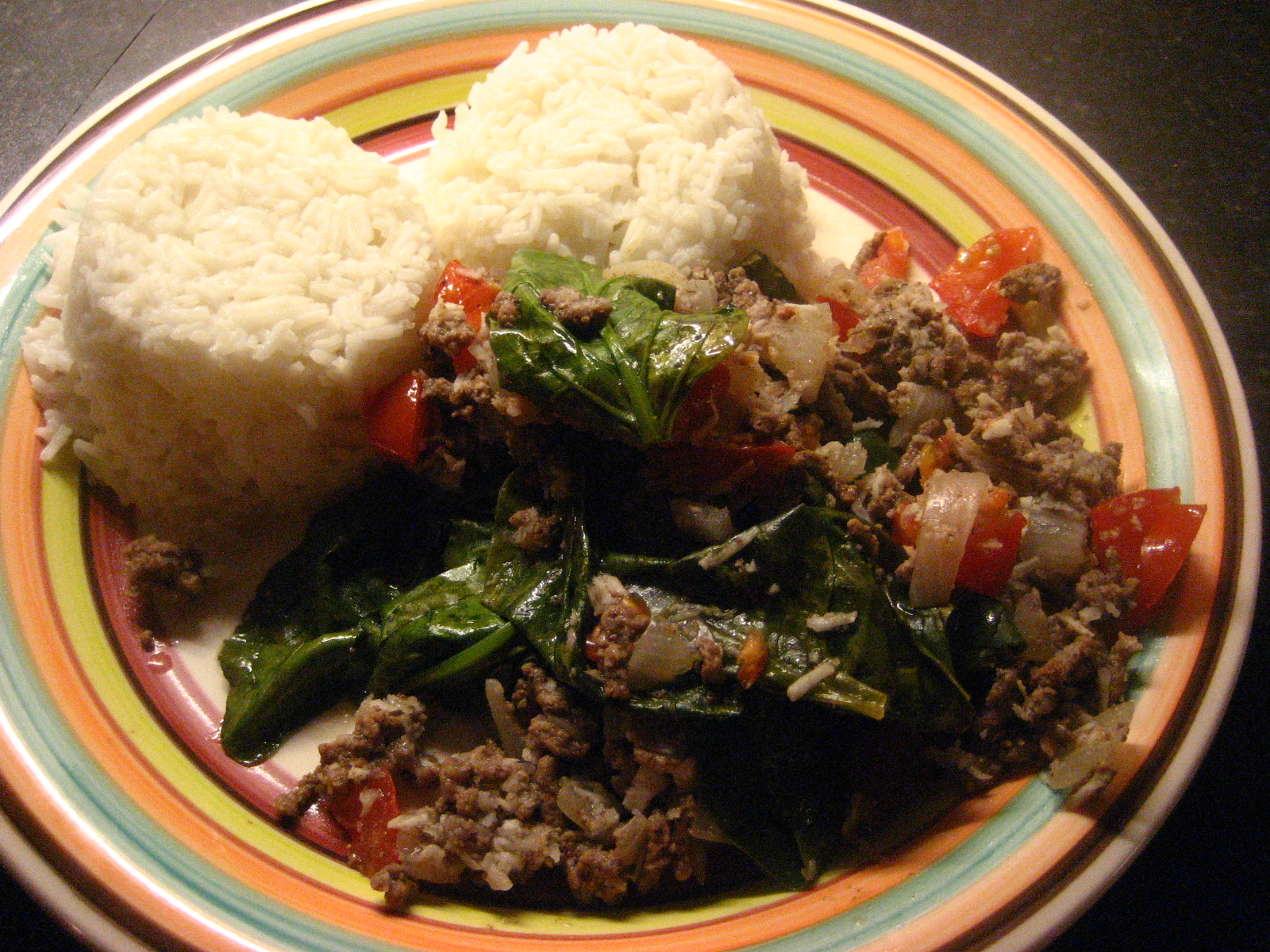
Once baked, I served the palu sami with rice.  My partner actually enjoyed it this time round, so that's a measure of success in itself!  The packages that I opened straight away, sort of fell apart on opening, which was fine, but not very aesthetically pleasing.  Other packages that I chilled over night in the fridge kept their shape really well, as you can see in the photos below:

Palu Sami with rice

Lithuanian rye bread with 'chilled' Palu Sami packets
Image credits:

All photos were taken by me, please feel free to reuse, under the Creative Commons license:

Attribution (especially to this blog post)
Share alike
Non-commercial