Showing posts with label Polynesia. Show all posts

Saturday, 15 August 2015

Solomon Islands - Blackbirders, beachcombers and the story of Jack Renton

I'd highly recommend Nigel Randell's book The White Headhunter: The story of a 19th century sailor who survived a South Seas' heart of darkness (2003). It's incredibly well-researched, informative and I found it very easy to read. 

The sailor in question was Jack Renton, a young man from the Orkney Islands who was press-ganged into working on a ship bound for the Pacific Ocean. Finding himself in hellish conditions extracting guano on a remote island in (what is now) Kiribati, he and several other men escaped and spent weeks drifting across the Pacific until they finally made landfall in Malaita, in the Solomon Islands. 
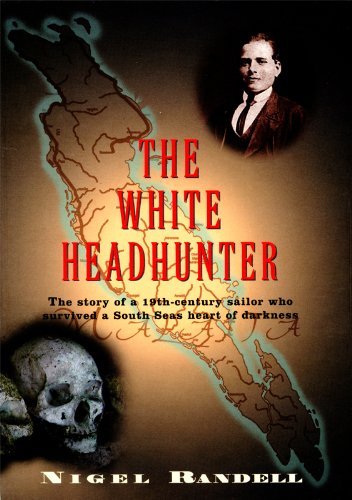
Randell's The White Headhunter (2003)
Jack Renton was the only survivor of the journey and went to live with a tribe in Sulufou, one of the artificial islands on Malaita's east coast. He remained on Malaita for eight years, during the 1870's, before being 'rescued' by fellow Europeans and brought to Australia, where his sensational story was published in the Brisbane Courier

Perhaps the most sensational parts of Renton's story (his involvement in war parties, headhunting and his marriage to a local Malaitan woman) were glossed over, being considered subjects that were too sensitive for his 19th century audience.

People were much more interested in hearing about how savage the tribes were in Malaita, which already had a reputation for being one of the most dangerous places in the world.  

Randell's theory is that it wasn't a black and white case of 'civilised white man forced to live with savages' but, rather, that Renton experienced a lot of kindness from the native people of Sulufou; he learnt their language and came to understand a culture steeped in centuries of tradition.

In fact, after a visit home to his native Orkney Islands, Renton missed the Pacific so much that he returned to Australia to take up a post inspecting ships that were sourcing Pacific labourers for work in Queensland's sugar cane plantations. 

The press-ganging of native Pacific Islanders to work in Queensland, known as blackbirding, was quite common in the mid-19th century. Ruthless blackbirders took advantage of the Pacific Islanders' desire to trade and they tricked men and women to come on-board their ships, so they could remove them from their native islands and transport them to a life of hard labour in Queensland. 

Pacific Islanders being freed from a blackbirding ship
State Library of Victoria, file on Wikipedia
Blackbirding caused a lot of problems, culturally, to the extent that white Europeans were no longer welcomed, as the Pacific Islanders feared kidnapping and death as a result of contact with the white Europeans on the blackbirding ships. 

Some blackbirders even masqueraded as Missionaries, because they knew that Missionaries had a relatively good reputation in places like the New Hebrides (modern-day Vanuatu), until it got to the point that the Pacific Islanders felt they could trust no-one and there were several cases where bona fide Missionaries were murdered, because the Islanders thought they were blackbirders. 

By the time Renton was rescued from Malaita, the recruitment of labour from the Pacific Islands had settled down somewhat into, more-or-less, acceptable three-year contracts. Once the Islanders understood that they would be able to earn some money and return home after their contracts expired, there was a lot more interest in travelling to Queensland for work.

What I loved about the way Randell did his research was that he used parallel narratives, i.e. both European sources, such as the many 19th century Beachcomber memoirs and the oral traditions of the Islanders themselves. It's interesting to note how the Islanders' oral accounts of Renton's time on Malaita, differ somewhat from the more official European version of his time on that island. 

Footprint in the sand, from my own photos
I'm also fascinated by the role that Beachcombers played in the politics of the 19th century Pacific region. According to Randell there were an estimated 1,500 Beachcombers of European origin living on various Pacific Islands in the 1830's. Most beachcombers lived on the friendlier Polynesian Islands rather than places like the Solomon Islands or Vanuatu. 

Some of them ended up in the Pacific as a result of shipwreck, others chose to live on Pacific Islands, in order to escape enforced labour or imprisonment in the new British penal colony of New South Wales. They played an interesting inter-cultural role, as contact between Europeans and the Pacific Islanders developed and I couldn't help but think again of the flip side of Solomon, i.e. the Queen of Sheba and the birth of international diplomacy. 

Randell also writes a lot about the establishment of Missionary stations in the Pacific and the power and influence that Missionaries eventually gained. Renton's friend, Kwaisulia, who eventually became the 'big man' in Sulufou, was dismissive of Christianity, but there was something inevitable about the advent of European traditions in the Pacific.

Nowadays 92% of people in the Solomon Islands profess Christianity as their religion, with only 5% of people following traditional animist beliefs (funnily enough, most of these are on Malaita!)


Saturday, 13 October 2012

Fiji - Bula Poly-Mela-Micronesia!

Currently being based in London, I can only really dream about travelling to Fiji.  It's more than 10,000 miles (16,000 kilometres) from London to Suva, Fiji's capital - that's literally the other side of the Earth!  Still, one can but dream and, during the next few weeks, I want to virtually travel to Fiji using the media of books, movies, music and food.  I invite you to join me on this virtual journey!

Poly- Mela- or Micronesia?

This is my second time to blog about an Oceanic nation - way back when I started this blog, in 2009, I blogged about the Micronesian nation, Kiribati.  Fiji is officially part of Melanesia, so I'm starting with the question - what's the difference between Poly- Mela- and Micronesia?

This terminology is European, not surprisingly and the words come from the Greek words for 'many' (πολοί Poly-), 'black' (μέλας Mela-) and 'small' (μικρό Micro-) - so Polynesia means many islands, Melanesia means black islands and Micronesia means small islands.  

So is there a difference between the three?
Tanoa, King of Ambau
The easiest answer is yes. Although all of Oceania shares inter-related languages and cultures, there is a notable difference between the countries of Melanesia and those of Polynesia.  Melanesian culture is closer to that of Papua New Guinea and it's possible to trace a continuum of ethnic identity from Papua, all along the various island groups (Solomon Islands, Vanuatu) to Fiji.  These islands were called Melanesia because of the darker skin colour of their inhabitants - a bit un-PC by 21st century standards, but Melanesia literally means 'islands where the blacks live'.  

Polynesia

Fiji is right on the edge of this cultural divide and, although they are considered to be Melanesians, many Polynesians consider Fijians to be 'not so distant relatives'.  There is also one Polynesian island in Fiji, Rotuma, which is quite far from the main island groups and has a very different language and culture than the rest of Fiji.  I think the Polynesian islands are the ones we think of most, when we think of the South Pacific - Polynesia is all about Tahiti and French Polynesia,Tonga, Samoa, Easter Island etc.  Polynesia also includes Europeanised places like Hawaii and New Zealand.  The origins of the Polynesian people are quite obscure - some people believe they also came from Papua, some say China and Taiwan. 

Micronesia

Pacific cultural area by Kahuroa
I can't see anything that distinguishes the Micronesian islands from the rest of Oceania, apart from their remoteness on the northern edge of the South Pacific and the fact that they are all really tiny with no larger islands like Viti Levu and Vanua Levu in Fiji, or Tongatapu in Tonga.  The Micronesian countries are some of the most obscure and smallest in the world, including Kiribati, Palau, Nauru and the Federated States of Micronesia!  


I'm pasting in a map of the Pacific Cultural area, which I think is a really good visual aid to understanding the region.  This has been released into the public domain by wiki-user Kahuroa.  

For research purposes, I bought a second-hand copy of Lonely Planet's Fiji (7th Edition 2006).  The pen-marks and notes inside indicate that it's been well-used on someone's diving trip to Fiji and I could swear that the pages still hold a faint scent of the faraway south seas! I'm looking forward to learning about Fiji, I hope that you are too!

Image credits:

All images used in this post are in the public domain, including the drawing of Tanoa, King of (Am)Bau, which is from the David Rumsey map collection.