Saturday, 5 July 2014

Oaxaca - What the Heart doesn't feel

When I start blogging about a new place, I like to do a 'Google Instant test' to see what's out there on the Internet, in terms of the place I'm blogging about. It's an interesting thing to do, if you want to try it for yourself - basically, you start typing a sentence eg. Do Germans . . .? or Are Chinese people . . .? and Google fills in the rest of the question based on what other people have been searching for.  It's a great insight into the things people are interested in and can produce some surprising, and often disturbing, results.

Why do Mexicans . . .

I tried this with Why do Mexican . . . and the top results included things like Why do Mexican immigrants move to the United States? Why do Mexicans look Asian? and Why do Mexican cartels behead?  Looking back on my first blog post on Oaxaca and the stereotypes I mentioned (immigration, drugs, violence), it's sad to think that this is all Mexico means to most people!  The purpose of this blog is to help me get beyond the stereotypes and learn something else about the places I'm blogging about.

The Google Instant question that intrigued me most however was:

Why do Mexicans stare?

I had no preconception about Mexicans staring and I was a bit shocked by this question, although it's obviously a hot topic for many people (mostly in the USA?)  There is an implicit prejudice/racism in the question and a fascinating psychology behind the fear that this question touches on; fear of attack, sexual assault, fear of being observed, fear of envy or intimacy.

Why do people stare?


Staring man in Sri Lanka by Brett Davies
Eye contact is a very intense thing for any species and we humans are no exceptions.  When dealing with wild animals or even domestic pets, such as dogs, making eye contact can trigger a violent attack and whilst human 'civilisation' has evolved in a way that removes aggression and violence from everyday life, direct eye contact with a stranger is still a potentially risky thing to do!

Ever notice how people don't make eye contact in elevators?  The intensity of being in an enclosed space means we tend to keep our eyes fixed on the floor or the changing lights of the elevator buttons!

Even during conversation, with someone we know, we tend not to make eye contact, except at the end of each sentence, to ensure the other person has been listening and has understood.  In some cultures, keeping your eyes lowered is extremely important - I'm thinking of places like Japan, China and Thailand.  In India, eye contact has class barriers, in some countries, like Saudi Arabia, eye contact is restricted by gender.

In most parts of the world, we get around eye contact issues by wearing sunglasses, a safe retreat from the threat of eye contact, but also a potentially menacing approach that says: Keep your distance.

The etiquette of eye contact

The Juju death stare by Viewminder
I think cultural differences are at the heart of this question.  Perhaps it's not that Mexicans stare, but that they hold eye contact for a split-second longer than people in the US are used to?  We northern Europeans are famous for our love of personal space and I think our slightly more modest approach to eye contact, touching and physical space has been carried over to the United States, even if they do engage in a bit more back-slapping that we would consider to be appropriate!

I'd imagine that Mexicans, on the other hand, are much more open and relaxed in terms of eye contact and physical space, presumably a cultural import from Spain and the norms of southern European culture. The question Why do Mexicans stare? opens up a cultural Pandora's box that is essentially European in origin.

Aztec and Mayan cultures had strict protocols around eye contact and, like in India and East Asia, ordinary people weren't expected to make any eye contact with their superiors.  The Spanish conquistadors violated all taboos in relation to looking the Aztec leaders/priests directly in the face and they had no respect for the personal space the Aztec leaders/priests were accustomed to.

The Eye of the Beholder

Staring child by Erin/ephotography
Have you ever noticed that young children stare a lot?  This is because they haven't yet learned the social conventions around eye contact.  They stare out of curiosity and their stares are non-threatening, although they can make adults uncomfortable, as we're not used to high-levels of eye contact.

There are two times in our lives when we spend a lot of time staring into someone else's eyes.  When we're infants, we spend months staring into the eyes of our mothers, in fact, that's all we see, or want to see in the early part of our lives. And, of course, when we fall in love, we spend a lot of time staring into the eyes of our lover, as though loss of eye contact, will mean the loss of love!

There's a link between aggression and passion and eye contact is both the language of those who love and those who hate.  If you've ever watched a boxing match, you'll be familiar with the 'stare down' and non-physical precursor to the fight when the boxers try to intimidate each other.  Have a look at this YouTube video showing some of the most famous 'staredowns' in boxing history to see what I mean.

In a more innocent way, we play with this difficult social skill when we have competitions to see who can win at 'outstaring' other people.

Windows to the Soul


Such is the importance of eye contact to our psychology that our languages are full of idioms and expressions which I could fill a whole other blog post with.  One of my favourites is:

The eyes are the windows to the soul

This is a traditional English proverb that has been recycled many times by writers, poets and lovers.  To me it encapsulates everything I've mentioned above; fragility, weakness, submission, vulnerability.

I also love the traditional Irish expression:

Is maith an scáthán súil charad (A friend's eye is a good mirror)

Friends are definitely people we can make eye contact with, we bare our souls to friends and let them experience our weaknesses and vulnerabilities.  It's a social bond which is amazing, if only because it exists outside the usual protective circles of family/spouses.
The Rokeby Venus by Diego Velázquez

It's interesting to have a look at the Spanish expression:

Ojos que no ven, corazón que no siente

We usually translate this with an equivalent English-idiom 'Out of sight, out of mind' but I'm much more interested in the literal translation of this expression:

What the eyes don't see, the heart doesn't feel

Perhaps the reverse scenario of US citizens who are intimidated by 'staring Mexicans' is the perception of Mexicans that people in the US are unfeeling and not very welcoming.  Something worth thinking about?

Image credits:

I personally find it very difficult to take photographs of people, when I'm travelling around the world.  It's a skill I haven't yet mastered, which is a shame, as people are so interesting!  The image of the man in Sri Lanka was taken by Flickr member, photosightfaces aka Brett Davies, who is originally from Sydney. Brett has a whole series of photos of people in Sri Lanka, it's a really interesting collection to browse through.

The photo of the Juju death stare is by Flickr member, Viewfinder - originally from Chicago, you can see more of Viewfinder's photos on his photo stream.  There's an interesting story behind this photo, which you can read on the photo's own information page on Flickr.

The picture of the staring child is by Flickr member, ephotography, aka Erin, who is from Vancouver in Canada.  You can see more of Erin's photos on her photo stream.

Thanks to Brett, Viewfinder and Erin for sharing these images with us using the Creative Commons license.

Nowadays, we feel safe with images that stare at us from a painting or a photograph, but I've included an image of The Rokeby Venus by Diego Velázquez (1647-51) to remind us how this painting was considered to incredibly controversial at the time.  The woman, who was probably a courtesan, was shown to be staring at the observer, something that was unheard of in 17th century European painting, even though she is depicted as staring at us indirectly through a mirror!  

Saturday, 28 June 2014

Oaxaca - The United States of Mexico

I am very excited to start blogging about Oaxaca and Mexico, a country I know very little about, despite its important place on the world stage. Like most people, my 'knowledge' of Mexico mostly consists of news reports about drug cartels, illegal immigrants or violent gangs.

During the next few weeks, I'm looking forward to learning more about this country, through the lens of Oaxaca, I want to discover Mexican music and literature, I want to learn about Mexico's great linguistic diversity, about the cultures that survived the European conquest, the modern-day Aztecs and Mayans.  I want to find out about Mexican telenovelas and read some Mexican literature.  I want to prepare a traditional Oaxacan dish (if you have any suggestions, please leave a comment below!)

Which United States?

When we hear the words 'United States', I'm sure most of us think 'USA', so it was interesting to discover that the official name of Mexico is Etados Unidos Mexicanos or the United States of Mexico/Mexican United States.  In the 21st century, the USA and USM are two different sides on the see-saw, with the USA very much in the ascendant and Mexico considered to be somehow less developed and less important, despite the fact that Mexico has the world's 14th largest economy, just behind Spain and just ahead of South Korea.  They're also not doing too badly in the FIFA World Cup!

Say Oaxaca?

Oaxaca by Alex Torres
Oaxaca is a part of Mexico that isn't that well-known to the rest of the world.  I really only found out about Oaxaca when I was blogging about Enrique's Journey and Honduras.  Many illegal immigrants riding the trains to the border of the USA pass through Oaxaca and this got me interested in finding out more about this less familiar Mexican state.

I started by pronouncing Oaxaca as o-aksaka but, I now realise that it's pronounced more like wahaka. The pronunciation of Oaxaca got me thinking about the links between Mexico and the United States. Wahaka sounds a lot like a Native American Indian word and it made me understand that our modern perception of Mexico/USA means we separate Aztec culture from US Native American Indian culture when, actually, they're very much related to each other.

Native Americans and the arrival of Europeans

Oaxaca by Alex Torres
Funnily enough the last place I blogged about beginning with the letter O was Oklahoma.  I learned a lot about Native American culture, when I was blogging about Oklahoma and I feel there is a real 'trail of tears' in the Native American story that stretches from Oklahoma to Oaxaca and beyond.

I'm reading a really interesting account of  the Spanish conquests of Mexico and Peru by BBC books called Conquistadors by Michael Wood (2000). It's an informative and clearly-written account of the 16th-century conquistadors, Cortes and Pizarro.  It's a pretty horrific tale and, from a 21st century point of view, a real tragedy that the great cultures of Mexico and Peru were destroyed by Europeans without a second thought.

The Mexican Jigsaw

Oaxaca by Alex Torres
The chapters on Cortes and the Aztec Empire have given me a real sense of Mexico, as it existed in the 16th century, long before modern borders and states.

In fact, the big division, culturally, in Mesoamerica seems to have been between the Aztecs and the Mayans.  Even in modern times, Yucatan probably has more in common with its neighbours Belize, Guatemala and Honduras than it does with the rest of Mexico.  I'm speaking in cultural terms, of course, economically, with its thriving tourist industry Yucatan is a world apart.

When Europeans first started arriving in Veracruz and other parts of eastern Mexico, the Aztec culture was slightly beyond reach, hidden away in the Mexican valley.  The modern name Mexico, comes from this specific geographical area, once sheltering the Aztec capital of Tenochtitlan, now occupied by the conurbations of Mexico City.

Between the valley of Mexico and Oklahoma were much smaller cultures, eking out an existence in the harsh deserts of Chihuahua, Colorado and Mojave.  Aztec rule had barely reached these northern deserts, when the Spanish turned up on the scene.

Oaxaca's place in the jigsaw


Oaxaca en México.svg
"Oaxaca en México" by Yavidaxiu - Own work. Licensed under Public domain via Wikimedia Commons.
What is now Oaxaca was only part of the Aztec empire for 30 years before the Spanish arrived and changed the political landscape forever.  Oaxaca is a very mountainous place, most of the state is 2,000 metres above sea-level, which made it inaccessible in past centuries and, to an extent, protected from the radical Europeanisation that happened in other parts of Mexico.

You can still see this today, in the fact that Oaxaca is Mexico's most ethnically complex state with sixteen officially recognised indigenous cultures.  More than half of Mexico's speakers of Native American languages live in Oaxaca and the Spanish language isn't as ubiquitous in Oaxaca, as it is in other parts of the Mexico.  I guess Oaxaca is the Mexican equivalent of Oklahoma, but much more so!

Missing pieces of the jigsaw

It wasn't until the 19th century that Native Americans felt the pressure from the growing power of the United States of America and that nation's manifest destiny and expansion westwards.  Mexico lost around half of its land area during the 19th century, the missing pieces of the Mexican jigsaw being modern states like California, Arizona, Texas and New Mexico.

I'm embedding a useful YouTube video below, from the Open University, which explains the changes that took place in Mexico and the United States in the 19th century.  I thought it was quite poignant to note that, whilst the 19th century was all about borders crossing people, the late 20th and early 21st centuries are all about people crossing borders.


I guess the fate of these two countries will be forever intertwined and I hope the future of US-Mexican relations will be one of mutual respect, cooperation, promotion of Native American cultures and a sense of shared history.

Image credits:

Oaxaca doesn't really have an official flag, so I made my own image which combines the Mexican national flag, but replaces the national seal with the Oaxacan state seal.

For this blog post, I wanted to highlight the work of Flickr member psicoloco aka Alex Torres, who is originally from Mexico City.  You can see more of Alex's beautiful photos on his photostream.

Thanks Alex for sharing these images with us using the Creative Commons license.  

Sunday, 8 June 2014

Nordrhein-Westfalen - The Final Word on German Tourism

Until I started researching for this blog, I'd never heard of Engelbert Kaempfer, the 17th century naturalist from Lippe in Westphalia, who travelled through Russia and Persia, all the way to Japan, arriving in Nagasaki in 1690.  He wrote The History of Japan, one of the most famous accounts of a European journey to that most secretive of nations.

The ubiquitous German Tourist

You know that you've managed to get off the beaten track, when the only other Europeans you encounter are Germans.  When I was blogging about Eritrea, back in September 2012, I came across the work of the UNWTO (the World Tourism organisation).  Every year the UNWTO publishes a report on world tourism and it's fascinating to look at the summaries of their findings.  For the purposes of this blog, I have decided to look at the summaries from 2014 and 2004, to find out how many Germans are travelling and how popular Germany is as a tourist destination.

World Tourism in 2003

Bavarian Alps, a popular tourist destination in Germany
Germany has often topped the UNWTO list as the country which provides the biggest revenues in terms of 'outbound' tourism (ie. Germans travelling as tourists to other countries).  Looking at the report from 2004 (which analyses data from international tourism in 2003), Germany was top of the list with a 12% share of the world's outbound tourism.  US citizens were the second-biggest travellers in 2003, followed by the British and the Japanese.

The top tourist destination in 2003 was - perhaps not surprisingly - France, which frequently tops this list as the most visited country in the world. Germany took 9th place as a tourist destination, just behind Mexico and ahead of Canada.

World Tourism in 2013

The picture has changed quite a bit over the past ten years, with the rise of China and the strength of the Chinese economy.  There were more Chinese tourists travelling the world in 2013, than tourists from any other country (11% of the 'outbound' tourism market). German tourists are now in third place (7.4%) and a little bit behind tourists from the United States.

Interestingly, Japanese tourist numbers have dropped dramatically and Japan doesn't even appear in the top ten list any more, despite the fact that Japanese tourists were the fourth biggest group in 2003.  There has also been a sizeable growth in the number of Russian tourists, who were the tenth largest group in 2003, but are now the world's fourth largest group.

France is the world's most popular tourist destination
France remains the most popular tourist destination in the world, however, Germany has become increasingly popular, going from 9th to 7th place.  Germany now receives more tourists than the UK, but slightly less than Turkey, which has seen an explosion in tourist numbers during that 10 year period.

The next ten years in Tourism

It'll be interesting to see how things change over the next ten years - will France still be the world's most popular tourist destination?  Will the number of Chinese and Russian tourists be even higher, or will they be lower?  I think it's a difficult industry to make predictions about and that only time will tell!


Image credits:

Both images were taken by me - please feel free to use them with the Creative commons license:

- Attribution
- Non-commercial
- Share alike

Wednesday, 4 June 2014

Nordrhein-Westfalen - Books and Movies

The Books

I've read five books, as part of my research for Nordrhein-Westfalen.  Here's the list with links to blog posts, where relevant:

Germany: Insight Guides (2005) ed. Tony Halliday and others.  This book provided me with a good overview of German history and culture.  It's got me really interested in visiting the Rhine valley again, perhaps a cycling or walking trip will be on the cards in the near future!

Reading list for Nordrhein-Westfalen
All Quiet on the Western Front (1929) by Erich Maria Remarque.  I wrote a blog post about this fantastic novel back in April.  I read the 1996 Vintage edition with an afterword by Brian Murdoch, who is Emeritus Professor of German at the University of Sterling and an expert on Remarque.

The Lost Honour of Katharina Blum (1974) by Heinrich Böll. I also wrote a blog post about Böll's novel.  I read the Minerva edition of 1993.

Protestantism: A Very Short Introduction (2011) by Mark A Noll part of the Oxford University Press Very Short Introduction series.  Regular readers will know how much I love these books and I found Noll's Protestantism invaluable when I was researching my blog post on Protestantism in Germany.

Beethoven: The Music and the Life (2003) by Lewis Lockwood.  I must admit, I didn't read the entire book - it was very much a last minute addition to my reading list and I just didn't have time to read the whole thing, although I found the bits I read enjoyable.  Lewis is a musicologist from New York city, who is an expert on Beethoven.  This book was a finalist for the 2003 Pulitzer prize for Biography.  He alternates each chapter, to combine biography and musicology and I found this approach really engaging, although I can't tell my arpeggio from my adagio!  I used the early chapters of this book to inform my blog post on Beethoven.

The Movies

Nastassja Kinski in Paris, Texas (1984)
I didn't really know anything about Wim Wenders before I started blogging about Nordrhein-Westfalen and I'd never seen any of his movies, although some of the names (e.g. Paris, Texas) would have been familiar to me.

He's quite an iconic film director, originally from Düsseldorf, his movies portray an emptiness and silence that, in many ways, symbolise the broken soul of post-war Germany.  Wenders also has a lot to say about American culture and some of his most famous movies are set in the United States.

I couldn't get my hands on all of the Wim Wenders' movies I wanted to see, but I managed to watch the following:

Alice in the Cities (1974)
Paris, Texas (1984)
Wings of Desire (1987)
Don't come knocking (2005)

Opening sequence from Paris, Texas (1984)
His movies are quite slow-moving and should definitely be appreciated for their artistic qualities rather than story-telling.  I particularly loved Alice in the Cities, one of his earliest movies - shot in black and white, it's mostly set in the Rhine valley and the industrial cities of the Ruhr.

In Paris, Texas I can see the influence of Wenders on a whole generation of US movies - those bleak landscapes and slightly surreal shots.  I've just recently finished watching the popular US series Breaking Bad and I can see hints of Wenders in the deserts of New Mexico.  The boundaries between TV and cinema are increasingly blurred these days and I like the fact that TV programmes are embracing style as well as substance.

Here are some of the themes that Wenders' movies tend to deal with:

Typically stark Wenders shot from Wings of Desire
- Individuals who are outside the norms of society (the character of Stanton in Paris, Texas or the angels in Wings of Desire)
- Road trips
- Alienation from a world which is incredibly materialistic
- Timelessness
- Children being abandoned by their mothers
- Adults who disappear
- Shots of faces within faces
- the trauma of progress (ubiquitous television in United States, changing landscape of the Ruhr valley)
- melancholic and repetitive music

As well as learning about Wim Wenders, I also watched both movie versions of All Quiet on the Western Front, the fantastic 1930 film and the less engaging version from 1979.

I had a really nice Easter weekend with my sister in Leeds, when we devoted several hours to my research and watched Amadeus (1984, dir. Miloš Forman), the slightly crazy movie about Mozart and Immortal Beloved (1994, dir. Bernard Rose) starring Gary Oldman.  I loved both movies and they helped me contextualise the development of music in the Classical period and the influence that Mozart may have had on the work of Beethoven.  I'd recommend either of these movies to anyone who wants to learn more about these composers.

I'm going to leave you with a trailer from Immortal Beloved so you can get a sense of what the movie is about:

Image credits:

The image of the books was taken by me.

The images of the stills from Wim Wenders' movies are from photos taken by me. These images are being used to illustrate this blog post and promote these movies. By publishing these images, I'm not condoning or encouraging reproduction of these images on the Internet or anywhere else. These images are not meant to bring the actors into disrepute or suggest their endorsement of this blog post, but are meant to highlight the performances of these actors in these movies. 

Saturday, 31 May 2014

Nordrhein-Westfalen - How I made Rheinischer Sauerbraten

I visited Japan recently and, whilst I was there, I noticed that the Japanese are very fond of European cooking and that there are a plethora of European-style restaurants in every major Japanese town or city. Of course, by European cooking, I mean French and Italian and it's interesting how other European cuisines, like the cuisines of Germany, Britain, Poland etc aren't that well known or valued around the world.

I must admit that I'd never heard of Sauerbraten (Sour Roast) before I started looking around for a dish I could make which would represent Nordrhein-Westfalen.  Sauerbraten is one of Germany's most famous dishes and I had lots of fun (and made a big mess in the kitchen) preparing the Rhineland version, Rheinischer Sauerbraten.

Sauerbraten ingredients 
I've spent a lot of time preparing stew-type dishes for this blog; whether's it Jèrriais Pais au Fou, Liberian Palava or Cambodian Somla Machou, I guess there's a basic principle in world cuisine which makes 'bunging it all in one pot' very easy!  Interestingly, my experience preparing Rheinischer Sauerbraten reminded me more of the dish I made when blogging about Korea.  It was all about cooking/preparing parts of the dish separately, then arranging them together at the end.  

Also, I must admit that this isn't actually the first time I have prepared German food for this blog - the dishes I prepared for both Indiana and Wisconsin, were basically German ones that have been exported to the United States.  I guess German cuisine is more familiar to us in terms of what we'd usually think of as American fast food?

I used a recipe from the Food network, as the inspiration for my Rheinischer Sauerbraten.  

There were four main parts to this dish:

1. The meat - Das Fleisch

Topside, after almost three days of marinating
Traditionally horse meat, but I opted for beef (Aberdeen Angus topside) - because of the nature of the dish, it's important to have a tougher cut of meat, like the topside, top rump or even silverside.  I've used this opportunity to learn a little more about the different cuts of beef and I came across a really useful guide from Delicious Magazine, which shows where the different cuts of beef are taken from.  Interestingly, cuts of beef are different in British and American English.  

The really interesting part of this recipe is that the beef should be marinated for at least three days before cooking.  I didn't have three days, as it happens, but I managed to marinate the beef for about 60 hours and it was fairly tender after I'd cooked it.  

The meat is also the 'sauer' part of the recipe, as it's marinated in red wine vinegar and pickling spices, so the beef is basically pickled for three days.  

Here is a list of the ingredients that I used:

500g Beef Topside - Rindfleisch (Huftsteak)
275ml red wine vinegar - Rottweinessig
200ml water - Wasser
Salt - Salz
Pickling spices - Beizen Gewürze
200g brown sugar - brauner Zucker

Beef topside after 45 minutes in the oven
I think Sauerbraten is traditionally a pot roast, so the beef would be roasted in a pot with vegetables for several hours.  I followed the recipe, which recommended oven roasting and so, after marinating for almost three days, I put the meat in a cake tin, sprinkled some brown sugar on top and roasted it in the oven for forty-five minutes at 180 degrees Celsius (350F).  I guess you could also braise the meat before roasting, but the method I used gave the meat a slightly cooked exterior with a succulent medium-rare interior.  

The sugar melted on the top to give the meat a really lovely glaze.  I used a lot of sugar in this dish and, I guess, the overall effect of all of that sweetness was to balance the sour elements of the dish - a clever combination!

2. The sauce - Die Sauce

Ginger snaps
Perhaps one of the most fascinating things I've learned from making this dish is the fact that you can make a really nice sauce from biscuits/cookies!  I must admit, I was a little bit doubtful, when I first read the recipe, but it worked!  And I guess it makes sense, what are biscuits after all but flour and butter?

Reserved stock from the roasted meat - Brühe aus dem Rindfleisch
500ml water - Wasser
8 crushed Ginger snap cookies - zerkleinerten Lebkuchen
3 tablespoons red wine vinegar - Rottweinessig
Sugar - Zucker
150ml sour cream - Saure Sahne
150ml raisins - Rosinen

Add sour cream and raisins to change the texture
I should say at this point that I didn't cook these parts of the dish in linear order and was doing bits and pieces simultaneously.  I've ordered them for your benefit, so it's easier to understand the various components and how to make them.  

To make the sauce, I simply crushed the Gingerbread biscuits in a saucepan, then added the stock from the beef, which had been baking in the oven for forty-five minutes and two cups of water (around 500ml). I then added the red wine vinegar and sugar, brought everything to the boil, then simmered until other parts of the meal were ready.

A few minutes before I was ready to serve the meal, I poured the contents of the saucepan into a plastic mixing bowl, added the sour cream and raisins and stirred.  As you can see from the photo, the sour cream does change the texture and colour of the sauce.  

3. The Cabbage - Der Kohl

Chopped apples
I cheated slightly in this part, buying cabbage that was ready for cooking.  You might have noticed that I've used a lot of Waitrose ingredients with this particular dish and this is mostly due to time constraints and the fact that I've recently discovered online grocery shopping!  

300g red cabbage - Rotkohl
2 apples - Äpfel
150g apple sauce - Apfelmus
Sugar - Zucker
200ml red wine vinegar - Rottweinessig

Apples and red cabbage go really well together
I'm not a massive fan of red cabbage, but combining red cabbage with apples is a great idea!  I guess the first rule of German cooking should be 'don't run out of red wine vinegar' - which is exactly what happened to me by the time I got to the cabbage.  I substituted with some of the liquid that was left over from the marinade, although the cabbage was very vinegary as a result.  

Making this part of the meal was quite straight forward.  I first added the apples to a large saucepan, then the marinade liquid/red vinegar, followed by the red cabbage and apple sauce.  I brought everything to the boil, then simmered until the whole meal was ready.  It's important to keep stirring these ingredients, as the apple softens and mixes in with the cabbage.

4. The Noodles - Die Spätzle

Spätzle mix
Making the Spätzle (little sparrows) was really good fun and very messy!  I've made noodles before, when I cooked Mongolian Tsuivan, however, this time was a bit different, as Spätzle are something like a cross between noodles and gnocchi.  

4 eggs - Eier
175ml milk - Milch
Salt - Salz
Black pepper - schwarzer Pfeffer
Nutmeg - Muskat
450g flour - Mehl

Frying the Spätzle
The recipe said 450g of flour, but I didn't trust it and only put in 350g, which I now regret, as my mixture was too liquidy and my Spätzle didn't turn out exactly the way I wanted - still, we live and learn.  So, definitely use 450g flour and mix in the eggs, milk, pepper and nutmeg.  

I brought a large saucepan of water to the boil, then used my potato ricer to separate the Spätzle mixture into long strings which dropped into the boiling water.  You can make quite a lot of Spätzle with the amounts suggested above and I did three batches in the boiling water, removing the Spätzle batches after a few minutes of boiling.  

The best bit is frying the Spätzle in butter, which gives them a crispier texture.  This was the very last thing I did, before assembling all four elements together; meat, sauce, cabbage and Spätzle to make Rheinischer Sauerbraten!  It was immense!!

Rheinischer Sauerbraten

Meat, sauce, cabbage and Spätzle


Image credits:

All images were taken by me on my trusty Canon EOS 1100D.  Feel free to use these images with the Creative commons license:

- Attribution
- Non-commercial
- Share alike

Monday, 26 May 2014

Nordrhein-Westfalen - Beethoven's 'Ode to Joy'

As well as having been the capital of West Germany for a good part of the 20th century, Bonn was also the birthplace of Ludwig van Beethoven, one of Europe's greatest composers.  At a time when Vienna dominated Europe's musical scene, it's hard to imagine how a backwater like Bonn could have produced a talent as prodigious as Beethoven's.

Except that Bonn wasn't really a backwater in the late 18th century, being part of the Electorate of Cologne, a vestige of the Holy Roman Emperor, it was ruled by the Archduke Maximilian Francis, youngest child of the Hapsburg ruler Maria Theresa.  Max Franz was a big music fan and an early patron of Beethoven, Bonn's very own child prodigy, later seen as a musical successor to Vienna's Wolfgang Amadeus Mozart.  

In the Shadow of Mozart

It's hard with the distance of time, to separate the different eras in which European composers lived, so I was surprised to learn that Beethoven wasn't so much a contemporary of Mozart, as a generation later than Mozart and a composer who, in many ways, grew up in Mozart's shadow.  Mozart was the original child prodigy who took Europe by storm in the years immediately before Beethoven's birth in 1770.  

13-year old Beethoven, by an unknown artist
Like all child prodigies, both Beethoven and Mozart had pushy fathers who channelled their own creative frustrations into their progeny.  Beethoven's father was an alcoholic who lied about Beethoven's age, to promote the idea of him as a child prodigy, the 'in' thing in European courts on the lookout for a 'new' Mozart. 

Actually, Beethoven's father held him back in many ways.  Because of his father's alcoholism and the death of his mother when he was just seventeen, Beethoven took over the guardianship of his younger siblings, a responsibility that hampered his creative development and kept him in Bonn, at a time when he wanted to live in Vienna.

We're not sure whether or not Beethoven actually met Mozart, when he first travelled to Vienna in 1787. It's possible that Beethoven sat in the audience at one of Mozart's concerts, but didn't actually get to meet the great maestro.  By the time Beethoven moved to Vienna in 1792, Mozart was dead.  

Phenomena and Noumena

The music of Mozart and Beethoven heralded a new departure in European culture and a move from the highly-ornate and complicated Baroque period, to the thematically simpler and romantic period, now known as Classical.  Both Mozart and Beethoven were influenced by the principles of the Enlightenment and the wider political and cultural changes that were transforming late 18th-century Europe.  

Rain, steam and speed (1844) JMW Turner
Revolutions in the American colonies and in France rocked the status quo and prompted an artistic response that celebrated the 'brotherhood of man', the poetry of Friedrich Schiller and William Blake, as well as the music of Mozart, Beethoven and many others. Beethoven spent his teenage years reading Schiller and he used the words of Schiller's Ode to Joy in his Ninth Symphony, perhaps his most famous work. 

Artists of the time were also influenced by the Prussian philosopher, Immanuel Kant.  Kant talked a lot about the difference between phenomena, i.e. things as we experience them and noumena, things as they exist in themselves, beyond our direct experience.  When you listen to Beethoven's music, you can sense that he moved his art into the realm of noumena rather than phenomena.  I guess it was the noumena which gave Romanticism its characteristically uplifting (and occasionally frightening) nature.  Just look at the paintings of J.M.W. Turner or read the poetry of John Keats and you'll see what I mean.  

A self-sustaining Artist

Beethoven graffiti in Graz by southtyrolean
Both Mozart and Beethoven gave us an image of 'the artist', that remains popular today; tortured by their own creativity, misunderstood, impoverished, romantic and wild.  Beethoven's appearance was shabby and many in his audience wondered how such an unkempt figure could produce music that was so beautiful.

In the Baroque period, composers and musicians were seen as little more than servants, more important than the kitchen staff, but less important than the valets. However, at a time when revolution loomed and royal purses became more constrained, many courts could no longer afford to pay for an entire orchestra and this seems to have prompted a move towards the self-sustaining artist.  Mozart was one of the first to attempt to have a career that was independent of the patronage of a single court and this unsettled his contemporaries.  He was a bit ahead of his time, unfortunately, and died in poverty at the early age of 35.  

By the time Beethoven came along, the idea of a self-sustaining artist had gained more currency and Beethoven was able to win patronage from many different sources and sustain an unprecedented level of independence.  It's interesting when you compare this with Joseph Haydn, who spent most of his career in the servitude of the Hungarian Esterházy family and was only able to work for himself towards the very end of his life.  

The Music of Beethoven

During my research into Beethoven, I sometimes found it difficult to get my hands on full-length versions of many of his symphonies, piano concertos and sonatas or string quartets.  These days, our 'knowledge' of classical composers like Beethoven, Mozart or Haydn, generally comes from television advertisements or popular CD collections along the lines of Best of . . . In our increasingly fast-paced world, it seems as though we don't really have the patience for an entire symphony or concerto.  

It means that much of Beethoven's work will remain unheard by a sensory-overloaded 21st century audience. I tried to listen to as much of Beethoven's work as I could, but there was so much of it that I find myself discriminating (as The Best of collections do) in favour of his most well-known works.

If you only listen to one entire symphony in your life, then it should be the Symphony no. 9 in D minor, opus 125, aka 'Beethoven's Ninth'. It's perhaps the best piece of music ever written and resonates down the centuries in a way that inspires the noblest feelings, even in a 21st century listener.  I'm embedding a YouTube video, so you can listen to the whole thing (it's only an hour long - just sit back, close your eyes and submit to Beethoven's noumenal journey to the essence of human existence).  


The terribly sad thing about Beethoven's Ninth is that he never got to hear it himself.  Perhaps because of his rigorous training in childhood, Beethoven began to lose his hearing when he was only 26 years old.  It's quite tragic that he couldn't fully interact with the world and enjoy the full volume of the orchestra performing his greatest works but, perhaps, his deafness forced the music inside him and increased the noumenal quality of work he produced in later life?

A Song for Europe

The final movements of Beethoven's Ninth contain the Ode to Joy, Schiller's words set to music.  It's a really inspirational piece and exudes an optimism that promises a better world in which all men (and women?) are equal.  

O Freunde, nicht diese Töne!
Sondern lasst uns angenehmere anstimmen,
und freudenvollere.
Freude!

Oh friends, not these sounds!
Let us instead strike up more pleasing
and more joyful ones!
Joy!

This piece of the Ninth Symphony is used as the Anthem of Europe, by the European Union.  On a day when the results of the recent European elections have come in, I find myself wanting to listen to Beethoven's Ninth more than ever!

Image credits:

The image of the painting of 13-year old Beethoven by an unknown artist is taken from Wikimedia commons and is believed to be in the public domain.  You can see more information about the file at its description page.

The image of Turner's painting is also in the public domain.

The image of the Beethoven graffiti in Graz, Austria is by flickr member southtyrolean, who is originally from South Tyrol in Italy.  You can see more of southtyrolean's photos at his photo stream.  Thanks for sharing this image with us, using the Creative Commons license.  

Tuesday, 20 May 2014

Nordrhein-Westfalen - The Lost Honour of Katharina Blum

I always like to discover some new literature from the place I'm blogging about so, when it came to Nordrhein-Westfalen, my research brought me to the door of Heinrich Böll, one of Germany's best-known writers.

I'd never heard of Böll before, so it was a pleasure to read his novel The Lost Honour of Katharina Blum which is set in the Rhineland, in 1970's West Germany.  Throughout his life Böll was somewhat of a rebel and, I'd imagine, a thorn in the side of the authorities - he refused to join the Nazi youth in the 1930's, although he was later drafted into the Wehrmacht.  He was interested in society's misfits and dealt with topics that were both uncomfortable and challenging for the West German government.

The novel was quite short and written in an usual style, as the narration is somehow done 'at a distance'.  I'd recommend it to anyone interested in modern German literature and, to give you a taster, I've picked out some of the novel's key themes below.

Theme: Post-war pessimism


Cologne 1945 by Gordon Ross
Böll is one of Germany's post-war writers associated with Trümmerliteratur - or the 'literature of the rubble'. Trümmerliteratur deals with the issues of a post-war society that has to deal with the physical and moral devastation caused by war.  It's well-known that Böll was strongly affected by the destruction caused in Cologne by Allied air raids.  He felt indifferent towards the new city that rose from the ashes of World War Two and his novel is full of pessimism and resentment towards the West German authorities.

Böll's novels were incredibly popular in the ex-Soviet Union, which makes a lot of sense, as he focused on the moral emptiness of capitalism and the banality of the reconstructed West Germany that was his home. Katharina Blum is unemotional and disengaged from the world around her and she is hostile to the authority figures who are pursuing her because of her involvement with Ludwig, a young left-wing radical she met at a party.

Theme: Red scare

Post-war Germany found itself divided in a new, politically-polarised world of capitalism v communism. Whilst Brandenburg and Saxony fell under the influence of the Soviet Union and eventually became the German Democratic Republic (East Germany), Nordrhein-Westfalen became the heart of the capitalist Federal Republic of Germany (West Germany) with it's new capital in Bonn.  

Böll's novel deals with the fear of communism that had such an influence on the politics of 1970's West Germany.  New left-wing organisations such as the RAF (Rote Armee Fraktion), aka the Baader-Meinhof gang, were terrorising West Germany with bank robberies and bomb attacks, kidnapping leading capitalists and killing police officers. 

I remember being amazed, when the Internet first came along, to learn about the RAF and Baader-Meinhof group - it's not exactly the kind of thing we were taught about in school and learning about this 'carefully concealed' chapter of history was my first experience of the kind of autonomy online research can provide. Despite their violent acts, the RAF gained a certain amount of sympathy amongst working-class West Germans and Katharina Blum, in a way, epitomises the ambivalence of a non-political West German towards the government's campaign on terror.

Theme: Fear of an Independent Woman

Katharina finds herself in the unusual position, for the 1970's, of being an independent woman.  After her marriage breaks down, she finds a job as a cleaner and manages to put away some money, so she can buy her apartment.  Whilst trying to establish whether or not she is really guilty of aiding and abetting a revolutionary, a lot of the 'evidence' of Katharina's guilt is based on the fact that she has her own life and could, potentially, choose any number of male sexual partners.  

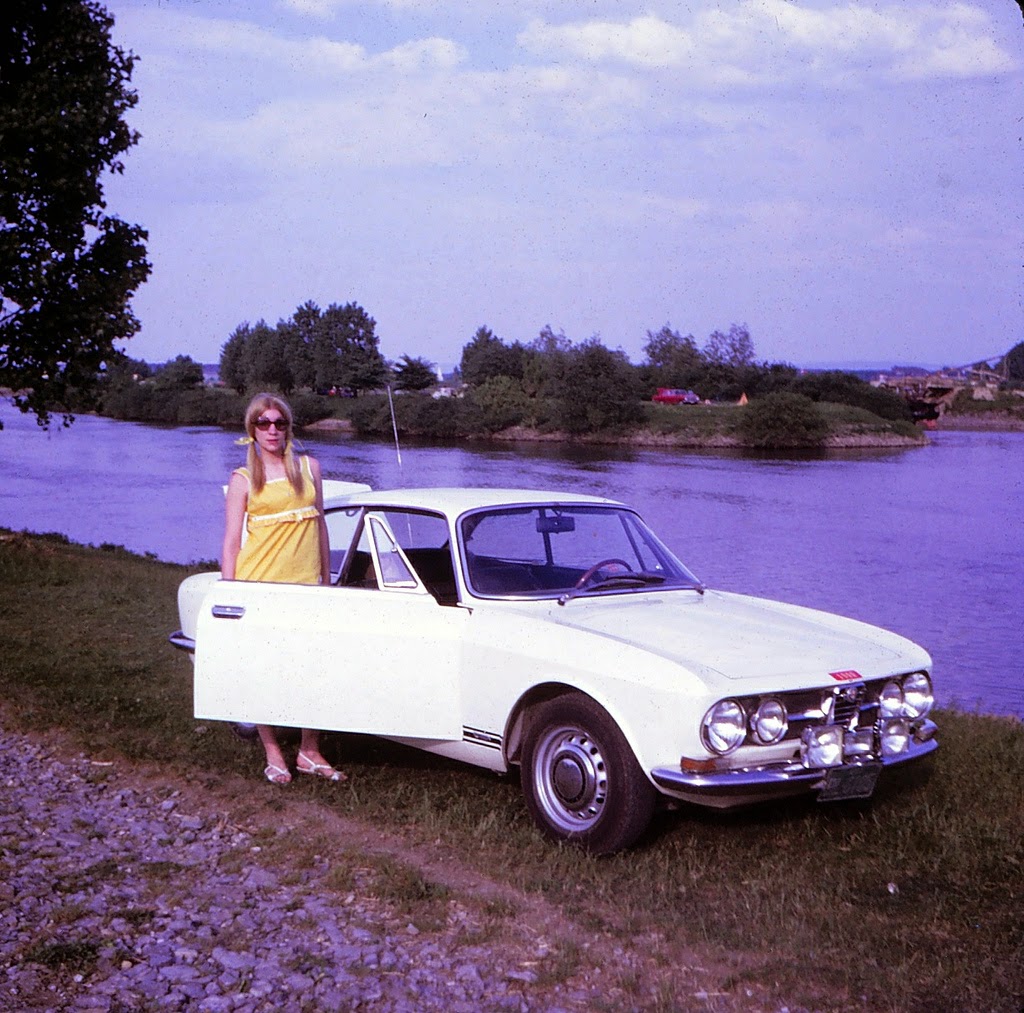
River Main, 1970 by Barbara Ann Spengler
As it happens, she was involved in a love affair with a high-ranking government official - a married man - and her efforts to protect his name make the authorities even more suspicious of her behaviour, so that the conclusion is her being found guilty.  

It's as though she is guilty of being a single woman with control over her own life and, therefore, not answerable to or under the control of any man.  Katharina, for her part, has a long list of men who've done wrong by her, despite her attempts at being independent, she is ultimately limited by the rules of a man's world.  

As a single woman she's also seen as 'fair game' by the male investigators.  When one of the investigators tries to hit on her 'she in her dry way had given him to understand that, irresistible though he might be in his own eyes, he was not so in hers'

Theme: The Power of the Media

This theme is one we understand really well today, but I think Böll's novel must have been one of the first to deal with the power that the Media has to influence the outcome of a legal process.  Because she has no man to protect her, the male-dominated media tears Katharina's life to shreds, the argument being that, as a figure of 'public interest', she no longer has the right to privacy or benefit of the doubt.

Because of her coldness and apparent lack of remorse, the Media decides that Katharina is guilty and hound her in the papers, painting her out to be heartless, communist and immoral.  It's interesting how 'appearing remorseful' can play such an important part in public trials - we've seen it very recently in the case of Oscar Pistorius.  Katharina's emotional coldness is a major factor in her perceived guilt.

Theme: The Anarchy of Carnival

I was also quite interested in the fact that the backdrop to Katharina's story is the spring Carnival - as popular in the Rhineland, as it is in Venice or southern Europe.  Carnival is a time when the normal rules that govern society are suspended - it's a chance to let your hair down and unleash your sexuality, but it's also a time of anarchy and grotesque danger.  I've noticed that carnival is quite often the backdrop for crime novels and movies.

The action of The Lost Honour of Katharina Blum starts on Weiberfastnacht, the first Thursday of the German carnival weekend, also known as the 'women's carnival'.  It's on Weiberfastnacht that Katharina goes to the party, where she meets Ludwig and brings him back to her apartment.  It really is her night, before the nightmare of the carnival weekend, when she sees her life crumbling before her eyes.  The novel ends on Rosenmontag - the biggest day of the Rhineland carnival - and the joys of those around her contrast with the miserable situation Katharina finds herself in.   

Image credits:

The image of Cologne after the Allied bombings in 1945 was shared by Flickr member, Gordon Ross, who is originally from Vancouver in Canada.  You can see more of Gordon's images on his photo stream

The image of the RAF logo is in the public domain, you can see more information at the file page on Wikimedia Commons.  

The image of the woman with the German car was taken by Flick member Ladycliff, aka Barbara Ann Spengler, who now lives in Arizona.  This photo was taken by the River Main in 1970.  You can see more of Barbara's photos on her Flickr account.  

Thanks to Gordon and Barbara for sharing these images with us, using the Creative Commons license