Showing posts with label British Empire. Show all posts

Friday, 31 July 2015

Solomon Islands - Welcome to the Happy Isles!

The first time I remember becoming aware of Honiara, the capital of the Solomon Islands, was when I was living in Thailand in 2004 and I used to watch the weather reports on Australian TV.  I'd never heard of this interesting-sounding place, although I probably had a vague awareness that the Solomon Islands existed.  Ever since then, I've had a mild fascination with this small nation, in the western Pacific Ocean and, it goes without saying that I'd love to visit sometime although, for now, a virtual journey to the Solomon Islands will have to do!

The quest for El Dorado

As I've started my research into the Solomon Islands, I'm already making connections to places I've blogged about previously, namely Oaxaca in Mexico, Yemen and Fiji.

When I was blogging about Oaxaca, I learned about the arrival of the Spanish in central America - the disastrous first contact with Mesoamerican people, such as the Aztecs and the bloodthirsty greed for gold that led the Spanish to Peru and the search for the Golden one or El Dorado.

Beach near Havalo by Jenny Scott
The story of European contact with the Solomon Islands very much starts in Peru.  Having failed to find the fabled El Dorado in the Amazon jungle, the Spanish listened to Inca legends about Tupuc Yapanqui and the discovery of a fabulously rich kingdom of Terra Australis in the Pacific ocean.  In 1567, Álvaro de Mendaña de Neira, the nephew of the governor of Peru, managed to convince his uncle to fund an expedition in the Pacific ocean, which ultimately brought him to what we now call the Solomon Islands.

The expedition was a disaster but, rather than admit this and in the hope of funding a second, more successful expedition, Mendaña returned to Peru with stories of a wealthy Pacific kingdom, which soon became known as the Solomon Islands, named after the wealthy Biblical King.  Mendaña eventually died in the Solomon Islands, on his equally disastrous second expedition, but the name has survived to the 21st century - a strange Middle Eastern reference, in a faraway place.

The Queen of Sheba and the man-eating myth

In 2011, I blogged about the Queen of Sheeba and her visit to King Solomon, a prototype of subsequent diplomatic missions.  Mendaña's tales from the Pacific also set in stone a pattern of cultural interaction, where Europeans began to believe that cannibalism was widespread amongst the people of the Pacific and this reminded me of the research I did when I was blogging about Fiji in 2012 and Obeyesekere's study of the man-eating myth.

The Lost islands and World War Two

House in Havalo village by Jenny Scott
After two unsuccessful attempts by the Spanish to colonise the Solomon Islands, they pretty much remained lost in time, as contemporary maps of the Pacific were so inaccurate, that the Solomon Islands was believed to be much further to the east than they actually are.

Despite this loss of contact between Europeans and Solomon Islanders, the European memory of the islands remained and, even today, many of the main islands Santa Isabel, Santa Cruz and Guadalcanal still have the names that were originally given to them by the Spanish in the 16th century.

Guadalcanal is probably the most well-known of the islands and became a theatre of the Pacific war in the 1940's, when the US army fought the Japanese to gain control over this strategic island group, so close to Australia. The British first started getting interested in the Solomon Islands towards the end of the 18th century, but it wasn't really until the 1890's that they established a protectorate over the island group and the British Solomon Islands joined the world stage.

British interest in the Solomons was mostly linked to their fledgling colony in Australia, but also the fact that, in the late 19th century, the Germans were muscling in on (what is now) Papua New Guinea.  A strange anomaly in the Solomons' story is that Bougainville, one of the islands in the Solomon group, is now part of Papua New Guinea rather than the modern-day nation of Solomon Islands.

Man in canoe by Jenny Scott
Islands adrift in time

The Solomon Islands has a couple of nicknames; the Happy Isles and the islands adrift in time.  I'm looking forward to finding out more over the next couple of months, reading, listening, cooking and watching movies associated with the Solomon Islands.  I do hope you'll join me on my virtual journey to this remote corner of the Pacific!

Image credits:

For this first blog post, I wanted to highlight the photos of Flickr member Jenny Scott, a.k.a. Adelaide Archivist.  Jenny took these photos in Halavo village, which is on the Nggela Sule island in the Solomons' central province.  Thanks Jenny for sharing these images using the creative commons license.  

Sunday, 19 February 2012

Barbados - a realm in the Commonwealth of Nations

Barbados has, arguably, had a closer relationship with Britain than any of the other Caribbean islands.  The island was often referred to as 'Little England' and, like many former colonies of the British Empire, Barbados has retained elements of British culture, whether it's use of the English language, education and legal systems which are based on the British ones or the fact that Bajans drive on the left!  It should come as no surprise to find out that Barbados is a member of the Commonwealth of Nations, an inter-governmental organisation, that promotes goodwill and mutual respect between nations, most of which were part of the British Empire. 

The meaning of Commonwealth

I think the word commonwealth has become so synonymous with the Commonwealth of Nations (usually just called the Commonwealth) that we've stopped thinking about the meaning of this word.  When you think about it 'common wealth' sounds a bit like socialism, ie. that wealth should be shared amongst all of the nations' inhabitants.  One of the most famous commonwealths of history was Cromwell's commonwealth, which disestablished the monarchy and, effectively, made Britain into a republic.  The term 'common wealth' has a lot in common with the Latin res publica (public things) and the two terms are interchangeable in some contexts, which surprised me.

Commonwealths past and present

Commonwealths have existed in the past, where citizens have created a republic which, although it may have paid tribute to a monarch, was essentially run by and for the people.  Past commonwealths existed in places like Iceland and during the Polish-Lithuanian union.  Four US states; Kentucky, Massachusetts, Virginia and Pennsylvania are commonwealths and some nations officially use the title commonwealth, eg. the Commonwealth of the Bahamas (still, it doesn't quite have the same ring as the People's Republic of the Bahamas!).  When I lived in Uzbekistan in 2001, I discovered that I was living in the Commonwealth of Independent States (CIS) - an organisation committed to co-operation between ex-Soviet Socialist Republics. 

The Commonwealth of Nations flag
The Commonwealth of Nations

Formerly known as the British Commonwealth, the Commonwealth of Nations is very much a successor to the British Empire and membership of this Commonwealth is predominantly based on a nation's status as an ex-British colony.  Things have changed in recent years and countries like Mozambique and Rwanda, which were never part of the British Empire, have been admitted to the Commonwealth. 

You might wonder what the point of the Commonwealth is, but it helps to think about the fact that the Commonwealth nations have a combined population of more than 2 billion people (although if India ever left, this would change dramatically).  There's also a lot of wealth in the Commonwealth and the GDPs of Britain, Canada, Australia and India alone are a major chunk of the world's economy. 

Terminology of the Commonwealth family

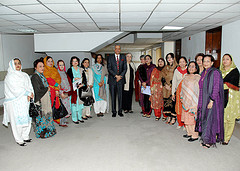
Kamalesh Sharma on a visit to Pakistan by ComSec
I've been learning some new terminology related to the Commonwealth, the first one being the Commonwealth Family.  As I understand it, this refers to a range of organisations that promote co-operation between Commonwealth countries, not just in terms of trade, but also in the fields of education, law, sport, diplomacy etc.  One the most famous members of the Commonwealth Family is the Commonwealth Games, a sporting event modelled on the Olympics.  The next Commonwealth Games will take place in Glasgow in 2014. 

Queen Elizabeth II is recognised as the symbolic head of the Commonwealth and, originally, the Commonwealth (quite ironically) excluded member nations that were republics.  This all changed when India became a republic in 1950.  Nowadays, the majority of the Commonwealth's 54 nations are republics and only 16 of the Commonwealth's countries also have the Queen as their Head of State.  These 16 countries, which included Barbados, as well as countries like Australia, Canada and the UK, are known as Commonwealth Realms.

As Commonwealth countries don't see each other as foreign nations, they don't have embassies or ambassadors in each others countries, but instead have High Commissions and High Commissioners.  It's playing with words, perhaps, but I'm sure the words carry some kind of legal import. 

Commonwealth HQ in London by ComSec
Ireland in the Commonwealth?

Over the years several nations, like Pakistan and Nigeria, have been suspended from the Commonwealth, usually because of political troubles or human rights violations.  Fiji is currently suspended from the Commonwealth and I'm sure most people will be aware of the tension between South Africa and other Commonwealth nations during the Apartheid period.  Other countries, like Zimbabwe, have chosen to leave the Commonwealth.  Even more countries, like Algeria, the Sudans and Yemen are currently applying for membership.

Ireland became a republic in 1949, before Indian independence changed the status of republics in the Commonwealth. This act was enough to sever Ireland's relationship with (what was then), the British Commonwealth.  I think Ireland's refusal to recognise the British monarch as head of the Commonwealth probably had a lot to do with it as well.  I can't help but wonder whether or not Ireland has missed out on a great opportunity for international collaboration and trade.  I'm sure we've managed to maintain good relations with many of the Commonwealth nations, in any case, but I wonder if the 21st century Commonwealth of Nations would be a much friendlier organisation for Ireland to be a part of? 

La Francophonie

As part of my research, I was also surprised to find that there is a French version of the Commonwealth of Nations, called La Francophonie.  It seems to concentrate mostly on promotion of French language, but seems to have a parallel 'family' that looks at different kinds of collaboration.  Like the anglophone Commonwealth, la Francophonie also addresses issues like human rights. 

Image credits:

The flag of the Commonwealth is in the public domain and copyright-free. 

All other images have been shared on Flickr by the Commonwealth Secretariat (flickr user ComSec).  The Secretariat is the 'civil service' of the Commonwealth of Nations.  You can see more images on ComSec's photostream and you can find out more about the Commonwealth at the organisation's official website