Showing posts with label UK. Show all posts

Saturday, 29 June 2013

Jersey - Tax us if you can!

Taxation has been in the UK news a lot in recent weeks - whether in relation to the proposed clampdown on 'tax havens' or the fact that Starbucks has just paid corporation tax in the UK (to the tune of £5 million) for the first time in almost four years.  Whilst people in Jersey would hotly dispute the idea that their island is a 'tax haven', it's commonly perceived as such by taxpayers in the UK.  Jersey has long had its own system of taxation and islanders will maintain that their laws on taxation are every bit as robust, even more so, than in the UK, where many loopholes facilitate cases of tax avoidance. 

Tax evasion or avoidance?

There's a very simple difference between tax evasion and tax avoidance - evasion is illegal, ie. when you don't pay your taxes or you're involved in illegal activities such as smuggling.  Tax avoidance on the other hand is legal - any individual or company with a good accountant can figure out ways of keeping their tax bill at a minimum amount, which might include registering elements of your business in one of the world's 73 'tax havens' or simply setting up an offshore account, where you can transfer your money to a place where it won't be heavily taxed.


Why do we pay taxes in the first place?

Jersey pound note by David Holt London
Well, it's very simple - taxation is the collection of communal funds that provide the infrastructure that a society needs.  Every worker in society produces something - whether it's a more traditional scenario of a farmer growing vegetables which he will then sell in the market, or a modern scenario of a call-centre worker providing customer service via telephone or email, infrastructure (roads, telecommunications) is vital to connect the producer of goods with his/her market.  Not to mention the provision of health care, education, social welfare, defense etc. that anyone who lives in a 'civilised' society should expect to have access to.

The link between civilisation and taxation is an important one and, in the current economic climate, individual nations, such as the UK (but also the US, Germany etc) are feeling less tolerant towards individuals or companies that engage in tax non-compliance and avoid making a full contribution to the country where they live/work/use the infrastructure and resources.  After all, why should someone enjoy the benefits of a civilised society, when they don't pay for it?

Tax as a global issue

In the olden days, before globalisation, the relationship between a tax-payer and his government was a lot clearer.  Most goods were physically produced locally, therefore it was more obvious to which authority the tax-payer should pay his/her taxes.  Nowadays, with many goods being 'services' more than physical things - it's sometimes not so clear as to where the goods are produced and where they are sold.

There is no international taxation system, therefore each country (or tax-independent jurisdictions, like Jersey) is free to decide its own rates of taxation.  This is completely legal and, unless tax-independent jurisdictions deliberately use 'harmful tax competition', they aren't doing anything wrong.

Jersey - VAT and banking

Jersey coin by tigerweet
Jersey has never adopted Value Added Tax (VAT) on goods, a taxation which is common elsewhere in Europe.  This means that the price of luxury goods, in particular, is much lower than elsewhere in Europe and, therefore, those who can afford it, will buy their luxury goods in Jersey, where there is no VAT, rather than in England and France, where VAT adds around 20% to the original price.

With a population of around 97,000, Jersey has 32,000 registered companies and 46 banks - at any given time, it's estimated that there are £189 billion pounds deposited in the island's banks (around £2 million for each of Jersey's inhabitants) - even with the estimated 250 millionaires who live in Jersey, something just doesn't quite add up!  


It's clear that, with the independence of tax systems in places like Jersey and the relative ease of moving people, goods and services internationally in the 21st century, countries with higher taxes are going to lose out on vital revenue that equips the society where these goods and services might be making a profit for the individual or company who is moving their financial assets elsewhere.  In the case of Starbucks - it's easy to compare the number of coffee sales to the amount of the company's taxation - but what about less tangible products, such as the branding, advertisement or even the raw materials used to produce their goods?

International tax Watchdogs

Sailing at Mont Orgeuil by Alex Fearn
The main international watchdogs on taxation are: UNESCO, the EU, individual governments and civil society organisations.  One of these civil society organisations, the Tax Justice network has published an interesting paper called Tax us if you can which is well worth a read, in terms of the background of international tax avoidance and how this has a wider impact on the Developing World. 

UNESCO has pushed for the signing of bilateral Tax Information Exchange Agreements (TIEAs) between countries in the Developed world and those countries most often considered to be tax havens.  These agreements provide a framework for collaboration so countries can find out whether or not their citizens are avoiding paying tax by putting their money in offshore accounts.  I read an interesting article about a recent case between Norway and Jersey, where the Royal Court of Jersey has rejected an appeal on behalf of Berge Gerdt Larse, a Norwegian businessman, regarding an information request the Norwegian government has made under the TIEA signed with Jersey in 2008.  It's thought that this case could set an important precedent for the implementation of other TIEAs around the world.

International co-operation on taxation

Being branded as a tax haven could, ultimately, be bad for business and places like Jersey have been co-operating with the international community, vis-a-vis regularising the situation of international investments in the island.  The case of Starbucks in the UK shows that there is increasing pressure for companies to be 'ethical' when it comes to paying their taxes - ultimately they could lose a lot of business, if customers perceive an unacceptable level of tax injustice.  The Larse/Norwegian case shows increased transparency for wealthy individuals also and, perhaps, signals the beginning of the end of 'banking secrecy' that epitomises many of the world's banking havens.

By contrast, Switzerland, which prides itself on 'discretion' has yet to sign any TIEAs and the Swiss parliament's lower house has recently rejected proposed amendments to the country's secrecy laws, which could see Swiss banks being prosecuted by the US for aiding tax evasion.  The US is one of only two countries in the world (the other is Eritrea) which obliges its citizens to pay taxes, regardless of where they actually live. 

Image credits:

All images have been shared by flickr members, David Holt London, tigerweet and Alex Fearn - thanks to David, Sarah and Alex for sharing these images with us using the Creative Commons license. 

Monday, 17 June 2013

Jersey - what's in a name?

There is quite a contrast between Jamaica, the last place I blogged about beginning with the letter 'J', and Jersey, the place I have chosen to blog about next.  Jamaica is a parliamentary democracy with almost 3 million people - GDP per capita is around $9,000.  Jersey is a crown dependency with vestiges of feudal rule - it has a population of around 98,000 people, the GDP per capita is $57,000 (more than 6 times that of Jamaica).

One the other hand, they both have Elizabeth II as the Head of State (she's known as the 'Duke of Normandy' in Jersey and 'the Queen of Jamaica' in Jamaica), they both have a complicated history with the UK and they both have English-speaking populations.  Like Jamaica, Jersey is divided into parishes, many of which are named after saints - eg. St Ouen, St John, St Clement in Jersey and St Andrew, St Elizabeth, St Catherine in Jamaica. 

Jersey - part of the UK?

Elizabeth Castle, St Helier by paulafunnell
It might surprise many people in Britain to learn that Jersey isn't actually part of the UK.  It's a crown dependency which means that, although Elizabeth II is the Head of State and the UK has constitutional responsibilities for Jersey, it's a self-governing island and retains many rights and privileges that go back to the time of the Norman conquest of England. This also means that Jersey is not part of the European Union, although it has a special relationship with the EU. 

Likewise, it might surprise people to know that the other Channel islands are not part of the UK, nor is the Isle of Man, which is located in the Irish Sea.  Just this week, the UK Prime Minister had a special meeting with representatives of the crown dependencies, as well as British Overseas territories, such as Bermuda and the Cayman Islands, the so-called 'tax havens', to discuss a clamp-down on tax regulation in these British territories that aren't part of the UK.

Channel Islands or Îles Anglo-Normandes?

In France, the Channel Islands are called les Îles Anglo-Normandes or the 'Anglo-Norman islands', which is, perhaps, an even more accurate description of what they are, than the term 'Channel Islands' - the first thing I've learned during my research is that these islands aren't actually in the English Channel at all, but are in the Gulf of St Malo!

Okay, the Gulf of St Malo is, arguably, part of the English Channel (which, by the way, has no real meaning to the French, who call this body of water La Manche or 'the sleeve'), but the term Channel Islands is quite a political one, as it makes it sound as though they are just off the coast of Kent when, in fact, they are many miles south of England, off the coast of France.

Channel Islands around the world

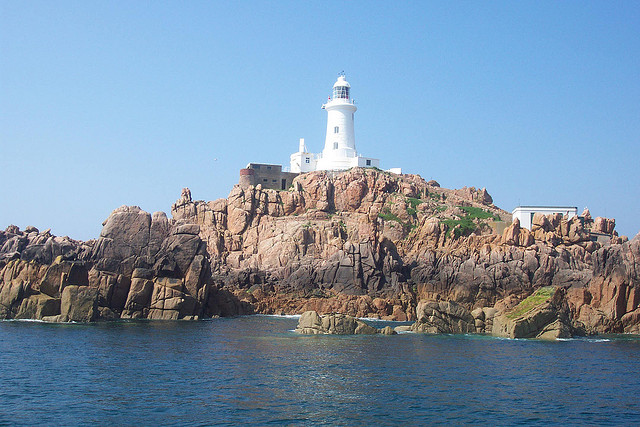
Corbiere lighthouse in Jersey by paulafunnell
Interestingly, Slavic languages have followed the French example, eg. Russian (Нормандские острова - Normandskie ostrova) and Polish (Wyspy Normandzkie) .  Most Germanic languages use the term, Channel islands - German (Kanalinseln) and Norwegian (Kanaløyane) - Latin languages often, quite diplomatically, offer two alternatives, eg. Spanish (islas del Canal or islas Anglonormandas).

In Welsh, they're, quite patriotically, known as Ynysoedd y Sianel and in Breton they are, equally patriotically, called Inizi Angl-ha-Norman.  In Irish they are known, bizarrely, as Oileáin Mhuir nIocht which means 'Islands in the (Isle of ) Wight Sea'!  The rest of the world seems to conform with the English name - eg. Thai (หมู่เกาะแชนเนล - H̄mū̀ keāa chæ nnel) and Bahasa Indonesia (Kepulauan Channel).

The meaning of Jersey

Adding to the Anglo-Norman mix is a good deal of Scandinavian!  The Channel Islands were frequently raided by Vikings, back in the day, and the three main islands Jersey, Guernsey and Alderney all have the -ey ending, which is similar to the -øy ending, meaning 'island' in modern Norwegian.  The Romans called Jersey Caesarea and I can't help but wonder whether or not the modern name of this island is a combination of Latin Caesarea and Scandinavian -ey. 

Channel Islands from Wikimedia Commons
Home from home?

Like many people who live in Britain or Ireland, I've had a very vague awareness of Jersey and the Channel Islands.  In my mind, it has been a picture not unlike the Isle of Wight or Dorset in the 1950's.  The first thing I've learned is that it's a lot more complicated than that.  The Channel Islands are only miles from the French coast and the influence of French culture means that the islands (whatever you want to call them) are a very unique blend of English, Norman, French and Viking.  Some people still speak the Norman language Jerriais on Jersey and, despite their obvious Britishness, the Channel Islands retain a strong local identity, which I'm already intrigued by.

Over the next few weeks, I intend to learn about the food, music, history and culture of Jersey - why not join me on this virtual journey and we can learn about Jersey together!


Image credits:

The map of the Channel Islands is taken from Wikimedia Commons and you can see the file information there.  

The images of Jersey are from Flickr member paulafunnell - Paula has created a whole set of photos taken in Jersey, which you can see in her photostream.  Thanks to Paula for sharing these images with us using the Creative Commons license.