Showing posts with label john wayne. Show all posts

Sunday, 18 October 2015

Solomon Islands - The Final Word

I've really enjoyed learning about the Solomon Islands over the past few months.  We haven't had the greatest summer in England this year, so it's been nice to transport myself on a virtual journey to the soft seas of the Pacific ocean!

I was starting from scratch with the Solomon Islands, to be honest, so I've learned a lot about this island nation and it intrigues me - I hope that, one day, I'll be able to visit for myself and understand the real context of everything I've been blogging about.

Summary of the themes

To summarise my virtual learning journey to the Solomon Islands, I started with a bit of history and the first European contact with the islands, during the period of Spanish exploration in the 16th century.  I also learned about the shameful 19th century tradition of blackbirding (kidnapping of Pacific islanders to work on plantations in Queensland) and the fascinating story of Jack Renton.

August saw the FINA World Championships in Kazan, Tatarstan and I took this opportunity to learn about different swimming styles and the contribution made by the Solomon Islands to the Solomons/Australian crawl!

Solomon Islands Fish and chips
In any virtual journey to the Solomon Islands you'll be sure to learn about the Pacific battles in World War Two.  The seas around the Solomon Islands are full of wrecked battle ships and submerged aircraft, as Guadalcanal became a major theatre of war between the Japanese and Allied forces.  As part of my research, I watched Terrance Malick's The Thin Red Line - a beautifully shot movie, which captures the surreal timelessness and brutality of war.

I couldn't really find a national dish from the Solomon Islands that wasn't essentially palu sami (which I've made several times before), so I created my own dish, Pacific-style fish and chips, using ingredients that would be more common in the Solomon Islands.

As usual, I did all of this with a fabulous soundtrack and I managed to find lots of great music from the Solomon Islands, including the lullaby Rorogwela which was sampled by Deep Forest in the early 1990's.

Books

I read four books as part of my research into the Solomon islands - here's the list:
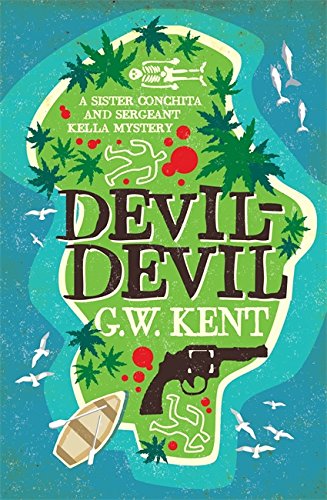
Devil-Devil by GW Kent
Lonely Planet: Solomon Islands (1997) - ed. Mark Honan and David Harcombe - although this edition is almost twenty years old, I still found it very informative and, interestingly, it's hard to find a more modern guidebook on the Solomon Islands.  I guess the rule of 'profit margins' has taken over and publishers are less keen to take on more exotic projects these days - in any case, I love reading guidebooks from the mid-90's as it coincides with the period when I started travelling and, therefore, leads me virtually down alternative paths that my life might have taken!

Solomon Time (2002) by Will Randall is one of the few travelogues based in the Solomon Islands. The story of an English school teacher who gives up his life in the UK, to set up a chicken farm in Rendova, it was an amusing read, but I can't say I learnt a lot from this book.

Devil-Devil (2011) by G.W. Kent - unfortunately, I didn't find time to blog about this wonderful book by GW Kent.  It's a detective novel set in Malaita and Honiara and I really enjoyed reading it, although I don't usually read that genre.  I loved the characters and I learnt a lot about Solomon culture as well - I'd highly recommend this series of novels!

The White Headhunter (2003) by Nigel Randell - a really informative and 'heavy' read, which I used for my blog post about blackbirding and Jack Renton.

Movies

I watched three movies in total, that were somehow connected to the Solomon Islands:

The Thin Red Line (1998) dir. Terrance Malick - see the link to my blog post on this above.

Operation Pacific (1951) dir. George Waggner and starring John Wayne and Patricia Neal - this was a more traditional war movie and, as it turns out, was set more around the Philippines than the Solomon Islands.  It was interesting to compare the approach to war movies in the 1950's, when everything was so romanticised and the late 90's, when the real horror of war was more in focus.  It's not a bad movie, as they go and very typical of that era.

Tanna (2015) dir. Bentley Dean and Martin Butler - the London Film festival is on at the moment and I've always intended to go to a showing, but somehow managed to miss this in previous years. Unfortunately, they didn't have any movies from the Solomon Islands on the programme this year, but they did have this wonderful movie from neighbouring Vanuatu, so I decided to watch it as part of my research into the Pacific region.  It's set on the island of Tanna in Vanuatu and a representative of the community in which the movie is shot came all the way to London to talk to us about his culture and traditions.  It was a truly memorable experience and it's a really beautiful movie.

I'm going to try to make a visit to the London Film festival an annual outing that coincides with whichever place I'm blogging about in future (or as close as I can get, culturally).

Other themes

As usual there were many other themes that I didn't have time to blog about, but if you're interested in continuing a learning journey about the Solomon Islands, I would suggest the following additional themes:

Diving
Headhunting
Futsal
Tattoos
Coconuts
Albinos
IATA codes
Missionaries in the Pacific
The Malaita Massacre
The shark callers of the Pacific
The Lau people
Crocodiles
DBS - Distressed British Subjects
The Chinese in the Pacific
Kastom
Te lapa - navigating with underwater lightening strikes
Quonset huts
The Marching Rule movement
The Kakamoras or pygmy people
Nguzunguzu - traditional carvings on war canoes
Pijin English
Richard Francis Burton - the British adventurer and orientalist
Evil spirits like the basana
JF Kennedy's time in the Solomon Islands
Cargo cults

Wednesday, 27 January 2010

Oklahoma - Gunfights and the Sun Dance


I've been watching Western movies this month, not all of them directly connected to Oklahoma, but still, it's an important part of American culture, a film genre that was the bain of my existence as a child - Western movies and country music are two things a child in Ireland will either learn to love or hate.

It's interesting to watch these movies now, years later, when I can grasp the concepts and the history behind them and it's been fun re-exploring a genre that I was happy to dismiss as cliched. Really, Westerns are about the human experience, man's determination to survive in a ruthless world, against the backdrop of a harsh landscape and an unforgiving moralism. The Western hero is a loner, a cowboy or renegade, living on the edge of society, unimpressed by such feminine concepts as equity and justice.

It amazes me how many sub-genres there are of Westerns - Spaghetti Westerns, Sci-Fi and Urban Westerns, from the ex-soviet world we had Osterns, more likely to depict the Indians as oppressed peoples fighting for their dignity.  We have revisionist Westerns.  We even have Brokeback Mountain :-)


I watched two movies that were quite different from each other. The first, A Man Called Horse, starring Richard Harris, later of Dumbledore fame (Harry Potter 1 & 2) who, I found out, was born in Limerick in Ireland. This was an interesting movie. Amazingly, I was a good half hour into the movie before I really noticed that most of the language on-screen was Sioux, and that there were no subtitles! Yet, I'd understood everything, without knowing the actual words the actors were using.

I guess A Man called Horse would be considered to be a revisionist Western. The White man actually becomes Indian, first as a ploy to escape the tribe that have captured him, then because he really believes in the culture he's adopted, although the ending leaves a little bit of ambiguity about this point. He marries one of the tribeswomen and undergoes the excruciating Sun Dance initiation. It's certainly very different than your average Western, but I still felt as though something wasn't quite right. The depiction of the Indian tribes seemed too black and white somehow.

The second movie was a Western of epic proportions, Gunfight at the OK Corral, based on actual events in Tombstone, Arizona. I absolutely loved this movie, which surprised me. It was the triumph of good over evil, law over banditry. The 'relationship' between Wyatt Earp (played by Burt Lancaster) and Doc Holliday (played by Kirk Douglas) was fascinating in that shy and bumbling 'I love you' kind of way that 'real' men have of expressing themselves. I've read a bit about Burt Lancaster and he seems to have been one of the good guys: a champion for gay rights, a left-winger and a very versatile actor, a total contrast to that other great 'hero' of the Westerns, John Wayne.

This was a movie about the clash of civilisation with the anarchy of the Wild West, I guess, the clash of long-established American values with the hastily organised society of the frontier. I'm glad the good guys won in the end. I'm a natural optimist and this also seems to be a national trait of Americans.  Perhaps the American dream is not so much a dream = fantasy, as an dream = aspiration?

Image credits

The photo of the cactus is from flickruser Fritz Liess and shows a cactus at the Desert Botanical Garden in Arizona.