Showing posts with label pork. Show all posts

Sunday, 29 December 2013

Maharashtra - Vegetarianation

In recent blog posts, I've been using a technique that I call the 'Google instant' test, to find out which questions are most asked on the Internet, in relation to the place that I'm blogging about.  It's quite good fun and very interesting, if you try it - just type in something like 'Do Indians . . . Is China . . . Are British people . . .' and you might be surprised by some of the questions that are commonly asked by people all around the world.

I've not done the Google Instant test on any Indian state before - so I thought I would broaden the scope a bit beyond my current topic, Maharashtra.  In the interests of easy-reading, I've limited it to one question only, which means, of course, that I've selected the question that I think is most interesting, i.e. 


Do Indians eat meat?

Pork tenderloin
As evidenced by previous blog posts (see Korea - the Google Instant Test) - we are a bit obsessed about what people in other countries eat.  There is a lot of anxiety around 'foreign food' - at least, in the English-speaking world - I haven't yet tried the Google Instant test in another language, so I'm not sure if it's just English-speakers who are obsessed with the things people eat, or if this is a worldwide phenomenon.

It's quite an interesting question, in relation to India, as Indian's do have a different approach to diet, especially when talking about meat consumption, than other parts of the world.  The main religions of India - Hinduism, Islam, Sikhism, Jainism and Buddhism - all have restrictions in terms of eating meat.  Pork and beef, in particular, are off the menu for many Indians, because of their religious beliefs.

It's estimated that almost a third of Indians (around 400 million people) are wholly vegetarian.  To be honest, if I lived in India, I think I would be vegetarian too.  The vegetarian food I ate in India was much tastier than any of the meat dishes I tried (especially in South India) - the meat tended to be stringy and full of bones, so I stopped eating meat after the first few days.

Goat meat is popular across Africa
I found an interesting report on The Guardian's website, which compares meat consumption across the globe.  India has one of the lowest levels of meat consumption in the world - an average of 4.4 kilos per person. 'Western' countries tend to be the biggest meat consumers per capita - if you compare India, for example, with the United States (120 kilos per person - almost 30 times the Indian average) or the UK (84 kilos per person - almost 20 times the Indian average).

I was also quite interested in meat consumption in China (58 kilos per person), as China is, potentially, the world's largest market for meat.  India's neighbours also tend to have low consumption, if we compare India with Sri Lanka (6.3 kilos) and Pakistan (14.7 kilos).  Being a Muslim nation (as Pakistan is) doesn't necessarily mean lower meat consumption and I looked at the statistics for Saudi Arabia (54 kilos per person), which is almost as much as China.

Finally, I looked at Liberia (10.4 kilos), as I have recently blogged about this country and I wanted to see what meat consumption is like in Africa.  Meat consumption tends to be low in Africa, not because of religious reasons, but because of the high price of meat compared to local wages. 

Interestingly, the Guardian report compares meat consumption with CO2 emissions and cancer rates, which are correspondingly higher in meat-eating countries and the prevalence of cardiovascular disease and diabetes, which is higher in non-meat-eating countries. Of course, this might not be down to meat consumption, as there is an obvious 'developed/developing' nation divide within these statistics. 

Perhaps the most interesting thing of all is to compare meat consumption today (2013) with the meat consumption rates in the past (1969).  Looked at this way, we can see a marginal increase in countries like the USA and UK, of around 15%.  India and Sri Lanka have seen higher increases in meat consumption than 'Western' countries, about 20% in India and 40% in Sri Lanka, whereas Pakistan has almost doubled its level of meat consumption in that 40 year period.

How sustainable is a world of meat-eaters?
Both China and Saudi Arabia have had massive increases in meat consumption, with a 400% increase in Saudi Arabia and a 500% increase in China!

The rate of meat consumption in Liberia hasn't changed that much in 40 years, although it's actually gone down from a higher level of meat consumption (11.7 kilos) in 1989 which, no doubt, reflects an intervening period of civil war and political instability.

If the rate of meat consumption was to increase massively in India, as it has done in China, I wonder what impact that would have on the world's consumption of meat?  Higher demand would most definitely push up the prices.  I'm not a vegetarian and have no real wish to give up eating meat - however, I do think it would be better if we all cut down on the amount of meat we're eating - particularly in the so-called 'developed' world.  As we're finishing our leftover turkey and ham from our Christmas dinners, it might be worth bearing in mind the sustainability of our livestock/poultry/fish populations in a world full of meat-eaters!

Image credits:

I eat meat regularly, so I thought I would use my own images of meat to illustrate this blog post.  Please feel free to re-use these, under the Creative commons license:

- Attribution (particularly to this blog post)
- Share alike
- Non-commercial

Sunday, 5 May 2013

Indiana - How I made Pork Tenderloin sandwich

After some research online, I quickly came to the conclusion that Indiana's most traditional dish is 'Pork tenderloin sandwich'.  I find it interesting that some of the main foods that we consider to be typical for the USA, have their origins in Germany.  I'm mostly thinking of the ubiquitous hamburger (from Hamburg), but also of frankfurters (from Frankfurt).  Indiana Pork tenderloin sandwich is pretty much a burger and chips and a variation of the European dish Wiener Schnitzel

I've made Schnitzels before, so Pork Tenderloin sandwich was quite straight forward and familiar to me.  I couldn't find a perfect recipe, as there seems to be some variation in how the version from Indiana is made - I mostly got my inspiration from the following recipe and then improvised.  I didn't want to oven bake the tenderloin, as I didn't have time and I also didn't want to deep-fat fry it, as this is really unhealthy, so I just pan fried it.  Finally, I used pork loin chops, not tenderloin, so traditionalists should stop reading now!

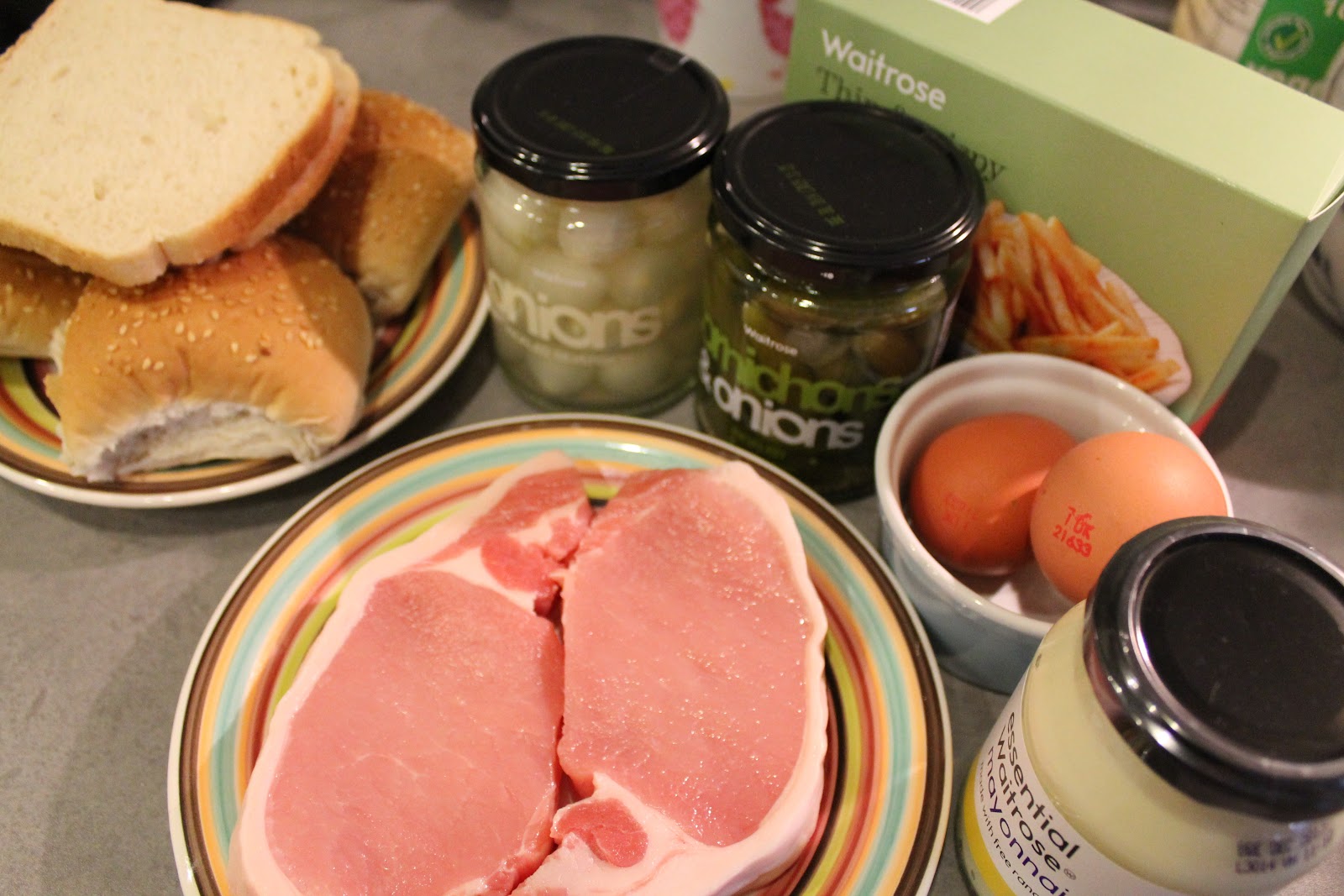
The ingredients

The main ingredients
300g Pork tenderloin (or loin chops, depending on how fast you want to cook!)
4 burger baps
2 pieces of stale bread, to make breadcrumbs
2 eggs
Half a cup of milk
Half a jar of pickled onions
Half a jar of cornichons (or gherkins)
Three healthy dollops of mayonnaise
A box of oven-bake french fries
Garlic salt
Oregano

How I made Pork Tenderloin sandwich

First you should use a food processor to make the breadcrumbs - it's important that the bread is fairly stale, as this creates better crumbs for the 'breading' of the pork.  Of course, you can buy ready-made breadcrumbs, but I find it easier to make my own. 


Use a food processor to make breadcrumbs
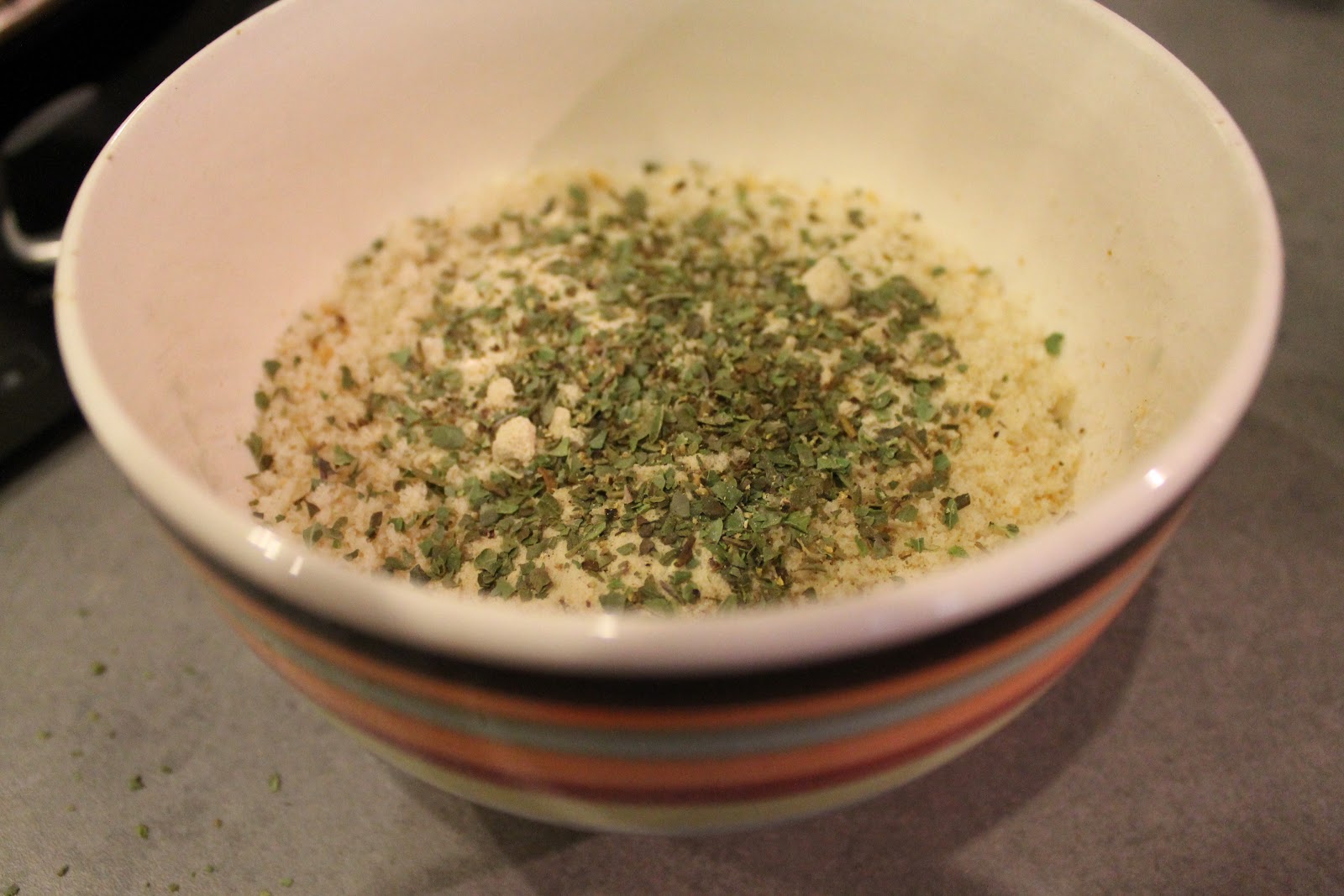
Breadcrumbs

The recipe I looked at recommended adding Garlic salt and oregano to the breadcrumbs, which I think were a really nice addition to the taste of this dish, although I doubt that either of these ingredients is very traditional for the Indiana version!  I also added ground black pepper, but I omitted the salt, as I'm trying to keep down my salt intake. 

Add Garlic salt and Oregano to the breadcrumbs for a non-traditional twist


In a separate bowl, I whisked the two eggs together and then added milk to create a sticky liquid which helped the breadcrumbs stick to the pork pieces. 

Whisk the eggs
Egg/milk and crumbs for 'breading' the pork

If you're using loin chops, as I did, you will need to take the fat off, then cut each chop in half lengthwise and then cut each length into two thinner slices.  The real trick to making tenderloin, or any kind of Schnitzel, is that you need to tenderise the meat and flatten it out into thin slices.  I don't yet have a meat tenderiser, so I used a rolling pin instead.  It's a good idea to cover the pieces of pork in cling film, before you tenderise them. 

Pork chop cut into four thinner slices
Ready to be bashed - sorry, tenderised - by a rolling pin!
The slices of pork after they have been tenderised

The result was a plate full of thin pork slices.


I then dipped the pork slices in the egg/milk mixture and in the breadcrumb mix, then fried them over a high heat.

Add the pork pieces after dipping them in the egg/milk mixture and breadcrumb mix

Fry the pieces until the pork has cooked through


You can choose whichever condiments you like for this dish - my preferences were pickled onions, cornichons and mayonnaise.  If Pulp Fiction is anything to go by, then it's clear that people in the US prefer ketchup on their fries, just like in the UK and unlike Belgium/Germany/France where people use mayonnaise.  I'm not sure why I opted for mayonnaise, but it seemed to fit better with the dish and I enjoyed dipping my chips/fries in the mayo and smearing it over the fried pork. 

Pork tenderloin sandwich with fries
I guess it's a matter of taste.  I found an interesting blog post about the use of ketchup and mayonnaise, which you might also find interesting. 

The finished dish with a selection of condiments
Anyway, the result was delicious - an easy dish to make and one you should definitely try for yourself. 

Image credits:

All photos were taken by me, please feel free to reuse, under the Creative Commons license:

Attribution (especially to this blog post)
Share alike
Non-commercial