Saturday, 24 August 2013

Korea - Something to Envy?

I've just finished reading Barbara Demick's book Nothing to Envy: Real Lives in North Korea (2010).  It's a fascinating read and I feel that this book has given me a real insight into what has happened on the Korean peninsula, especially North Korea, in the past 60 years.  I'm also left wondering, as so many have been left wondering before me, how the North Korean regime has managed to hold on to power for so long?

I wanted to share three things I learned from Demick's book, that I think are important or resonate with places I've blogged about in the past.

1. The Famine

View from the Juche Tower by Marcelo Druck
I'd normally consider myself to be quite well up on world affairs but, somehow, I seem to have completely missed the fact that there was a major famine in North Korea, between 1994 and 1998.  True, it was a time in my life when I was bit disengaged from the bigger picture, mostly concentrating on my final exams at university and my first attempts at travelling and living abroad. 

Or perhaps I'm not the only one who missed this?  Perhaps it wasn't really known in the West at the time, due to the secrecy surround the hermitic People's Democratic Republic?  It's estimated that anything up to 3.5 million people died during the Famine (Demick puts the figure between 600,000 and 2 million) and I find it astounding that this could happen, in the closing decade of the 20th century, in a country surrounded by some of the most prosperous nations on Earth!

2. The North Korean Army

Portraits of Kim Il-sung and Kim Jong-Il by Marcelo Druck
I also learned that North Korea, which has a similar population to Ghana and less than half the population of the UK, has the fourth largest army in the world!  There are 1.1 million people actively serving in the Korean People's Army, out of a total population of around 25 million people.  Unbelievably, North Korea has a larger army than Russia and is only surpassed in size by the new Superpowers; China, the United States and India. 

If you also count reserves and paramilitary forces, then North Korea has the biggest army in the world, almost 9.5 million people!  Perhaps this explains why the regime has stayed in power for so long?  Demick also explains North Korea's Songun or military-first policy, which prioritises the People's Army, in terms of resources and food supplies.  It has to be said that South Korea is also an incredibly militarised society, for its size.  With a population similar to England, South Korea's army is three times the size of the British army.

3. Mongolia's soft spot for religious dissenters?

Juche Tower by Marcelo Druck
Much of Demick's research is backed up by real-life stories of North Koreans who defected to South Korea and I found it interesting to read about the Mongolian route to South Korea.  The only way out of North Korea is across the northern border to China - those who can afford it organise fake passports that will get them on flights from Harbin and Beijing to Seoul.  For those with limited resources, fleeing to Mongolia is the best, albeit, more perilous option.

I noticed that the stories about defectors via Mongolia seemed to mostly involve North Koreans who were practising, or claiming to practise Christianity and it reminded me of my previous blogging about Mongolia, when I learned about the 'loss of religion' in Mongolia and how this has impacted on the national psyche.  Perhaps the Mongolians have something of a soft spot for the religious refugees fleeing North Korea?

Nothing to Envy

The title of Demick's book is from a popular slogan used by the establishment in North Korea.  She uses this slogan ironically - it should mean 'North Korea has nothing to envy in the rest of the world', but it could also mean 'The rest of the world has nothing to envy in North Korea' - also the fact that 'envy' is suggested at all, reveals that it's probably the greatest fear that the North Korean regime has - ie. that it's people will finally succumb to the temptations of the decadent capitalist world around them. 

I've just started reading another great book - The Impossible State: North Korea, Past and Future (2013) by Victor Cha and he also makes a reference to this slogan.  I'm not sure if I'll have time to finish Cha's book, before my month (or so) with Korea runs out, which is a pity, as I'm already getting quite involved in his interpretation of recent events. 

Who knows what the future holds for Korea - every political analyst and commenter seems to have underestimated the power of the North Korean state and we've been led to believe that the People's Democratic Republic could fall any day now, except it never does!

Image credits:

For this blog post, I wanted to highlight the photography of flickr member mardruck - aka Marcelo Druck.  Marcelo has taken some really beautiful photos in Korea and North East Asia - these photos are from the set Pyongyang - thanks Marcelo for sharing these images with us, using the Creative Commons License. 

Saturday, 17 August 2013

Korea - How I made Naengmyun - 냉면

In my search for a traditional Korean dish, I stumbled upon a really great cookbook The Food and Cooking of Japan and Korea (2010) by Emi Kazuko and Young Jin-Song.  Not only does it have lots of great recipes, well-described with plenty of pictures (which all good recipe books should have!) - but they also provide a narrative explanation and background to Japanese and Korean cooking and what you can expect to find in Japanese and Korean kitchens. 

Finding myself spoilt for choice, I decided to steer away from Korean dishes, like Bulgogi, that might be more familiar to the European palate - instead I chose a less familiar dish Naengmyun.  Perfect for hot summer weather -  it translates as 'cold noodles'

The Ingredients

The ingredients
350g of beef - 쇠고기 (saegogi) - the recipe said 90g, but I didn't think this would be enough
1 onion - 양파 (yangpa)
1/4 white radish/mooli - 무 (mu)
1/2 cucumber - 오이 (oi)
1 leek - 리크 (likeu)
1 Asian pear - 배나무 (baenamu) - unfortunately, I couldn't find an Asian pear, so I substituted with a European pear - 서양배 (seoyangbae)
Fresh ginger - 생강 (saeng-gang)
4 cloves of garlic - 마늘 (maneul)
Buckwheat noodles - 소바 (soba)
Shaoxing rice wine - 사오싱주 (saosingju)
Mustard - 머스터드 (meoseuteodeu)
1 egg - 달걀 (dalgyal)
salt - 소금 (sogeum)
sugar - 설탕 (seoltang)

How I made Naengmyun - 냉면

I started by boiling a large pot of water, then added the beef which I had cut into strips.  The recipe recommended boiling a whole flank of beef and cutting it into strips later, but I thought this method would be more effective and less messy!

Bring a pot of water to the boil and add the beef strips
It's important to scoop away the beefy froth that forms on top of the boiling water, before reducing the heat to let the beef boil for about an hour. 

Remove the beefy froth that forms on top of the boiling water
Whilst the beef was boiling I prepared other elements of the dish.  Something I've noticed about North East Asian cooking is that it mostly involves preparing lots of little bits and pieces of dishes, which are later combined by the diner to create a full meal.  Naengmyun was no exception. 

First I prepared the white radish - by cutting off 1/4 of the vegetable - peeling it and chopping it into small bite-size sticks.  It was my first time to prepare white radish and I really like the taste and crunchy texture of it.  I coated the radish sticks in sugar, salt and rice wine.  I then prepared the cucumber and pear in a similar way and put all three in the fridge to be served later.

White radish, called Mooli in Hindi

Chop the white radish into bite-size sticks

Prepare the cucumber by de-seeding

Also take the core out of the pear

Cucumber and pear sticks ready for chilling!

Next I prepared the noodles - boiling them in water for about two minutes, before draining them until the water ran clear.  I also put them in a bowl in the fridge for later. 

Boil the buckwheat noodles (soba) for about two minutes

After simmering the beef for 45 minutes, I prepared the vegetables that would go with it, to make the broth.  This involved washing and chopping the leek, cutting the onion, garlic and ginger root into small pieces.  Once the beef had simmered for about an hour, I added the vegetables, brought the whole lot to the boil and then simmered again for another twenty minutes.

Prepare the leek, onion, ginger and garlic

Add the vegetables to the pot and simmer for a further 20 minutes

My final touch was to prepare a saucer and ramekin with the condiments; salt, sugar, rice wine and ginger - to be added to the soup at the very end.  I also hard-boiled an egg and put this in the fridge to chill. 

The condiments: sugar, salt, mustard and Shaoxing rice wine

When the beef and vegetables had fully cooked, I strained the broth into a container - put the meat and vegetables in another container and put the whole lot in the fridge to chill.

Beef and vegetable broth

Chill the beef and vegetables in the fridge

Naengmyun is best served cold, on a hot summer's day.  It's a bit weird, from a European perspective, to eat cold soup, but I wanted to do it proper Korean-style! 

Naengmyun

Close-up with Hite beer

After chilling all the ingredients, I set the table - then invited my partner to make his dinner by adding the cold broth, noodles, meat and vegetables, radish, cucumber and pear sticks, egg and condiments.  Oh - and not forgetting a cold Hite beer!

Buying Korean food in London

Although I couldn't find Asian pear, I managed to find all of the other ingredients for this dish by taking a trip to Burlington Road in New Malden, Kingston-upon-Thames - the heart of London's Korean community. 

As well as buying the ingredients for Naengmyun, I also bought some ready-made Kimchi (김치 ) and some Soju (소주), just to taste!

Kimchi and Soju

Image credits:

All photos were taken by me, please feel free to reuse, under the Creative Commons license:

Attribution (especially to this blog post)
Share alike
Non-commercial  
 

Saturday, 10 August 2013

Korea - the Google Instant test

I want to introduce a new feature to my blog this month.  It's something I find quite fascinating, as I've been researching different world cultures for this blog: I'm calling it the Google Instant test.

Since Google introduced Google Instant in 2010, you may have noticed that, when you start typing something in the Google search field, a drop down list of suggested topics appears and changes 'instantly' as you're typing.

The intention is to save users time and, I'm assuming, the suggestions are based on the most googled topics.  Try typing - Are Germans . . . or Do French people . . . or Is China . . . into Google's search engine and the resulting most-frequently-googled questions are often quite amusing, occasionally sad or even shocking!  Some of the questions people ask make me wonder about the future of the human race!  Others are incredibly revealing, honest or relevant - depending on what you think the motivation for asking might be.

Here's what I found when I started asking questions about Korea:

Is Korea going to bomb us?

With variations - eg. Is Korea going to bomb UK? and Is Korea going to bomb America?  Of course, my Google Instant test is English-language based and, undoubtedly, the questions reflect the obsessions of English-language speakers, or those who use the English as their main access-language for the Internet.   

It's quite a sad question really and reflects the genuine anxiety that is out there about Korea - presumably, North Korea and the fear that Pyongyang is stacked high with nuclear weapons, ready to bring down Western civilisation! 

I'm no expert, but I very much doubt that 'Korea' is going to bomb us.  Despite the occasional media-frenzy about countries in the Axis of Evil - as far as I understand it,

North Korea is an incredibly impoverished nation whose government rattles the sabres of war every now and then but, realistically, doesn't have the ability to seriously threaten either the US or Britain.  That doesn't mean that the situation in North Korea isn't worrying, but it's always good to keep things in perspective and see through the politically-motivated hyperbole.

Do Koreans eat dogs?

Dog on Cable Beach by Me
Well, I guess the answer is yes.  From what I've read, Koreans - particularly Korean men - do occasionally eat dog.  Not pet dogs, but a special kind of dog, Poongsan, whose meat is called Gaegogi and is prepared in a special soup called bosintang - which means 'body nourishing soup'. 

As far as I can tell, it's not an incredibly common practice and the consumption of dog meat is restricted to certain traditions and often hidden from foreign visitors.  It's interesting how obsessed we are (at least, we in the West) about other people's eating habits - I touched on this in a previous blog post about allegations of cannibalism in the South Pacific.  

Do Koreans eat cats?

I very much doubt that this is true, although Koreans may have eaten cats in the past.  Again, I think this obsession with what Koreans eat reveals more about us in the 'West' than it does about Koreans!  Eating cats seems to be particularly taboo to me and I was surprised to see this question appearing, whereas I could have predicted the dog-eating question.  I did come across stories of cat-eating, very recently, when I was researching for my blog post about Jersey during the Nazi occupation

Do Koreans use chopsticks?

Yes, they do and I've read that the tradition in Korea is to use metallic chopsticks, rather than the wooden (or plastic) ones that people use in China and Japan.  Of course, Koreans share a lot of cultural traditions with both China and Japan, but they have a slightly different tradition in Korea, where they use chopsticks and a spoon to eat their meals.  The spoon is used for eating rice.

Are Koreans Chinese?

Korean dancer by Brendan Lally
I found this question a bit strange - Koreans are obviously not Chinese, but I guess I can understand why people would ask, especially coming from a society which is remote from East Asia - it's a bit like saying Are Scottish people English?  Koreans share a lot of their culture with China, especially Manchuria, but they have managed to maintain an independent culture, language and, perhaps, outlook on the world.

After the partition of Korea, North Korea was particularly close to China and received a lot of support from its fellow-Communist neighbour.  China established diplomatic relations with South Korea in the early 1990's and, economically at least, it would seem as though China and South Korea are getting along just fine. 

Do Koreans have middle names?

Korean naming traditions are very interesting and I can understand why this question is so popular as it does indeed look as though all Koreans have a middle name.  Koreans tends to put their family name first (opposite to the Western tradition) - the most common family names being Kim, Lee and Park.  Interestingly, most people share one syllable of their first name with their siblings, although this doesn't seem to be a hard a fast rule.

For example, Ban Ki-Moon, the Secretary-General of the UN, has three children; two girls, Ban Seon-Yong and Ban Hyun-hee and one son, Ban Woo-hyun - one daughter and son share a common syllable hyun.  It's also interesting that Ban Ki-Moon's wife is called Yoo Soon-taek - Korean women don't give up their birth name when they get married.

Do Koreans have eyelashes?

Detail of Hong Sung Chul's 'Eye' by robpatrick
I found this question to be extremely bizarre!  Why wouldn't Koreans have eyelashes?  It's also worrying that this question is the second most popular in the Do Koreans have . . category. 

From what little I know about Koreans - at least, South Koreans - they have a strong sense of aesthetic and, like many people in East Asia, they spend a lot of money on cosmetics, skin-whiteners and fashion.  Seoul has it's own fashion week and Korean designers, such as Andre Kim and Doo-Ri Chung, are known the world over.

These are just a few of the 'top' questions about Korea - I'm very aware that there are other search engines out there apart from Google and other languages apart from English but, still, I think the results are fairly revealing and an interesting filter which shows Western 'understanding' or obsessions about Korean culture.   

Image credits:

The image of the dog was taken by me on Cable Beach, Broome, Western Australia.  

The image of the dancer is by Dance photographer - Brendan Lally - you can see more of Brendan's images on his photostream

The close-up of Hong Song Chul's art work was taken by Flickr member robpatrick

Thanks to Brendan and Rob for sharing these images with us, using the Creative Commons license.  

Saturday, 27 July 2013

Korea - a Tale of Two Nations

Taking on Korea is quite a challenge - with a combined population of around 74 million and a land area slightly smaller than that of the UK, both the Democratic People's Republic of Korea (North Korea) and the Republic of Korea (South Korea) offer a rich tapestry of culture, music, movies and literature, which will be hard to capture in a small number of blog posts.  I see this as my starting point with the Koreas and I may come back to either country in more detail at a later date.

I also feel that it's important to look at both Koreas, in this first virtual journey around Korean culture.  Perhaps South Korea is much more familiar to us, because of links with the US and the West?  North Korea seems distant and remote - an experience which lies outside the realms of Western imagination - but a place that is fascinating, nonetheless.

Koreans in Uzbekistan and Ireland

My experience of Korea comes mostly through the many Uzbeks and Tajik families, who saw their fathers and older brothers heading off to Seoul and Pusan, to earn money which they would send back home to Uzbekistan.  Their experience of Korea sounded pretty harsh to me - uncomfortable living conditions and relentless work in a society where they are, on the whole, regarded with suspicion.

In an ironic reversal of history, I also met my first Koreans in Uzbekistan, Russian-speaking descendants of Korean peasants who were moved away from the Russian border with Korea, so it could be populated by white Europeans.  I also briefly taught two Korean students during a summer I spent in Dublin - they were incredibly polite, deferential and diligent.

Korea in the shadows

I find Korea interesting as a place that has lived in the shadow of its two, more powerful, neighbours - Japan and China.  As I've started researching Korean history, I can see that it is dominated by Korea's relationship with these two neighbours and, more recently, with other big countries, such as Russia and the United States.  Through it all, the Koreans have remained independent, proud of their language, culture and heritage although, sadly, still divided by the political manoeuvring which took place at the end of World War 2.

A tale of two nations?

Korean reunification flag
I also want to blog about both Koreas, as it feels natural to think of Korea as a whole or single nation.  Of course, the reality of 60 years of separation means that the two Koreas which were created in 1948 have followed different paths and really started developing their own distinct histories and cultures.

It's hard to undo the sense of 'difference' which is created when a country splits in two and I wonder if, one day, Korea will reunite, like Vietnam, Yemen and Germany - or whether the years of separation will reinforce the countries' distinct identities, as it has done in my own country, Ireland?


However you feel about Korea, I hope you'll join me over the next few weeks, as I read books about Korea, listen to Korean music, cook Korean food and watch Korean movies!

Saturday, 20 July 2013

Jersey - the Final Word

I've tried to be 'tight' with my timing on Jersey and it really feels as though I've merely scratched the surface in terms of my research into life on the island.  My blog posts can only capture a fraction of my learning experience and this 'final word' is an attempt to summarise the learning journey I've been on for the past month or so.

A summary of the themes

During my research on Jersey, I learned about Jersey's legal status - not part of the UK, but being closely linked culturally and politically.  I also learned about Jèrriais, the native language of the island, now considered to be severely endangered.  I learned about Jersey's reputation as a tax haven and I learned about the Occupation of the Channel Islands by the Nazis, during World War Two.  Finally, I learned how to make Bean Crock or Pais au Fou and Jersey Wonders, traditional recipes from the island. 

Tools for Research

I read the following books:

Tools for research in the afternoon light
Insight Guides: Channel Islands (2007 reprint, editor Brian Bell), which was useful for background research on topic areas.

Living with the Enemy (2002 reprint) by Roy McLoughlin - a useful overview of life in the Channel Islands under Nazi rule.

I also read Night of the Fox (1986) by Jack Higgins, the well-known author who has made Jersey his home.  It was an interesting novel and not the kind I would normally read, but I enjoyed it.  Perhaps most interesting was how a standard plot was turned on its head - somehow the 'good guys' seemed to be the deceptive ones and the ones who made the confession at the end - except it all turned out in their favour, whereas, normally the confession scene happens just before the bad guys get caught!

Finally, I read This is how you disappear (2007), a book of poetry by Jersey-born Jeremy Reed - but more about that later . .

Apart from The Others (2001) dir. Alejandro Amenábar and starring Nicole Kidman, there don't seem to have been many movies set in Jersey.

Nevertheless, I had great fun watching the very first series of Bergerac, the 80's detective show, which brought the island to British TV screens.  It's a bit dated now, of course, but I enjoyed John Nettles' performances and was surprised to learn that his birth-mother was Irish, although he was brought up by adoptive parents.

It was great to see the island on film and funny to think of the image Bergerac portrayed of Jersey, as a hive of international espionage, drugs, homosexuality, inheritance disputes and Korean war veterans!  I didn't watch the TV series when it was aired, back in the day, so it was all new to me and the kind of experience I would have completely missed, if it weren't for this blog!

I also loved the theme music - reggae meets French accordion - it's very catchy!

Unfortunately, other musical experiences were thin on the ground, but luckily the island's reputation has been saved by the wonderful Nerina Pallot who was nominated for the award of British Female Solo Artist at the Brits in 2007.  I particularly liked the song Patience, which is from her debut album, Dear Frustrated Superstar (2001) - I'm pasting in a clip from YouTube below, so you can hear for yourself.


Other Themes

As usual, I couldn't cover all of the themes I would have liked to, in such a short space of time, so here is a suggested list of additional Jersey themes which you can explore in your own free time;

Sleeves and Knitwear
Potatoes
Witchcraft
The Battle of the Flowers
The Jersey National Trust
Dutch Elm disease
Limpets
The St Ouen Wreckers
Lily Langtry, the Jersey Lily
William Prynne
Durrell and conservation
Smuggling
The Chausey islands
Salvage Rights
The Channel Islands on the Vinland map
The Clameur de Haro
The Beast of Jersey
Conway's Jersey Temple in Henley-upon-Thames

Dinner Party trivia

And here are some tidbits of information about Jersey, that will no doubt impress your fellow guests at upcoming dinner parties:

Jersey folk are nicknamed crapauds - the French word for toad - especially by their traditional rivals in Guernsey

The combined population of the Channel Islands is 160,000 people - an estimated 100,000 people live on Jersey

St Helier has over 50 international banks

John Copley's Death of Major Peirson (1793)
Jersey's most famous painting is John Copley's Death of Major Peirson (1793) - which depicts the 'Battle of Jersey' when locals defended the island from a French invasion

New Jersey in the United States was land given to Sir George Carteret, Governor of Jersey by Charles II, in recognition of his (and the island's) support of the Royalist cause

Whilst Jersey supported the Royalists in the Civil War, Guernsey supported the Parliamentarians

The Channel Islands were famous for their knitwear, hence the use of the word Jersey to mean jumper or sweater - I suspect that the Irish word for sweater, which is geansaí, comes from trade and contact with neighbouring Guernsey

There was a thriving illegal tobacco trade between Jersey and Devon in the 17th century

The first Red Pillar Post Boxes, those famous icons of London and England, were erected in Jersey in 1852

The differences in wildlife distribution between the Channel Islands is inexplicably large, eg. there are no magpies on Alderney and Jersey is the only island to have moles

Jersey was known as the Isle of Congers (eels) during the Middle Ages

Jersey has 350 miles of road

St Helier, the capital of Jersey, was named after a Belgian monk

There is an Irish community in St Helier which dates back to Napoleonic times

When Lord Carrington heard that the Jersey-born actress Lily Langtry had lost her parrot, he famously quipped 'I didn't know she had a parrot, but I'd heard she had a cockatoo'

Jesse Boot, the founder of Boots chemist's, married a woman from Jersey and is buried on the island

The Final word on Elegies

I want finish with a bit of poetry by one of Jersey's most famous literary sons, Jeremy Reed.  I don't often read poetry, as part of my research for this blog, so it was a pleasure to spend time reading This is how you disappear - Reed's book of elegiac poems from 2007. 

The collection reads like a who's who of London's gay artists, musicians, film directors and surrealists poets, many of whom were close friends of Reed's, some of whom died during the AIDS epidemic of the 80's and 90's.  Of course, I was already familiar with some of the people Reed writes about, like Derek Jarman, whose work I really love and Dusty Springfield whose music has been enjoyed by many of us.

I was much less familiar with some of the other people that Reed has written Elegies for - for example, the surrealist poet David Gascoyne, the US lyric poet John Wieners and the experimental musician John Balance.  It's a beautiful collection and my first taste, not only of the surrealist movement, but also of a gay London world that might otherwise be lost in the fog of memory.

I'm going to leave you with an excerpt of Reed's Elegy for John Balance and a YouTube video of Coil's At the Heart of it All.


'As you were carried off alone
in a black carriage led by a black horse
along a puddled drive to disappear
at the third bend - a stand of trees
commanding view and winter clouds
big on us, like they'd never clear'

Image credits:

The photo of my research tools was taken by me.

John Copley's Death of Major Peirson is in the public domain and, therefore, copyright-free. 

Sunday, 14 July 2013

Jersey - How I made Pais au Fou and Jersey Wonders

Jersey is quite well known for its food - especially Jersey Royal potatoes - but also its cream, butter and other produce that appear in English markets quite early in the season.  A quick bit of research led me to the conclusion that the most traditional Jersey dish I could make would be Bean Crock, known as Pais au Fou in Jèrriais (literally peas in the oven), a dish that reminded me a lot of a French cassoulet or bean stew.

To be honest, it was quite an easy dish to make - the only unusual thing about it being the fact that I had to keep it in the oven for 5 hours - a terribly long time to cook anything in our fast-paced 21st century world!  I looked at several different recipes for this dish, but was mostly influenced by this one - I added carrot to the recipe, otherwise it might have been a bit too bland. 

Ingredients for Pais au Fou - Jersey Bean Crock
The ingredients

250g White haricot beans
250g mixed beans
2 onions
2 carrots
5 bay leaves
Black pepper
500g pork belly

How I made Pais au Fou

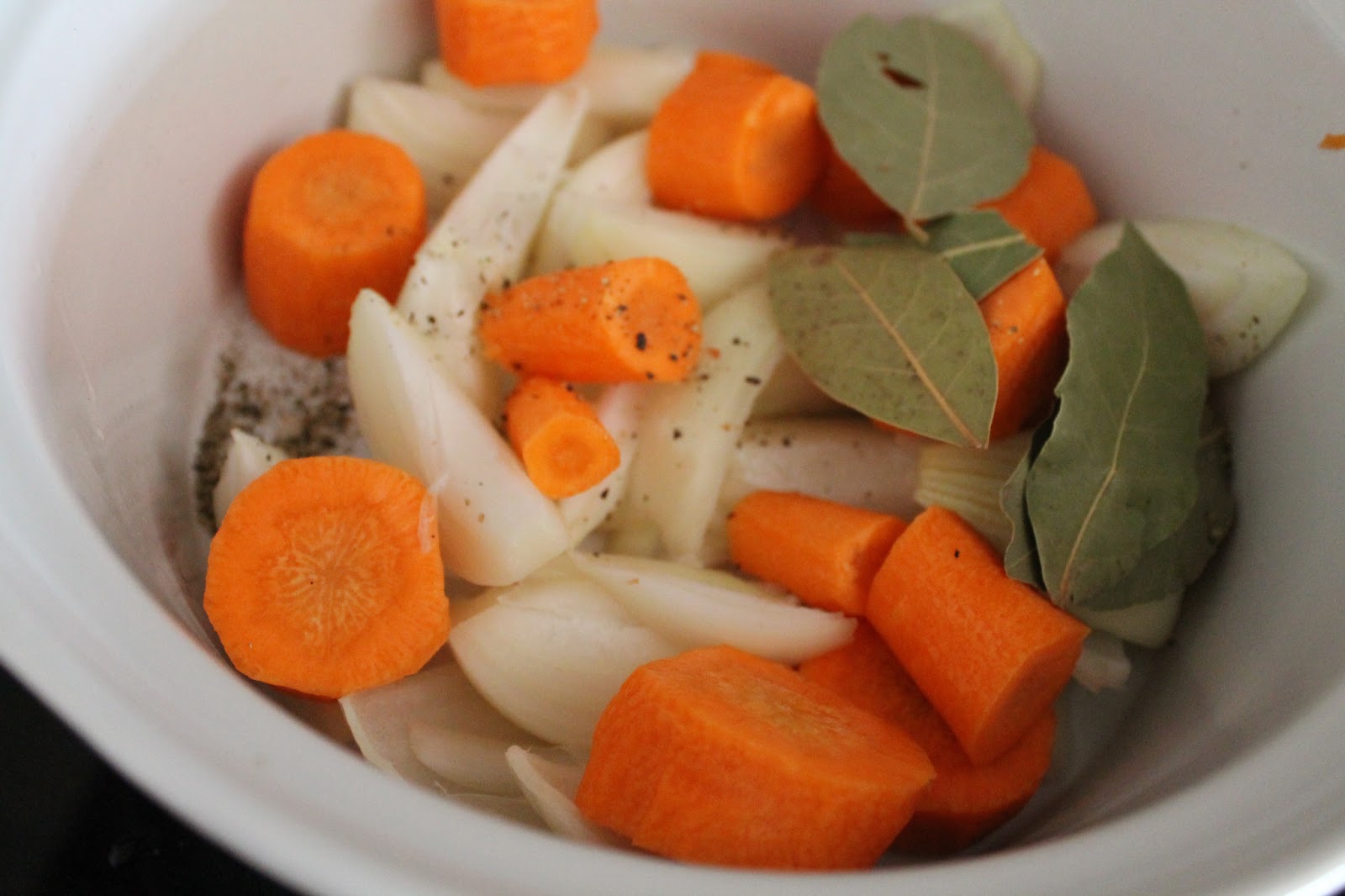
First, I chopped up the onions and carrots and put them in a large, over-proof casserole dish, topping the chopped vegetables with the bay leaves and pepper.  In Jersey, it's traditional to use a stone crock pot, hence the English name of this dish.


Chop the carrot and onion, add bay leaves and pepper

Add the pork belly pieces, including fat

Next, I chopped up the pork belly and added this to the casserole dish.  I must admit, I'm not a great fan of fat and pork belly is very fatty but, after 5 hours in the oven, the meat and fat were equally succulent and I think I actually enjoyed eating fat, for the first time in my life!

Finally, I added the beans and enough water to cover all of the ingredients.  I guess a purist would use dry beans and boil them before adding them to the casserole dish, but I opted for the easier option of tinned beans and the end result was tasty.

Add the white Haricot beans and mixed beans

Cover all ingredients with water, then put in the oven for five hours

It's a slow-cooking dish, so I left it for five hours in the oven at 150 degrees (Gas mark 2), which is quite a low heat.  I stirred the dish once an hour, to make sure nothing was sticking to the pot and that there was enough water. 

Check the pot about once an hour, to make sure it doesn't dry out

The end result was a yummy Pais au Fou served with Royal Jersey potatoes.  With all the fat and beans, it's also a good idea to serve something green on the side - I quite randomly choose rocket!

Royal Jersey potatoes
Jersey Bean crock - Pais au Fou


La Mèrvelle de Jèrri


Not content with the challenge of Jersey Bean Crock, I also decided to try my hand at making Jersey Wonders or Mèrvelles, a traditional pastry, which is quite similar to English doughnuts or French beignets

Learning how to cook something new is one thing, any idiot can do it, even me!  Learning how to bake something new is a totally different story and I found it quite challenging, although I was really happy with the end result. 

Ingredients for Jersery Wonders or Mèrvelles
I relied a lot on a recipe on the BBC's website and I also watched a video on YouTube, which helped me visualise the process for making wonders, especially how to twist the dough and give my wonders a traditional shape. 

The ingredients

500g self-raising flour
115g (4 ounces) of butter
230g (8 ounces) of caster sugar
6 eggs

How I made Jersey Wonders

I sieved the flour and caster sugar into a mixing bowl, then rubbed in the butter, which I'd cut up into small blocks.

Cut the butter into small 'blocks'

Next, I whisked the eggs in a separate bowl and slowly added the egg mixture to the bowl, mixing the whole lot together until I had a sticky, eggy paste. 

Mix the flour and sugar and work into the blocks of butter until you have a crumbly mix

Whisk the six eggs
Add the eggs to the flour/sugar/butter mix

According the recipe, you should use your hands to make small 'golf balls' from the mixture, which you put on an oven tray and cover with a damp tea-towel for two hour.

Use your hands to make several dozen 'golf balls'
Cover the balls with a damp cloth and leave for two hours

My 'balls' were slightly larger than golf balls, but it didn't really matter, as I was able to divide them in two later, to get smaller pastry shapes, more suitable to making wonders.


The next bit was probably the hardest and I used a lot of extra flour, on my hands and on the rolling pin, to roll out the balls and create an oblong shape.  On the video, I noticed that she cut three slits into the flat oblong and twisted the pastry through the middle one, so I did the same.

Use extra flower to flatten out the balls
Make an oblong shape and cut three slits in the pastry

Twist one end of the pastry through the middle slit and create a doughy shape like this
The result is a strange looking pastry mixture, that reminded me of a fleur-de-lys or a dainty woman's shoe!  I was really beginning to doubt whether or not this delicate mess would become anything edible but, luckily, in the final stage it all came together quite nicely.


The final stage involved heating up some vegetable oil in a pan and dropping the Mèrvelles into the hot oil, 5 or 6 at a time, until they became bloated and rose to the surface.  I was a bit confused by the recipe, when it said to cook the Mèrvelles on each side, when they turned golden brown. 

In my mind, I had an image of a flipping them over, on a frying pan, but I soon understood that I would have to turn the Mèrvelles over in the oil, so they would cook on each side.

Add Mèrvelles to the hot oil

When the go brown on one side, turn them over


I'm quite proud of my Jersey Wonders and enjoyed having them for breakfast with a nice cup of coffee!

Jersey Wonders or Mèrvelles


Image credits:

All photos were taken by me, please feel free to reuse, under the Creative Commons license:

Attribution (especially to this blog post)
Share alike
Non-commercial