Showing posts with label Judaism. Show all posts

Friday, 26 December 2014

Quebec - Je me souviens

Quebec's motto is Je me souviens or I remember and this has prompted me to do some research into memory and how our memories work, not a topic that's specific to Quebec, of course, but something which is of universal interest to the human experience.

It's not entirely clear how Quebec's motto came about, however, it seems to have been first written in stone in 1883 by the architect, Eugène-Étienne Taché, who designed the provincial parliament building in Quebec city.  It's funny how writing the motto in stone has literally kept it in human memory, so it persists as Quebec's motto until modern times.

Remember what, exactly?

Coat of Arms of Quebec
There are several possibilities for the source of this motto - it could have been adapted from the Latin phrase Ne obliviscaris (Do not forget) which is on the arms of the British Marquess de Lorne (a.k.a. the 9th Duke of Argyll) who was the fourth Governor General of Canada, including the period when the parliament was being built.  Or, as others point out, it could mean I remember the founders of Quebec (Jacques Cartier, Samuel de Champlain etc) who were also honoured with statues on the parliament building.

Whichever way you look at it, Quebec's motto seems to encapsulate an idealogical struggle between the British rulers of Canada and their French subjects in Quebec - whereas the British are saying Don't forget (who is in charge around here), the French-Canadians are responding, I remember (who the founders of Canada actually were).

Personally, I think Taché's motto was a quiet act of rebellion on behalf of French-Canadians, superficially paying respect to the British Governor-General, but with a hidden message that would inspire fellow Canadiens.

What I don't remember

I've always thought of myself as having a bad memory - I think it's because I'm easily distracted and don't fully process things when they're happening, so I have bad 'recall' of events afterwards.  It amazes me when I look over the past blog posts and how many things I've understood and 'known' at one point, but no longer really remember.  Perhaps this blog should be called Learning (and then forgetting) about the World! 

Of course, it's impossible to remember everything and what I'm left with, after all of my learning and research, is a deeper understanding of the place I'm blogging about and a general impression that stays with me, even if I don't remember the detail of everything I've learnt! The joy of the Internet and the digital revolution, in a way, is that we no longer really need to remember things - information is constantly just a few clicks away, but I wonder how this will impact on future generations' ability to remember things?

Why do we need to remember things?

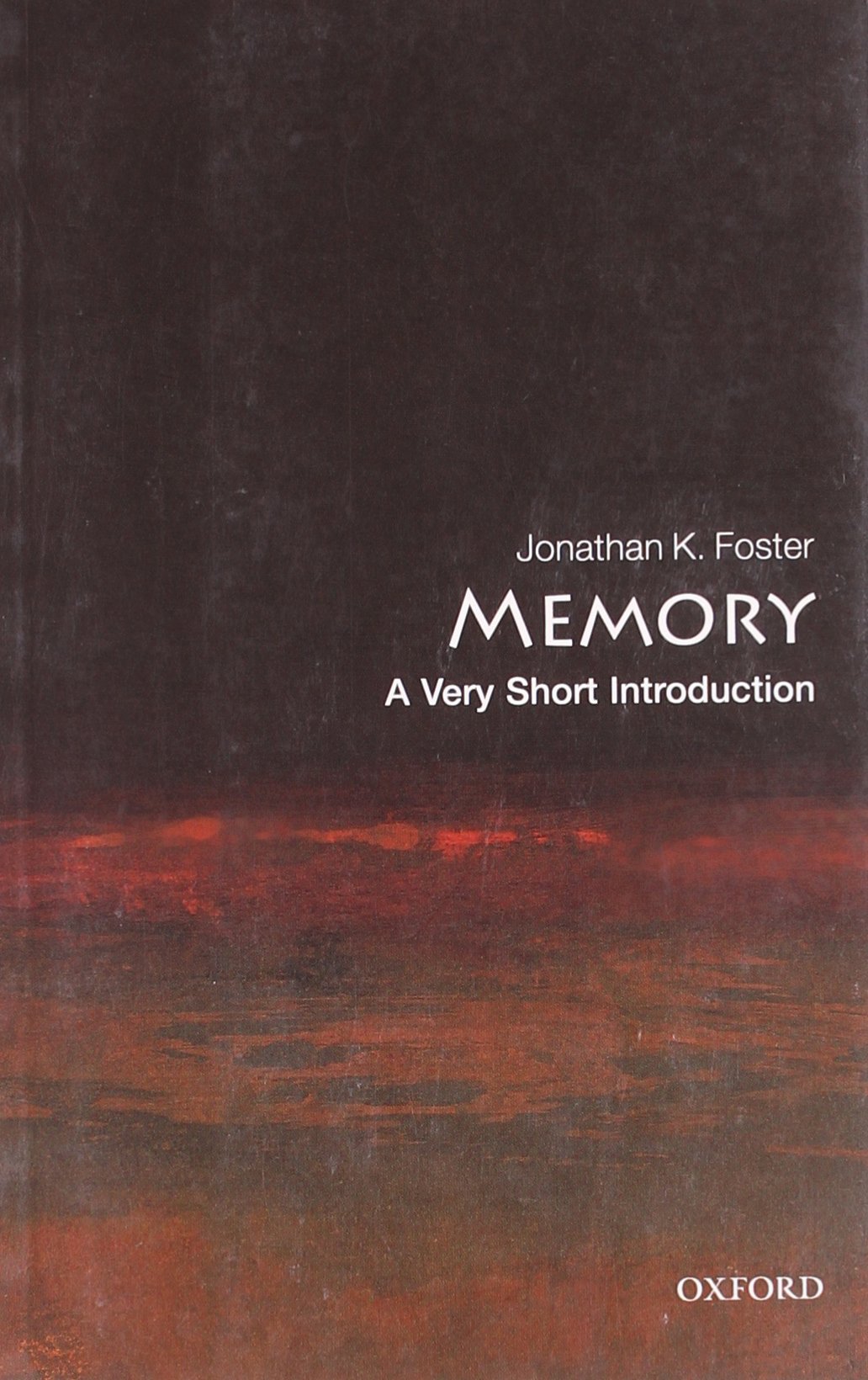
To help with my research, I read Memory: A very short introduction by Jonathan K Foster, part of the Oxford University Press's VSI series.  It's an interesting book which outlines our understanding of memory, how we memorise things, the difference between short- and long-term memory and major developments in human understanding of memory, such as Ebbinghaus' Learning curve, Bartlett's The War of the Ghosts story and Schacter's Seven sins of memory.

I was really impressed by the evidence of how unreliable memory is. A lot of the time, our memories are either completely made up or influenced by how we were feeling when the memory was being created.  Of course, there is a strong connection between memory and learning and, to answer the question above, the reason we need to remember things is because memory is key to our survival.

Without memory, we wouldn't be able to use the tools that have made us so successful as a species - not just physical tools, such as hammers and knives, but also tools like language, the ability to write and to think rationally, learning how to drive or operate machinery or technology - these are all dependent on our ability to consign thoughts and processes to memory.

How reliable are our memories?

What is a little bit worrying, however, is that we trust our memories as much as we do. If you ever talk to your parents, siblings or friends about events that happened a long time ago, you'll often find that you each have your own version of events.  Precisely because we can't remember the detail of things that we experience, our minds tend to summarise and leave us with an impression that becomes our total understanding of the past.

It's quite scary that, given what we know about the unreliability of memories, eyewitness accounts of crimes still play a large part in the evidence given in trials. I'm not sure what the solution is, but I do wonder whether or not eyewitness testimony is really that valid?

Change blindness

Another interesting phenomenon mentioned in the VSI book is the fact that most of us are blind to minor changes taking place in our immediate environment. As we're busy processing the world around us, our brains filter out information that doesn't seem to be that relevant.

There is a well-tested experiment on change blindness that shows how you get Person A to ask Person B for directions on the street, but when you interrupt the conversation and replace the Person A with Person C, Person B will continue giving the directions without noticing that the person they're talking to is someone else.

Really interesting and I'm pretty sure I would fall for this one!

Another perspective on Je me souviens

The Quebecois motto Je me souviens has become a mantra for nationalists in Quebec, however Eric R Scott, a documentary film director based in Montreal has turned the motto on its head, by using it as the title for his documentary on anti-semitism in Quebec in the 1930's.  You can watch the whole documentary on YouTube and it's a topic that has caused a lot of controversy and inspired debate in modern Quebec (but also in Canada and other parts of the world).

I guess Je me souviens could be used as a rallying cry for any minority or subjugated population that has been written out of the history books. It is important to remember the past and learn from the mistakes of previous generations, particularly around issues such as the Holocaust.  I suspect, however, that reaching public consensus on how the past is remembered, is something that will continue to cause controversy and inspire debate for many years to come!


Saturday, 20 September 2014

Palestine - The Cause of a Country

I've known for some time that I would be blogging about Palestine and it's interesting in recent months to see how the Palestinian Territories, particularly Gaza, have come and gone in the news. Palestine has become a real cause célèbre in the past hundred years, particularly on the left of the political spectrum and it's fair to say that most of us will know more about Palestine than we do about other places I've blogged about, eg. Eritrea or Kiribati!

Or do we? 

As I've started researching about Palestine and started trying to see the world through Palestinian eyes, my first conclusion is that Palestine is a place we think we know, through news headlines and politics, but what do most of us really know about Palestinian culture, beyond the political sphere? I don't want to criticise the well-meaning solidarity that exists for Palestine around the world, but I'm coming to the conclusion that Palestine is a cause for most people when, what the Palestinians really need, is a country.

The Palestinian-Israeli Conflict - A Very Short Introduction

The Dome of the Rock by F.R.L.
I've always wanted to read a book that would explain the Palestinian-Israeli conflict in a concise and clear way and Martin Bunton's The Palestinian-Israeli Conflict - A Very Short Introduction (2013 - part of the Oxford University Press series that I love so much!) does just that.

Like most people out there, I had a rough idea of the history of Palestine/Israel and a sense of the reasons for conflict, but Bunton's book helped me order the events and understand the important milestones, particularly in the 20th century, when Palestinians saw their mandated territory shrink from 75% to 22% of the land currently recognised as Israel and the Palestinian territories.

The issues are complicated, needless to say, and I don't have time to go through all of them, but I will share one interesting thing that I learned regarding Jewish settlement in the eastern Mediterranean towards the end of Ottoman rule and during the period of the British Mandate (1920-1948).  At first the need for a Jewish homeland was so strong that most Jewish settlers bought land in the plains between Jerusalem and the Mediterranean Sea, rather than the ancestral Jewish homelands in the mountains of Judea and Samaria (a.k.a. the West Bank).

View from the Garden of Gethsemane by F.R.L.
The plains contain some good farming land, particularly for citrus fruits, with easy access to the port of Jaffa and European markets, however, this part of Palestine was also vulnerable to Bedouin raids, so the majority of the Palestinian population stayed in the mountains.

Thus, the Jewish homeland, which is now Israel, ended up in lands that weren't ancestral Jewish lands and the Palestinian population ended up in the West Bank, which is the ancestral homeland, not just of Judaism, but also of Christianity and with sacred Islamic sites as well.

Unfortunately, nationalism has dominated the Palestinian-Israeli discourse, with each side claiming the other has no real identity and a reluctance on the part of the Israeli government to fully hand over control of the West Bank to the Palestinian authorities, usually under pressure from right-wing Jewish groups to hold on to the Jewish ancestral homelands.

Which Palestine?

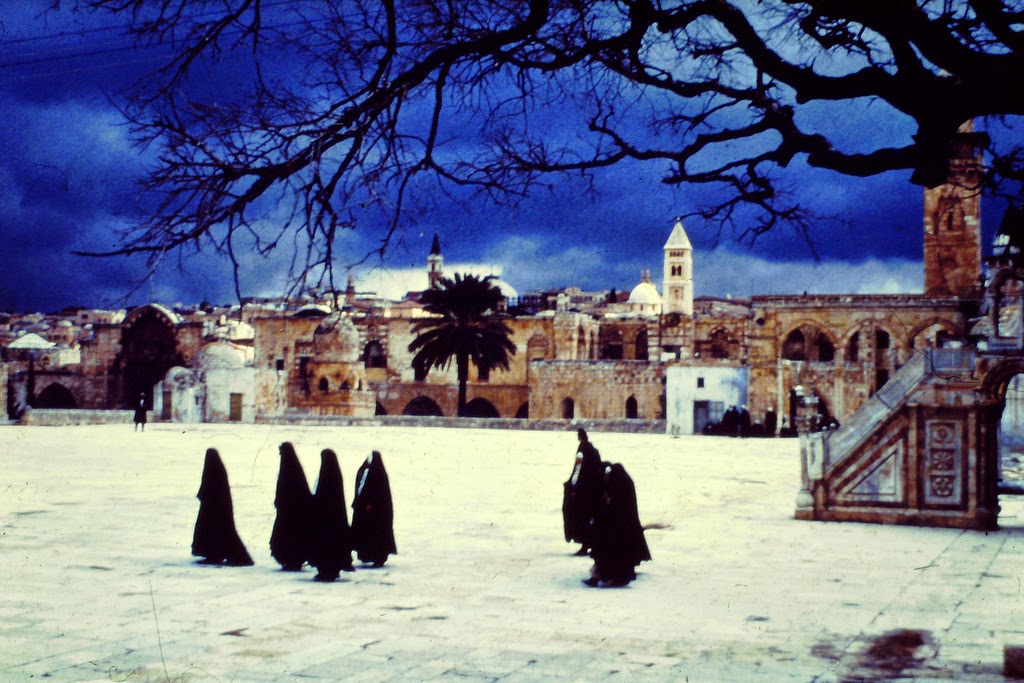
Christian nuns on the Temple Mount by F.R.L.
I'll probably need to explain what I mean when I say Palestine, as well, as Palestine means different things to different people.  There is Palestine as seen by the majority of Palestinians, an historic land incorporating the West Bank, Gaza and Israel.

There are the Palestinian territories, the de facto political entities of the Gaza strip and the West Bank, currently under varying degrees of Israeli occupation.

There is the State of Palestine, the nation declared by the Palestinian Liberation Organisation (PLO) in 1988.  It's the most internationally accepted form of Palestine, being an observer state at the U.N. and recognised de jure by more than two-thirds of the world's countries (United States, Australia and European countries being notable exceptions).

The Palestine I want to blog about is not so much a geographical one, as a cultural one.  More than any other place I've blogged about, it's going to be hard to get away from the politics of Palestine (even food can be political!) but I'll try to learn more about the culture of Palestine through movies, books, music and cooking.

It's hard to learn about Palestine and not learn about Israel, but my blog posts will focus on Palestinian culture, rather than Israeli culture, regardless of the geographical realities or political understanding.

I hope you'll join me on this learning journey over the next month or so, I'm sure it will be an interesting experience!

Image credits:

To illustrate this blog post, I wanted to share some photographs from Flickr member F.R.L. who is originally from Munich in Germany.  Rather than create just another slide show for friends and relatives, F.R.L. took the brave move to put his photos on Flickr!  Thanks for sharing these images with us F.R.L. and yes, they are interesting!

You can see more of F.R.L.'s photos on his photo stream.  

Saturday, 19 February 2011

Veneto - the Jews of Venice

Something I didn't know about Venice was that it gave the world its first ever ghetto in the early 16th century.  Seen from an early 21st century viewpoint and after everything that happened during the last century, it's easy to condemn this action as a repressive one and a dangerous precedent for future centuries.  From a 16th century perspective, it's a bit more complicated.  Jewish history in Europe goes back thousands of years and, whilst the relationship between Jewish populations and their Christian and Muslim neighbours was never completely harmonious, there were times and places when everyone seemed to get along quite well. 

I first became aware of this when I was visiting Girona in Catalunya, a few years back.  Girona had a flourishing Jewish community back in the 12th century and Jews and Christians lived peacefully together for hundreds of years.  All of this changed with the Edict of Expulsion which saw all Jews expelled from Spain and Spanish territories, including the islands of Sardinia and Sicily - Sicily also had a sizeable Jewish population at this time.  The Portuguese expelled their Jewish population in 1497 and those who left, known as the Sephardi Jews sought refuge in more tolerant places in the Ottoman Empire and countries in northern Europe, like the Netherlands.  You can find out more about Jews in the Netherlands in my blog about the famous Sephardi philosopher Baruch de Spinoza. 

The Spanish expulsions triggered (yet another) wave of persecution against Jews in western and southern Europe.  Naples, which was also under Spanish rule, didn't expel its Jewish population, but the persecution of Jews was relentless in Italy throughout the early 16th century  It was in this context that the Venetians decided to confine their Jewish population to an area of the city which was uninhabited, ie. an island in the middle of the Cannaregio district of Venice, accessible by two main bridges and a place where the city's Jewish population could easily be 'protected' from anti-Jewish pogroms of their Christian neighbours. 

The origin of the word ghetto

Venice Ghetto by Adrian Murphy

I've read a few different sources on this, but most ethnologists agree that the word ghetto is a derivative of the Venetian word geto from the verb 'to throw/cast' (cf. French  jeter) which doesn't refer to the fact that the Jews were 'cast away' on this island, but rather to the slag heaps from the foundry where metal was cast.  It's hardly surprising that the Venetians came up with the ghetto concept, considering the nature of Venice, which is made up of hundreds of islands, separated (as the Jewish ghetto was) by canals and linked only by boats or bridges.  It was easy to 'seal off' an area of the city and force the Jewish population to live there. 

Although the ghetto was ostensibly a 'safe' place for Jews to live, guarded by Christian watchmen (who were paid for by the Jewish population), in reality it was, like most of the world's subsequent ghettos, nothing more than a living prison.  Jews were only allowed to roam the rest of the city during the daytime and were forced to wear red caps and badges, so they could easily be identified.  As in other parts of the Europe, the Jews were limited in terms of the professions they could have - in Venice, they were limited to work involving textiles, taxes and medicines.  Jewish doctors were renowned and the Venetian Doge always had a Jew as his personal physician.  I wonder what happened if the Doge were taken ill at night!

Was Shakespeare anti-Semitic?


Shylock and Jessica by Gottlieb
 Probably the most famous representation of life for Jews in Venice was Shakespeare's The Merchant of Venice.  To my great shame, I've never read the play but, as part of my research for this blog, I watched the 2004 film version by Michael Radford.  It's a great movie, with a star-studded cast, including Jeremy Irons, Al Pacino (who played Shakespeare's most famous Jew, Shylock), Lynn Collins and Joseph Fiennes.  By all accounts, the movie uses most of the lines in the original play and, whilst I don't think it was Shakespeare's greatest play (although my unfamiliarity with the text could be clouding my judgement), it did have some classic lines, such as 'all that glisters is not gold' and I was really moved by Shylock's famous Hath not a Jew eyes? speech.

As to whether or not Shakespeare was anti-Semitic?  The story of The Merchant of Venice is incredibly anti-Semitic and Shylock is presented as a caricature, more than a character, a stereotype of the Jew that an Elizabethan audience would recognise and despise.  But in the Hath not a Jew eyes? speech, it's as though Shakespeare is trying to get through the prejudices of his audience and is appealing for greater tolerance towards Jews. 

In the modern age, everyone wants to claim Shakespeare.  We all want to know whether or not he was gay, or racist, anti-Semitic, sexist or even whether or not he was actually a she.  Whilst I think it's important to speculate and this raises some interesting questions for discussion, Shakespeare was writing for an audience that he (or she!) understood very well and I'm not sure his personal opinions really came into it.  If a writer creates a character that is anti-Semitic, or racist, or homophobic, does that mean that the writer is any of these things?  I don't think it does.  Writers portray the society they live in and Shakespeare's plays reflect the world as it was in the late 16th century. 

I think Radford recognised the need to adapt Shylock for a 21st century audience and although he doesn't contemporise the play, as Baz Luhrmann did with Romeo and Juliet, he does direct a portayal of Shylock that is more sympathetic to a modern audience.  The danger of The Merchant of Venice is the powerful nature of Shylock's caricaturisation.  The play was popular in Nazi Germany, when it was used to vindicate the hatred the Nazis had for Jewish people.

Extension of the meaning of ghetto

One way or another, the idea of the Jewish ghetto caught on and, although it wasn't always called this, there were Jewish ghettos in most European cities.  Whilst western Europeans were persecuting Jews in the 16th century, the Polish Empire was pretty tolerant so that, by the 20th century, Poland and other eastern European countries had large Jewish populations.  When the Nazis invaded Poland, they re-established the Jewish ghettos of eastern Europe, the most famous one being in Warsaw.  The Warsaw Ghetto saw an estimated 400,000 Jews cramped in unbearable conditions in a tiny area of the city.  100,000 people died of disease and starvation in the Warsaw Ghetto, even before the Nazis started carting Jews off to the concentration camps, like the one at Auschwitz/Oświęcim.  The ghetto was completely destroyed after an uprising in 1943.

The modern concept of ghetto has extended to include any section of a city that has a large ethnic (and usually impoverished) population.  Some of the most famous ghettos are in the United States, especially in New York, where ghettos were established in the Lower East Side of Manhattan, in East Harlem and in Brighton Beach.  Of course, modern ghettos aren't usually enforced by law, but come into existence due to immigration patterns and are usually reinforced by a vicious circle of invisible 'social boundaries' that keep the ghetto's inhabitants impoverished and out of the wealthier (and usually whiter) parts of the city.  Sociologists like Loic Wacquant described this as hyperghettoization, which leads to certain parts of a city becoming unmanageable in terms of providing infrastructure.  When hyperghettoization occurs, it becomes even harder to break the cycles of violence and poverty for the people who live there. 

The early 20th century saw a lot of black people migrate from the poorer southern states of the US, to the industrial cities of the north, such as Chicago and Detroit.  Much more than in the UK, American cities seem to be incredibly segregated, in terms of race.  Not through deliberate planning by the city authorities, but because of immigration patterns and the effects of hyperghettoization.  In the post World War 2 period, a social phenomenon, known as 'white flight', emerged, where poorer white families in the ghettos, who had more social mobility due to the colour of their skin, moved up the social ladder and migrated to the suburbs of places like Chicago and Detroit, leaving the ghettos almost completely inhabited by black communities, compounding the alienation and ghettoization of black culture.


Venice skyscraper by Jon Kleinman
 Getting back to the idea of the ghetto as a place of protection of refuge, there are constant debates in the LGBT community about the ghettoization of gay culture.  Whilst many modern cities have a specific gay area, often called a 'village', like Soho in London or Le Marais in Paris (which was previously a Jewish ghetto), many gay people argue that there is a real danger in living separately from the mainstream of society.  Ghettoization can reinforce the isolation of the gay community and led to greater stereotyping of people who are LGBT.

The Venetian ghetto today

Perhaps the most shocking thing about the original Jewish ghetto in Venice, is that Venetian Jews were still confined there until as late as 1866.  Although Napoleon's armies pulled down the gates of ghettos all over Europe, the Austrians re-established the Venetian ghetto and Jews continued to live there for most of the 19th century.  As the population of the ghetto increased, its inhabitants were forced to build upwards, so that the buildings of the ghetto began to ressemble 19th-century skycrapers!  The ghetto is still in existence today and is somewhat of a cultural centre for Jews in Venice.  Like most of Venice, it's now more of a tourist attraction. 

Image credits:

The image of the flag of Veneto was provided copyright-free on Wikimedia, the original image having been supplied by wikuser Vajotwo with this derived version being added by wikiuser Flanker - you can see a more detailed description of this image at http://en.wikipedia.org/wiki/File:Flag_of_Veneto.svg

The image of the Venice Ghetto sign is by flickruser adrian, acediscovery, a fellow-Irish man, originally from Cork, but now living in London.  Adrian is also interested in travel and the world around us - you can see more of his work (both writing and imagery) on his blog http://acediscovery.blogspot.com/  You can also follow Adrian on Twitter @acediscovery

The image of Shylock and Jessica is by the Jewish painter Maurycy Gottlieb and is in the public domain. 

The image of the 'Venice skyscraper' is by flickuser drdad aka, Jon Kleinman who is from Dayton, Ohio.  You can see more of Jon's photos at http://www.flickr.com/people/jonkleinman/

Monday, 23 August 2010

Saudi Arabia - An introduction to Islam

As I'm blogging about Saudi Arabia, I think this is a perfect opportunity for me to learn about Islam, the same way I learned about Hinduism when I was blogging about Rajasthan.  I'm no expert though and I apologise in advance for misrepresenting any aspects of the religion, I can assure you it's not intentional. 

I must admit, I did know a little bit about Islam, before I started reading for this blog, at least the Uzbek version of Islam, as I lived in Samarkand for almost two years.  Unlike a lot of Westerners, I've had a very positive experience of Islam and I like to think that I have understood more about the religion than the negative stereotypes of Western media sources.  As with Hinduism, I need to profess my disbelief in any religions or the existence of God, but I find the whole subject of religion fascinating and I'm interested in learning more. 

Blogging about Islam is such a massive undertaking and I really just want to begin with the basics.  A lot of the information I'm taking is from Malise Ruthven's Islam: A very short Introduction, published as part of a series by Oxford University Press (that I'm always raving on about).  The opinions expressed in this blog are my own.  Other things I would like to cover in future blogs about Saudi Arabia are Muhammad and Shari'a Law.  I'll probably leave other aspects, such as the Quran, Sufism, Shi'a, the role of women and Jihad to future blogs about other Muslim countries.

Origins

I guess the most surprising thing about Islam for a Westerner is that it doesn't really differ from Western religions in the way, for example, that Hinduism does. It's important to remember that Islam is part of the same religious tradition as both Christianity and Judaism.  As Christianity developed from Judaism and went off in its own direction, adapting to the European societies that identified with Christian beliefs, Islam was a reaffirmation of traditional beliefs and an attempt to purify the message of God that had been corrupted and confused in Jewish and Christian interpretations.  I can't help comparing the origins of Islam to the origins of Protestantism in Europe, ie. getting back to the essentials of religious practice and away from the corruption and materialism of the predominating church. 

I guess there is a big difference between orthodoxy (ie. harmony of beliefs) and orthopraxy (ie. harmony of practice) and whilst Islam is relatively orthodox in relation to Christianity and Judaism, it's not necessarily orthoprax and it's the practice of Islam that is difficult for Westerners to understand, as it so often differs from the way Christians and Jews practise their respective religions.

The diversity of Islamic orthopraxy

Unlike Christianity, there is no centralised 'church' in the Muslim faith.  Even Saudi Arabia, which might be considered to be the centre of Islamic beliefs, with the important religious sites in Makka and Medina, wouldn't really be acceptable as the leader of Islam for most believers. 

Leadership comes at a local level and this leads to a diversity in Islam that most people in the West fail to recognise.  An estimated 23% of the world's population follow Islam but it's far from being a monolithic community.  I can understand the frustration of Muslims everywhere, when they are portrayed as religious fanatics and fundamentalists.  We can quite easily identify the differences in Christian beliefs and practices, in terms of the different Christian sects, Catholicism, Orthodoxy, the myriad of Protestant belief systems.  Similarly, Islam has been adapted to local circumstances and whilst the essential orthodoxy of the religion is consistent, the practice of Islam varies from one community or society to the next.

The fall of Communism and Islamophobia

Islam is perceived to be the fastest growing religion in the world and, since the fall of communism in the late 80's, there has been a growing anxiety in the West, which sees Islam as the main obstacle to Western orthopraxy.  I would argue that orthopraxy in the West goes beyond religion - even those of us who are not practising Christians share a belief system of sorts, based on the values of the Enlightenment and a liberalism which is the basis of most Western societies.  This seems to bring us directly into conflict with Islam and the news headlines in the past few weeks have been all about headscarves (France), mosques (New York) and charity, or the lack of it (Pakistan).  The western media definitely sensationalises these conflicts and, in my opinion, distracts from the very real changes that are occuring in Islam at the present time, as it adapts to the pressures of a globalised society and dominance of western consumerism. 

Whilst people in the West live in fear of an Islam that wants to convert us all and impose Shari'a law, societies based on Islamic beliefs and traditions are finding themselves confronted with the overwhelming impact of globalisation and a capitalist system that seems to preclude any alternatives to consumerism and greed.

The Five Pillars of Islam

As a belief system that has spread right across the world and has been adopted by so many different types of societies and cultures, the central ethos of Islamic beliefs is incredibly clear and uncomplicated.  I guess the Five Pillars of Islam unite the Muslim community in a way that strengthens Islam and helps it meet the challenges of 21st century life.  The five pillars are:

1. Shahada - the basic declaration of faith

lâ ilâha illallâh, Muḥammadur rasûlullâh - There is no God but God and Muhammad is his messenger - this is what the Arabic writing on the Saudi flag says.

2. Salat - Worship

This relates to prayer and the idea (at least in the Sunni tradition) that Muslims must pray five times a day

3 Zakat - alms-giving/compulsory charity

It's no coincidence that Saudi Arabia is one of the world's largest contributors of aid to poorer countries.

4 Sawm - the fast during Ramadan

Fasting is an important part of Islamic orthopraxy.

5 Hajj - pilgrimage to Makka

All good Muslims should try to make a pilgramage to Makka at least once during their lifetime. 

To be honest, I don't think any of these five pillars would be unfamiliar or unacceptable to Christians and, on a very basic level, I'm beginning to wonder what all the fuss is about!

Image credit

The photograph of a Muslim family in Langkawi, Malaysia was taken by self-confessed flickr addict Jim Boud - you can see more of Jim's photos at http://www.flickr.com/people/boudster/ 

The image of the children at prayer was taken by flickruser Ranoush, aka Rana Ossama, who is a student from Ismailyah in Egypt - you can see more of Rana's photos at http://www.flickr.com/people/ranoush/

Thanks Jim and Rana for sharing these images with the world using the Creative Commons License.