Showing posts with label vanilla. Show all posts

Sunday, 14 June 2015

Réunion - The Final Word

Proposed flag for Réunion
I've found Réunion a fascinating place to blog about - as I've been researching for this blog and learning more about the interesting mix of cultures that Réunion has inherited, I've been mentally planning a trip to the island, at some unspecified time in the future!

As it happens, I have visited a few of the places I've blogged about, having become really interested in these places as a result of my 'armchair learning' experience.  The places I've visited so far as a result of this blog are: Hong Kong, Iceland, Jersey, Quebec and Barbados and I'm hoping to visit Korea and Mongolia later this year!

Of course, there are quite a few places I've blogged about that I may never get the chance to visit (I'm thinking of places like Kiribati, Liberia and Yemen), but a visit to Réunion is a distinct possibility and, as with any of the places I've blogged about, I'd love to visit sooner, rather than later, before Réunion changes too much!

The Themes

During my time blogging about Réunion, I've learned about the history of the island and how Réunion is part of France, although it lies thousands of miles south of Paris, in the Indian Ocean. I've learned about the role that Réunion has played in the cultivation of vanilla, a notoriously expensive plant that originates in Mexico and is incredibly difficult to grow.  I also learned how to make Canard a la Vanille, a typical Réunionnais dish and this was my first time to physically handle vanilla and cook with it.

Books

I read the following books, as part of my research:

Some of the books I read as part of my research on Réunion
Insight Guides: Mauritius, Réunion and Seychelles (2009) - the second edition that Insight guides have published about the Mascarene islands - very informative, as Insight guides usually are.

Vanilla: Travels in Search of the Ice Cream Orchid (2004) by Tim Ecott - which has chapters on Réunion, but also covers Mexico, Tahiti and Madagascar.

La Grand-Mere Kalle (2006) by local writer Yves Manglou - which brings to life the mythology of Réunion.  You can read my blog post about this book for more information.

Island Born of Fire (2006) by R.B. Trombley - a scientific book about the geological make-up of the island - a little bit over my head and difficult to read, but interesting all the same.

The Age of Kali (1998) - a collection of travel essays by William Dalrymple - I'd never read Dalrymple before, but I definitely want to read more! His essays are mostly about India and Pakistan, but he does include a couple of interesting essays on Sri Lanka and an essay on Réunion called The Sorcerer's Grave.

Movies

I could only find one movie which was set on Réunion, Francois Truffaud's La sirène du Mississippi (1969), which I also blogged about.

Music

I also had a wonderful time listening to the music of Réunion and I created a play list, which includes songs by artists such as Firmin Viry, Granmoun Lélé and Faham.

Other themes

As usual, I came across other themes that were interesting, but I didn't have time to research into further - if you want to continue your own learning about Réunion, I would suggest the following 'other' topics:

Edward's Dodo by Roelant Savery (1626)
The Euro and how Réunion was the first place to adopt this new currency
The pirate La Buse and his hidden treasure, which people believe is still buried somewhere on the island
Les enfants de la Creuse - Réunion's own stolen generation of children who were removed from their parents and brought up in France
Volcanoes
The Dodo and how it became extinct
The French code noir which sought to prevent the intermarrying of races
Réunion during World War 2
The Kerveguen sugar empire

The Final Word on Métissage

One thing that came through strongly during my research on Réunion was the importance of métissage in the identity of this far-flung French outpost. Métissage is the French word for mixing and it's a good way of describing the development of culture on Réunion, which has mixed elements of Africa, Asia and Europe to produce a new culture, totally unique to the island.

Expeditus, photo by Jean Poussin
An interesting manifestation of métissage is the cult of St Expédit, the island's unofficial patron saint. According to William Dalrymple, in his book The Age of Kali, the cult of  St Expédit on Réunion started in 1931, when a mysterious package, supposedly containing relics of a Christian saint, arrived on the island from the Vatican and bore a stamp saying spedito, which is the Italian word for expedited or  'sent quickly'.

The cult of St Expédit took such a hold on the island that the Catholic Church was forced to create a 'back story' for the saint and aligned St Expédit with the Roman soldier, Expeditus who became an early Christian martyr in 4th century Armenia.  Whether it's true or not, Dalrymple's theory is an interesting one and I do love a good mystery!

In modern times, shrines to St Expédit on Réunion are usually painted blood red and people pray to the saint for all kinds of things - the cult of St Expédit lends itself to Réunion's métissage culture, mixing African ancestor worship, Hindu reincarnation's of Vishnu and Tamil interpretations of Christianity.  Statues of St Expédit are sometimes mysteriously beheaded and there is something distinctly un-Christian about the magical powers and ability to answer prayers, that St Expédit has been credited with.

The cult of Expeditus is also really popular in Chile, for some reason and I find the whole thing fascinating but also slightly bizarre!

Image credits:

Although I've been using a coat of arms to represent Réunion during my blog posts, I have since discovered a proposed flag for the island, so I wanted to represent this in my final blog post.

The image of Edward's Dodo, the 1626 painting by the Flemish painter, Roland Savery is in the public domain.

The photo of the Expeditus statue has been uploaded to Wikimedia Commons by Jean Poussin and you can see more information on this image here.  

Saturday, 18 April 2015

Réunion - How I made Canard à la Vanille

Due to its strategic location in the western Indian ocean and its history as a centre of contact between European, African and Asian cultures, the island of Réunion has quite a variety of culinary traditions. Whether it's Indian-style carris or Madagascan-style stews like rougail, there's quite a lot to choose from.

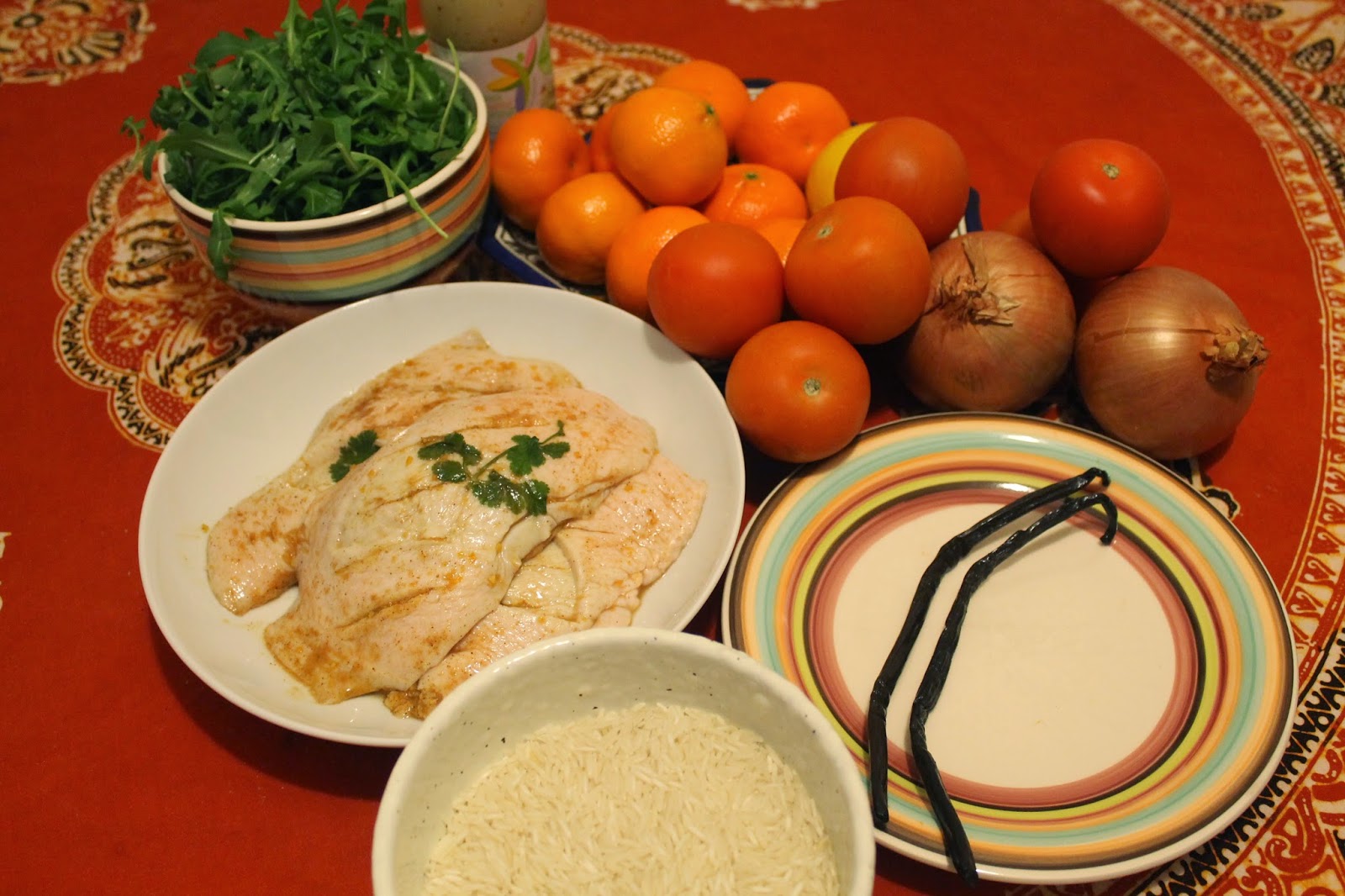
I plumped for a dish that combines European and African traditions, with a bit of Chinese duck thrown in for good measure!  As I've recently been learning about the history of vanilla and the role Réunion has played in global vanilla cultivation, I really wanted to experiment by cooking with vanilla myself, for the very first time.

I looked at a few different sources online and then made my own recipe, but I was heavily influenced by Celtnet,org's recipe for Clementine and Vanilla Duck.  This is a great website, that I've used many times in the past and it's a labour of love which currently needs some funding to keep the website going, if you're interested in supporting a worthy cause!

The ingredients


Ingredients for Canard à la Vanille
4 duck breast fillets - 4 filets magret de canard (my fillets were marinated in lemon juice and star anise, which gave them a lovely taste)
2 vanilla pods - 2 gousses de vanille
6 oranges - 6 oranges (smaller oranges like clementines or mandarins work best - I used mandarins)
orange juice - jus d'orange
4 tomatoes - 4 tomates
2 onions - 2 oignons
a cup of rice - une tasse du riz
1 lemon - 1 citron
rocket salad - salade de roquette
French dressing - vinaigrette

How I made Canard à la Vanille

I usually start by making my rice, which I added lemon juice and rind to, once it had cooked, to give it nice tangy taste.

Preparing the orange juice

Next, I prepared the main ingredients.  I chopped the duck breasts into bite-sized pieces; separated four of the oranges into segments or carpels; juiced the other two oranges; chopped the onions; chopped the tomatoes; halved the vanilla pods, then sliced them lengthwise to expose the vanilla seeds.

Prepare the ingredients for the Vanilla Duck stew

I started by frying the duck breasts until they had cooked through and browned on the outside - I removed the duck pieces and set them to one side.

Cook the duck pieces until they brown
Next I fried the chopped onion, until it had softened and yellowed a bit - I added a dash of water and some orange juice, to collect some of the duck fat at the bottom of the pan, so I could start making a sauce.  Next I added the orange pieces and vanilla pods, finally adding the chopped tomatoes and letting the whole mixture stew on a low heat for about 20 minutes, occasionally adding orange juice or water.

Vanilla and orange stew
It was interesting handling the vanilla - the pods were quite 'earthy' and smelt amazing, when I'd split them open.  Most people I know have only ever used vanilla to make ice-cream or dessert, so it was a thrill to add it to a stew - it also felt a bit decadent, considering the price of vanilla pods!

Vanilla pods
Once in the ingredients had stewed a bit, I re-added the duck pieces and some more orange juice and let the whole lot stew on a slightly higher heat for another ten minutes.

Vanilla Duck stew

I served with the lemon-rice, rocket salad and French dressing.  The end result was miam-miam!

Canard à la Vanille served with lemon-rice and rocket salad

Image credits:

All images were taken by me on my trusty Canon EOS 1100D.  Feel free to re-use these images with the Creative commons license:

- Attribution (especially to this blog post)
- Non-commercial
- Share alike


Friday, 3 April 2015

Réunion - In Search of the Ice-Cream Orchid

When I started researching Réunion, I was interested in finding out what the island is famous for and vanilla came up quite quickly as a potential topic, which surprised me, as I had no idea about Réunion's role in the history of vanilla production.

To prepare for this blog post, I managed to get my hands on a copy of Tim Ecott's Vanilla: Travels in Search of the Ice Cream Orchid (2004), a really informative and enjoyable book, which traces the history of vanilla from its natural habitat of Veracruz/Oaxaca, to the first successful cultivation of vanilla overseas in Réunion and its later cultivation in other parts of the world.

As I've blogged about Oaxaca and the Columbian Exchange, I wasn't that surprised to learn that vanilla comes from the 'New World'.  I'm developing a default assumption that many of the world's most popular plants/food products come from the Americas (cacao, chillies, rubber, turkey, potatoes, to name but a few!).

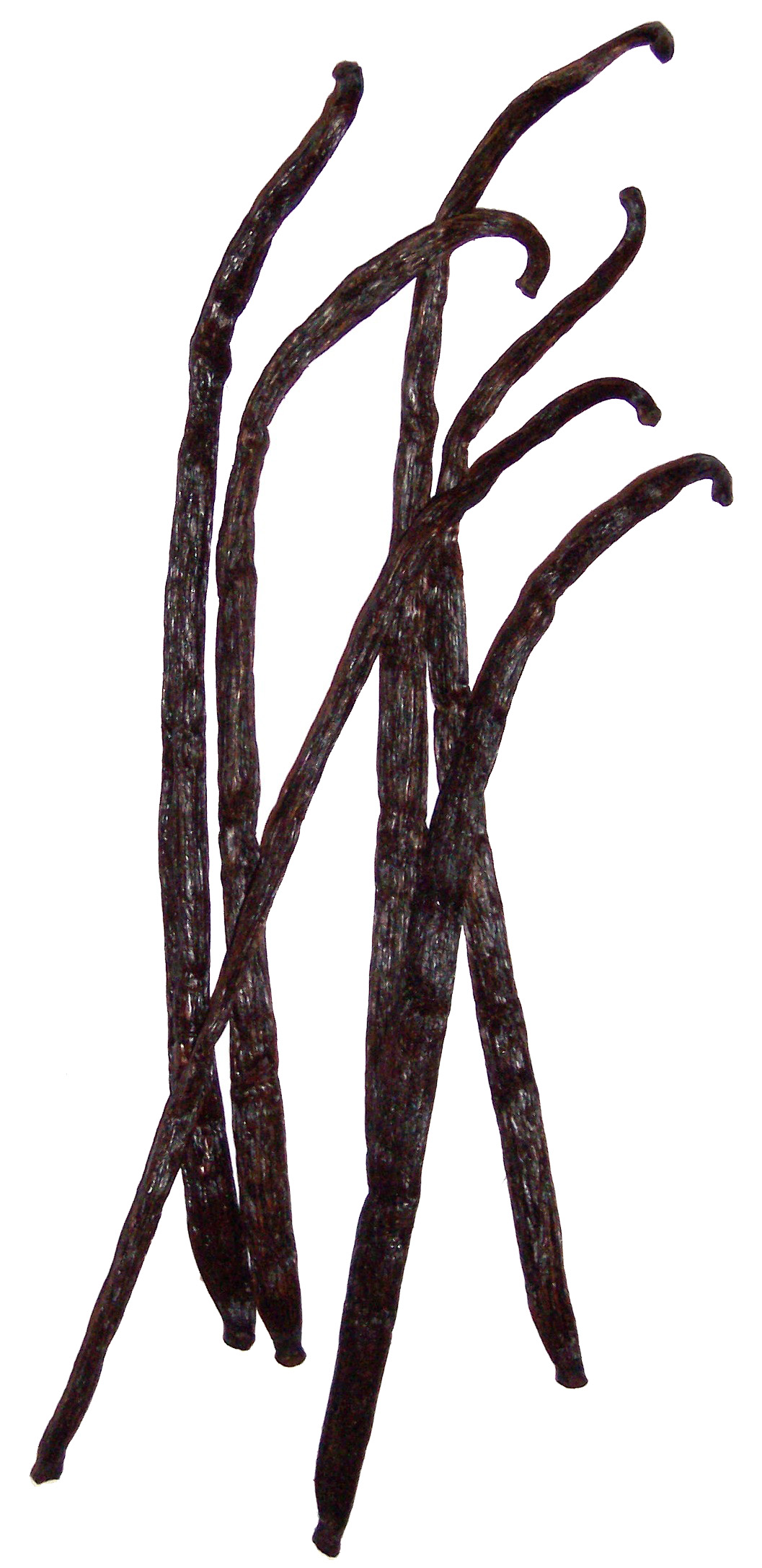
Vanilla pods by B.navez 
What's interesting about vanilla, at least vanilla planifolia, the highly aromatic species of vanilla that we use in food flavouring and perfumes, is that it really wasn't that widespread, even in the Americas and has only been found in its natural state, in a very concentrated area of southern Mexico. The Aztecs called vanilla tlilxochitl or 'black flower' as, by the time vanilla pods arrived in Tenochtitlan (modern-day Mexico city), they had dried out and discoloured, therefore the Aztecs had never seen live vanilla plants.

Of course, there are many types of vanilla and most are not aromatic. Due to the scarcity and labour-intensiveness of vanilla farming, it has become a much sought-after delicacy and could cost anything between $20 and $300 a kilo, depending on the global harvest, the second most expensive ingredient after saffron - not bad for a non-essential food!

Similar to my blog post on cloves, it turns out that vanilla is a type of flower and it's the only orchid which is cultivated as a food source, rather than for decorative purposes.  There are many artificial vanilla extracts on the market and the chances are, if you think you've tasted natural vanilla, you probably haven't!

So what drives our obsession with this hard-to-cultivate flower pod?  It seems there are three main answers: chocolate, ice-cream and soft drinks.  Vanilla has long been added to chocolate and this is how Europeans first encountered its taste. In the late 19th century, people in the United States started becoming a bit obsessed with ice-cream production, which pretty much sealed the future success of vanilla!  Also, although they don't release details of their 'secret recipes', I'm pretty sure that companies like Coca-Cola and Pepsi use real vanilla extract in the manufacture of their soft drinks.

Because of its dependency on pollination by a particular species of mountain bee that's only found in southern Mexico, vanilla cultivation didn't transfer to other parts of the world as quickly as other American plants, such as cacao and potatoes.  In his book, Ecott tells a really interesting story about Edmond Albius, the slave-boy on Réunion island who discovered the technique for self-pollinating vanilla plants and opened up the rest of the world to vanilla production.

Edmond Albius, circa 1863
Albius' fate was tied up with the racism of that time and, rather than being fêted or honoured for his ingenious discovery, white Europeans couldn't believe that a slave-boy would have the intelligence to make such an important contribution towards the world of science and many refused to recognise that his intervention in the development of vanilla production was anything more than an accident.  He died impoverished on Réunion island in 1880, during the decade when Réunion became the first place to overtake Mexico in terms of vanilla production.

Ecott also travels to some of the other great centres of vanilla production such as French Polynesia (Tahiti) and Madagascar.  As the price of vanilla is so high, there is a lot of secrecy around the industry and Ecott's book gave me an insight into a world of armed vehicles, heavily-guarded crops and clandestine flights between Antananarivo and Paris!

A bad harvest can inflate the price of next year's vanilla, as happened in 2004, when the price reached $500 dollars per kilo.  There has also recently been a hike in worldwide vanilla prices, so the drama around vanilla cultivation seems destined to continue for many years to come.

I found some really useful information on the website of the Food and Agricultural Organisation (FAO) of the United Nations.  According to their stats, the top producers of vanilla in the past two years have been Indonesia and Madagascar (both producing over 3,000 tonnes of vanilla), followed by Mexico, Papua New Guinea and China (with just around 500 tonnes each).

As you can see from the stats below, the production of vanilla in Réunion has fallen dramatically in the last twenty years, from 93 tonnes of vanilla in 1993, to just 8 tonnes of vanilla in 2013.

Vanilla production in Réunion, according to FAO

Réunion's main crop these days is sugar cane and, by way of comparison, I learned that Réunion produced almost 2 million tonnes of sugar cane in 2013 - nothing near the 460 million tonnes produced by world leader Brazil, but not bad for a small island in the Indian ocean and obviously they now produce a lot more sugar cane than they do vanilla.

In the same period, vanilla production has doubled in Indonesia and trebled in Madagascar. Something to think about next time you tuck into a tub of vanilla ice-cream!

Vanilla production in Indonesia, according to FAO
Vanilla production in Madagascar, according to FAO
Image credits:

The image of the vanilla pods is from Wikipedia and has been shared using the Creative commons license - see more details about this image on the file information page.  

The image of Edmond Albius is in the public domain and the statistic images are from the Food and Agricultural Organisation's stats portal.