Showing posts with label Polenta. Show all posts

Wednesday, 29 February 2012

Barbados - Fried Fish and Cou Cou

In preparation for this month's cooking task, I visited London's only Bajan restaurant, Bajan Spice which is on Nunhead Common in Southwark.  I have to say that, for such a modest, unassuming cafe, the food at Bajan Spice is pretty amazing!  I'd highly recommend it, if you're based in London, or just visiting and want to sample some Bajan cuisine.

The National Dishes of Barbados
Bajan Spice at Nunhead Common
I went with my partner and BAM (Best Aussie Mate - of Walking the Chesters fame) and between us we tried two of Barbados' national dishes - Cou cou and Pudding and Souse.  What was also great about going to Bajan Spice was that I saw how Cou cou should be made and this really helped when I came to making Barbados' national dish a day later.

Pudding & Souse
Pudding and Souse is another interesting dish, with lots of yucky things like 'pigs trotters', but it was surprisingly tasty!  Sousing is a process of pickling, used mainly with salt-fish, it was quite common on ships crossing the Atlantic, as it meant that food could be preserved for the journey.  It's interesting how Souse was then adopted in far-flung colonies like Barbados and transformed into something palatable - admittedly the addition of spices helps!

Flying Fish and Cou Cou

Fried Fish and Cou Cou
Actually, Barbados' national dish is Flying Fish and Cou Cou - but it's difficult to get your hands on flying fish, so I settled for snapper (as Bajan Spice had used red snapper in their Cou Cou recipe).  I looked at various different recipes on the Net and my end was result was a combination of several recipes.  Cou Cou is very similar to West African Fufu which is something I cooked when I was blogging about Togo

Lots of recipes had 'modernised' the dish, with lots of rich sauces and tomatoey flavours, but I was aware of the comments section on other blogs, where enraged Bajans extolled the virtues of a much simpler dish.  Also, there wasn't one recipe for this, but separate recipes for each part of the dish.  I'm afraid I might have missed the sauce part and I would definitely recommend some kind of sauce for this dish, if you decide to make it yourself. 

How to fillet a fish

Also - another good learning experience for me was how to fillet fish, as I'd never done this before!  (Any readers who've stumbled on this blog and are taking it for a professional cooking blog, please look away now!).  It was quite straight forward, although messy and I didn't have a proper 'fish tweezers thingy' to remove the rib-cage bones.  I found it really useful to watch the following video on Youtube by the Underground Cookery school, which explains how to fillet round fish, like snappers:


I'm not a big 'fish-eater' but cooking for this blog has made me aware of how important fish is to different cultures across the world.

The Ingredients 

The Ingredients
For the Cou Cou

1 onion (chopped)
8-10 okra (sliced)
a bowlful of cornmeal (and extra to thicken the Cou Cou)
butter (to grease the Cou Cou container)

For the Fried Fish

2 snappers or other round fish (filleted!)
Lemon juice
Dried thyme
Garlic salt
Cayenne pepper
Sea salt
Black pepper
Flour (or, even better, cornflour)
1 egg
Breadcrumbs

How I made Cou Cou


Mmmm . . . lovely okra!
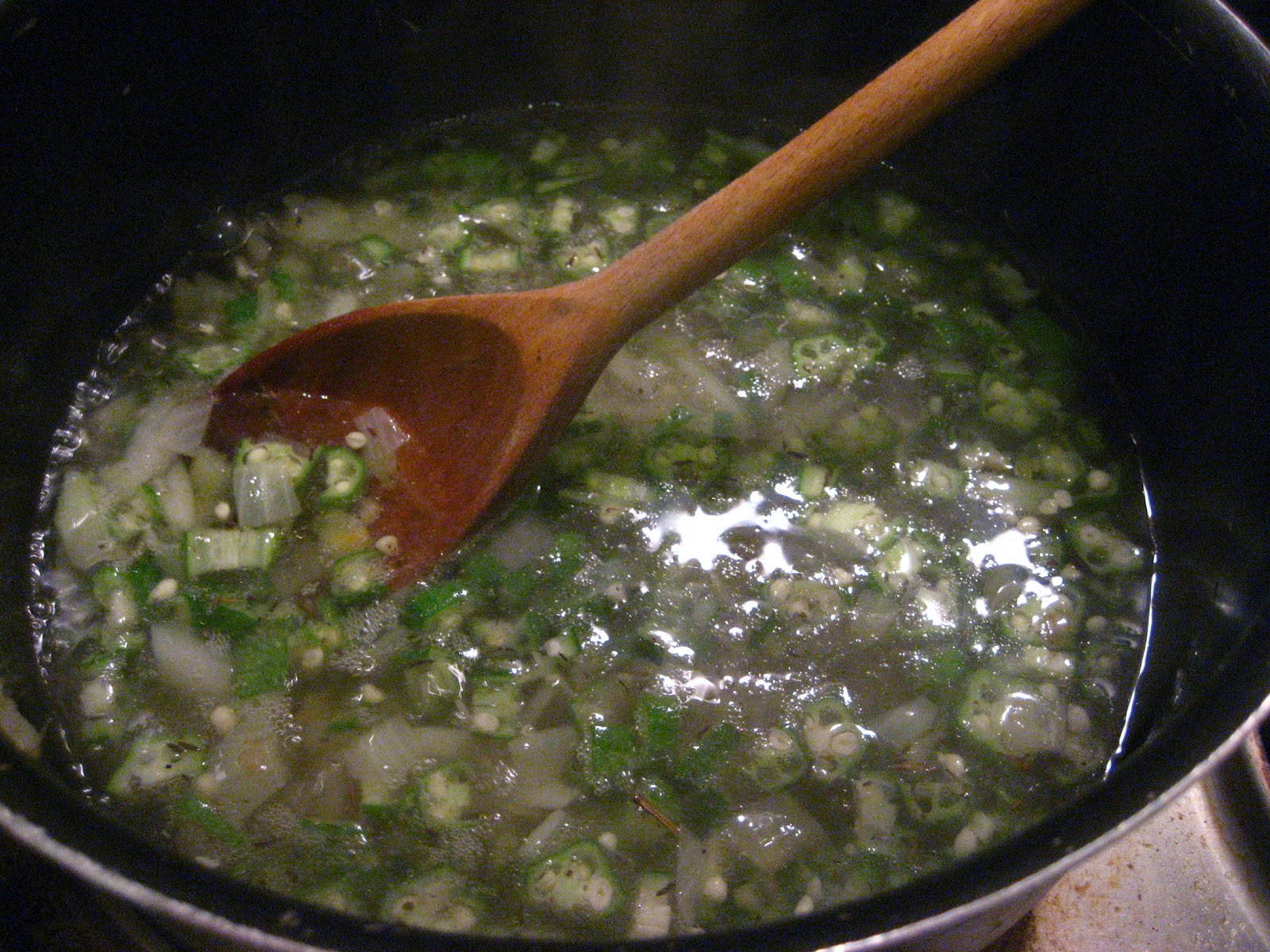
First I fried the onion, adding dried thyme to give it a bit of extra flavour.  Next I added 
the pieces of okra and let these fry for a minute, before adding a litre of water.  The last time I cooked okra was when I was blogging about Oklahoma.  Actually, reading through my Oklahoman recipe for Choctaw Catfish and Fried Okra, it's got a lot in common with Cou Cou and Fried Fish!

It's important not to over-boil okra so, after a few minutes, I removed the okra and fried onion, using a slotted spoon and put them in a bowl to be added again later.  At this point, I poured half of the liquid into a container and started stirring the cornmeal (polenta) into the remaining liquid.


Fry the onion with some dried thyme


Add the okra and about 1 litre of water
The recipes I read recommended covering the cornmeal in cold water first, but I don't think this was a great idea, as the whole mixture was very watery and I ended up using even more cornmeal to thicken it.  Thankfully, having had proper Cou Cou in Bajan Spice the day before, I had a fair idea of what the consistency of Cou Cou should be like.  Really it ends up almost solid, like a pate.

Mixing cornmeal, onion and okra

It should look something like this!


Once the cornmeal and liquid had thickened somewhat, I put the fried onion and okra back into the mixture.  After a few more minutes, I poured everything into an oven-proof container and baked it for about 10 minutes to solidify the Cou Cou.  I was quite pleased with the end result, although my photo doesn't really do it justice!

What to do with the fillet of fish

Once I had filleted the fish, I washed it in lemon juice and then rinsed it with water.  I then put the fillets into a bowl and covered them with a mixture of dried thyme, garlic salt, cayenne pepper, sea salt and black pepper.  I covered the bowl and let it marinate in the fridge for about an hour and a half (during which time I had a snooze - no one said cooking Bajan food had to be stressful!).

Wash the fish fillets with lemon juice

The spices, herbs and salts for marinating


Once marinated, I coated the fish fillets in cornflour (you could also use regular flour), dipped them in the egg, which I had beaten in a bowl and pressed them onto a plate full of breadcrumbs.  I had also prepared the bread crumbs in my food processor and I think fresh bread crumbs make all the difference. 

Hunks of bread

and bread crumbs!


Marinated, coated, dipped and pressed, I finally fried the fillets and served them up with the slabs of Cou Cou.  The Cou Cou was nice, the fish was delicious and I'll definitely be using elements of this recipe again - in fact, I'm planning a Cou Cou & Fried Chicken dish for later this week. 

Frying the fish fillets

Fried fish and Cou Cou


Image credits:

All photos were taken by me - please feel free to re-use these images under the Creative commons license:

- Share alike
- Attribute (especially to this blog post)
- Non-commercial

Some of the websites I used for the recipe were:

www.tasteslikehome.org
www.islandflave.com
www.totallybarbados.com

Wednesday, 2 February 2011

Veneto - the Makings of a Venetian Feast!

I was really excited about making some traditional Venetian dishes and I spent most of last weekend, when I wasn't watching DVDs or blogging, preparing three Venetian meals, which I want to share with you below.

To compliment the three meals, I also went the extra mile to get some authentic Italian ingredients.  There's a really lovely shop in Marylebone, La Fromagerie, that stocks all kinds of regional European wines and cheeses, so I stopped off on my way from work, one day last week, to hunt down some Venetian cheese and wine.  Okay, it's a little bit pricey, but worth it, if you want to taste authentic Venetian ingredients. 


Asiago and Ciabatta
 For the cheese, I chose a sample of Asiago.  Probably the most famous Venetian cheese, it's a D.O.P. (Denominazione di Origine Protetta) and I got fresh Asiago, rather than mature, as I wanted to eat it with bread.  I also bought a fairly expensive bottle of Valpolicella, Villa Spinosa Classico Superiore from 2005.  To go with the cheese, I bought a delicious Ciabatta in Waitrose and a cheap bottle of Soave, a Venetian white wine, which I used in my cooking. 

Spaghetti alle Vongole

The first dish I prepared, on Saturday night, was a very traditional Spaghetti alle Vongole - the vongole in my case being some capesante (scallops) which I had in my freezer (I was being a bit economical with Saturday's meal!).  I also threw in some Gamberi (prawns) for good measure.  The other ingredients included:


Ingredients
 Olio d'oliva extra vergine Extra Virgin Olive Oil
Prezzemolo Parsley
Spaghetti
4 spicchi di aglio 4 garlic cloves
2 scalogni 2 shallots
Burro non salato Unsalted butter
Peperoncino in polvere Chilli powder
Vino bianco White wine (preferably a Soave)

By the way, ignore the limone (lemon) in the photograph.  I got a bit too enthusiastic, when I was grabbing things from the fridge!

First I prepared the spaghetti in the normal way, making sure it was al dente and adding a big lump of unsalted butter to give it a slightly oily taste and stop it sticking to the pan.  I try to keep my spaghetti in boiling water for as short a time as possible and let it continue cooking in its own steam, with the water removed, when I take it off the heat.

Spaghetti with unsalted butter


Shallot & garlic with chilli powder

Next I fried the garlic and shallots until they had softened, adding the chilli powder to give it a bit of a kick.  Chilli is not something I would normally associate with Italian cuisine, but I think the food in Venice is a little bit spicier, which makes sense, considering Venice built its vast fortunes on the spice trade. 

After this I added the scallops, prawns and white wine with chopped parsley.  I simmered the dish for about 20 minutes, until the liquid had boiled off a little bit, then I served with the spaghetti. 


Spaghetti alle Vongole


Risi e Bisi

On Sunday morning, I turned my hand to Risi e Bisi or 'peas and rice', a very traditional Venetian dish which is associated with spring time.  It's a kind of soupy risotto - but it shouldn't be very liquidy.  It reminded me a lot of the Caribbean dish I love 'peas rice', except without the spices.  It was dead easy to make.  Here are the ingredients I used:


Ingredients for Risi e Bisi
 Prezzemolo Parsley
1 cipolla 1 onion
Pancetta tagliata a dadini Diced pancetta
Brodo vegetale Vegetable stock - it's good to make this from the pea shells, but I cheated with Oxo cubes!
Parmigiano-Reggiano (the original Parmesan cheese)
Burro non salato Unsalted butter
Arborio Risotto Risotto, short-grain rice - you'll find this in any supermarket in the UK
Piselli Peas - I used the frozen variety (cheating again!)

To start with I fried the chopped onion, then added the diced pancetta.  I let both of these cook for about 5 minutes, then added the rice.  I know some people struggle with risotto, but I think the key is extreme vigilance.  I covered the rice, onion and pancetta with vegetable stock, then topped up after a few minutes, when the risotto had absorbed the liquid, then topped up again, added the peas, then topped up again . . . and again, until I had added about a litre of vegetable stock to the pan. 

Fry the onion and pancetta


Add the risotto, stock and peas


Add the parsley
 
Add unsalted butter


Add Parmesan cheese

Risi e Bisi


To be honest, I probably added a little bit more stock than I normally would for a risotto, but I wanted to stick to the Venetian version of this dish, which is meant to be a little bit soupy.  Finally I added the chopped parsley, then the unsalted butter, then the parmigiano and served with thin slices of ciabatta, with the creamy asiago cheese! 

Sgombri Affumicati in Umido

My plans to make Anguille (Eel) in Umido were scuppered by the fact that my local Waitrose didn't have any eel (shame on them!).  I was really looking forward to cooking eel for the first time and it's incredibly Venetian!  Anyway, I had to improvise, so we had sgombri affumicati (smoked mackerel) instead.  I think in umido translates into English as 'in humid', but I'm not entirely sure what that means!  The ingredients I used were:


Ingredients for Sgombri in Umido
 Olio d'oliva Olive oil (a light one this time)
Passata di pomodoro Tomato passata (or concentrated tomato)
1 cipolla 1 onion
1 limone 1 lemon
1 spicchio di aglio 1 garlic clove
4 filetti di sgombro affumicato 4 smoked mackerel fillets
polenta
salvia sage
Vino bianco White wine

First I prepared the polenta.  I'm never quite sure how to do this, so I boiled some water, then added enough polenta to thicken into a sloppy paste.  I absolutely love polenta, but it can be unexciting, not to mention messy, when you serve it up.  To make things a little bit more interesting, I used the juice of the lemon to add a bit of zest to the polenta.  I then used a ramekin to mold polenta cakes - letting the polenta sit in the ramekin long enough to solidify, before turning each cake out onto a metal tray I use for cooking pizzas.  Once I had used up all the polenta in this way, I grilled the cakes, which helped harden the exterior, but left the polenta still soft and steamy inside.  Yum yum!


Tomato passata and Polenta

Making polenta cakes

Grilled Polenta cakes


I also prepared the tomato passata by heating it in a small saucepan, adding a glassful of white wine to give it a more liquidy texture and keeping it on a low heat until I was ready to add it to the fish.

Finally I fried the onion until it softened, added the smoked fish until it was heated through and starting to bubble a little bit.  Then I added the lemon rind, then the chopped sage.  When the mixture had cooked through, I poured over enough of the tomato passata to cover everything, let it come to boiling point, then reduced the heat and simmered for about 15 minutes. 


Fry the onion and smoked fish


Add the lemon rind

Add the parsley

Add the tomato passata


I served with the grilled polenta cakes, a couple of slices of ciabatta and the delicious Valpolicella. 

Why not give this a try at home - if I can do it, anyone can, believe me!


Sgombri Affumicati in Umido


Image credits:

The image of the flag of Veneto was provided copyright-free on Wikimedia, the original image having been supplied by wikuser Vajotwo with this derived version being added by wikiuser Flanker - you can see a more detailed description of this image at http://en.wikipedia.org/wiki/File:Flag_of_Veneto.svg

All photos of the food were taken by me.  Please feel free to reuse these images under the Creative Commons License, Attribution Share Alike - preferably with a link to this blog!

Monday, 2 November 2009

Lesotho - Chakalaka and Pap

Chakalaka and Pap was probably one of the easiest dishes I've made as part of this learning experience. Chakalaka is a fiery hot stew made from everything red and orange - tomatoes, bell peppers, scotch bonnets (I know, again!), onion and carrot. I added chicken and the result was a delicious, albeit incredibly spicy, dish. For Pap, I used Polenta, which I have an inexplicable fondness for and which helped cool my mouth down, as I shovelled it into me in sticky spoonfuls.

I think Chakalaka is probably the second hottest dish I've ever eaten. The hottest dish was in rural Thailand and was called Phad Phet, literally 'fried spicy'. Whatever you do, if you go to Thailand, never order anything which is called 'fried spicy'! Mind you, I probably should have used regular chillies, rather than the Scotch bonnets which I seem to be dangerously drawn to.

After much nose blowing, forehead mopping and watching my partner, Zhenya, turn a funny crimson colour, I comforted myself with the thought that my stomach probably needed a good spicy dish to kill any harmful bacteria, or just . . . anything, lying around in there. Am I the only one who finds that palate-blowing spices can be cleansing?

Anyway, we've lived to tell the tale. Would definitely make Chakalaka again, but maybe ease up on the chillies next time! As you can see from my photo, I've tried to make the polenta look presentable, by shaping it in a ramekin, before putting it on the plate :-)