Showing posts with label chocolate. Show all posts

Friday, 3 April 2015

Réunion - In Search of the Ice-Cream Orchid

When I started researching Réunion, I was interested in finding out what the island is famous for and vanilla came up quite quickly as a potential topic, which surprised me, as I had no idea about Réunion's role in the history of vanilla production.

To prepare for this blog post, I managed to get my hands on a copy of Tim Ecott's Vanilla: Travels in Search of the Ice Cream Orchid (2004), a really informative and enjoyable book, which traces the history of vanilla from its natural habitat of Veracruz/Oaxaca, to the first successful cultivation of vanilla overseas in Réunion and its later cultivation in other parts of the world.

As I've blogged about Oaxaca and the Columbian Exchange, I wasn't that surprised to learn that vanilla comes from the 'New World'.  I'm developing a default assumption that many of the world's most popular plants/food products come from the Americas (cacao, chillies, rubber, turkey, potatoes, to name but a few!).
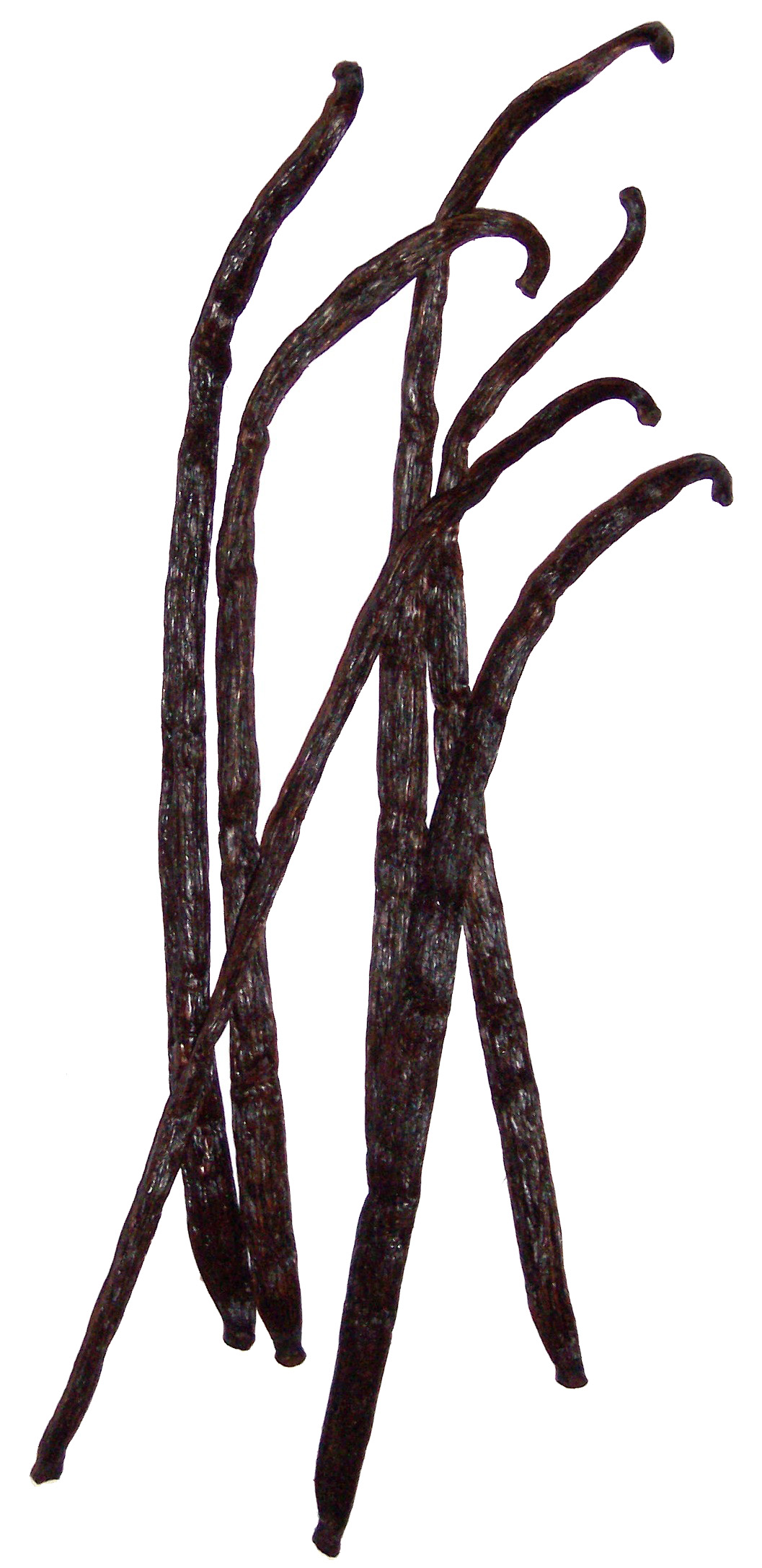
Vanilla pods by B.navez 
What's interesting about vanilla, at least vanilla planifolia, the highly aromatic species of vanilla that we use in food flavouring and perfumes, is that it really wasn't that widespread, even in the Americas and has only been found in its natural state, in a very concentrated area of southern Mexico. The Aztecs called vanilla tlilxochitl or 'black flower' as, by the time vanilla pods arrived in Tenochtitlan (modern-day Mexico city), they had dried out and discoloured, therefore the Aztecs had never seen live vanilla plants.

Of course, there are many types of vanilla and most are not aromatic. Due to the scarcity and labour-intensiveness of vanilla farming, it has become a much sought-after delicacy and could cost anything between $20 and $300 a kilo, depending on the global harvest, the second most expensive ingredient after saffron - not bad for a non-essential food!

Similar to my blog post on cloves, it turns out that vanilla is a type of flower and it's the only orchid which is cultivated as a food source, rather than for decorative purposes.  There are many artificial vanilla extracts on the market and the chances are, if you think you've tasted natural vanilla, you probably haven't!

So what drives our obsession with this hard-to-cultivate flower pod?  It seems there are three main answers: chocolate, ice-cream and soft drinks.  Vanilla has long been added to chocolate and this is how Europeans first encountered its taste. In the late 19th century, people in the United States started becoming a bit obsessed with ice-cream production, which pretty much sealed the future success of vanilla!  Also, although they don't release details of their 'secret recipes', I'm pretty sure that companies like Coca-Cola and Pepsi use real vanilla extract in the manufacture of their soft drinks.

Because of its dependency on pollination by a particular species of mountain bee that's only found in southern Mexico, vanilla cultivation didn't transfer to other parts of the world as quickly as other American plants, such as cacao and potatoes.  In his book, Ecott tells a really interesting story about Edmond Albius, the slave-boy on Réunion island who discovered the technique for self-pollinating vanilla plants and opened up the rest of the world to vanilla production.

Edmond Albius, circa 1863
Albius' fate was tied up with the racism of that time and, rather than being fêted or honoured for his ingenious discovery, white Europeans couldn't believe that a slave-boy would have the intelligence to make such an important contribution towards the world of science and many refused to recognise that his intervention in the development of vanilla production was anything more than an accident.  He died impoverished on Réunion island in 1880, during the decade when Réunion became the first place to overtake Mexico in terms of vanilla production.

Ecott also travels to some of the other great centres of vanilla production such as French Polynesia (Tahiti) and Madagascar.  As the price of vanilla is so high, there is a lot of secrecy around the industry and Ecott's book gave me an insight into a world of armed vehicles, heavily-guarded crops and clandestine flights between Antananarivo and Paris!

A bad harvest can inflate the price of next year's vanilla, as happened in 2004, when the price reached $500 dollars per kilo.  There has also recently been a hike in worldwide vanilla prices, so the drama around vanilla cultivation seems destined to continue for many years to come.

I found some really useful information on the website of the Food and Agricultural Organisation (FAO) of the United Nations.  According to their stats, the top producers of vanilla in the past two years have been Indonesia and Madagascar (both producing over 3,000 tonnes of vanilla), followed by Mexico, Papua New Guinea and China (with just around 500 tonnes each).

As you can see from the stats below, the production of vanilla in Réunion has fallen dramatically in the last twenty years, from 93 tonnes of vanilla in 1993, to just 8 tonnes of vanilla in 2013.

Vanilla production in Réunion, according to FAO

Réunion's main crop these days is sugar cane and, by way of comparison, I learned that Réunion produced almost 2 million tonnes of sugar cane in 2013 - nothing near the 460 million tonnes produced by world leader Brazil, but not bad for a small island in the Indian ocean and obviously they now produce a lot more sugar cane than they do vanilla.

In the same period, vanilla production has doubled in Indonesia and trebled in Madagascar. Something to think about next time you tuck into a tub of vanilla ice-cream!

Vanilla production in Indonesia, according to FAO
Vanilla production in Madagascar, according to FAO
Image credits:

The image of the vanilla pods is from Wikipedia and has been shared using the Creative commons license - see more details about this image on the file information page.  

The image of Edmond Albius is in the public domain and the statistic images are from the Food and Agricultural Organisation's stats portal.

Sunday, 10 August 2014

Oaxaca - How I made Mole Negro

You can learn a lot about another culture by preparing one of their traditional dishes.  Latin American food has more or less caught on in other parts of the world and most of us will have tried fajitas or burritos at some point.  In fact, I've even made enchiladas before, when I was blogging about Honduras, last year in March.

For Oaxaca, I wanted to try something more ambitious so, after some research, I settled on one of Mexico's most complicated dishes, Mole Negro.  I'd only ever heard of mole (pronounced mo-ley) in US movies and TV series, usually mentioned by a homesick Mexican character!  My main challenge was to conceptualise 'mole' - I had no idea (and I'm still not 100% sure) what a mole should look like, or taste like . . what's its texture should be.

I'll mention at this point that I don't think I was entirely successful at conceptualising/making a mole so, if you're looking for a perfect guide to mole-making, you should probably look away now!  The difference between what I'm doing in this blog and what others do in more 'foodie' blogs is that I'm learning about the culture of the place I'm blogging about, rather than expecting perfect results.  The learning experience is the result, if that makes sense?

Mexican ingredients

Dried Mexican chillies
Mole has a lot of ingredients, usually around 25 different things go into a mole sauce.  It was important for me to put the right kind of chillies in my mole, so I travelled around London trying to source as many authentic Mexican ingredients as I could find.  

My first stop was the Casa Mexico in Bethnal Green but, unfortunately, this shop was closed, even though it should have been open, according to information I found online.  I can't really recommend this shop because of this, although others have given it good reviews.  

Not to worry - wasted journey to Bethnal Green, but I was able to hop down to Borough Market at London Bridge, which is a great place to pick up all kinds of speciality foods.  For my Mexican ingredients I went to the Cool Chile Company and I'd highly recommend this for London readers who are searching for Mexican ingredients.  

Profiting from the Columbian Exchange

Four kinds of chilli
In an earlier blog post, I mentioned the Columbian Exchange which saw new foods from the Americas spreading to Europe and beyond.  My experience making mole involved three traditional Mexican ingredients; chilli, chocolate and tomatillos.  

The chillies were dried and I managed to get my hands on four different types: Guajillo, Mulato, Chipotle and Pasilla.  Most of my experience with chillies to date has involved fresh chillies and it was quite an interesting experience to cook with these dried Mexican chillies, as I got a new sense of the texture of chillies - the fact that they can have nutty, smoky or fruity tastes, rather than simply being hot and spicy.  The texture of the dried chillies was a little bit like worn leather, but they also reminded me, bizarrely, of my youth, when my grandfather would give me dulse, a kind of dried seaweed which is popular with older people in Ireland. 

It's hard to believe there was ever a time when we didn't consume chocolate (believed to come from the Nahuatl (Aztec) word xocolatl - xococ = bitter and atl = water).  I'm a big fan of chocolate, although it's only as an adult that I've tasted 'real' chocolate, the bitter Latin American kind that is best served as a drink or sauce.  I love cooking with chocolate and I was happy to find delicious Mexican chocolate at the Cool Chile Company. I think my mole tasted more of chocolate than anything else - perhaps I went a bit overboard!

Real Mexican chocolate

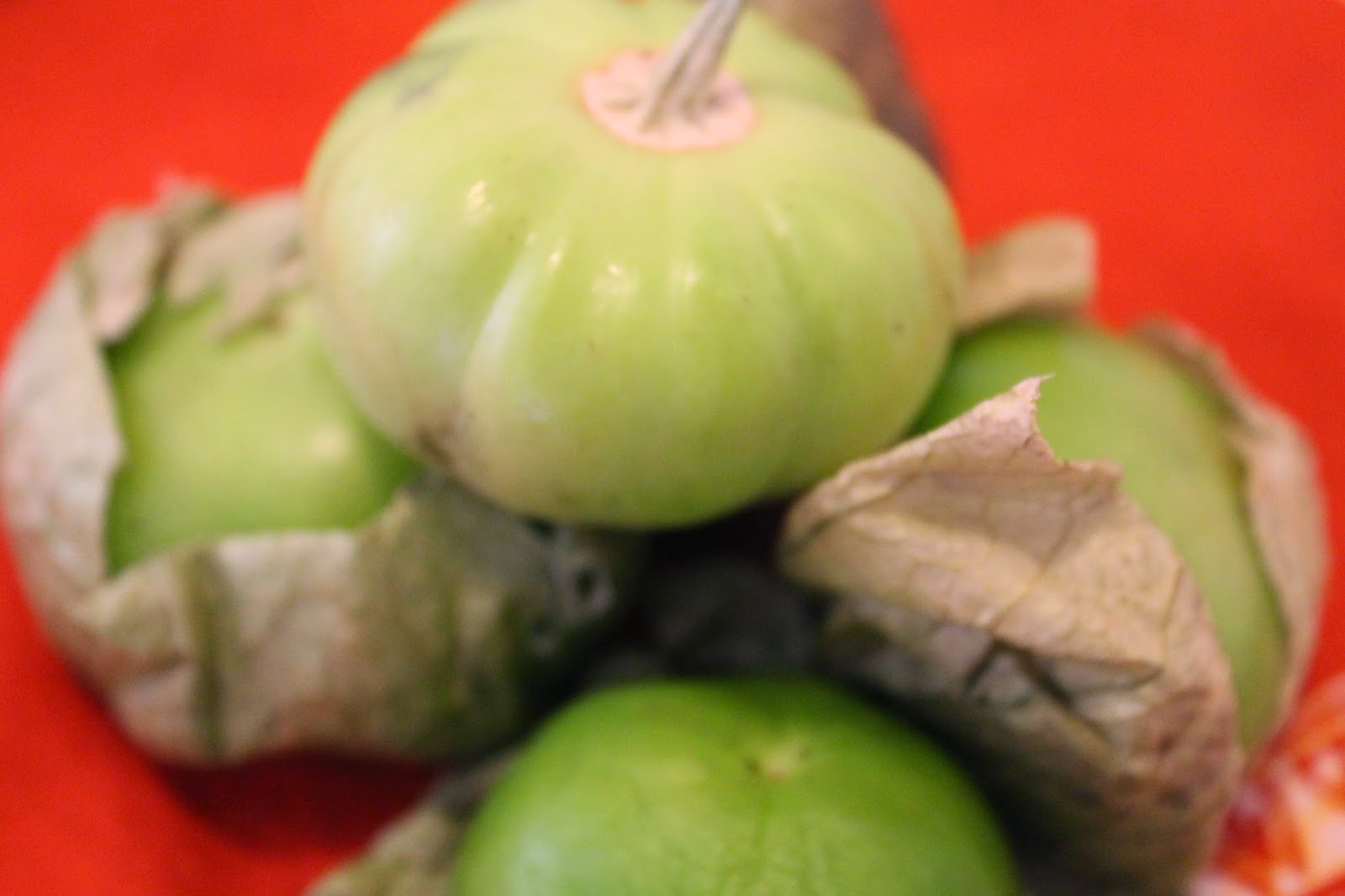
This was also my first time to prepare tomatillos and I'm still fascinated by this fruit which, although it looks a bit like a tomato, it has a different taste and is surrounded by paper-thin leaves, which you need to remove before cooking.  I like cooking new things, so I was excited about my first experience of tomatillos and I look forward to preparing them again some time in the future.

Tomatillos

The recipe

I looked at a lot of mole recipes when I was researching this dish - each one seemed to be more complicated than the last and I was surprised to learn that it would take at least five hours to prepare this dish!  I eventually settled on a recipe from La Cocina de Nathan, which seemed marginally less complicated than the others and I enjoyed Nathan's amusing approach to cooking.  I didn't blacken the tortillas, as he suggested and I also adapted this recipe to suit my own needs.  

Here are the ingredients that I used (I've included the Zapotec words, where I could find them):

For the stock:

Ingredients for Mole Negro
2 chicken breasts - pechuga de pollo/buyu
2 chicken legs - pierna de pollo/buyu
1 bell pepper - pimiento morron
2 onions - cebollas
garlic - ajo
4 tomatoes - tomates/bichooxhe
cumin - comino
3 bay leaves - hojas de laurel
chicken stock - caldo de pollo

Chillies - Chiles/Guiiña

Mulatto chillies - chiles mulatos 
Pasilla chillies - chiles pasillas - pasilla means 'little raisin' and this chilli has a fruity flavour
Guajillo chillies - chiles guajillos
Chipotle chillies - chiles chipotles - chipotle means 'smoked chilli' in Nahuatl language

Other ingredients


Best to prepare the ingredients before cooking
5 tomatillos - tomatillos
1 plantain - plátano/biduaa
2 slices of bread - pan
sesame seeds - semillas de sésamo
handful of peanuts - cacahuetes
handful of raisins - pasas de uva
1 cinnamon stick - rama de canela
black peppercorns - granos de pimienta negra
3 cloves - clavos de olor
chocolate - chocolate/dxuladi (the Zapotec word was also borrowed from Nahuatl language)
corn tortillas - tortillas de maiz/gueta

Making the mole

It wasn't that difficult to actually make the mole - just complicated and time-consuming, there is a lot to remember.

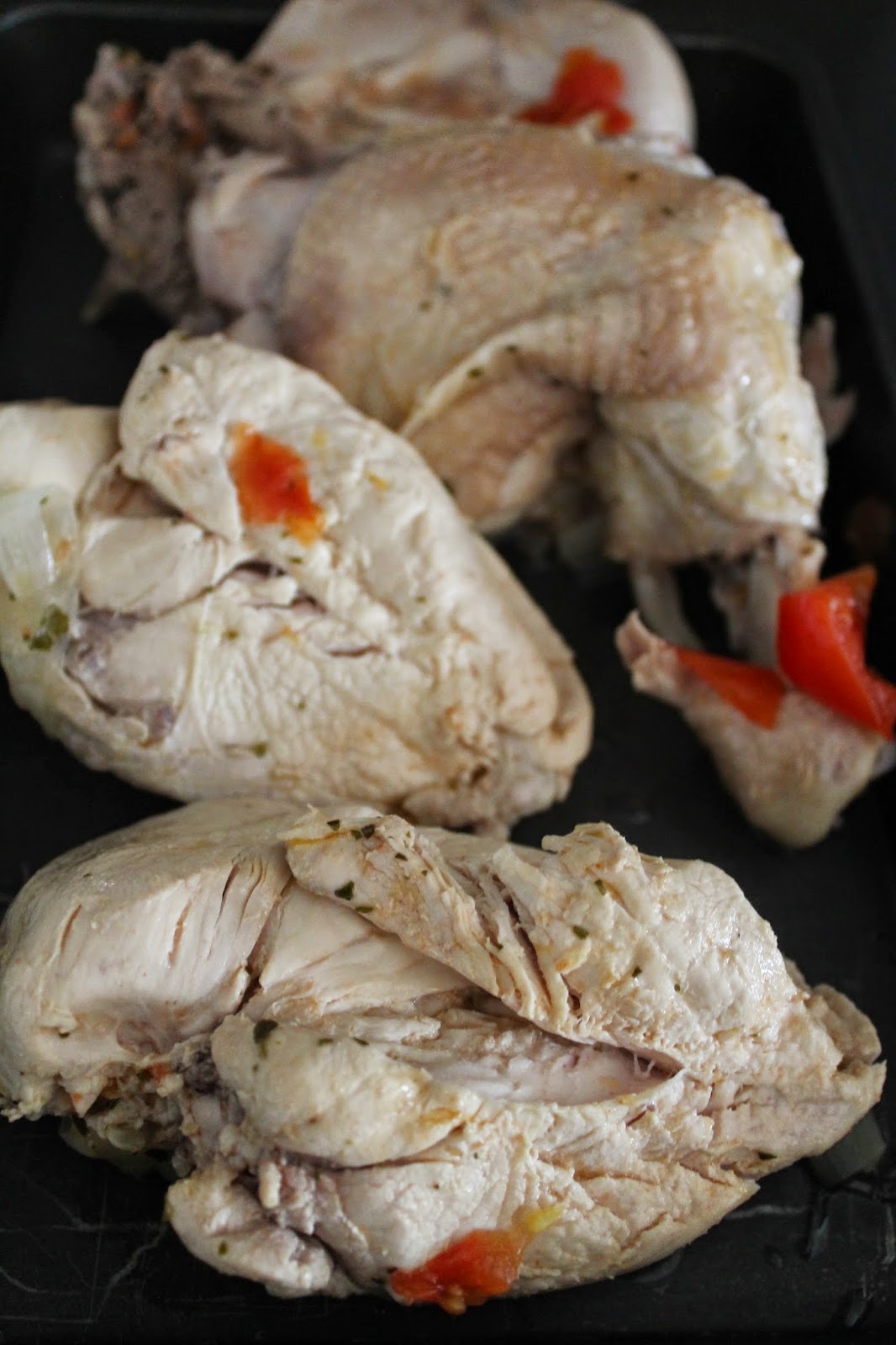
Basically you start by boiling the chicken in water and adding all of the vegetables and other ingredients to make a chicken stock.  I boiled the chicken and vegetables for around 1.5 hours, after which I put the chicken aside and added some of the stock to my mole.  I think this is probably where I went a little bit wrong - as I was trying not to add too much stock, my mole ended up being more of a paste than a liquid.  If I was making this dish again, I would add all of the stock to the other mole ingredients.

Boil the chicken

And the vegetables

Put the cooked chicken to one side

For the other mole ingredients, it's just a matter of frying everything - plantain, tomatillos, half the tomatos, one of the onions, spices, nuts, seeds, raisins and chillies. Once all of the ingredients had been fried (and this took a bit of time), I put the fried chillies and raisins into a pot, covered them with stock and boiled them for about twenty minutes.

Plantain

Peanuts, peppercorn and cinnamon

Fried chillies releasing their oils and flavours

Fried bread, of the French variety

Fried tomatillos, onion and tomatoes

Sesame seeds

Peanuts, raisins and cinnamon

After that, I blitzed all of the ingredients (except the chicken and chocolate) in my food processor, adding some stock (but not enough) to create a kind of mole paste.  I then put the paste in a saucepan and added the chocolate, bringing this to the boil before simmering for about half an hour.

Chillies and spices in chicken stock

Blitzing the ingredients in my food processor

Heat the mole paste in a frying pan
Add chocolate
Finally, I heated the corn tortillas, put the chicken on top and added my mole paste. This should really have been a proper sauce, but I didn't make it liquidy enough and should have put all of the stock and other ingredients into the food processor in batches.

Mole Negro with chicken and corn tortillas

Nevertheless, it was a fairly tasty meal and I ended up with lots of mole paste which I've been eating on toast ever since - yum yum!

Chicken with mole sauce
Image credits:

All images were taken by me on my trusty Canon EOS 1100D.  Feel free to re-use these images with the Creative commons license:

- Attribution
- Non-commercial
- Share alike