Showing posts with label cloves. Show all posts

Friday, 3 April 2015

Réunion - In Search of the Ice-Cream Orchid

When I started researching Réunion, I was interested in finding out what the island is famous for and vanilla came up quite quickly as a potential topic, which surprised me, as I had no idea about Réunion's role in the history of vanilla production.

To prepare for this blog post, I managed to get my hands on a copy of Tim Ecott's Vanilla: Travels in Search of the Ice Cream Orchid (2004), a really informative and enjoyable book, which traces the history of vanilla from its natural habitat of Veracruz/Oaxaca, to the first successful cultivation of vanilla overseas in Réunion and its later cultivation in other parts of the world.

As I've blogged about Oaxaca and the Columbian Exchange, I wasn't that surprised to learn that vanilla comes from the 'New World'.  I'm developing a default assumption that many of the world's most popular plants/food products come from the Americas (cacao, chillies, rubber, turkey, potatoes, to name but a few!).
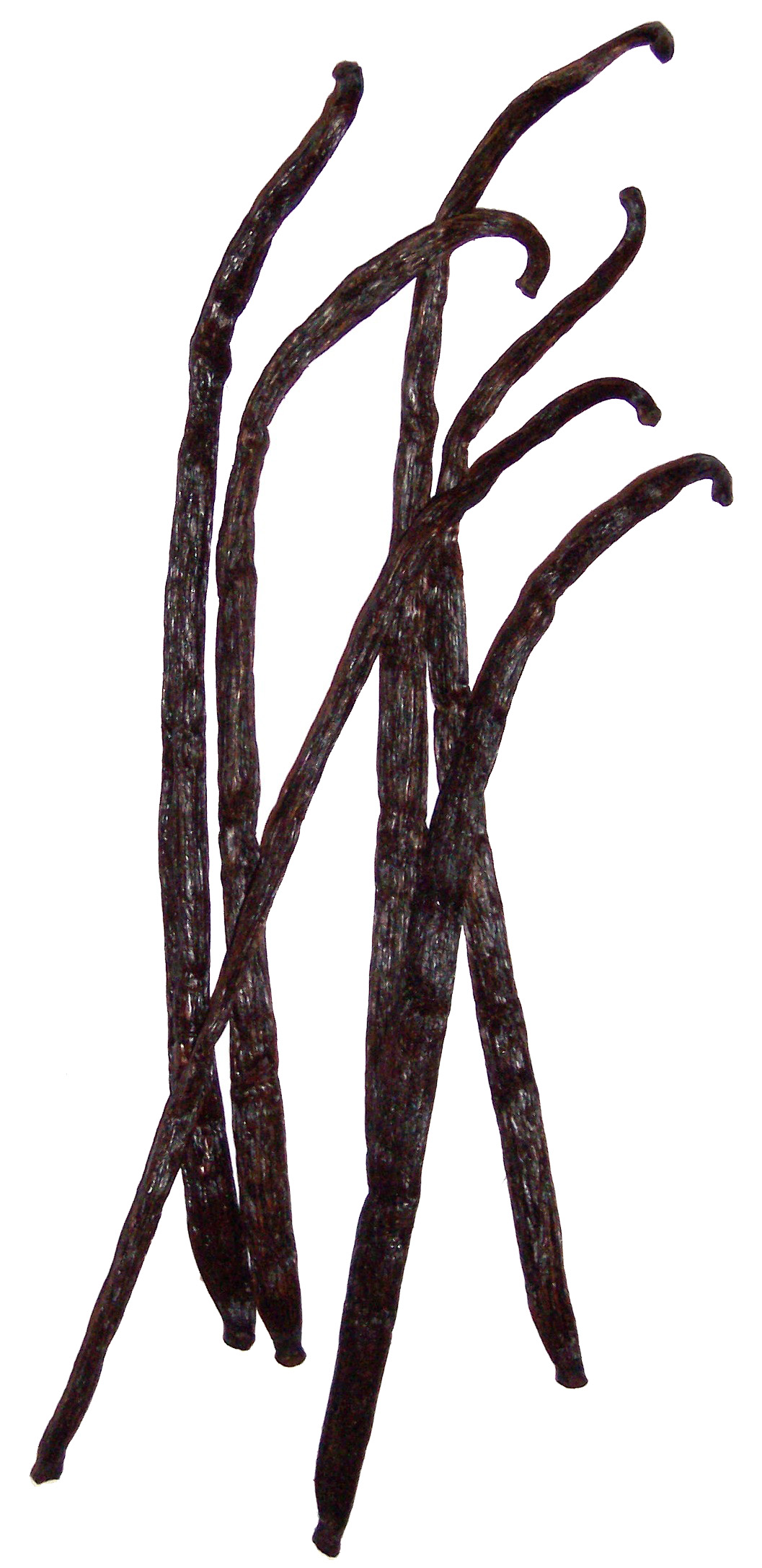
Vanilla pods by B.navez 
What's interesting about vanilla, at least vanilla planifolia, the highly aromatic species of vanilla that we use in food flavouring and perfumes, is that it really wasn't that widespread, even in the Americas and has only been found in its natural state, in a very concentrated area of southern Mexico. The Aztecs called vanilla tlilxochitl or 'black flower' as, by the time vanilla pods arrived in Tenochtitlan (modern-day Mexico city), they had dried out and discoloured, therefore the Aztecs had never seen live vanilla plants.

Of course, there are many types of vanilla and most are not aromatic. Due to the scarcity and labour-intensiveness of vanilla farming, it has become a much sought-after delicacy and could cost anything between $20 and $300 a kilo, depending on the global harvest, the second most expensive ingredient after saffron - not bad for a non-essential food!

Similar to my blog post on cloves, it turns out that vanilla is a type of flower and it's the only orchid which is cultivated as a food source, rather than for decorative purposes.  There are many artificial vanilla extracts on the market and the chances are, if you think you've tasted natural vanilla, you probably haven't!

So what drives our obsession with this hard-to-cultivate flower pod?  It seems there are three main answers: chocolate, ice-cream and soft drinks.  Vanilla has long been added to chocolate and this is how Europeans first encountered its taste. In the late 19th century, people in the United States started becoming a bit obsessed with ice-cream production, which pretty much sealed the future success of vanilla!  Also, although they don't release details of their 'secret recipes', I'm pretty sure that companies like Coca-Cola and Pepsi use real vanilla extract in the manufacture of their soft drinks.

Because of its dependency on pollination by a particular species of mountain bee that's only found in southern Mexico, vanilla cultivation didn't transfer to other parts of the world as quickly as other American plants, such as cacao and potatoes.  In his book, Ecott tells a really interesting story about Edmond Albius, the slave-boy on Réunion island who discovered the technique for self-pollinating vanilla plants and opened up the rest of the world to vanilla production.

Edmond Albius, circa 1863
Albius' fate was tied up with the racism of that time and, rather than being fêted or honoured for his ingenious discovery, white Europeans couldn't believe that a slave-boy would have the intelligence to make such an important contribution towards the world of science and many refused to recognise that his intervention in the development of vanilla production was anything more than an accident.  He died impoverished on Réunion island in 1880, during the decade when Réunion became the first place to overtake Mexico in terms of vanilla production.

Ecott also travels to some of the other great centres of vanilla production such as French Polynesia (Tahiti) and Madagascar.  As the price of vanilla is so high, there is a lot of secrecy around the industry and Ecott's book gave me an insight into a world of armed vehicles, heavily-guarded crops and clandestine flights between Antananarivo and Paris!

A bad harvest can inflate the price of next year's vanilla, as happened in 2004, when the price reached $500 dollars per kilo.  There has also recently been a hike in worldwide vanilla prices, so the drama around vanilla cultivation seems destined to continue for many years to come.

I found some really useful information on the website of the Food and Agricultural Organisation (FAO) of the United Nations.  According to their stats, the top producers of vanilla in the past two years have been Indonesia and Madagascar (both producing over 3,000 tonnes of vanilla), followed by Mexico, Papua New Guinea and China (with just around 500 tonnes each).

As you can see from the stats below, the production of vanilla in Réunion has fallen dramatically in the last twenty years, from 93 tonnes of vanilla in 1993, to just 8 tonnes of vanilla in 2013.

Vanilla production in Réunion, according to FAO

Réunion's main crop these days is sugar cane and, by way of comparison, I learned that Réunion produced almost 2 million tonnes of sugar cane in 2013 - nothing near the 460 million tonnes produced by world leader Brazil, but not bad for a small island in the Indian ocean and obviously they now produce a lot more sugar cane than they do vanilla.

In the same period, vanilla production has doubled in Indonesia and trebled in Madagascar. Something to think about next time you tuck into a tub of vanilla ice-cream!

Vanilla production in Indonesia, according to FAO
Vanilla production in Madagascar, according to FAO
Image credits:

The image of the vanilla pods is from Wikipedia and has been shared using the Creative commons license - see more details about this image on the file information page.  

The image of Edmond Albius is in the public domain and the statistic images are from the Food and Agricultural Organisation's stats portal.

Sunday, 25 September 2011

Zanzibar - the curious cultivating of cloves

When you look at Unguja (Zanzibar Island) and Pemba on the map, you can't help comparing them to two cloves studding the surface of the Indian ocean.  Trade in cloves has a long history, going back as far as Roman times. The cultivation of cloves has played an incredibly important part in the history of Zanzibar and was the source of much wealth for Zanzibar's previous owners, the sultans of Oman. 

Along with Mafia Island, which is further south, Unguja and Pemba were often referred to as 'the Spice Islands'.  These African spice islands weren't quite as famous as the Spice islands of Indonesia, Maluku, where the some of the world's most valuable spices (including nutmeg and cloves) originated. 

The flag of independent Zanzibar
Cloves were introduced to Zanzibar from the French colony of Mauritius in the early part of the 19th century.  Cloves were first grown on Unguja, before cultivation was moved to Pemba, which became the biggest clove-producer in the world.  To see how important clove production was to the country, you just have to look at the flag of the short lived independent Zanzibar, which contained two cloves on a red background. 

The Clove economy


Just as Yemen has lost out in terms of coffee production Zanzibar, in more recent years, has lost its prime position as the centre of clove cultivation.  This was mostly due to bad economic policies of Tanzania's socialist government in the 1960's, combined with a massive increase in clove production in Indonesia in the 1980's, which brought down the price of cloves on the worldwide market.  Today Tanzania ranks a distant third in terms of clove production, behind Indonesia and Madagascar.  There was an attempt to privatise the industry in 2007, but it might be a case of 'too little, too late'

An essential ingredient!


A hot whiskey by bmeabroad
I think the first time I saw a clove was in a hot whiskey, when I was about 20 years old!  We had a particularly cold winter and I have fond memories of braving the frost and snow with my sisters, to visit the local pub, hot whiskey with cloves being the best thing to melt the icicles hanging from our noses!  The taste reminded me of the stripey sweets I used to love as a child.  I now know these are called clove satins, but I'm sure we called them something else back then!  As an adult, I absolutely love the taste of cloves and use them quite a bit when I'm cooking, especially in Indian foods like curries and biryanis.

What's in a clove?


It surprised me to learn that cloves are basically flower buds that haven't yet opened.  They belong to the wider family known as angiosperms which are plants that produce seeds and flowers.  Cloves are related to myrtle and other plants such as Australian white apples and bush cherries.  They are red when harvested, but the version that reaches us on the other side of the world, looks shrivelled and black.

Etymology of the name


Cloves by me
The English word 'clove' comes from the Latin clavus meaning 'nail'.  They do look like those little wooden nails you see in traditional buildings and furniture and the nail reference has been borrowed into most languages, so you have hřebíček (little nail) in Czech, szegfűszeg (nail spice) in Hungarian, гвоздика gvozdika (little nail) in Russian etc.  

There is an interesting relationship between the English word for clove and the verb to cleave, which means to part or separate (possibly by hammering in a nail!).  The Latin name for clove is syzygium aromaticum - the syzygium bit referring to the cloves 'petals' being joined together.  

Cloves in Europe


Cloves have been used in lots of different ways around the world.  Apart from boiled sweets and hot whiskies, cloves have also been used in some European cuisines.  The Dutch seem to be particularly fond of the taste, which is not surprising, as they colonised Indonesia and cloves are used in traditional Dutch recipes for cookies and stews.  


Clove cigarettes and fragrances 


Clove cigarettes by Sarah Mae
One of the things that has been driving forward clove production in Indonesia is the fact that clove oil is used in the production of kretek ie. cheap Indonesian cigarettes.  An estimated 90% of Indonesians smoke kreteks and the kretek industry is massive, employing around 10 million people.  In the West, in the Goth sub-culture, clove cigarettes gained popularity due to their dark and pungent aroma!


In some countries like China and Japan, Oil of Cloves has been used in the production of incense and even fragrances.  By all accounts, anyone who wanted to have an audience with the Emperor of China was encouraged to chew cloves before being admitted to his presence, to get rid of the smell of bad breath.

Good for your health?


Oil of Cloves by Amanda Slater
Cloves have also been used extensively in medicine and dentistry.  Oil of cloves is a remedy for toothache and cloves are also believed to be natural anthelmintics, ie. they can get rid of parasitic worms.  In the Ayurvedic tradition, cloves are believed to increase heat in the system.  Chinese medicine also sees cloves as a 'hot' element, which can relieve stomach ache, but shouldn't be used for the treatment of 'fire' conditions.  Perhaps this passionate 'heat' of cloves is the reason why some cultures also believe they can prevent premature ejaculation!  


The Spice trade


When I was researching the history of Venice, I learned how important the spice trade was to Europe.  Wars were fought over spices and cloves and nutmeg were literally worth their weight in gold.  The search for new trade routes to India, ultimately led to the 'discovery' of America by Europeans.  Honestly, the lengths people will go to get a decent curry!  

Footage from Zanzibar in 1925


I'm going to leave you with a link to some fascinating footage from www.colonialfilm.org.uk - it was filmed in 1925 as part of the British Instructional Film's Empire series.  It's amazing really to look at images of Zanzibar from almost a century ago.  At that time Zanzibar produced around 90% of the world's cloves and this short film shows the process that was used to harvest the clove crop.  


PS - don't worry, there's nothing wrong with the sound on your computer, it's a silent movie!


Image credits:

The image of the hot whiskey with a slice of lemon and cloves is by flickr member bmeabroad - you can see more of bmeabroad's images at their photostream

The image of the cloves was taken by me.


The image of the clove cigarettes is by Sarah Mae who is a librarian, originally from Hyattsville in Maryland.  This image was taken from her flickr photostream, but you can find out more about Sarah at her website.  Djarum is one of Indonesia's biggest kretek brands, but as you can see from the photograph, these cigarettes are also sold in the United States. 


The image of the bottle of Oil of Cloves is by amandabhslater aka Amanda Slater, who is a retired Analytical Chemist from New Malden in Surrey.  Amanda has taken up digital photography on her retirement and you can see more of her images at her photostream on Flickr.  
 

Thanks to Sarah and Amanda for sharing these images with us using the Creative Commons License.