Showing posts with label gender. Show all posts

Tuesday, 20 May 2014

Nordrhein-Westfalen - The Lost Honour of Katharina Blum

I always like to discover some new literature from the place I'm blogging about so, when it came to Nordrhein-Westfalen, my research brought me to the door of Heinrich Böll, one of Germany's best-known writers.

I'd never heard of Böll before, so it was a pleasure to read his novel The Lost Honour of Katharina Blum which is set in the Rhineland, in 1970's West Germany.  Throughout his life Böll was somewhat of a rebel and, I'd imagine, a thorn in the side of the authorities - he refused to join the Nazi youth in the 1930's, although he was later drafted into the Wehrmacht.  He was interested in society's misfits and dealt with topics that were both uncomfortable and challenging for the West German government.

The novel was quite short and written in an usual style, as the narration is somehow done 'at a distance'.  I'd recommend it to anyone interested in modern German literature and, to give you a taster, I've picked out some of the novel's key themes below.

Theme: Post-war pessimism


Cologne 1945 by Gordon Ross
Böll is one of Germany's post-war writers associated with Trümmerliteratur - or the 'literature of the rubble'. Trümmerliteratur deals with the issues of a post-war society that has to deal with the physical and moral devastation caused by war.  It's well-known that Böll was strongly affected by the destruction caused in Cologne by Allied air raids.  He felt indifferent towards the new city that rose from the ashes of World War Two and his novel is full of pessimism and resentment towards the West German authorities.

Böll's novels were incredibly popular in the ex-Soviet Union, which makes a lot of sense, as he focused on the moral emptiness of capitalism and the banality of the reconstructed West Germany that was his home. Katharina Blum is unemotional and disengaged from the world around her and she is hostile to the authority figures who are pursuing her because of her involvement with Ludwig, a young left-wing radical she met at a party.

Theme: Red scare

Post-war Germany found itself divided in a new, politically-polarised world of capitalism v communism. Whilst Brandenburg and Saxony fell under the influence of the Soviet Union and eventually became the German Democratic Republic (East Germany), Nordrhein-Westfalen became the heart of the capitalist Federal Republic of Germany (West Germany) with it's new capital in Bonn.  

Böll's novel deals with the fear of communism that had such an influence on the politics of 1970's West Germany.  New left-wing organisations such as the RAF (Rote Armee Fraktion), aka the Baader-Meinhof gang, were terrorising West Germany with bank robberies and bomb attacks, kidnapping leading capitalists and killing police officers. 

I remember being amazed, when the Internet first came along, to learn about the RAF and Baader-Meinhof group - it's not exactly the kind of thing we were taught about in school and learning about this 'carefully concealed' chapter of history was my first experience of the kind of autonomy online research can provide. Despite their violent acts, the RAF gained a certain amount of sympathy amongst working-class West Germans and Katharina Blum, in a way, epitomises the ambivalence of a non-political West German towards the government's campaign on terror.

Theme: Fear of an Independent Woman

Katharina finds herself in the unusual position, for the 1970's, of being an independent woman.  After her marriage breaks down, she finds a job as a cleaner and manages to put away some money, so she can buy her apartment.  Whilst trying to establish whether or not she is really guilty of aiding and abetting a revolutionary, a lot of the 'evidence' of Katharina's guilt is based on the fact that she has her own life and could, potentially, choose any number of male sexual partners.  
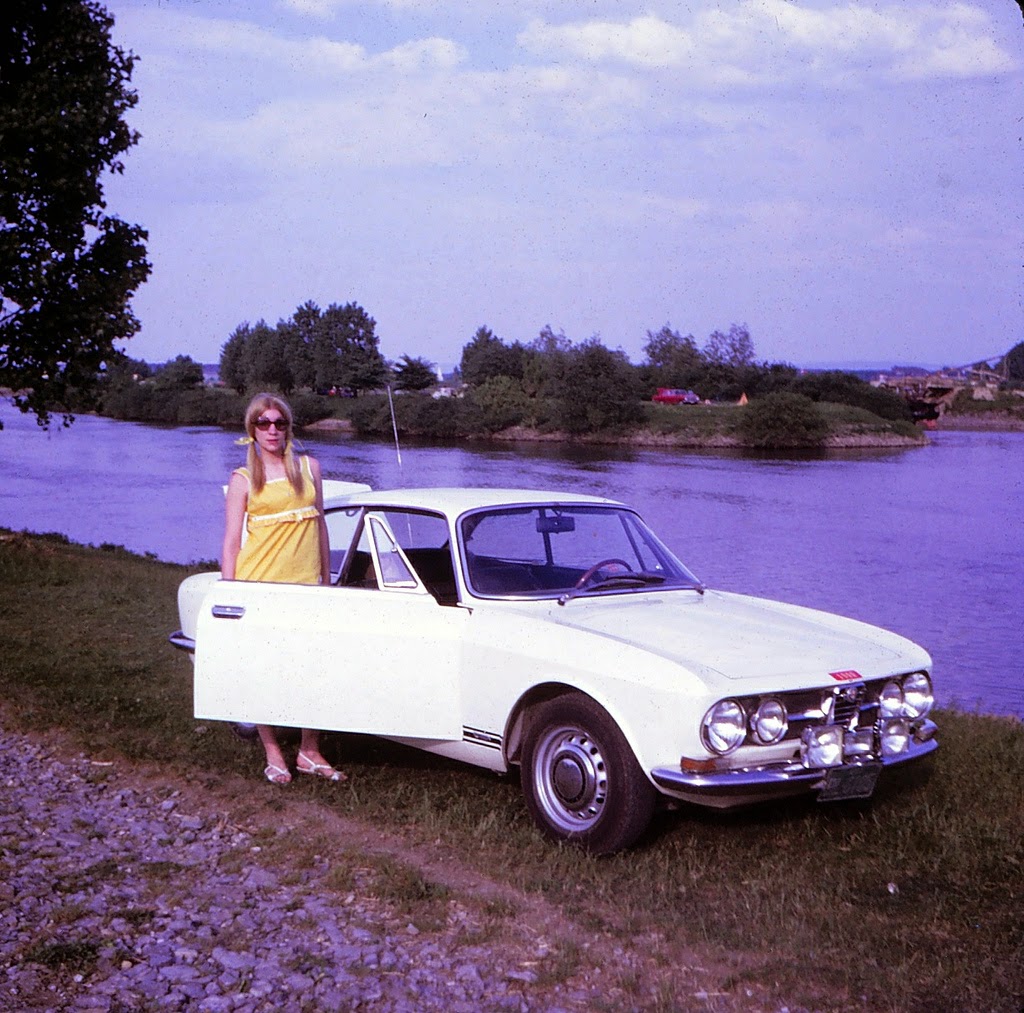
River Main, 1970 by Barbara Ann Spengler
As it happens, she was involved in a love affair with a high-ranking government official - a married man - and her efforts to protect his name make the authorities even more suspicious of her behaviour, so that the conclusion is her being found guilty.  

It's as though she is guilty of being a single woman with control over her own life and, therefore, not answerable to or under the control of any man.  Katharina, for her part, has a long list of men who've done wrong by her, despite her attempts at being independent, she is ultimately limited by the rules of a man's world.  

As a single woman she's also seen as 'fair game' by the male investigators.  When one of the investigators tries to hit on her 'she in her dry way had given him to understand that, irresistible though he might be in his own eyes, he was not so in hers'

Theme: The Power of the Media

This theme is one we understand really well today, but I think Böll's novel must have been one of the first to deal with the power that the Media has to influence the outcome of a legal process.  Because she has no man to protect her, the male-dominated media tears Katharina's life to shreds, the argument being that, as a figure of 'public interest', she no longer has the right to privacy or benefit of the doubt.

Because of her coldness and apparent lack of remorse, the Media decides that Katharina is guilty and hound her in the papers, painting her out to be heartless, communist and immoral.  It's interesting how 'appearing remorseful' can play such an important part in public trials - we've seen it very recently in the case of Oscar Pistorius.  Katharina's emotional coldness is a major factor in her perceived guilt.

Theme: The Anarchy of Carnival

I was also quite interested in the fact that the backdrop to Katharina's story is the spring Carnival - as popular in the Rhineland, as it is in Venice or southern Europe.  Carnival is a time when the normal rules that govern society are suspended - it's a chance to let your hair down and unleash your sexuality, but it's also a time of anarchy and grotesque danger.  I've noticed that carnival is quite often the backdrop for crime novels and movies.

The action of The Lost Honour of Katharina Blum starts on Weiberfastnacht, the first Thursday of the German carnival weekend, also known as the 'women's carnival'.  It's on Weiberfastnacht that Katharina goes to the party, where she meets Ludwig and brings him back to her apartment.  It really is her night, before the nightmare of the carnival weekend, when she sees her life crumbling before her eyes.  The novel ends on Rosenmontag - the biggest day of the Rhineland carnival - and the joys of those around her contrast with the miserable situation Katharina finds herself in.   

Image credits:

The image of Cologne after the Allied bombings in 1945 was shared by Flickr member, Gordon Ross, who is originally from Vancouver in Canada.  You can see more of Gordon's images on his photo stream

The image of the RAF logo is in the public domain, you can see more information at the file page on Wikimedia Commons.  

The image of the woman with the German car was taken by Flick member Ladycliff, aka Barbara Ann Spengler, who now lives in Arizona.  This photo was taken by the River Main in 1970.  You can see more of Barbara's photos on her Flickr account.  

Thanks to Gordon and Barbara for sharing these images with us, using the Creative Commons license

Sunday, 23 October 2011

Zanzibar - the home of Swahili

Spoken or understood by an estimated 100 million people, Swahili or, to give the language its official name, Kiswahili,  ranks as one of the world's major languages.  It's spoken by many people as a second or third language and the number of native speakers is much smaller, at around 5 million people.  It was the language of trade along the East African coast and, although it's a Bantu language, Swahili has many borrowings from Arabic, including the name of the language, which comes from the Arabic word for 'coast' ساحل sawahil.

The Home of Swahili

I think it's fair to say that Zanzibar is the home of Swahili language and culture.  The dialect of Unguja, Kiunguja has been adopted as the standard for all Swahili dialects.  The name Zanzibar is connected to Zanj (black), the name used by medieval Arabs for the East African coast. As the language of trade, Swahili also has native speakers in the coastal areas of Tanzania, Kenya and Somalia, as well as in the Comoros islands and, due to inland trade, there are more obscure versions of Swahili, such as Kingwana, spoken by small tribal groups in the eastern provinces of the Democratic Republic of the Congo.  It's a lingua franca in all of these countries, except Somalia and is becoming increasingly popular in neighbouring countries like Uganda.

Swahili on the web

Zanzibar street sign by Al Stevens
The BBC has its own Swahili language pages and there is a Google search engine in Swahili.  I often think Wikipedia is a good indicator of a language's web presence, as it is created by ordinary people, as opposed to a government body or initiative.  Swahili has a presence on Wikipedia, but it's fairly low for a language of its size.  Perhaps this is because people are less likely to use the Internet in places where Swahili is spoken as a native language?  There are currently less articles on the Swahili Wikipedia than on the Icelandic one and Swahili ranks 74th in terms of size, amongst the different language Wikipedias.  Having said that, it's still one of the biggest African languages on Wikipedia, only Yoruba has more articles, from the Niger-Congo language family (and, of course, Arabic, which is Afro-Asiatic).

The use of Noun Classes

Like most of the other Bantu languages, Swahili employs noun cases to categorise nouns.  These are usually indicated by prefixes, eg. m-/wa- (denoting nouns connected to people) or ki-/vi- (denoting things which are man-made, including languages).  Linguists have identified up to 16 of noun cases in Swahili, although this is a bit controversial, as it is based on the Meinhof system, which counts singular and plural noun cases separately.

For Example

There are some very good examples of Swahili noun cases on Wikipedia, one of which I'm summarising here, as I thought it was quite interesting.  It relates to the Bantu noun classes 3 m- (singular) and 4 mi- (plural), which are often called the 'tree' classes and are mostly used with things that occur naturally, but are neither human nor animal, things like . . . well, trees!  This group includes words like, mwitu (forest) and mtama (millet), but also things which are usually made from plants, eg. mkeka (mat - although these are probably made from plastic nowadays!).
Zanzibar beach by Al Stevens

This group also includes natural and supernatural forces, such as mwezi (moon), mlima (mountain) and mto (river).  The group is also extended to include 'things that spread', like the branches of a tree, so we get words like mwavuli for umbrella and moshi for smoke.  This group also includes more abstract words like mpaka (border) and mwendo (journey).  Of course, the noun class doesn't just affect the noun, but also influences the form of the adjective and verb which, I guess, means you really need to know your noun classes in order to speak Swahili properly!

Noun Classes around the world

I think it's fair to say that noun classes are a fairly unfamiliar concept to speakers of Indo-European languages (like English), although I think we do differentiate between animate and inanimate objects, to a degree.  It's interesting that noun classes tend to exist in societies that live in closer harmony with the natural world - they can be found in Native American languages, the Bantu languages of Africa and Aboriginal languages of Australia, like Dyirbal and Ngangikurrunggurr.  They're also found in a handful of Causcasian languages, notably Bats which is spoken by a small number of people in a remote mountain village in the north-east of Georgia.  I wonder if the death of animist traditions and beliefs, led to the death of noun classes in other world languages?

Noun Class v Gender

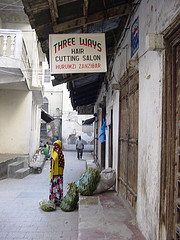
Three Ways Salon by Al Stevens
Some linguists consider the use of gender in many European languages, as a type of Noun Class.  I don't really understand what the difference is and it's worth noting that, whilst we usually think of Gender as meaning masculine, feminine or (in languages like German) neuter, actually gender comes from the Latin word genus meaning 'type' or 'class', unrelated to male/female aspects of the noun.  If you've ever studied French, I'm sure you'll have wondered why some words are considered to be masculine and others feminine!  In Russian, many of the nouns describing men use the feminine gender and I think there is enough evidence around to understand that the use of this term has been corrupted by the male/female dichotomy.

Perhaps then gender, in European languages, is a vestige of earlier, more complex, noun classes?  English has almost completely got rid of gender, each phase of 'modernisation' of the language has used gender distinctions less and less.  Perhaps the trend in language development is away from the use of noun classes?  There are certainly more nouns (or things) to talk about these days, than there were in the eras of our grand-parents and ancestors and, perhaps, this makes the categorisation of nouns too complex to even bother with?  I wonder how Swahili deals with modern inventions, such as computers or iPhones?

I'm going to leave you with a video from YouTube, which was posted by www.bookbox.com - a project which helps children learn languages through story-telling.  The story is called The First Well and is spoken in the Kenyan dialect of Kiswahili.

Image credits:

For this blogpost I wanted to highlight the work of flickrmember almacaw aka Al Stevens, who lives in a small village in Sussex.  You can see more of Al's images at his photostream and find out more about his approach to web design on his website.  

Thanks Al for sharing these images of Zanzibar using the Creative Commons license.