Showing posts with label noun classes. Show all posts

Sunday, 23 October 2011

Zanzibar - the home of Swahili

Spoken or understood by an estimated 100 million people, Swahili or, to give the language its official name, Kiswahili,  ranks as one of the world's major languages.  It's spoken by many people as a second or third language and the number of native speakers is much smaller, at around 5 million people.  It was the language of trade along the East African coast and, although it's a Bantu language, Swahili has many borrowings from Arabic, including the name of the language, which comes from the Arabic word for 'coast' ساحل sawahil.

The Home of Swahili

I think it's fair to say that Zanzibar is the home of Swahili language and culture.  The dialect of Unguja, Kiunguja has been adopted as the standard for all Swahili dialects.  The name Zanzibar is connected to Zanj (black), the name used by medieval Arabs for the East African coast. As the language of trade, Swahili also has native speakers in the coastal areas of Tanzania, Kenya and Somalia, as well as in the Comoros islands and, due to inland trade, there are more obscure versions of Swahili, such as Kingwana, spoken by small tribal groups in the eastern provinces of the Democratic Republic of the Congo.  It's a lingua franca in all of these countries, except Somalia and is becoming increasingly popular in neighbouring countries like Uganda.

Swahili on the web

Zanzibar street sign by Al Stevens
The BBC has its own Swahili language pages and there is a Google search engine in Swahili.  I often think Wikipedia is a good indicator of a language's web presence, as it is created by ordinary people, as opposed to a government body or initiative.  Swahili has a presence on Wikipedia, but it's fairly low for a language of its size.  Perhaps this is because people are less likely to use the Internet in places where Swahili is spoken as a native language?  There are currently less articles on the Swahili Wikipedia than on the Icelandic one and Swahili ranks 74th in terms of size, amongst the different language Wikipedias.  Having said that, it's still one of the biggest African languages on Wikipedia, only Yoruba has more articles, from the Niger-Congo language family (and, of course, Arabic, which is Afro-Asiatic).

The use of Noun Classes

Like most of the other Bantu languages, Swahili employs noun cases to categorise nouns.  These are usually indicated by prefixes, eg. m-/wa- (denoting nouns connected to people) or ki-/vi- (denoting things which are man-made, including languages).  Linguists have identified up to 16 of noun cases in Swahili, although this is a bit controversial, as it is based on the Meinhof system, which counts singular and plural noun cases separately.

For Example

There are some very good examples of Swahili noun cases on Wikipedia, one of which I'm summarising here, as I thought it was quite interesting.  It relates to the Bantu noun classes 3 m- (singular) and 4 mi- (plural), which are often called the 'tree' classes and are mostly used with things that occur naturally, but are neither human nor animal, things like . . . well, trees!  This group includes words like, mwitu (forest) and mtama (millet), but also things which are usually made from plants, eg. mkeka (mat - although these are probably made from plastic nowadays!).
Zanzibar beach by Al Stevens

This group also includes natural and supernatural forces, such as mwezi (moon), mlima (mountain) and mto (river).  The group is also extended to include 'things that spread', like the branches of a tree, so we get words like mwavuli for umbrella and moshi for smoke.  This group also includes more abstract words like mpaka (border) and mwendo (journey).  Of course, the noun class doesn't just affect the noun, but also influences the form of the adjective and verb which, I guess, means you really need to know your noun classes in order to speak Swahili properly!

Noun Classes around the world

I think it's fair to say that noun classes are a fairly unfamiliar concept to speakers of Indo-European languages (like English), although I think we do differentiate between animate and inanimate objects, to a degree.  It's interesting that noun classes tend to exist in societies that live in closer harmony with the natural world - they can be found in Native American languages, the Bantu languages of Africa and Aboriginal languages of Australia, like Dyirbal and Ngangikurrunggurr.  They're also found in a handful of Causcasian languages, notably Bats which is spoken by a small number of people in a remote mountain village in the north-east of Georgia.  I wonder if the death of animist traditions and beliefs, led to the death of noun classes in other world languages?

Noun Class v Gender
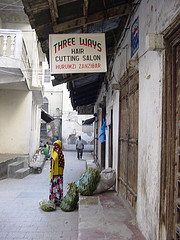
Three Ways Salon by Al Stevens
Some linguists consider the use of gender in many European languages, as a type of Noun Class.  I don't really understand what the difference is and it's worth noting that, whilst we usually think of Gender as meaning masculine, feminine or (in languages like German) neuter, actually gender comes from the Latin word genus meaning 'type' or 'class', unrelated to male/female aspects of the noun.  If you've ever studied French, I'm sure you'll have wondered why some words are considered to be masculine and others feminine!  In Russian, many of the nouns describing men use the feminine gender and I think there is enough evidence around to understand that the use of this term has been corrupted by the male/female dichotomy.

Perhaps then gender, in European languages, is a vestige of earlier, more complex, noun classes?  English has almost completely got rid of gender, each phase of 'modernisation' of the language has used gender distinctions less and less.  Perhaps the trend in language development is away from the use of noun classes?  There are certainly more nouns (or things) to talk about these days, than there were in the eras of our grand-parents and ancestors and, perhaps, this makes the categorisation of nouns too complex to even bother with?  I wonder how Swahili deals with modern inventions, such as computers or iPhones?

I'm going to leave you with a video from YouTube, which was posted by www.bookbox.com - a project which helps children learn languages through story-telling.  The story is called The First Well and is spoken in the Kenyan dialect of Kiswahili.

Image credits:

For this blogpost I wanted to highlight the work of flickrmember almacaw aka Al Stevens, who lives in a small village in Sussex.  You can see more of Al's images at his photostream and find out more about his approach to web design on his website.  

Thanks Al for sharing these images of Zanzibar using the Creative Commons license. 

Wednesday, 5 January 2011

Urals Federal District - an Introduction to the Uralic Languages

I've long had a fascination with the Uralic languages.  Having studied Linguistics at university, I already had an idea of what these languages are and (more or less) where they are spoken.  This blogpost is meant as an introduction to the Uralic languages for those of you who have no idea of what they are and where they are spoken, but it's also an opportunity for me to refresh my memory and learn a little bit more about these languages, especially about their fate in the 21st century.

So where are they spoken?

It's no coincidence that I'm writing these blogs as part of my research into the Urals - I've already mentioned the Khanty-Mansi people in my overview of the Urals Federal district, but the Uralic languages are spoken by more than 20 million people and extend way beyond the Urals region, north and east into Siberia, west into the Volga region and into Eastern Europe, where the major Uralic languages of Finnish, Saami, Estonian and Hungarian can be found. 

It's still not really known with any certainty where the Uralic languages originated - the generally accepted theory is to the west of the Urals, in the Volga region - other theories, include, Siberia, the Baltic region, even eastern Poland has been posited as a possible homeland for the speakers of these languages. What's certain is that the languages exist on both sides of the Urals, so Uralic has been adopted as a kind of compromise term.

Further sub-divisions

What I didn't really realise, prior to doing some research into the Uralic languages is that they are further sub-divided in a way that roughly divides them up into:

- languages closely related to Finnish, Saami and Estonian
- languages closely related to Hungarian
- languages that are distinct from both of these

The languages related to Finnish, Saami and Estonian are the ones in the Volga region (Mordvin, Komi, Udmurt, Mari).  The ones closest to Hungarian are the Urals languages (Khanty and Mansi).  The languages that are distinct from both of these are those of the far north, eg Nenets and Selkup and are still known by the offensive term of Samoyedic languages, from the Russian самоед (samo-yed) which literally means 'self-eater' or cannibal! 

This reminds me of when I was blogging about Togo and Greenland and came across the origin of the term Eskimo which is from the Algonquian language and means 'eaters of raw flesh'.  The term has gone out of use, rightfully so, and so should the term Samoyedic - an alternative, Samodeic has been suggested by concerned ethnologists, but it would probably be even better to have a term derived from one of the languages concerned. 

Linguistic diversity in Russia

Again, it might surprise people to know that there is a real diversity of languages spoken in Russia, very few of them being Indo-European (Russian and Ossetian being the other most-referenced Indo-European languages, although I can't help thinking of all the ethnic Ukrainians, Germans etc. that live in Russia).  Apart from the Uralic languages, there are millions of speakers of other non-Indo-European language families, such as Altaic (Turkic, Mongolian and Tungusic), Caucasian languages and even Paleo-Asiatic languages, which bridge the linguistic spectrum from Russia into Alaska and Canada.  Of course, Russian is the lingua franca and spoken by 85% of Russia's population.  Being a champion of lesser used languages, I hate to see the smaller ones disappear and certainly the advent of the Internet age is helping revive and resusicate languages which, otherwise would be dying out.

Wikipedia and the preservation of lesser used languages

I think Wikipedia is a good example of how smaller languages can be given new life.  Being open-source and created by dedicated users, Wikipedia is a perfect platform (not the only one) for those who are interested in keeping a language alive.  As part of my research, I did a quick analysis of the presence of Uralic languages on Wikipedia.  Of course, Finnish has the greatest presence, with over a quarter of a million articles on the Finnish version of Wikipedia.  It's currently the 15th 'biggest' language on Wikipedia and has more articles than, for example, the Turkish and Korean wikipedias.  Finnish is followed by Hungarian (more than 180,000) articles and Estonian (more than 81,000 articles), but many of the 'smaller' Uralic languages also have a presence on Wikipedia.

Another thing I learned about the Uralic languages in Russia is that there is a big difference in numbers between the languages in the Volga region, which have about 2.5 million speakers between them and the languages in the Urals, which have about 12,000 (Khanty) and 3,000 (Mansi) speakers.  It's probably not surprising then, that the languages of the Volga (Mordvin etc.) have their own versions of Wikipedia, whereas Khanty and Mansi don't. 

Language preserved in songs and stories

As is often the way with languages that are dying out, it is the older generation who continue to speak them  on a day-to-day basis and as a native tongue.  I guess if you are a young person who speaks Khanty and you want to seek further opportunities, for example, by finding a job in Moscow, then it's inevitable that you will end up speaking Russian most of the time and lose touch with your native language.  Like my own native language, Irish, there does seem to be something of a revival of languages on the Internet and it's become a lot easier in recent years to communicate in your native language online with people at a distance and also to access native speech and texts through online media.

Another great source of materials is, of course, Youtube and I'm pasting in a little video below posted by nurianbek225 which will let you hear the Khanty language in speech and song.  Any of you who speak Hungarian might be surprised to find similarities between Hungarian and Khanty, whose modern-day speakers live thousands of miles apart!


The structure of Uralic languages and the importance of geography

What's interesting about the Uralic languages from an Indo-European point of view is that they are so different.  If you've ever heard spoken Finnish or Hungarian, I'm sure you'll know what I mean!  What's also interesting is that Hungarian and Khanty can retain so many similarities in vocabulary and grammatical structure, despite the geographical divide and the intervention of centuries of separation, with little contact between speakers. 

In the models of language families currently accepted by Linguists the world over, stemming from the Victorian period and the scientific emphasis on categorising everything, this is proof of fact that language families exist.  However, I'm always interested in looking at things from a different angle and there are a lot of question marks around the categorisation of Uralic languages, in the same way as I suspected a certain amount of 'lazy linguistics' in the categorisation of African languages (see my earlier blogpost). 

Rather than slotting things into a box and leaving it at that, I wonder if it would be worth spending more time exploring the non-Uralic languages that have come into contact with the languages mentioned in this blogpost.  I still have a few question marks, which I'm listing below:

1. Contact with Russian:  Uralic languages are notorious for the number of noun cases they have, including things like lative (to the thing) and locative suffixes (at the thing).  Finnish has no less than 15 cases, including Essive and Marginal cases, which makes it incredibly difficult for non-Uralic speakers to learn.  Of course, Indo-European languages also have cases, but nowhere near as many and they seem to fizzle out the further West you go, with English barely keeping any of them!

Having studied Russian, I'm also aware of the fact that the Russians have chosen to retain a large number of cases.  My question is if Russian and English are both descended from a proto-Indo-European language, why did Russian keep so many cases and English get rid of them?  I wonder if mere historical contact with the Uralic languages influenced the development of Russian.  In the same way, Old English had a lot more noun cases and declinations than modern English does, which has been influenced by contact with French. 

2. Contact with Swedish and Norwegian.  A small point, but the Uralic languages use postpositions, rather than prepositions (ie. home at, rather than at home).  With my very limited knowledge of Scandinavian languages, I've also wondered why they affix the definite article after the noun (eg. hem home, hemmet home-the) rather than before, like in most other Indo-European languages that have articles.  Again, could this be the influence of contact with Finnish and Saami?

3. Contact with Turkic and Mongolian languages.  There are a lot of similarities in the grammatical structure of Uralic and Altaic languages, the most obvious being that the languages are agglutinative, ie. they keep adding syllables to the root of the word, rather than have seperate words, which can then be moved around.  The similarities are so strong tha some Linguists have suggested a link between the Uralic languages and the languages of Mongolia. 

I think the danger with Historical Linguistics is that it puts too much emphasis on lexicon, ie. languages having similar words for things, eg. comparing the numbers 1-10, whereas words are easily borrowed and shift from one language into another.  Think of the vocabulary of your grandparents and the words you most frequently use today.  Would they understand concepts such as google, wiki and twitter?  Yet these words have entered the mainstream of most modern languages very very quickly!

I think it would be better to look at the underlying grammatical structures of language and compare these, as well as using lexicon to describe a languages' relationship to the ones around it.

4. Contact with the South of India.  Something I hadn't heard of before, was the idea that the Uralic languages might bear some similarities to the Dravidian languages of southern Indian, possibly due to earlier geographical proximity or migration! 

To be honest, I find it all fascinating and look forward to doing further research into the Uralic languages at a later date. 

Image credits:

The map of the where Uralic languages are spoken was provided copyright free on Wikimedia, by wikiuser Martintg - Martintg is a prolific contributor to Wikipedia and seems to have somewhat of a specilisation in Estonia and Estonian culture.  You can see more info at his user page

The image of the poster written in Estonian was taken by me on my recent trip to Tallinn.  I've providing this copyright free with attribution (especially a link to this blogpost) and share alike. 

Saturday, 30 January 2010

Oklahoma - the Kiowa Nation

I've written a lot about Native American culture and history this month, as I believe this to be a good starting point for the US. The variety of Native American cultures is such that I've decided to focus on one Native American tribe for every state I learn about in the US.

Without even being aware of it, I've already fallen into the trap that many well-meaning outsiders fall into, which is to treat Native American culture like some kind of relic of a bygone age when, in fact, most of these cultures are alive and well. It's important to remember that Native American cultures have a present, as well as a past and a future that will (hopefully) be long and rich.

For Oklahoma, I've chosen the Kiowa tribe (pronounced like Iowa, with a K in front). Like most Native American tribes in Oklahoma, the Kiowa came from elsewhere, in this case from (what is now) Southern Canada. But they came by choice, unlike other tribes that were forcibly resettled in the Indian territory.

Kiowa is a name that they picked up from the mountains they passed through in Montana and is the Blackfoot word for 'Grizzly Bear'. Already I'm enthralled by a tribe whose name comes from their travels. The Kiowa also seem to be incredibly artistic people, with lots of Kiowa artists, musicians and handicrafts like bead-making, which they are famous for.

Although I studied Linguistics at University, I'm no great expert of the languages of North America, so I'm starting to build the blocks of knowledge about North American language groups. Kiowa and Tanoan stand almost as language isolates in the US. Linguists have tried to link them with their dominant neighbouring language family Uto-Aztec, but a link has never really been proven. I kind of wonder why linguists have tried to prove a connection, when it's obvious from history that the Kiowa and Tanoan people came from Canada?

One interesting thing about the Kiowa language is the way that they classify nouns. Anyone who has taught English will be familiar with our own system of grouping nouns into 'countable' (like chair/table) and 'uncountable' (like rice/water). Kiowa has four such categories, but also a system of prefixes that allows some flexibility.

For example, if you have a noun that is usually singular, like che (horse), you can make it plural by adding the suffix -gau, chegau = horses. In the same way, a noun like tose (bones) which is inherently plural (ie. we usually talk about more than one bone), you can make this singular by adding the same suffix -gau, so we get tosegau = one bone.

I don't know what this tells us about our cultures, but I can't help thinking that in English, the individual value of something is most important, we don't allow for inherent plural or dual, like Kiowa and other languages do. Has this got something to do with our material culture? We're always taking stock of individual possessions and counting them. Sadly, some of the earliest records written in English are lists of things (think about the Domesday book!) - it seems to be a linguistic-cultural obsession!!

When I found out that a writer of Kiowa descent, N Scott Momaday, had written a Pulitzer prize-winning novel called House Made of Dawn, I just had to get a copy.

The novel is divided into roughly three parts and, if I'm being honest, the first part was very difficult to read. I believe Momaday originally conceived the book as a book of poems and this poetic structure comes through strongly in the first part, where the narrative seems to jump around erratically and the story seeps into the cracks between the imagery and meditations of the characters.

The book is about a guy called Abel - I'm presuming this name is symbolic, Abel (Native America) being the innocent shepherd who is ruthlessly murdered by his cunning brother Cain (the White Man?).  Abel is brought up on a reservation and struggles with his place in the world, clumsily drinking his way through broken friendships and searching for a greater history of his people and the idyll of a man immersed in the natural landscape.

The second part of the book, which is much easier to read, deals with his time in Los Angeles, living the fraught life of a man out of context. His story reminded me a lot of the many 'tribes' of people who come to Moscow from all over the ex-Soviet Union, in search of a better life but with the odds stacked against them, often having their native culture corrupted and debased, home-sickness and feelings of dislocation driving them to the comforts of alcohol.

I think a lot of 'colonised' people feel that way. Being Irish, even in the 21st century, I sense my nation's trauma at having been forcefully separated from the land. What Momaday expresses in his book can't even been described as nostalgia for the loss of land and culture, it's something more than that and the only word I can come up with is 'longing' - I'm sure the Kiowa language can describe this feeling better than English. 

I look forward to learning more about the individual Native American tribes and filling in the linguistic and cultural jigsaw that makes up the American continent.

Image credits

The image of the Chief Two-Hatchett of the Kiowa nation is from Wikimedia Commons and is copyright free.

The image of the bookcover is from http://www.openlibrary.org/