Wednesday, 29 February 2012

Barbados - Fried Fish and Cou Cou

In preparation for this month's cooking task, I visited London's only Bajan restaurant, Bajan Spice which is on Nunhead Common in Southwark.  I have to say that, for such a modest, unassuming cafe, the food at Bajan Spice is pretty amazing!  I'd highly recommend it, if you're based in London, or just visiting and want to sample some Bajan cuisine.

The National Dishes of Barbados
Bajan Spice at Nunhead Common
I went with my partner and BAM (Best Aussie Mate - of Walking the Chesters fame) and between us we tried two of Barbados' national dishes - Cou cou and Pudding and Souse.  What was also great about going to Bajan Spice was that I saw how Cou cou should be made and this really helped when I came to making Barbados' national dish a day later.

Pudding & Souse
Pudding and Souse is another interesting dish, with lots of yucky things like 'pigs trotters', but it was surprisingly tasty!  Sousing is a process of pickling, used mainly with salt-fish, it was quite common on ships crossing the Atlantic, as it meant that food could be preserved for the journey.  It's interesting how Souse was then adopted in far-flung colonies like Barbados and transformed into something palatable - admittedly the addition of spices helps!

Flying Fish and Cou Cou

Fried Fish and Cou Cou
Actually, Barbados' national dish is Flying Fish and Cou Cou - but it's difficult to get your hands on flying fish, so I settled for snapper (as Bajan Spice had used red snapper in their Cou Cou recipe).  I looked at various different recipes on the Net and my end was result was a combination of several recipes.  Cou Cou is very similar to West African Fufu which is something I cooked when I was blogging about Togo

Lots of recipes had 'modernised' the dish, with lots of rich sauces and tomatoey flavours, but I was aware of the comments section on other blogs, where enraged Bajans extolled the virtues of a much simpler dish.  Also, there wasn't one recipe for this, but separate recipes for each part of the dish.  I'm afraid I might have missed the sauce part and I would definitely recommend some kind of sauce for this dish, if you decide to make it yourself. 

How to fillet a fish

Also - another good learning experience for me was how to fillet fish, as I'd never done this before!  (Any readers who've stumbled on this blog and are taking it for a professional cooking blog, please look away now!).  It was quite straight forward, although messy and I didn't have a proper 'fish tweezers thingy' to remove the rib-cage bones.  I found it really useful to watch the following video on Youtube by the Underground Cookery school, which explains how to fillet round fish, like snappers:


I'm not a big 'fish-eater' but cooking for this blog has made me aware of how important fish is to different cultures across the world.

The Ingredients 

The Ingredients
For the Cou Cou

1 onion (chopped)
8-10 okra (sliced)
a bowlful of cornmeal (and extra to thicken the Cou Cou)
butter (to grease the Cou Cou container)

For the Fried Fish

2 snappers or other round fish (filleted!)
Lemon juice
Dried thyme
Garlic salt
Cayenne pepper
Sea salt
Black pepper
Flour (or, even better, cornflour)
1 egg
Breadcrumbs

How I made Cou Cou


Mmmm . . . lovely okra!
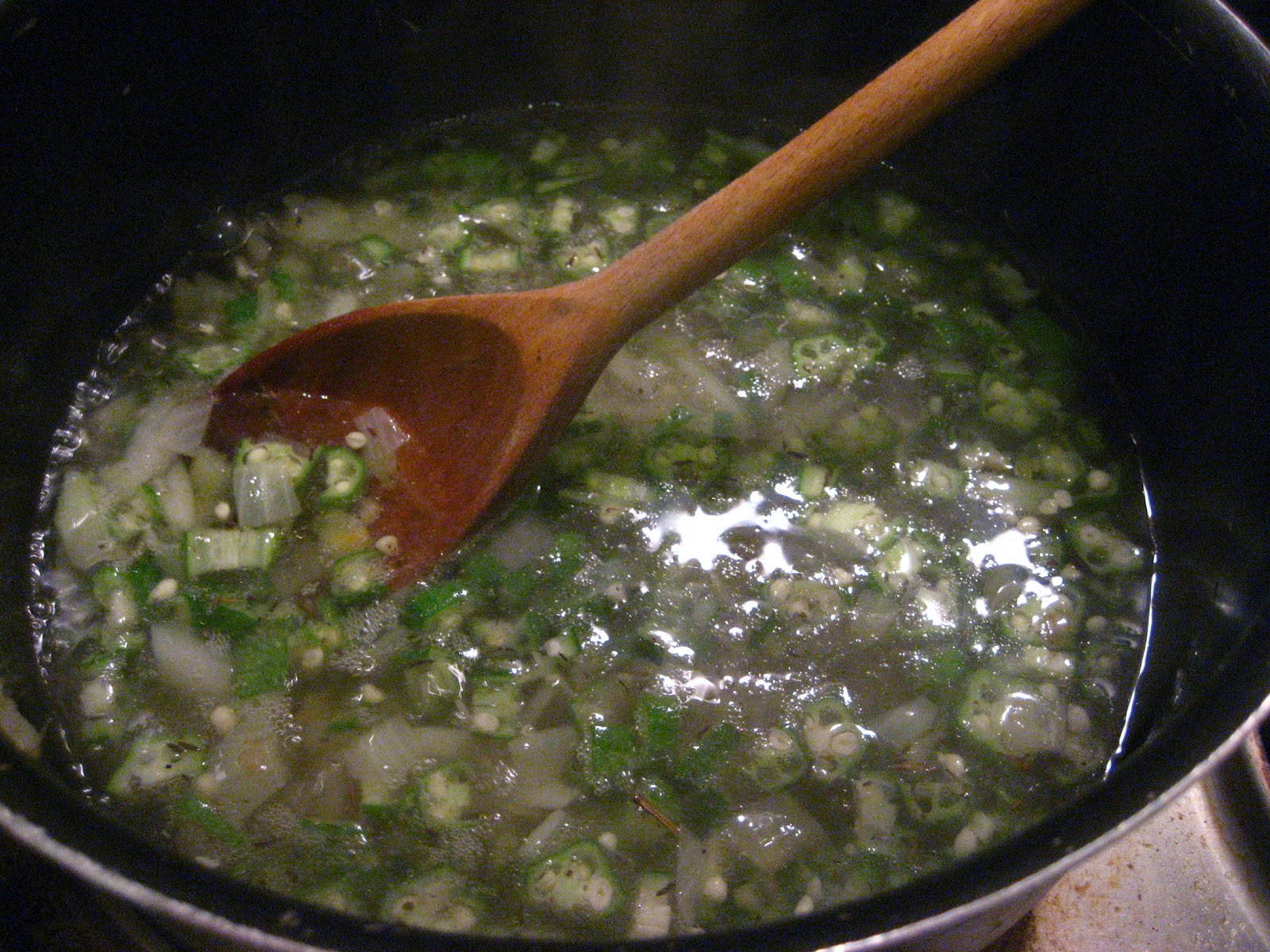
First I fried the onion, adding dried thyme to give it a bit of extra flavour.  Next I added 
the pieces of okra and let these fry for a minute, before adding a litre of water.  The last time I cooked okra was when I was blogging about Oklahoma.  Actually, reading through my Oklahoman recipe for Choctaw Catfish and Fried Okra, it's got a lot in common with Cou Cou and Fried Fish!

It's important not to over-boil okra so, after a few minutes, I removed the okra and fried onion, using a slotted spoon and put them in a bowl to be added again later.  At this point, I poured half of the liquid into a container and started stirring the cornmeal (polenta) into the remaining liquid.


Fry the onion with some dried thyme


Add the okra and about 1 litre of water
The recipes I read recommended covering the cornmeal in cold water first, but I don't think this was a great idea, as the whole mixture was very watery and I ended up using even more cornmeal to thicken it.  Thankfully, having had proper Cou Cou in Bajan Spice the day before, I had a fair idea of what the consistency of Cou Cou should be like.  Really it ends up almost solid, like a pate.

Mixing cornmeal, onion and okra

It should look something like this!


Once the cornmeal and liquid had thickened somewhat, I put the fried onion and okra back into the mixture.  After a few more minutes, I poured everything into an oven-proof container and baked it for about 10 minutes to solidify the Cou Cou.  I was quite pleased with the end result, although my photo doesn't really do it justice!

What to do with the fillet of fish

Once I had filleted the fish, I washed it in lemon juice and then rinsed it with water.  I then put the fillets into a bowl and covered them with a mixture of dried thyme, garlic salt, cayenne pepper, sea salt and black pepper.  I covered the bowl and let it marinate in the fridge for about an hour and a half (during which time I had a snooze - no one said cooking Bajan food had to be stressful!).

Wash the fish fillets with lemon juice

The spices, herbs and salts for marinating


Once marinated, I coated the fish fillets in cornflour (you could also use regular flour), dipped them in the egg, which I had beaten in a bowl and pressed them onto a plate full of breadcrumbs.  I had also prepared the bread crumbs in my food processor and I think fresh bread crumbs make all the difference. 

Hunks of bread

and bread crumbs!


Marinated, coated, dipped and pressed, I finally fried the fillets and served them up with the slabs of Cou Cou.  The Cou Cou was nice, the fish was delicious and I'll definitely be using elements of this recipe again - in fact, I'm planning a Cou Cou & Fried Chicken dish for later this week. 

Frying the fish fillets

Fried fish and Cou Cou


Image credits:

All photos were taken by me - please feel free to re-use these images under the Creative commons license:

- Share alike
- Attribute (especially to this blog post)
- Non-commercial

Some of the websites I used for the recipe were:

www.tasteslikehome.org
www.islandflave.com
www.totallybarbados.com

Sunday, 19 February 2012

Barbados - a realm in the Commonwealth of Nations

Barbados has, arguably, had a closer relationship with Britain than any of the other Caribbean islands.  The island was often referred to as 'Little England' and, like many former colonies of the British Empire, Barbados has retained elements of British culture, whether it's use of the English language, education and legal systems which are based on the British ones or the fact that Bajans drive on the left!  It should come as no surprise to find out that Barbados is a member of the Commonwealth of Nations, an inter-governmental organisation, that promotes goodwill and mutual respect between nations, most of which were part of the British Empire. 

The meaning of Commonwealth

I think the word commonwealth has become so synonymous with the Commonwealth of Nations (usually just called the Commonwealth) that we've stopped thinking about the meaning of this word.  When you think about it 'common wealth' sounds a bit like socialism, ie. that wealth should be shared amongst all of the nations' inhabitants.  One of the most famous commonwealths of history was Cromwell's commonwealth, which disestablished the monarchy and, effectively, made Britain into a republic.  The term 'common wealth' has a lot in common with the Latin res publica (public things) and the two terms are interchangeable in some contexts, which surprised me.

Commonwealths past and present

Commonwealths have existed in the past, where citizens have created a republic which, although it may have paid tribute to a monarch, was essentially run by and for the people.  Past commonwealths existed in places like Iceland and during the Polish-Lithuanian union.  Four US states; Kentucky, Massachusetts, Virginia and Pennsylvania are commonwealths and some nations officially use the title commonwealth, eg. the Commonwealth of the Bahamas (still, it doesn't quite have the same ring as the People's Republic of the Bahamas!).  When I lived in Uzbekistan in 2001, I discovered that I was living in the Commonwealth of Independent States (CIS) - an organisation committed to co-operation between ex-Soviet Socialist Republics. 

The Commonwealth of Nations flag
The Commonwealth of Nations

Formerly known as the British Commonwealth, the Commonwealth of Nations is very much a successor to the British Empire and membership of this Commonwealth is predominantly based on a nation's status as an ex-British colony.  Things have changed in recent years and countries like Mozambique and Rwanda, which were never part of the British Empire, have been admitted to the Commonwealth. 

You might wonder what the point of the Commonwealth is, but it helps to think about the fact that the Commonwealth nations have a combined population of more than 2 billion people (although if India ever left, this would change dramatically).  There's also a lot of wealth in the Commonwealth and the GDPs of Britain, Canada, Australia and India alone are a major chunk of the world's economy. 

Terminology of the Commonwealth family

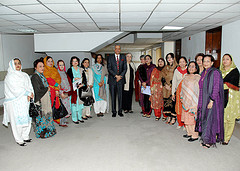
Kamalesh Sharma on a visit to Pakistan by ComSec
I've been learning some new terminology related to the Commonwealth, the first one being the Commonwealth Family.  As I understand it, this refers to a range of organisations that promote co-operation between Commonwealth countries, not just in terms of trade, but also in the fields of education, law, sport, diplomacy etc.  One the most famous members of the Commonwealth Family is the Commonwealth Games, a sporting event modelled on the Olympics.  The next Commonwealth Games will take place in Glasgow in 2014. 

Queen Elizabeth II is recognised as the symbolic head of the Commonwealth and, originally, the Commonwealth (quite ironically) excluded member nations that were republics.  This all changed when India became a republic in 1950.  Nowadays, the majority of the Commonwealth's 54 nations are republics and only 16 of the Commonwealth's countries also have the Queen as their Head of State.  These 16 countries, which included Barbados, as well as countries like Australia, Canada and the UK, are known as Commonwealth Realms.

As Commonwealth countries don't see each other as foreign nations, they don't have embassies or ambassadors in each others countries, but instead have High Commissions and High Commissioners.  It's playing with words, perhaps, but I'm sure the words carry some kind of legal import. 

Commonwealth HQ in London by ComSec
Ireland in the Commonwealth?

Over the years several nations, like Pakistan and Nigeria, have been suspended from the Commonwealth, usually because of political troubles or human rights violations.  Fiji is currently suspended from the Commonwealth and I'm sure most people will be aware of the tension between South Africa and other Commonwealth nations during the Apartheid period.  Other countries, like Zimbabwe, have chosen to leave the Commonwealth.  Even more countries, like Algeria, the Sudans and Yemen are currently applying for membership.

Ireland became a republic in 1949, before Indian independence changed the status of republics in the Commonwealth. This act was enough to sever Ireland's relationship with (what was then), the British Commonwealth.  I think Ireland's refusal to recognise the British monarch as head of the Commonwealth probably had a lot to do with it as well.  I can't help but wonder whether or not Ireland has missed out on a great opportunity for international collaboration and trade.  I'm sure we've managed to maintain good relations with many of the Commonwealth nations, in any case, but I wonder if the 21st century Commonwealth of Nations would be a much friendlier organisation for Ireland to be a part of? 

La Francophonie

As part of my research, I was also surprised to find that there is a French version of the Commonwealth of Nations, called La Francophonie.  It seems to concentrate mostly on promotion of French language, but seems to have a parallel 'family' that looks at different kinds of collaboration.  Like the anglophone Commonwealth, la Francophonie also addresses issues like human rights. 

Image credits:

The flag of the Commonwealth is in the public domain and copyright-free. 

All other images have been shared on Flickr by the Commonwealth Secretariat (flickr user ComSec).  The Secretariat is the 'civil service' of the Commonwealth of Nations.  You can see more images on ComSec's photostream and you can find out more about the Commonwealth at the organisation's official website

Sunday, 12 February 2012

Barbados - Cromwell, Red Legs and the ethnic cleansing of Ireland

 
Quite by chance, as I was browsing through a bookshop in Belfast a few years ago, I came across a copy of Sean O’Callaghan’s To Hell or Barbados: The ethnic cleansing of Ireland.  It’s a fascinating book that deals with the little known ‘white slavery’ in the Caribbean islands, when many Irish, Scottish and, indeed, poor English were sent off to islands like Barbados to work as indentured servants on the labour-intensive sugarcane plantations.

To Hell or to Connaught
The title of O’Callaghan’s book needs no explanation to anyone, like myself, who was educated in the Republic of Ireland – ‘to Hell or to Connaught’ is a phrase famously attributed to Oliver Cromwell, when he invaded Ireland and tried to force the native Irish population to move to Connaught, Ireland’s western-most and poorest province. 

The idea was to populate Ireland with Protestant Dutch and English settlers, much as Elizabeth had authorised the plantation of Ulster with Protestant settlers in the late 16th century. Needless to say, after the chaos of Cromwell’s conquest, Ireland proved to be an unattractive destination for potential settlers, who preferred to risk their lives with the savage 'Red Indians' of New England, than the unruly native Irish in Leinster and Munster. 

Ethnic cleansing in the 17th century?
Ethnic cleansing is a term that is bandied about a lot these days, stemming from the etničko čišćenje of the 1990's, that characterised the breakup of Yugoslavia.  I think it’s difficult to apply a term like this to a 17th century context, as ethnic cleansing somehow infers a concept that is particularly rooted in the late 20th century.  Having said that, it’s clear that Cromwell would have preferred to remove all native Irish (and Catholics) from Ireland and it’s scary to think that, in a 20th century context and with modern technology at his disposal, he could have committed genocide in Ireland or ‘ethnically cleansed’ the country in the way that O’Callaghan seems to suggest. 

It didn’t work, of course – the reality was that the people most predisposed to live and work in Ireland were the native Irish and Cromwell’s army found that the only way they could work the land in the 'ethnically cleansed' provinces, was by employing native Irish labour.

Indentured service in the Caribbean

Beach at Bathsheeba by IrishMBO
Another way of getting rid of lots of native Irish men, women and children was by sending them as indentured servants to Barbados.  Far from being the slightly upmarket tourist destination that Barbados is today, a trip to Barbados in the 17th century was nothing less than a death sentence.  O’Callaghan does an interesting comparison of the conditions of indentured servants versus the conditions of the slaves imported from Africa. 

He points out that, as indentured service was nominally for a fixed period of time, usually 7 years, the plantation owners had little interest in the long-term well-being or health of their indentured servants.  Slaves, on the other hand, were a long-term investment and it was in the plantation owners’ best interest to get the most out an adult slave during their working life.
Barbados Parliament by IrishMBO
For that reason O’Callaghan claims that the life of an indentured servant was, in some ways, worse than that of a slave.  He claims that they had worse living conditions than the African slaves and almost as little control over their destinies.  Many of the Irish people who were sent to Barbados couldn’t speak English and had little idea what was written in the contracts they were signing.  Worse than all of this, O’Callaghan portrays the grotesque living conditions of indentured servants – he describes how the women were often raped whilst working in the fields and how indentured servants could be beaten to death or hanged, if they tried to escape, with few legal repercussions for their ‘employers’

Anti-Irish racism
Some of the language used by Cromwell and his troops is shocking in how they described Irish people as somehow 'sub-human'.  It’s no surprise that there was little sympathy in Cromwell’s England for a race of people considered to be worse than animals.  The extreme nature of Cromwell’s Protestant revolution also meant that anyone professing the Catholic faith was considered to be a natural enemy of England.

The Irish in Jamaica
Ironically it was Cromwell’s hatred of Catholics that led to freedom for some of the Irish sent to Barbados.  His ‘Western Design’ was an attempt to take all Catholic Spain’s Caribbean possessions and bring them into the English commonwealth.  Two of Cromwell’s henchmen, Penn and Venables, led a disastrous campaign to capture the island of Hispaniola (modern-day Haiti and the Dominican Republic).  They led a rabble of thieves, criminals and newly-freed indentured servants which suffered a humiliating defeat at the hands of the Spanish. 

Not wanting to retreat from their campaign empty-handed (and therefore invoking Cromwell’s wrath), they decided to invade another Spanish island instead, even though it the island was strategically unimportant and with little natural wealth.  The campaign to capture Jamaica was successful and the island remained in British hands until the 20th century.

Jamaica provided a great opportunity for those Irishmen and women who had survived their servitude in Barbados, to start again with an offer of land and work.  There weren’t many others who were willing to colonise Jamaica and the Irish population ultimately integrated with the black slave population, which might explain why Jamaican English has a distinctly Irish lilt!

The 'Red Legs' of Barbados
It would seem as though most of the Irish who remained in Barbados completely lost their language and identity.  Many were brought to Barbados as children, with little to anchor them in their ancestral culture.  O’Callaghan describes a definite policy of (what he describes as) ‘miscegenation’, when plantation owners would use Irish women and West African men to produce a new race of mixed-race slaves, that would be the property of the plantation owners and could be employed in the fields or sent to the whorehouses of Bridgetown.  It makes pretty grim reading and it’s a shame that there is so little recorded history of what happened to Irish women and the children they gave birth to in Barbados.

Dad swimming by IrishMBO
One remnant of 17th and 18th century ‘white slaves’ in Barbados is the small population of ‘red legs’ who still live on the island.  They seem to occupy the lowest level on Barbados’ social scale and it’s unusual to come across a country where a ‘white’ population is in a lower social strata than a black population.  I find the survival of the ‘red legs’ fascinating, although they are more likely descended from Scottish settlers, who were sent to Barbados in the 18th century, than the Irish servants who were sent at the time of Cromwell. 
The ‘red legs’ of Barbados are notoriously reclusive and O’Callaghan’s attempt to communicate with these descendants of Irish and Scottish servants was relatively unsuccessful.  I wonder what responsibility, if any, Ireland and Scotland have towards these people.  Perhaps the governments of Ireland, Scotland and Barbados could work together to ensure greater opportunities and prosperity for a population that seems incredibly isolated and vulnerable?

Image credits:

The image of the book cover was taken by me.

All other images have been shared with us by flickr member IrishMBO, aka Mary Beth Kurspahic, who is a retired school teacher from the US.  Mary has lovely collection of Barbados photos, which you can see on her photostream.  You can also find out more about Mary at her website. Thanks to Mary for sharing these images with us, using the Creative Commons license. 

Friday, 3 February 2012

Barbados - Winning at Cricket in Babylon

Writing this blog gives me an opportunity to research unfamiliar topics.  As I’ve been learning about Barbados, I’m beginning to understand the cultural importance of cricket, not just to this tiny island nation, but to other former British colonies in the West Indies.  It has been interesting to learn how this most English of sports was once dominated by the West Indies, just as the sport is dominated by other ex-British colonies today. 

Cricket is not a sport I grew up with.  Although Ireland has a national cricket team, it’s all very low-key and the game carries an association with England and colonisation that is much more negative than it appears to be in the Caribbean or India/Australia/Pakistan.  Even in England, it seems to be somewhat of an upper-class game and I find it very quaint, when walking in the English countryside, to see the cricket teams in their white flannels whiling away a summer’s afternoon.
Fire in Babylon

Cricket on the beach by Republic of Avalon Radio
As part of my research I watched a fascinating documentary called Fire in Babylon.  The documentary was released (in the UK) in 2011 and, even if you have no real interest in or knowledge of cricket (like me), it’s well worth watching.  The film tracks the history of the West Indian cricket team and explains how they came to dominate Test Cricket (ie. International cricket matches) in the late 70’s and during the 1980’s. 

The movie also explains how winning at cricket has been incredibly symbolic for the ex-British colonies in the West Indies. By becoming a dominant force in world cricket and defeating England on their home turf, the people of the West Indies were able to restore a sense of pride to their culture and competed with their ‘ex-masters’ on an equal footing.
Cricket - a violent game?

Cricket player by Alister667
One thing I hadn’t realised about cricket is how incredibly violent it can be.  Fire in Babylon documents the way the Australian team changed cricket in the 70’s, by introducing ‘fast bowling’, an incredibly dangerous form of bowling that can see batsmen injured or even hospitalised.  The Australians thrashed the West Indies team during the 1960’s, until the West Indies decided to do some fast-bowling of their own and got their revenge, defeating England in 1973 and Australia in 1975. 

The West Indies team has produced some of the world’s most formidable fast bowlers and I can’t imagine how hard it must have been for their opponents to bat against balls that were bowled at up to 95 miles per hour!
The Calypso Cricketers

The documentary also explains the racism faced by the West Indies' cricket team, initially a patronising racism, referring to the West Indies team as the ‘Calypso cricketers’ when they played in Australia in the early 60’s, the racism became more hostile, as the West Indies started defeating the white European and South Asian teams.  All of this was happening at a time when the Civil Rights movement was in full swing in the United States and the Apartheid regime was at the height of its power.

Babylon v the Rastafarian movement

The name of the documentary refers to the Rastafarian term for ‘non-African nations’, ie. Babylon.  Rastafarianism exists all over the Caribbean and espouses a return to African culture and pride.  Its most famous proponent was the Jamaican, Marcus Garvey, but I’m sure Barbados has had its fair share of Rastafarian thinkers. 
West Indian unity through sport

What’s also quite interesting about the West Indies cricket team is that the sport managed to unite the West Indian nations in a way that has never been possible politically.  Political unity was tried out, when West Indies Federation was formed - a short-lived political union that lasted from 1958 to 1962.  When the chance came, the British islands of the Caribbean preferred to choose their own paths and independence. 
Famous Bajan cricketers

George Headley, the 'black' Bradman
Barbados has produced a fair share of the West Indies’ best cricketers.  I watched part of another (Australian-made) TV series, Legends of Cricket, which included a few episodes about famous cricketers of the West Indies. This included Bajan players such as, George Headley, known in Australia as ‘the black Bradman’ (although Bradman is known in the West Indies as ‘the white Headley!).  Also, Sir Frank Worrell, who is considered to be one of the most graceful players in cricket history.  There was also the ‘rock star’ of Test Cricket, Sir Garfield Sobers, who learned to play cricket on the beaches of Saint Michael. 

Something that really struck me about the Australian-made documentary was the deference paid to the West Indies cricketers by the modern Australian (white) sports commentators and cricket-players, who were interviewed for the show.  It’s unusual to see white people talking about their ‘black heroes’ and it would seem that the West Indies cricket team earned the respect of a white audience that might, otherwise, have been incredibly racist and hostile.  
Is West Indian cricket in decline?

I guess I’m beginning to understand how cricket can be a great source of unity for countries located on opposite sides of the world.  True, it’s incredibly exclusive and there is a limit to the number of national teams that can play Test Cricket.  Unlike rugby, the French haven’t really taken up the sport and neither Scotland nor Wales are not represented in Test Cricket, which makes it feel like a very English game.  Still, it is an important part of English culture and a positive link with parts of the world, like Barbados, that share a lot of history with England.
By all accounts, the popularity of cricket is waning in Barbados and other West Indian nations.  Young Bajans, Jamaicans and Trinidadians are looking more and more to the United States and basketball as an opportunity to express themselves through sport.  It would be a shame to see West Indian cricket go into decline, but I guess it's natural for young sportsmen and women to find those opportunities that are most relevant to their generation.  I wonder if cricket in England is facing the same competition from other more 'high-profile' sports such as football (soccer)?

Image credits:

The image of the young boys playing cricket on the beach in Barbados is by flickr member Republic of Avalon Radio aka Jim Fidler who is from Newfoundland in Canada.  You can see more of Jim's images on his photostream.

The image of the cricket player is by flickr member Alister667, aka Ali Jackson.  Again, you can see more images by Ali on his photostream.

The image of George Headley is from Wikimedia Commons and is in the public domain (and therefore copyright free).  You can see more information about this image at its description page on Wikimedia. 

Sunday, 15 January 2012

Barbados - Pride and Industry

It's 1800 kilometres (1100 miles) north from Manaus, the capital of Amazonas, to Bridgetown in Barbados, the place that I will be blogging about for the next month or so.

Barbados is one of the those places I've always dreamed about visiting.  I've only ever been to the Caribbean once, to Cuba, but Barbados would be high on the list for my next visit.  The country's motto is Pride and Industry and, from what I have read about Barbados so far, they have good reason to be proud; of their culture, of their democracy and the fact that Barbados is considered to be somewhat of a success story in the developing world.

Beach in Barbados by Loimere
It's a tiny country - the smallest one I've blogged about so far - it's slightly bigger than the Isle of Wight, a bit smaller than Lantau Island in Hong Kong and roughly the same size as Brooklyn and Queens put together.  I've also discovered that it's located a little bit apart from the other Windward islands of the Caribbean (eg. Martinique, St Lucia or St Vincent) lying about 100 miles to the east of the Windward chain. 

Barbados is also geologically different than its 'neighbouring' Windward islands.  Whilst they are mostly the volcanic summits of submerged mountains, Barbados is made up of coral and protected from the seas by a series of reefs.  It's very flat compared to other Caribbean islands and the difficulty of navigating ships to Barbados meant that, despite its Portuguese name (meaning 'beards'), Barbados remained continuously in the hands of the English from the 17th century until it gained independence in 1966.

Anglican-style church in Barbados by Loimere
Barbados has often been referred to as 'a little piece of England in the Caribbean' and ties with the UK remain strong.  It's believed that the island was originally inhabited by the Taino, a Carib people whose disappearance from Barbados is unexplained.  One theory is that the entire native population was transported by the Spanish to work on their plantations in Hispaniola (compare the fate of the Carib tribes in my earlier blog post about Jamaica). 

The word hurricane comes from the Taino word for their 'storm God', Juracan, who lived on El Yunque mountain in (what is now) Puerto Rico.  When he was angry, he would stir up the winds and seas and wreck havoc on the Caribbean islands, much as hurricanes do today!  Although Barbados lies directly in the path of many hurricanes, they tend not to hit the island directly and usually pass harmlessly northward. 

A busy street in Bridgetown by Loimere
The national language is English, but most people speak a dialect of English called Bajan. The dialect is believed to have been influenced  by languages of West Africa, such as Yoruba.  Like Yoruba, Bajan has no past tense, pronouns such as we have no accusative form (like English us), eg. in Bajan you would say - He see we (not He saw us). 

I'm hoping that, in the next few weeks, I'll be able to experience more Bajan culture.  I want to cook a traditional Bajan dish and read one of Barbados' most famous novels, In the Castle of my Skin by George Lamming.  I want to learn more about the role of sugar in the Atlantic slave trade.  I want to find out more about the West Indies' love affair with cricket, that most English of games!

Scene from The Tamarind Seed
I've already started listening to Calypso music and, as an introduction to Barbados, I watched a 1974 movie called The Tamarind Seed, starring Julie Christie and Omar Sharif - one of the few movies to be set in (and filmed in) Barbados.  I really liked the movie, which is about a love affair between a young English woman and a Soviet military attache.  You can catch glimpses of the island, as they drive around the countryside looking for a Tamarind tree that Julie Christie's character believes will have unusual seeds, shaped like the face of a man.  It's a movie about innocence and espionage.  The glimpses of Barbados were tantalising, but not nearly enough to satisfy my curiosity! 

Image credits:

The photos of Barbados, used to illustrate this blog post, were taken by flickr member, Loimere, aka Derek Hatfield, who is a self-confessed 'geek with a personality' from Wawa/Thunder Bay in Ontario.  You can see more of Derek's work on his website

The image of the still from the movie, The Tamarind Seed is from a photo taken by me. This image is being used to illustrate this blog post and promote Blake Edward's film. By publishing this image, I'm not condoning or encouraging reproduction of this image on the Internet or anywhere else. This image is not meant to bring the actors into disrepute or suggest their endorsement of this blogpost, but is meant to highlight the performances of these actors in this movie.

By coincidence, this is the second time I've blogged about a movie starring Julie Christie and Omar Sharif - see my earlier blog post about the movie version of Dr Zhivago

Saturday, 7 January 2012

Amazonas - Pichocu rü iperütogü

I'm going to finish my blogging about Amazonas with a greeting from the Ticuna language, which is spoken by about 25,000 people in Brazil.  Pichocu rü iperütogü means 'welcome' and, despite the fact that this is my last blog post about the Brazilian state of Amazonas, I feel that I'm just at the beginning of my Amazon journey, as possible themes for the future branch out in all directions. 

A summary of the themes so far

In the month or so that I've been blogging about Amazonas, I've learned about the History of the Amazon region and the fight for survival faced by its indigenous peoples.  I've learned about Dilma Rousseff, Brazil's first female President and I've learned about the many tributaries of the Amazon, mighty rivers in their own right.  I learned about the music of Brazil and the importance of rubber in everyday items around the world.  This month I taught myself how to make Peixe Assado com Farofa - cooking a dish from the region is always one of my favourite forms of research! 

Other themes

Other themes that I would like to explore further, at a later date, are:

Paradise, or the Garden of Eden

A comparison of the world's biggest forests/jungles
Jiu Jitsu, which is incredibly popular in Amazonas!
The symbolism of the Southern Cross
Butterflies
The different Amazonian tribes and their languages
The Garden of Eden
The Tordesillas Treaty, dividing the world between Spain and Portugal
The myth of El Dorado
The Jaguar
The Madeira-Mamore Railway
The Amazon River dolphins
Orchids
The story of Forlandia

Other research

As part of my research I read three books:

The Fate of the Forest: Developers, Destroyers and Defenders of the Amazon was written by Susanna Hecht and Alexander Cockburn.  It's a really interesting book, but quite heavy-going and academic with a wealth of information about the history of the Amazon region.  One of main themes that the book addresses is the danger of romanticising the Amazon and the natural world. 

Hecht and Cockburn argue that our ideal vision of places like the Amazon are as big, empty, pristine forests, protected from the environmental destruction of man.  Often in our attempts to save the environment, we don't really consider man as part of that environment and this is something, the book argues strongly, that we shouldn't lose sight of.  The Amazon has suffered terrible environmental damage from rubber extraction, gold mining etc., but there has also been a human price, with the loss of population and culture amongst the Amazon's tribes.  The ideal picture that many of us hold in our imaginations - a 'big, empty forest with no people' has major implication for the Amazon's indigenous tribes, who have been living there for hundreds of years. 

Book covers by me
I also read a travelogue called The River of Singing Fish by Polish-born writer and adventurer, Arkady Fiedler.  Despite the interesting title, the book itself was a bit dry, full of an affected personification of the Amazon's animals, it also had a thin veneer of racism that might have been acceptable when the book was first published in 1935.  It was mildly amusing, but I wouldn't really recommend it.

I also read a novel called At Play in the Fields of the Lord by Peter Matthiessen, which I would recommend.  It tells the story of a missionary couple and their child, who travel to a remote Amazon tributary in Peru, in an effort to convert the (fictional) Niaruna tribe to Christianity.  Another major character in the novel is a 'soldier of fortune' called Moon, an American adventurer of Native American heritage.  The novel explores the tensions between the missionaries and their misguided attempts at communicating with the Niaruna, but also shows a parallel spiritual journey of Moon, who goes native and ends up living with the Niaruna and adopting their customs.  It's a really interesting book and I wish I had more time to blog about it!  Apparently there is a movie version, but I couldn't get my hands on it.

As well as reading, I watched Bruce Parry's TV series Amazon, which was really interesting as an overview of the whole region.  I also watched John Boorman's The Emerald Forest starring his son, Charlie Boorman who plays a young man kidnapped, as a boy, by an indigenous tribe and brought up in their culture.  I thought it was a really interesting movie, although the depiction of the 'bad tribe' was a bit simplistic. 

Dinner Party Trivia

I've learned some interesting facts along the way, which I'll add to my growing repository of dinner party trivia!  I learned that:

- The Amazon contains 1/5 of the world's fresh water
- Uruguay used to be Brazil's most southernmost state, known as Cisplatina
- Brazil was the last country in the Western hemisphere to abolish slavery, in 1888
- the current native 'Indian' population in Brazil is around 300,000 people
- the term 'Rice Christian' is used, pejoratively, to describe people who convert to Christianity for economic or food gain
- Ayahuasca is a psychedelic drug that is used ceremonially by Amazon tribes people
- Manaus, the capital of the Brazilian state of Amazonas, means 'Mother of the Gods'
Women dancing by Gustavo Morejon
- Amazonian tribes include the Kalopalo, Tembe, Timbira, Guajajara, Omagua, Mayoruna, Tapajos, Txukahamei, Suya, Mundurucu, Kayapo, Apinage, Craho, Yanomami and many others
- Roger Casement, the Irish patriot, exposed the barbaric enslavement of indigenous tribes people on the Putumayo River in 1912
- there are an estimated 5 million species living in the Amazon region
- palynology is the study of pollen, an important component in paleoecology
- some of the Amazon's tribes believe that fire was stolen from the Gods by the Jaguar, which is similar to the European Promethean myth
- an epiphyte is a plant that grows on top of another one (orchids often do this), without feeding off it
- successional vegetation refers to sun-loving plants that pop up in the places where trees are felled
- Brazilian laws which are referred to as pra ingles ver (for the Englishman to see) are laws which are made to please foreigners and which the government has no intention of enforcing

Image credits:

The reproduction of Paradise or the Garden of Eden by Lucas Cranach the Elder is from Wikicommons and is in the public domain.

The wonderful image of the tribes women dancing is by flickr member Gustavo Morejon, who is a blogger and photographer from Ecuador.  You can find out more about Gustavo's work on his website. Thanks to Gustavo for sharing this image with us using the Creative Commons license. 

Monday, 2 January 2012

Amazonas - How I made Peixe Assado com Farofa

I've struggled a bit to find a suitable dish from Amazonas that I could learn how to cook.  The most traditional dish from this region seems to be Pato no Tucupi or 'Duck with Tucupi sauce'.  Tucupi sauce is made with the liquid extracted from wild manioc roots and is poisonous unless boiled thoroughly.  Try as I might, I couldn't find anywhere to buy Tucupi sauce in London and, not wanting to poison myself by making my own, I resorted to searching for another Amazonian-style dish that would be easier to prepare! 

I'm calling the dish I made Peixe Assado com Farofa, which sounds a lot better than 'Baked Fish with crumbs', which is the English-language translation!  Farofa is a very traditional Brazilian side, made from Cassava flour.  I imagine that the people of the Amazon would eat their farofa with Pirarucu (also known as Arapaima) but again, being London-based, I settled for a nice piece of cod.  Whilst it would have been great to taste a real Pirarucu, it's not an ethical option (not to mention the cost).  The Brazilian government has banned commercial fishing of Pirarucu, due to it's vulnerable conservation status, so I don't expect to see this Amazonian monster on supermarket shelves in the UK any time soon.

Ingredients for Farofa
Ingredients:

For the Farofa:

Chilli oil - óleo de pimenta
150g butter - manteiga
1 onion - cebola
1 red chilli - pimentão vermelho
200g Cassava (manioc) flour - farinha de mandioca

For the Baked Fish:

500g cod fillet - filetes de bacalhau
1 bell pepper - pimentão
2 spring onions - cebolinhas
3 plantains - bananas-de-terra
3 tomatoes - tomates
raisins - passas de uva
prunes - passas de ameixa
black olives - azeitonas pretas
3 eggs - ovos
Fresh coriander - coentro fresco

Preparing the Farofa

I did this bit last, but when I make this dish next time, I'll prepare the farofa first, which will give it a chance to cool down.  I started by heating some chilli oil in a frying pan.  Once the oil was hot, I added loads of butter - farofa can be quite dry, so it's good to add lots of butter (not to mention that butter is one of my main vices!).  Almost immediately afterwards, I added the chopped onion and chilli, frying these for a few minutes to let them soften.  Finally I added the Cassava flour and stirred this into the mixture until it formed a crumb-like mixture - I continued to fry the mixture for a few minutes before transferring it to a plastic bowl.

Heat the oil and melt the butter

Add the chopped onion and chilli

Fry until the onion softens

Add the flour and mix to get crumbs


This is the third time that I've cooked with cassava/manioc (see my earlier blogposts on West African Fufu and Paraguayan Payagua Mascada).  I'm not sure that I'll ever get used to the 'woody' taste of cassava and it's amazing to think that this root is eaten by millions of people around the world every day! I didn't quite realise that farofa is often crumbled over the top of a dish to give it a distinctive woody taste.  In retrospect, I might have preferred this to the patties that I made out of the farofa (no doubt I've been influenced by having made Payagua Mascada and Fufu). 

Preparing the fish

This bit was easy although, rather surprisingly, I realised that I've never baked fish before!  For anyone reading this blog for the first time, I'd like to reiterate that this post is in no way meant to be a professional guide to baking fish or preparing farofa! 

Prepare the fish

Add the chopped vegetables


I pre-heated the oven at 180 degrees celsius, put my cod fillet into a metal container layered with tin foil and olive oil, to prevent the baked fish from sticking to the tin.  I then added the sliced peppers, spring onions, plantain and tomatoes and baked these in the oven for 30 minutes.

After 30 minutes, I took the dish out of the oven and added the olives, raisins, prunes and coriander.  I could have added the raisins and prunes to the farofa, instead of the main dish and this is something I'll consider next time round. 

Add the olives, raisins and prunes


I baked the fish and vegetables for another 15 minutes before adding the cassava patties and topping with three fried eggs.  I then covered the whole dish with tinfoil and put it back in the oven for 10 minutes on a much lower temperature (120 degrees and then 0). 

I impressed myself with the results and I'm really pleased that I learned how to make farofa and bake fish!

Top with fried eggs and farofa

Plate up!


Sources:

All photos are by me - please feel free to reuse these using the Creative Commons license:

Attribution (especially to this blog)
Share-alike
Non-commercial

I looked at a variety of sources which influenced the way that I made this dish.  The most important of these was the following Youtube video from Cucabaruca.com (Nando Cuca), which taught me how to make farofa.  Enjoy!