
I've come across the word palava or palaver already during my research, as the name of the meeting houses in Liberian villages, where elders make important decisions about community issues.
We use the word palaver in English, in quite a negative way, to describe an unnecessary fuss, eg. What a palaver! It's thought that the origin of the word might be from Portuguese palavra which means word - although the palava dish is so spicy, I couldn't talk much as I was eating!
Liberia is the 32nd place that I've blogged about and the fifth African one - for each place that I've blogged about, I've tried to cook one of their national or regional dishes. I have to stress at this point that this is a blog about culture, not a blog about food (although the food posts are always very popular!).
If you want to see a proper food blog about palava have a look at Celtnet.org where I got my recipe - this is a great resource for any interested in 'world food' and I've used this website many times. I also found a really cool foodie blog called Kayotic Kitchen which has a great chicken palava recipe.
My intention when blogging about food for Learning about the World is to understand the food culture in the places I blog about, by comparing the ingredients and trying to recreate these national/regional dishes with what I have available in my local shops in London. I quite often have to (or even want to) substitute some of the ingredients in the original recipes and this process, in itself, is part of my learning experience.
The ingredients:
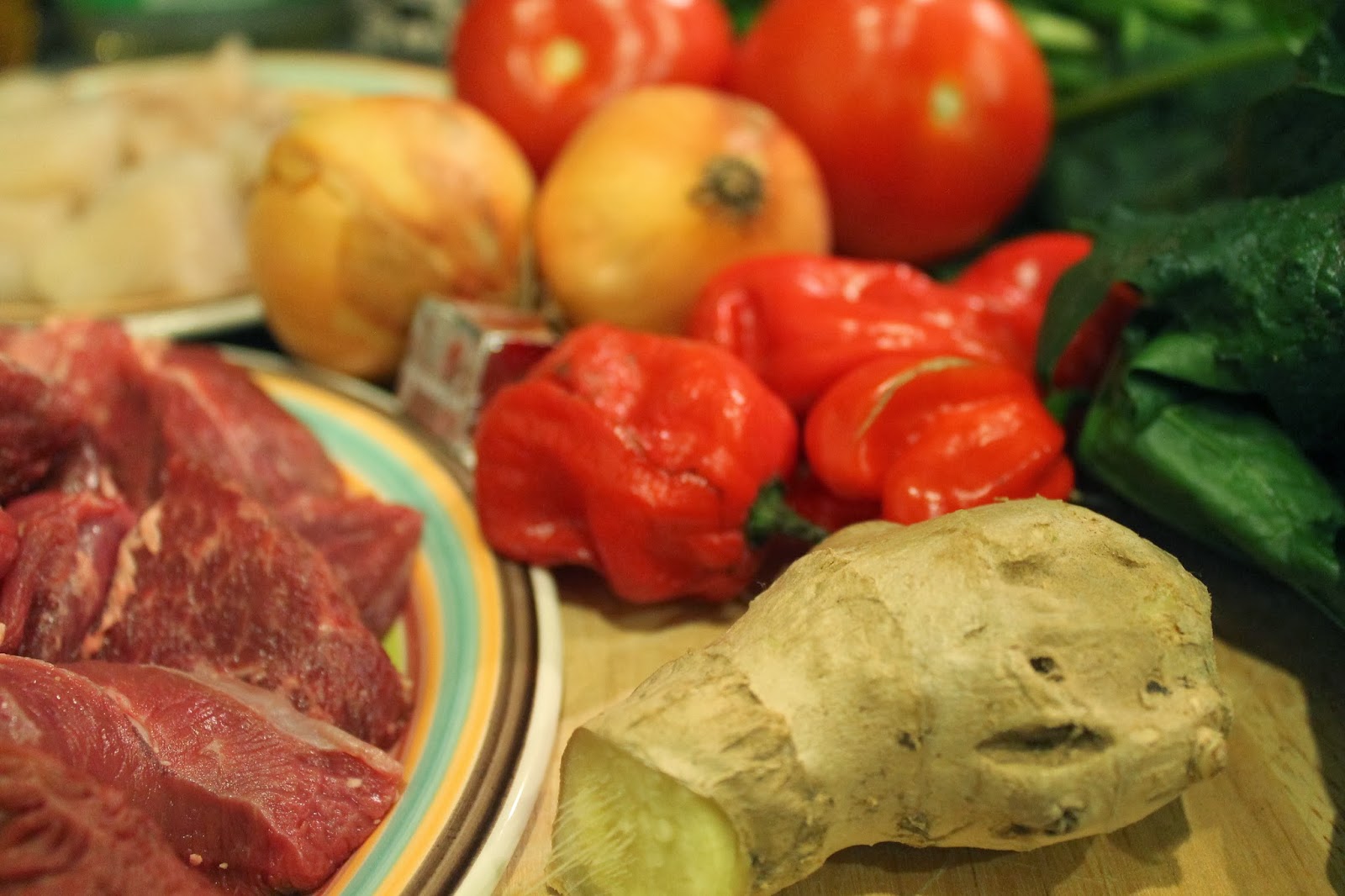 |
| Ingredients for Liberian palava |
300g dried fish - except I used fresh fish! I can picture the stalls full of dried fish in Waterside Market in Monrovia, a clever way to preserve fish in the hot weather, but finding dried fish in London isn't that easy - when we eat dried fish in the West, it's usually a snack with beer, not part of a meal.
It was also very weird cooking meat and fish together in one dish - I checked a few palava recipes and most of them seemed to have this option. I'm not sure why cooking meat and fish together is weird for me, perhaps it's a cultural thing? I realise that many people in Liberia would be happy to have either meat or fish, so perhaps adding both is an extravagance that makes the meal something special?
20g fresh ginger (grated) - Liberians love their ginger and so do I! Palava is actually the name of the sauce that is used in this dish and ginger is a key ingredient.
4 Scotch Bonnets - Scotch bonnets are incredibly hot chilli peppers and I've only cooked with them once before, when I made chakalaka. I must admit, I chickened out this time round and only added three of them, not four, as recommended by the recipe - the dish was still pretty hot with three Scotch bonnets in it!
2 small onions - one to form the basis of the palava sauce and the other one for cooking with the meat, sauce and fish
 |
| I used spinach/palak instead of bitterleaf |
A bunch of spinach - the original recipe recommends bitterleaf, but this is something which isn't to find in Europe. I guess I could have sourced some dandelion leaves, if I'd gone to a health food store, but spinach seemed like a good, leafy substitute, even if it doesn't have the same level of bitterness.
1 stock cube - I used beef
How I made Liberian palava
I started by preparing the palava sauce - the recipe suggests pounding the onions, chillies and tomatoes in a pestle and mortar, but I'm not a big fan of pounding, so I blitzed everything in my food processor instead.
 |
| Put the onion, ginger and chilli in a food processor - or pound them with a pestle and mortar, if you prefer! |
 |
| Add the two chopped tomatoes |
 |
| Palava sauce, which is much hotter than it looks! |
Next I prepared the meat. Goat's meat is quite tough and could be chewy, so it should be boiled for about an hour to soften it up a bit. I mixed the beef stock cube with 200ml of water, then put it in a saucepan with the goat's meat, brought the whole to a boil, then reduced the heat and simmered it for one hour.
 |
| Prepare some stock - I don't know if there is such a thing as a goat stock cube? I used beef |
 |
| Simmer the goat's meat for about an hour to tenderise |
 |
| Lovely chunks of goat's meat! |
Whilst I was simmering my goat's meat, I prepared some rice, to accompany the meal. Actually, fufu would be more traditional and I've made fufu before when I was blogging about Togo, but the reality is that many people in West Africa have rice with their main meal, so I wanted to do the same.
After an hour of cooking the meat, I took it off the heat - drained the stock into a jug and put the meat pieces to one side. I then fried the second onion, the palava sauce and the fish pieces, until the fish had cooked through.
 |
| Fry the onion and palava sauce, then add the fish pieces |
 |
| Fry until the fish pieces are fully cooked |
After this, I added the goat meat and spinach leaves, pouring the stock and some water on top, until the spinach was covered and I let meat, fish and vegetables stew for about fifteen minutes, until the spinach had cooked and the whole thing had taken on a fiery, soupy look!
 |
| Add the goat's meat pieces |
 |
| Then the spinach |
 |
| Then the stock and water |
It was dead easy to make - I'm not sure goat's meat is my favourite thing in the world and I think I would have enjoyed this dish more with either meat or fish, perhaps not both. Nevertheless, another world food dish to add to my growing recipe book!
 |
| Liberian palava served with rice |
Image credits:
All photos were taken by me, please feel free to reuse them, under the Creative Commons license:
Attribution (especially to this blog post)
Share alike
Non-commercial


