Showing posts with label African cuisine. Show all posts

Saturday, 16 November 2013

Liberia - How I made Palava

Palava is a dish that is quite common across West Africa and combines some of the most typical ingredients available in this part of the world.  The Liberian version is very similar to the palava made in other countries. And it's not at all unlike Chakalaka, which I made when blogging about Lesotho. 

I've come across the word palava or palaver already during my research, as the name of the meeting houses in Liberian villages, where elders make important decisions about community issues.

We use the word palaver in English, in quite a negative way, to describe an unnecessary fuss, eg. What a palaver!  It's thought that the origin of the word might be from Portuguese palavra which means word - although the palava dish is so spicy, I couldn't talk much as I was eating!

Liberia is the 32nd place that I've blogged about and the fifth African one - for each place that I've blogged about, I've tried to cook one of their national or regional dishes.  I have to stress at this point that this is a blog about culture, not a blog about food (although the food posts are always very popular!). 

If you want to see a proper food blog about palava have a look at Celtnet.org where I got my recipe - this is a great resource for any interested in 'world food' and I've used this website many times.  I also found a really cool foodie blog called Kayotic Kitchen which has a great chicken palava recipe.

My intention when blogging about food for Learning about the World is to understand the food culture in the places I blog about, by comparing the ingredients and trying to recreate these national/regional dishes with what I have available in my local shops in London.  I quite often have to (or even want to) substitute some of the ingredients in the original recipes and this process, in itself, is part of my learning experience.

The ingredients:
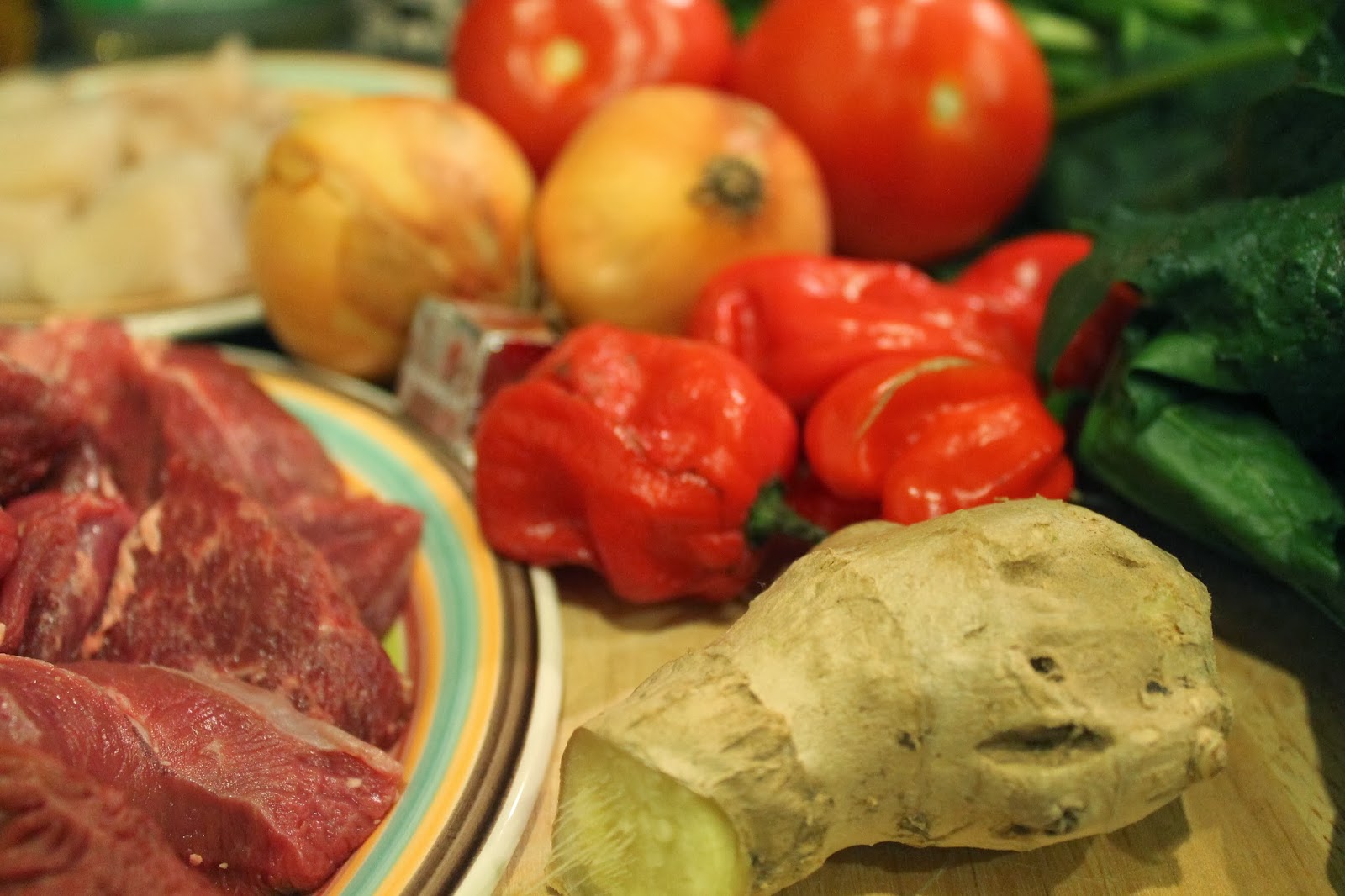
Ingredients for Liberian palava
500g goat meat - the original recipe had beef, actually, but goat meat is popular across West Africa and, as I had never cooked goat meat before, or even tasted it, I want to see what it was like.

300g dried fish - except I used fresh fish!  I can picture the stalls full of dried fish in Waterside Market in Monrovia, a clever way to preserve fish in the hot weather, but finding dried fish in London isn't that easy - when we eat dried fish in the West, it's usually a snack with beer, not part of a meal. 

It was also very weird cooking meat and fish together in one dish - I checked a few palava recipes and most of them seemed to have this option.  I'm not sure why cooking meat and fish together is weird for me, perhaps it's a cultural thing?  I realise that many people in Liberia would be happy to have either meat or fish, so perhaps adding both is an extravagance that makes the meal something special?

20g fresh ginger (grated) - Liberians love their ginger and so do I!  Palava is actually the name of the sauce that is used in this dish and ginger is a key ingredient.

4 Scotch Bonnets - Scotch bonnets are incredibly hot chilli peppers and I've only cooked with them once before, when I made chakalaka.  I must admit, I chickened out this time round and only added three of them, not four, as recommended by the recipe - the dish was still pretty hot with three Scotch bonnets in it!

2 small onions - one to form the basis of the palava sauce and the other one for cooking with the meat, sauce and fish

I used spinach/palak instead of bitterleaf
2 tomatoes - also to make the sauce

A bunch of spinach - the original recipe recommends bitterleaf, but this is something which isn't to find in Europe.  I guess I could have sourced some dandelion leaves, if I'd gone to a health food store, but spinach seemed like a good, leafy substitute, even if it doesn't have the same level of bitterness.

1 stock cube - I used beef

How I made Liberian palava

I started by preparing the palava sauce - the recipe suggests pounding the onions, chillies and tomatoes in a pestle and mortar, but I'm not a big fan of pounding, so I blitzed everything in my food processor instead. 

Put the onion, ginger and chilli in a food processor - or pound them with a pestle and mortar, if you prefer!

Add the two chopped tomatoes

Palava sauce, which is much hotter than it looks!

Next I prepared the meat.  Goat's meat is quite tough and could be chewy, so it should be boiled for about an hour to soften it up a bit.  I mixed the beef stock cube with 200ml of water, then put it in a saucepan with the goat's meat, brought the whole to a boil, then reduced the heat and simmered it for one hour.

Prepare some stock - I don't know if there is such a thing as a goat stock cube?  I used beef

Simmer the goat's meat for about an hour to tenderise

Lovely chunks of goat's meat!

Whilst I was simmering my goat's meat, I prepared some rice, to accompany the meal.  Actually, fufu would be more traditional and I've made fufu before when I was blogging about Togo, but the reality is that many people in West Africa have rice with their main meal, so I wanted to do the same.  

After an hour of cooking the meat, I took it off the heat - drained the stock into a jug and put the meat pieces to one side.  I then fried the second onion, the palava sauce and the fish pieces, until the fish had cooked through.

Fry the onion and palava sauce, then add the fish pieces

Fry until the fish pieces are fully cooked

After this, I added the goat meat and spinach leaves, pouring the stock and some water on top, until the spinach was covered and I let meat, fish and vegetables stew for about fifteen minutes, until the spinach had cooked and the whole thing had taken on a fiery, soupy look!

Add the goat's meat pieces

Then the spinach

Then the stock and water

It was dead easy to make - I'm not sure goat's meat is my favourite thing in the world and I think I would have enjoyed this dish more with either meat or fish, perhaps not both.  Nevertheless, another world food dish to add to my growing recipe book! 

Liberian palava served with rice

Image credits:

All photos were taken by me, please feel free to reuse them, under the Creative Commons license:

Attribution (especially to this blog post)
Share alike
Non-commercial  
 

Thursday, 27 September 2012

Eritrea - How I made Tsebhi Derho and Injera

There's quite a lot of choice when it comes to Eritrean dishes (although not a lot of fish, for a change!), but I plumped for a fairly simple traditional dish called Tsebhi Derho, a spicy chicken stew, which also involved learning how to make Berbere sauce and a purified butter combination known as Tegelese Tesmi.  And, of course, no Eritrean dish would be complete without a mountain of Injera - a kind of sourdough bread or pancake.

Mosob restaurant in London
I've eaten in Ethiopian restaurants before, where the food is quite similar to Eritrean, but to do some, ahem, research for this blog, I visited London's premier Eritrean restaurant, a really lovely place called Mosob, not far from Westbourne Park tube station, on the Hammersmith and City line.  I tried Tsebhi Derho at Mosob, so that was really useful, when it came to cooking it, a week or so later.

How I made Injera

I have to say that I'm becoming a big fan of Injera - it's very doughy, stretchy and tastes of yeast, but it's the perfect accompaniment to oily curries and stews, it's quite similar to Indian dosa.  This is the first meal that I've had to start preparing three days in advance!  Injera needs to ferment at room temperature for three days, until the dough starts to bubble and rise slightly, because of the yeast.  I wasn't sure if London room temperature would be quite as good as Asmara room temperature, but it seems to have worked out okay in the end!

Ingredients

Injera ingredients
Injera should really be made with teff, an Eritrean/Ethiopian food grain that is similar to millet or quinoa.  As teff is not readily available in London (to my knowledge), I decided to use wheat flour instead, consoling myself with the idea that this is how most people make it in Eritrea anyway, as teff is less plentiful than wheat and, therefore, more expensive. 

I used two main sources for all four recipes - mostly I used the Recipes Wiki - a site I've never seen before, but I also used one of my favourite sites Celtnet.org - which has a great selection of world recipes.  Both sites had very similar approaches to making Injera.

380g white flour
100g self-raising flour
50g whole-wheat bread flour (I'd run out of this, so didn't use it)
1 packet of dry yeast
600ml warm water
1/2 teaspoon baking soda
1/2 teaspoon salt

The main mistake I made with this, was that I added the baking soda and salt immediately, instead of after the three days fermenting - but it didn't seem to make a massive different to the outcome - all the same, I'd still recommend following the recipe.

Flour with yeast


Just mix all of the other ingredients together, cover with a tea towel for three days, stirring once a day.  To be honest, the mixture seemed to have fermented within twenty-four hours, but I dutifully left it for three days, as per the recipe!

Cover the mixture with a tea towel and leave for three days, stirring once a day


Injera mixture after three days fermentation


On the third day, I poured small dollops of the mixture onto a frying pan, in much same way as you would with a pancake mixture.  It's important to swirl the mixture around in the pan, so it's as thin as possible.  Once all of the moisture has evaporated from the dough and it is covered in 'craters', then you simply lift it out and leave it on a plate to cool.

Fry until all the moisture has evaporated

Through previous experience, I realised that it would be important to keep one piece of injera for each plate, to form the base of the served dish - with the others, roll them up into pancakes, which you can use later to scoop up the Tsebhi.

Rolls of injera ready to accompany the meal


How I made Berbere

Fresh red chillies
Berbere is a spicy paste that forms the base of the 'soup' for the stew.

Ingredients

Four types of seed - cumin, cardamom, coriander and fenugreek
Garlic (crushed)
Ginger (grated)
4 or 5 cloves
Turmeric powder
Black pepper
Paprika
Ground cinnamon
Dried red chillies (although I use fresh red chilli, equally as good!)

Mash the chillies, garlic and ginger
Dry-roast the seeds on a frying pan, until they start to pop, then grind them with the other ingredients until you have a spicy paste.  I also added a little bit of water, to give the paste some moisture.

Berbere paste and three hard-boiled eggs


How I made Tegelese Tesmi

Tegelese Tesmi is a kind of purified butter infused with onion, garlic and ginger.

Melt the butter in some water
Ingredients

200g unsalted butter
100ml water
1 small onion (chopped)
2 cloves of garlic
2 teaspoons ginger

Heat the butter and water together, until the butter melts, then reduce the heat, adding the onion, garlic and ginger - leave it to boil for 30 minutes, then strain the purified butter, which you can now call Tegelese Tesmi!  The only thing you need to remember with Tegelese Tesmi is not to stir it - I think stirring makes the mixture cloudy and messes up the delicate chemistry of the purifying process.  The end result looked and tasted a lot like Indian ghee.

Tegelese Tesmi - looks like ghee


How I made Tsebhi Derho
Ingredients for Tsebhi Derho

Ingredients

2 onions (chopped)
Berbere paste
Tegelese Tesmi
Some fresh ginger (grated)
2 garlic bulbs (crushed)
Juice of one lemon
Tomato puree
Sea Salt (or Table Salt)
3 large tomatoes (don't peel them, life's too short!)
500g chicken
3 hard-boiled eggs

Start by marinating the chicken for 30 minutes in lemon juice and sea salt. Fry the onion without any oil (and this seems to be an important point!) until it softens.  Add a little bit of water, as you're frying, to stop the onion from sticking to the pan.  Once the onion has softened, add the berbere paste and mix it through.  Then add the tegelese tesmi, mix and cook for about five minutes.

Marinate the chicken pieces in fresh lemon juice


By now the mixture is starting to look a bit oily, so add the tomato puree, tomatoes, garlic and ginger, to give it some more texture.  Bring to the boil, then simmer for about twenty minutes, until the tomatoes are almost melting into the base of the stew.

Fry the onion, then add the berbere paste
Add the tomatoes, puree, ginger and garlic

After twenty minutes, add the chicken, with another dash of water and let it simmer until the chicken is cooked through.

Add the chicken pieces with some water


Finally, put the boiled eggs into the stew and leave it for another few minutes, until the eggs have re-heated.

Add the hard-boiled eggs for the last five minutes of cooking


Serve the whole lot on a bed of injera with extra slices of injera on a side plate.  This dish is best eaten using your hands, tearing off pieces of injera and using them to scoop up the spicy mixture, dripping with oil and exotic flavours!  I had so much fun making this dish and the end result was really tasty - I look forward to making it again sometime soon!

Tsebhi Derho with injera

Don't forget to eat using your hands!

Image credits:

All photos in this blog post were taken by me.  Please feel free to re-use then with the following Creative Commons license:

Attribution (especially to this blog)
Share Alike
Non-commercial

Sunday, 2 October 2011

Zanzibar - how I cooked Octopus!

My search for a traditional Zanzibari dish brought up a few options, including the Portuguese Goan dish Sorpotel but, in the end, I couldn't resist the temptation of the Swahili dish Pweza wa nazi or Octopus in a coconut soup. 

I've seldom eaten Octopus before, never mind cooked it, so it was a real challenge for me.  Whilst it's relatively common in Mediterranean cuisine, I don't know many people in the UK or Ireland who eat octopus on a regular basis.  The islands of Zanzibar have ready access to the fruits of the ocean and octopus is a tasty example of traditional Swahili cooking. 

Where does one buy octopus in London?

Frozen octopus from Moxon's
My first quest was to find somewhere to buy octopus in London.  Most octopus here seems to come from Portugal and is usually frozen, as octopus doesn't travel well over long distances.  I looked at some online options, but with minimum orders of £35 and more, this wasn't really an affordable option for me.  Luckily, a work colleague pointed me in the direction of Moxon's, a posh fishmongers in South Kensington.  I've learned that octopus isn't cheap(!), £12.95 Sterling per kilo (that's 34,121 Tanzanian Shillings).  My next question was . . . how the hell do I cook it?

How does one cook an octopus?

Like a scene from Alien
Octopus bathes in milk
A trawl through the Internet brought up all kinds of options - beat it with a hammer first, smash it against some rocks (like I have rocks lying around in my kitchen!), don't overcook it (then another website said stew it for a very long time), boil it in its own ink and, one of my favourites, chuck it in the bin, who the hell eats octopus anyway? 

I settled for the advice of an Italian website, which has a recipe for Pweza wa nazi (they've incorrectly called it Pwewa, but the Swahili word for octopus should be pweza).  I'm providing a link to the original recipe for those of you who speak Italian.  I must admit that I improvised a lot this time and did things in a different order than the Italian recipe recommended.  I also used coconut milk from a tin. 

The Ingredients

1 octopus (pweza)
4/5 medium sized potatoes (viazi)
1 onion (kitunguu)
1 lime (ndimu)
coconut milk (maji ya dafu)
tomato puree (nyanya)
garam masala
cardamon (iliki)
cinnamon (dalasini)
2 pieces of garlic (saumu)

Preparing the octopus

First I had to defrost the octopus.  The portion I bought was almost two kilos, so I cut it in half and left it to defrost for about four hours, a process resembling a scene from the hit movie Alien.  Another work colleague recommended that I marinate the octopus in milk, which was a really good tip and helped to tenderise it.  The Italian recipe recommended boiling it for 30 minutes only (ie. not overcooking it, which is a mistake lots of people make, apparently).  This seemed to work quite well and when I tasted the octopus after 30 minutes of boiling, it was really succulent. 

At first when I was boiling it, the octopus seemed to swell up mightily, like a true creature of the deep, threatening to escape the pot.  Then it quickly shrank to a shadow of its former self and turned from a murky brownish colour to an exciting purplish red.

Creature of the deep

After 30 minutes of boiling

A succulent piece of octopus


Preparing the Pweza wa nazi

Once you've boiled octopus, you can add it to dishes, either freshly boiled in a salad or, as I did, as part of a curry/soup.  To make the coconut soup I fried the chopped onion and garlic.  Then I added the spices and tomato puree.  Once everything had softened and fried a bit, I added the octopus, which I had sliced up into bite-sized pieces.  I stir-fried the octopus for a bit, before adding the coconut milk.  Once this had come to the boil, I added pieces of potato that I parboiled so they would cook quickly.

Fry the onion, garlic and spices

Add the tomato puree and pieces of octopus

Add the coconut milk

Add the parboiled potato
Pweza wa nazi
I was worried about losing the tenderness of the octopus, so I only simmered the mixture for 30 minutes and this was enough to keep the octopus from getting hard or rubbery.

You can see the end result for yourself - easy pwezy!


Image credits:

All photos were taken by me.  Please feel free to re-use according to the Creative Commons license:

Attribution (especially to this blog post)
Non-commercial
Share alike

Sunday, 12 June 2011

Xinjiang - how to make DĂ  pĂ¡n jÄ«


Not surprisingly, Uyghur cuisine is incredibly similar to the cuisine of Central Asia and some of my favourite dishes from Uzbekistan, like plov (pilau rice) and laghman (a kind of stretched noodle) are also staples in Xinjiang.  Of course, a lot of our culture is connected to the food we eat and the food which is eaten in Xinjiang very much depends on who is cooking and eating it!  I tried to find something that was a crossover between Uyghur and Chinese cuisine and stumbled upon DĂ  pĂ¡n jÄ« or 'Spicy Chicken SautĂ©', also know as Big Plate Chicken. 

It seems to be a Uyghur dish with a Chinese name and I found a recipe on Jamie Oliver's website, of all places - the version I made was based on this.  I must say, it was much spicier than anything I tasted in Uzbekistan and the sheer amount of ingredients in this dish was overwhelming!

The Noodles

I was feeling adventurous at the weekend, when I made this, so I decide to make my own noodles from scratch.  It's not the first time I've made my own noodles, as I also did this when I cooked the Mongolian dish, Tsuivan, back in November 2009!

Ingredients:


Soft dough made of flour, water and egg
300g flour
200ml water
1 egg (beaten)
A pinch of salt

I started by mixing the flour, water and beaten egg in a bowl with a pinch of salt.  Then, using plenty of extra flour, I put the mixture on the kitchen counter and kneaded it until it formed a flexible dough.  I then used my rolling pin to flatten the dough to a very thin sheet, which I divided in two and cut into thin strips, by folding the sheets over on each other, putting flour on each fold and cutting the folded mixture lengthways.


Roll the dough out flat


Divide the dough in two


Rest the noodles on a dry tea-towel
I'd watched a video online of a Chinese woman making noodles, then made it up as I went along.  I also saw a video of a man in Xinjiang stretching noodles and then whipping the dough in a circular motion until it formed a long rope-like shape.  I briefly attempted something similar, but the bits of dough flying around my kitchen were enough to convince me to stop and leave it to the experts!

Once I'd cut the noodles, I hung them on a small table, on top of a dry tea-towel and left them to dry, as I got on with cooking the rest of the meal. 


Hey presto!  Home-made noodles!!
When the time came to cook the noodles, I brought a pot of water to the boil and chucked them in.  Amazingly they didn't all stick together or form a gloop at the bottom of the pan, but behaved really well, as noodles from a packet might - the only difference being that home-made noodles are about a hundred times tastier than anything from a packet!

The Spicy Chicken Sauté

Ingredients

You can see most of the ingredients that I used in the photo - except for a can of beer, which I used to boil the mixture.


A veritable feast
200g Chicken fillet (or other parts of the chicken, if you prefer - chopped into bite-sized chunks)
2/3 Bay leaves
Cinnamon powder (or Cinnamon sticks)
White Pepper Powder
Cumin seeds
Ground Cumin powder (Cumin is very popular in Central Asian dishes!)
Fresh Ginger
2 Tomatoes on the vine
1 green Pepper
1 red Pepper (although I left this out in the end, as it was already a lot of food!)
1 Carrot (cut into sticks)
4 red Chillies
1 White Onion (I'd never cooked white onion before, but it was delicious!)
2 Spring Onions (slice the bulbs and shred the stems, or cut them into diagonal slices)
2 potatoes (parboiled and chopped into small pieces)
4 whole Star Anise
Black peppercorns
Fresh Coriander


Prepare the ingredients
Preparation

I chopped all the vegetables and prepared the spices, putting them on saucers and in bowls, grouped according to which ones would be added to the wok together. 

Cooking

I heated up some groundnut oil in the wok, then added the red chillies, black peppercorn and sliced spring onion bulbs.  Once these had cooked a bit, I added the fresh ginger and dried spices (bay leaves, cinnamon powder, white pepper powder, cumin seeds, ground cumin powder and star anise).

Next I added the raw chicken, stirring it around in the (increasingly aromatic) spices and cooking it until it was completely white.  Then I added the potatoes and, a few minutes later, the shredded spring onion stems and carrot sticks. 


Add the onion bulbs, chilli and black peppercorns


Add the fresh ginger and dried spices

Add the chicken pieces and cook through
I then poured in a full can of beer and brought the mixture to boiling point before reducing the heat and simmering for 15 minutes.


Add the potatoes, carrots and spring onions


Simmer in beer for about 15 minutes

Finally, once I was convinced that the potatoes were tender enough to slice with a spoon, I added the white onion and chopped tomatoes.  I simmered the whole lot for another ten minutes or so, until the onion and tomatoes had cooked, before spooning the mixture onto a bed of home-made noodles, topping the dish with a handful of freshly-chopped coriander.


Add the tomatoes and white onion


Big plate chicken!

The result was a fusion of Central Asian and Chinese tastes, which went down a treat with my Kalmyk partner!

Image credits:

All photos were taken by me - please feel free to reuse these images, using the Creative Commons license, Share Alike Attribution (especially to this blog) and Non-Commercial.