Showing posts with label Middle Eastern cuisine. Show all posts

Saturday, 4 October 2014

Palestine - How I made Musakhan

Although I've cooked Arabian and Yemeni dishes before, like Kabsa and Saltah, this was my first attempt at making proper Middle Eastern food. I was spoilt for choice in terms of Palestinian dishes, but settled for Musakhan in the end, as I needed something easy after my recent experience trying to make a Mexican mole!

I looked at two different sources for inspiration - the first, a very entertaining and enjoyable book called Classic Palestinian Cuisine (2001) by Christiane Dabdoub Nasser.  Nasser tells the stories of the dishes and recounts his personal experiences, which makes this so much more than just a book of recipes!

Ground cardamom, sumac and cinnamon
If I'm being honest though, I was more influenced by the recipe in The Middle Eastern Kitchen (also 2001) by Ghillie Başan, as this recipe was a bit simpler and less labour-intensive.

I really love the format of The Middle Eastern Kitchen as it focuses on the individual ingredients and, perhaps not surprisingly, the recipe for Musakhan comes under the section on the spice called sumac.

My first time using sumac

Apart from sumac, the main flavouring for this dish, I was pretty sure I would find all of the ingredients I needed in my local area.  As it turned out, it was quite easy to find sumac as well and I think it's much more commonly available than I realised - I've just never noticed it before.

Sumac is made from dried berries and quite often sprinkled on salads or cooked meats to give them a kind of citrus flavour.  It's very tasty and I can see myself using this flavour a lot in future, as it adds a satisfying piquancy, if you don't want too much heat in your dish.

The ingredients

For the Musakhan


Musakhan ingredients
Olive oil - زيت زيتون
Butter - زبدة
2 onions - بصل
2 chicken breasts - دجاج
sumac - سماق
cinnamon - قرفة
cardamom (ground is best) - هال
1 lime - ليم
Mint - النعناع
Coriander - الكزبرة (although I decided not to use coriander in the end, as I wanted a more minty flavour)
4 pitta breads - خبز (actually it would be best to use real Palestinian bread, known as tabun which is the name of the oven it's cooked in, but I didn't have access to this, so pitta was a good substitute, especially as it's hollow inside and can be easily filled)

For the salad

2 cucumbers - خِيار
4 tomatoes - طماطم
Red pepper - فلفل حار
Yoghurt - الزبادي
Mint - النعناع
1 lime - ليم

How I made Musakhan

I started by making the salad, so I could chill it in the fridge whilst cooking the main meal.  I must admit that I'm not a massive fan of cucumber which I know sounds ridiculous, as it's probably one of the world's most inoffensive food products - I think I ate too much cucumber when I was living in Uzbekistan and it put me off!

Lovely, refreshing cucumber

Anyway, I first chopped the cucumber into chunks and mixed it with the yoghurt in a big bowl.  I then chopped up the tomatoes, pepper and mint, mixing these ingredients with the cucumber and put this in the fridge to chill.  Before taking it out of the fridge to serve with the main meal, I added lime rind and juice.

Red pepper added to cucumber and yoghurt mix

Cucumber and tomato salad
I added lime rind and juice to my salad, as well as to the main dish

To make the Musakhan I started by frying a lump of butter in some olive oil, then adding the onions and frying these until they turned a soft golden colour.

Fry the onions until they turn golden

I then added the chicken pieces and a couple of spoonfuls of sumac and stirred until the chicken had cooked through.

Add the chicken pieces and the sumac
Then I added the ground cardamon and cinnamon, along with lime rind and juice and chopped mint leaves, leaving the dish to simmer gently, only stirring occasionally,

Add the mint and spices

Let the dish simmer for about 20 minutes
As the main dish was cooking, I halved the pitta breads, opening up their central cavities before putting them in the oven for a few minutes to soften them up.

Halve the pitta bread and open the centre

A stack of pitta bread
Once the pitta breads had heated a bit, I took them out and spooned the Musakhan mixture into each piece of bread, before returning them to the oven to cook for around 8 minutes.  

Fill the pitta bread with the cooked Musakhan mixture

Bake in the oven for around 8 minutes
The end result was very yummy and the cold salad made a nice contrast to the warm bread and musakhan.  This was an easy dish to make and I'd highly recommend it!

Musakhan with salad

My Palestinian dinner
Image credits:

All images were taken by me on my trusty Canon EOS 1100D.  Feel free to re-use these images with the Creative commons license:

- Attribution (especially to this blog post)
- Non-commercial
- Share alike

Sunday, 14 August 2011

Yemen - How I made Saltah

Research into the national dish of Yemen very quickly brought me to a dish called سلتة Saltah, which is very close to the Arabic word سلت which means salt.  I don't know what the real thing tastes like, but the version I made wasn't too salty.  There seems to be only one recipe for Saltah knocking about on various different websites and this was the one I used.


Ingredients:

The Ingredients for Saltah, Hilbeh and Zhug
كوب واحد من النفط  one cup of oil
بصل 2 onions
البطاطا 4/6 potatoes
لحم مفروم minced meat (I used beef, but you could also use lamb)
لحوم البقر الأسهم beef stock
طماطم 2 tomatoes
بيض 2 eggs (which should be beaten)
عصير الليمون lemon juice
تشيليز 3/4 chillies
فصوص ثوم 6 cloves of garlic
حلبة نبات fenugreek seeds
كمون ground cumin
هال ground cardamom
كزبرة fresh coriander

Preparing Hilbeh and Zhug

Preparing Hilbeh
Preparing Zhug
Saltah is usually served with two condiments called Hilbeh and Zhug which are stirred into the dish at the very end.  I prepared these first, so I could put them in the fridge and chill them slightly.


Spices
Zhug and Hilbeh
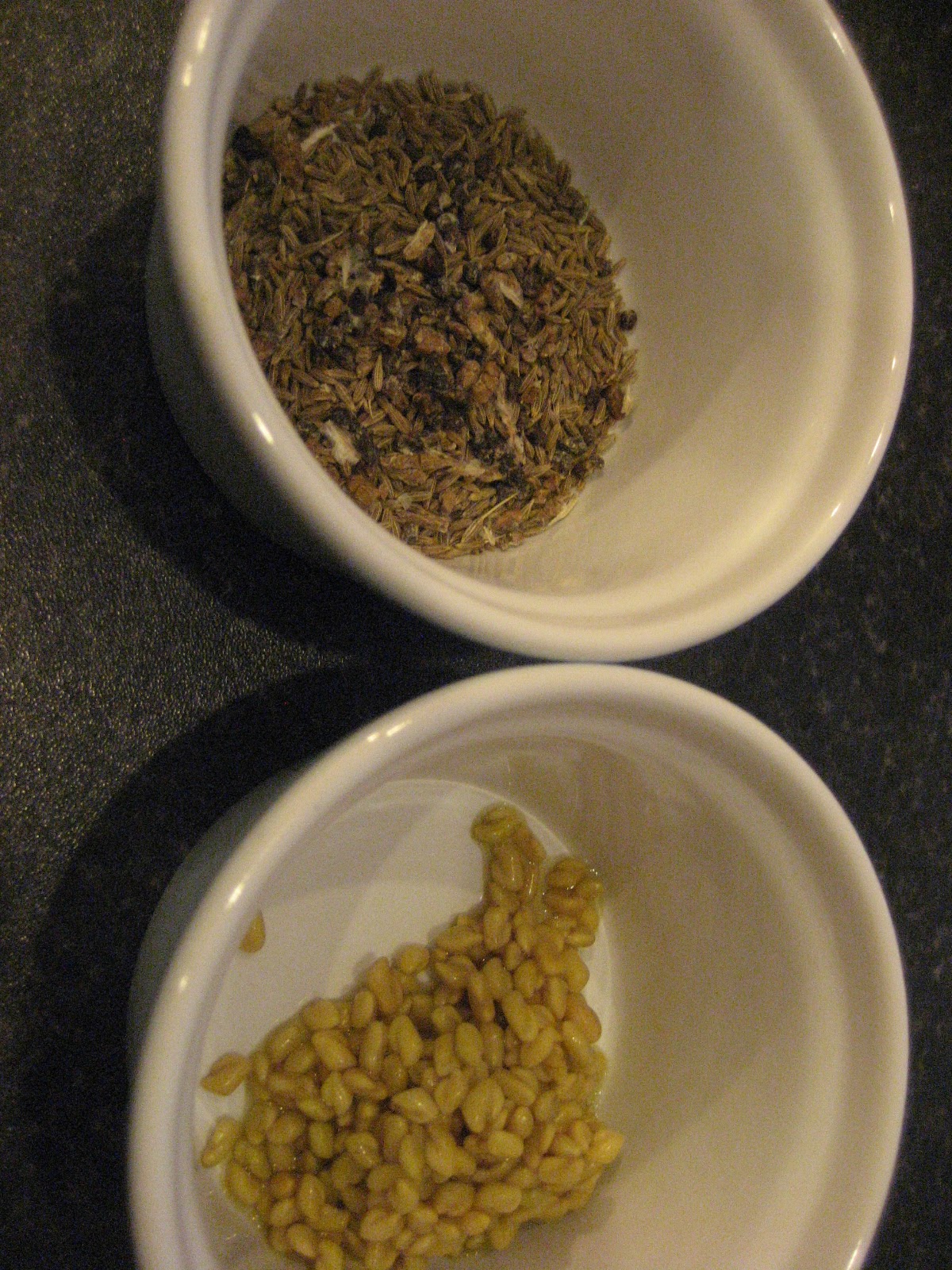
Hilbeh حلبة نبات is a green-coloured condiment based on fenugreek.  It was my first time ever cooking with this spice (the English name comes from the Latin for Greek hay).  Fenugreek is popular in Indian cooking and is often used to make curries.  I steeped the seeds overnight in a glass of water, as recommended by the recipe, then blitzed them in the food processor, with some water, 2 garlic cloves, a green chilli, chopped coriander and the juice of a lemon.

To make Zhug مهدي الشوق I mixed some red chillies, oil and coriander with 4 garlic cloves, ground cumin and cardamom seeds.  Zhug is a popular condiment throughout the Middle East and I'm sure many of us have had this on kebabs or falafel.

Preparing the Saltah

Fry the onion
Fry the beef
To make the Saltah, you start by frying the onions in a frying pan, then adding the minced meat and frying this until it is brown.  I fried the meat and onions in a pan, then added them to the main stewing pot later - this was mostly because I'd underestimated the amount of space I would need to cook this dish - however, it worked out quite well doing it this way, so I would also cook the meat separately in future.

Heat the tomatoes and potato
Add the beef stock


I parboiled the potatoes before adding them to the main pot with the tomatoes (which I had salted) and fresh coriander.  In retrospect, I probably should have added the coriander later. Once the tomatoes had softened a bit, I added beef stock and brought the mixture to the boil.  It was at this point that I added the meat and onions to the pot and reduced the heat.

Saltah
The original recipe recommends simmering for one hour, but I was in a bit of a hurry, so I let the ingredients simmer for forty minutes, before stirring in the egg and adding the condiments.

It was a really straight-forward dish to make and incredibly delicious.  I made quite a bit portion, so we also had Saltah for dinner the next day.  I'm sure you could add rice to the mixture (which would make it a bit like kabsa) but we decided to eat it with yummy slices of country bread.

Traditional Yemeni food in London

The Queen of Sheba restaurant
Halloumi starter
I decided to add a new element to my learning experience this time, by visiting a traditional Yemeni restaurant.  I'm sure that most of the world's cuisines are represented in London and, sure enough, there is a traditional Yemeni restaurant, not far from Paddington Station, called The Queen of Sheba.

Kabsa Lahan
I went there with some friends and, this being Ramadan, the restaurant was pretty empty, most of the bookings being later in the evening, after sunset.  Unfortunately, I couldn't try their Saltah, but we had a range of starters - halloumi, falafel, moussaka and kibbah (which I hadn't tried before).  We all ordered lamb-based dishes and I tried the Kabsa Laham which was quite good.  The portions were massive and, for the first time ever, my partner couldn't finish his dinner (he's usually asking for more!)

It was a nice addition to the learning experience and one I hope to repeat in future blogs.   

Image credits:

All photos were taken by me - please feel free to use this under the following Creative Commons license:

Attribution
Non-commercial
Share alike

Sunday, 1 August 2010

Saudi Arabia - Chicken Kabsa

Saudi Cuisine

I'm a big fan of Middle Eastern cuisine, so I was really looking forward to getting stuck in to a traditional Saudi dish.  After a bit of research online, I came to the conclusion that the staple of Saudi Arabia is a dish called Kabsa.  Not dissimilar to Uzbek plov but with lighter ingredients, such as orange, and not as much oil.  The recipe I used for this was from a website called inmamaskitchen.com

The ingredients

There was nothing unusual in this dish and I already had all of the spices in my cupboard, so it cost next to nothing to make.

The main ingredients are:

Chicken, which should be cut up into bite-sized mouthfuls.
Two onions, which should be chopped up finely.
Two carrots, which should be grated.
Orange zest
Four cloves of garlic, chopped (although this might have been overkill)
Tomato puree
Two tomatoes, chopped finely
Four cloves, four cardamom pods, a cinnamon stick, broken up
As much rice as you need for four people
Almonds, which should be cut into slices and raisins (I used sultanas) to scatter on the meal at the end.
Salt and pepper to taste.

Process:

I started by heating oil in a large saucepan and adding the chopped onions, letting them fry for a few minutes until they'd started to turn brown.

Once the onions have browned a bit, I added the chicken, garlic, chopped tomatoes and tomato puree and stirred these together for about five minutes until the chicken had turned white on the outside.  The recipe requires the addition of orange zest and, not wanting to waste the juice of the orange, I marinated the chicken in orange juice and then added this to the mixture when I added the chicken.  I don't know whether or not this was a good idea and the whole thing certainly tasted very orange-y, so I guess it's a matter of taste. 

After the chicken had fried a bit, I added the grated carrot and all of the spices and some salt and pepper.  This idea of this dish is that the chicken will cook with the spices for about twenty minutes or so.  After twenty minutes, you remove the chicken and add the rice, so that the rice cooks in the liquid of the Kabsa.  I must admit, I struggled a bit with the idea of removing the chicken at all, but I decided to go with the recipe in the end and kept the chicken warm in a metal contained with a foil covering. 

The rice should be long-grain - I used regular long-grain rice, but you could also use basmati.  To prepare the rice, I washed it in a sieve, which I think softens the rice and makes it easier to cook when you add it to the pot. 

The result was pretty delicious and I'll definitely be adding it to my international cuisine Smörgåsbord

(<-- After the chicken has been removed and the rice has been added)


(<-- Boil the rice for about twenty minutes)

(Chicken Kabsa, don't forget to scatter with almonds and raisins, or sultanas -->)


Image credits:

All photos were taken by me.