Sunday, 28 August 2011

Yemen - Coffee and Qat

It wasn't until I was blogging about the Netherlands that I learned that coffee originally came from Yemen.  Well, as with a lot of Yemeni things, it probably originated in Ethiopia but, I guess, Yemen was the first place that coffee was cultivated and turned into something palatable.  Whilst Yemen had been exporting coffee beans for quite a while, it was the Dutch who stole the young coffee plants and replanted them in their colonies in (what is now) Sri Lanka and Indonesia.  The rest, as they say, is history.

Coffee plantation by ineedcoffee.com
Coffee, from the Arabic word قهوة‎ (qahwah) came to Europe in two directions; exported as beans through the Ottoman Empire to Istanbul and Vienna - it later took Amsterdam, Paris and London by storm, resulting in a proliferation of coffee houses or cafes in 17th century Europe.  Looking at the top coffee-growing countries today, it's hard to believe that Yemen was ever at the centre of the trade in coffee beans.  Brazil is, by far, the biggest coffee-growing country, followed by Vietnam, Colombia and Indonesia.  Ethiopia has also reclaimed its tradition of coffee-growing and is currently the world's 5th largest coffee producer.

In terms of coffee consumption (per head of population), it might surprise you to know that people from Finland, Norway and Iceland consume more coffee than anywhere else.  In Ireland we also consume a lot of coffee, 3.5 kilos per person annually, according to 2007 figures from the World Research Institute.  In Britain, it's a lot less (2.8) and in the United States a bit more (4.2).  The global average in 2007 was 1.3 kilos per person annually.  Interestingly, Yemen's coffee consumption per person is almost zero!

Coffee Art by ineedcoffee.com
Whether coffee is beneficial or harmful is debatable - I'm sure the major coffee producing companies would point out the benefits of drinking coffee and it certainly helps increase concentration and stimulates the brain.  My rule-of-thumb is that most things are good for you in moderation.  I usually have one cup of coffee per day, first thing in the morning or as soon as I get to work.  I didn't drink coffee until I was in my early 20's, but I'd find it hard to give up now, so I guess it's pretty addictive!  I drank all kinds of coffee for years but then something changed and I can no longer stand instant coffee.  I didn't use to be such a coffee snob but I've come to the conclusion that instant coffee is vile, just like drinking coffee-flavoured hot water!  I prefer ground coffee in a French press (or сafetière). 

Qat plant by A Davey
It's interesting to compare the fate of coffee to that other (in)famous Yemeni plant, Qat.  They're similar in many ways - both plants increase concentration and can be addictive.  Both are important in social situations and mostly consumed by adults.  Qat is chewed rather than drunk.  It isn't consumed by nearly as many people every day as coffee is and, if you're wondering why you've never heard of it, that's probably because it's banned in most of the Western world.

Qat contains cathin and cathinone, which are like amphetamines that stimulate the brain, suppress appetite and cause a mild euphoria.  In Yemen, qat is consumed mostly (but not exclusively) by men, especially in the hour or so before sunset, when men gather to socialise, talk and listen to devotional music.  In his book, Yemen: Travels in Dictionary Land Tim Mackintosh-Smith rather poetically describes the importance of qat to Yemeni culture.  He calls this time the Hour of Solomon and says the songs that are sung then are 'as perilous as they are beautiful'.

Qat at an Ethiopian market by A Davey
Categorised as a drug in Saudi Arabia and in the Gulf states, the consumption of qat is strictly forbidden throughout the rest of Arabia.  It's also banned in Scandinavia, France, Germany, Ireland, Canada and the United States.  Interestingly, the use of qat in the UK is legal.  I don't imagine it's available at every corner store and I'm pretty sure its use is mostly restricted to immigrants of Yemeni, Somali and Ethiopian origin.  Still, it would be interesting to find out how widespread the use of qat is here in the UK.  I reckon it's only a matter of time before the new coalition government redefines qat as a controlled substance, in line with the laws of other European countries.

I guess if caffeine hadn't taken off in Europe in the way that it has, it could well have been classified as a drug.  It's interesting to think that one man's socially acceptable stimulant is another man's controlled substance!  I'm going to leave you with a song by the popular Yemeni singer, Mohamad al-Harithi which is typical of the songs sung during the Hour of Solomon.


Image credits:

The coffee images are by flickruser INeedCoffee/Coffee Hero aka Michael Allen Smith, a coffee enthusiast from Seattle.  Michael has a very amusing and interesting website which is well worth a visit. 

The images of qat and the at the market in Ethiopia was taken by flickruser A Davey who is from the Pacific northwest.  You can see more of his photos on flickr

Thanks to Michael and A Davey for sharing these images with us using the Creative Commons license

Saturday, 20 August 2011

Yemen - the Queen of Sheba and the women of Yemen

One of the things people from Yemen seem to be quite proud of is the country's claim to be the birthplace of the Queen of Sheba.  Sheba is also claimed by the Ethiopians, who called her Makeda and I'm beginning to see a pattern of cultural exchange that has blurred the edges of Yemeni, Ethiopian, Eritrean  and Somali culture.

Archaeological evidence from Ma'rib, a town in the desert just east of Sana'a, is offered as proof of the existence of Sheba.  Whether or not Sheba was a real personage hardly seems to be the point - it's what she symbolised that has become so important, not only to the Yemenis, but to the early Christians, Jews and Muslims.

Sheba and King Solomon

Solomon and Sheba by Piero della Francesca
Just as there is a paucity of historical evidence of the Queen of Sheba's existence, I've also found that there are very few interpretations (in the Western world) of the Queen of Sheba's life - the ones that do exist relate to her visit to Solomon, the King of Israel.  Most accounts tell how the Queen of Sheba had heard of Solomon's great wisdom and faith, so she travelled all the way to Israel to see his kingdom with her own eyes.  She has been depicted as being wealthy beyond belief and brought gifts of gold, spices and jewels which, I'm sure, made an impression on Solomon and his subjects.


As part of my research, I've read Kings 10:10, the paragraph in the Bible that relates to Solomon and Sheba.  It's an incredibly short version of the story and I can't help wondering what was left unsaid.  Other accounts have linked Solomon and Sheba romantically, but the Bible, rather enigmatically, merely states that 'King Solomon gave the Queen of Sheba everything she asked for'.

The Hollywood movie

Of course, the Hollywood version, King Vidor's 1959 epic, Solomon and Sheba is a lot more exciting.  Not only does Sheba (played by the Italian beauty, Gina Lollobrigada) seduce King Solomon (played by Yul Brynner, who was born in Vladivostok), but she is also partly responsible for the fall of Solomon's kingdom and the Hebrew God's destruction of Solomon's temple, when he allows Sheba and her cortege to hold a festival in honour of the Sheban love god, Ragan.

It's a great movie and I really enjoyed watching it.  I'm posting the link to a YouTube video, which shows one of the movies' most famous scenes, ie. the pagan orgy in honour of Ragan.  Gina Lollobrigada is fantastic and the scene reminded me of a Lady Gaga video.  Whilst Lady Gaga might only raise a few eyebrows in our modern times, Lollobrigada's dance in this scene caused quite a stir in late 1950's America!


Claude Lorrain's Embarkation of the Queen of Sheba
The Embarkation of the Queen of Sheba

Also as part of my research for this blog, I went to see Claude Lorrain's 1648 painting The Embarkation of the Queen of Sheba, which hangs in the National Gallery, here in London.  The Sheban port, as depicted by Lorrain, looks nothing like the photos and images I've seen of Yemen, but Lorrain's approach to this story was innovative, not only because of the way he used light in the painting, but also because of the subject matter - most artists and writers have only been concerned with Sheba's visit to Israel, whereas Claude chose to focus on her departure from Sheba, reflecting his interest in the theme of voluntary exile. 

The arrival of the Queen of Sheba

Handel's oratorio, Solomon, based on biblical stories about the wise king, was first performed at the Theatre Royal (now known as the Royal Opera House) in Covent Garden, London  on the 17th of March 1749.  The sinfonia from Solomon is better known as The Arrival of the Queen of Sheba and is a piece of music I have loved for many years.  I'm posting a video from YouTube below, so you can enjoy this piece of music firsthand (if you're not already familiar with it).


Soft diplomacy or cultural subjugation

I've been thinking a lot about Sheba's story and how it can be interpreted.  The optimist in me sees the story of Solomon and Sheba as one of the first portrayals of a diplomatic mission - one that wasn't based on war and conquest, but the exchange of gifts and cultural ideas.  In the biblical version of this story, Sheba leaves Israel peacefully and you get the impression that both Sheba and Israel have been enriched by this cultural contact.

I get the impression that, for many Yemenis, Sheba represents the 'glory days' of Yemen, when it was a land rich beyond any one's wildest dreams.  There are echoes of Yemeni history in the story of Sheba and, I think she is more a symbol of fertility and bountiful harvests, than an actual person.  Like a fallen queen, Yemen in more modern times has been culturally subjugated to the influences of a wider world.  Early Christians interpreted this story as the subjugation of pagan beliefs by monotheism.  For modern Yemenis, Sheba symbolises a country that is passive, female and exploited. 

Women in Yemeni society

Yemeni woman by localsurfer
The position of women in Yemeni society leaves a lot to be desired.  According to the Washington-based NGO, Freedom House Yemeni women have limited access to judicial institutions and the majority of law makers are men.  In the tribes, there does seem to be a strong role for women, but this varies from region to region and, in general, Yemeni women are discriminated against under the law.  For example, women in Yemen need a letter of approval from their 'guardian', before they can marry a non-Yemeni.  Bizarrely, Yemeni law considers the testimony of two women to be equal to that of one man.

There are no laws to protect women from sexual harassment at work - that is, if a woman can find a job, literacy levels amongst Yemeni women are incredibly low - according to the United Nations Development Programme (UNDP), 61.6% of women in Yemen are illiterate, which is double the illiteracy rate for men.  I'm not quite sure where the Queen of Sheba would fit in to modern-day Yemen! 

Image credits:

The image of Piero della Francesca's painting Legend of the True Cross - the Queen of Sheba Meeting with Solomon hangs in the Basilica de San Francesco which is Arezzo, in Italy.  This image is copyright-free, as it's in the public domain

The image of Claude Lorrain's Embarkation of the Queen of Sheba is also in the public domain.

The image of the young Yemeni woman was published on Flickr by localsurfer who is from Barnstaple in North Devon.  You can see more of his images on his website.  Also, it's worth having a look at the information he's written about this image, to get an idea of what life is like for women in Yemen.  Thanks localsurfer for sharing this image with us using the Creative Commons License. 

Sunday, 14 August 2011

Yemen - How I made Saltah

Research into the national dish of Yemen very quickly brought me to a dish called سلتة Saltah, which is very close to the Arabic word سلت which means salt.  I don't know what the real thing tastes like, but the version I made wasn't too salty.  There seems to be only one recipe for Saltah knocking about on various different websites and this was the one I used.


Ingredients:

The Ingredients for Saltah, Hilbeh and Zhug
كوب واحد من النفط  one cup of oil
بصل 2 onions
البطاطا 4/6 potatoes
لحم مفروم minced meat (I used beef, but you could also use lamb)
لحوم البقر الأسهم beef stock
طماطم 2 tomatoes
بيض 2 eggs (which should be beaten)
عصير الليمون lemon juice
تشيليز 3/4 chillies
فصوص ثوم 6 cloves of garlic
حلبة نبات fenugreek seeds
كمون ground cumin
هال ground cardamom
كزبرة fresh coriander

Preparing Hilbeh and Zhug

Preparing Hilbeh
Preparing Zhug
Saltah is usually served with two condiments called Hilbeh and Zhug which are stirred into the dish at the very end.  I prepared these first, so I could put them in the fridge and chill them slightly.


Spices
Zhug and Hilbeh
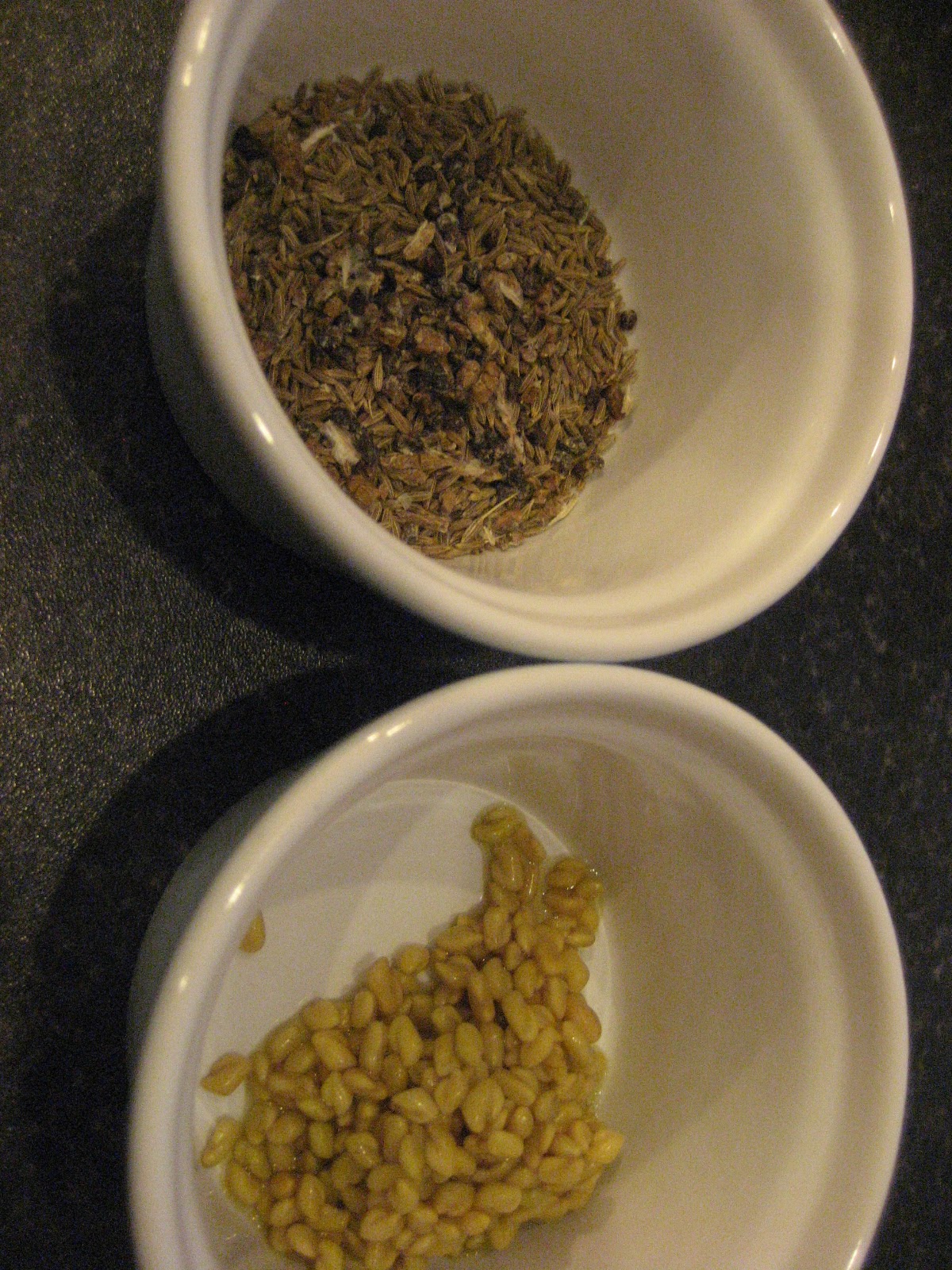
Hilbeh حلبة نبات is a green-coloured condiment based on fenugreek.  It was my first time ever cooking with this spice (the English name comes from the Latin for Greek hay).  Fenugreek is popular in Indian cooking and is often used to make curries.  I steeped the seeds overnight in a glass of water, as recommended by the recipe, then blitzed them in the food processor, with some water, 2 garlic cloves, a green chilli, chopped coriander and the juice of a lemon.

To make Zhug مهدي الشوق I mixed some red chillies, oil and coriander with 4 garlic cloves, ground cumin and cardamom seeds.  Zhug is a popular condiment throughout the Middle East and I'm sure many of us have had this on kebabs or falafel.

Preparing the Saltah

Fry the onion
Fry the beef
To make the Saltah, you start by frying the onions in a frying pan, then adding the minced meat and frying this until it is brown.  I fried the meat and onions in a pan, then added them to the main stewing pot later - this was mostly because I'd underestimated the amount of space I would need to cook this dish - however, it worked out quite well doing it this way, so I would also cook the meat separately in future.

Heat the tomatoes and potato
Add the beef stock


I parboiled the potatoes before adding them to the main pot with the tomatoes (which I had salted) and fresh coriander.  In retrospect, I probably should have added the coriander later. Once the tomatoes had softened a bit, I added beef stock and brought the mixture to the boil.  It was at this point that I added the meat and onions to the pot and reduced the heat.

Saltah
The original recipe recommends simmering for one hour, but I was in a bit of a hurry, so I let the ingredients simmer for forty minutes, before stirring in the egg and adding the condiments.

It was a really straight-forward dish to make and incredibly delicious.  I made quite a bit portion, so we also had Saltah for dinner the next day.  I'm sure you could add rice to the mixture (which would make it a bit like kabsa) but we decided to eat it with yummy slices of country bread.

Traditional Yemeni food in London

The Queen of Sheba restaurant
Halloumi starter
I decided to add a new element to my learning experience this time, by visiting a traditional Yemeni restaurant.  I'm sure that most of the world's cuisines are represented in London and, sure enough, there is a traditional Yemeni restaurant, not far from Paddington Station, called The Queen of Sheba.

Kabsa Lahan
I went there with some friends and, this being Ramadan, the restaurant was pretty empty, most of the bookings being later in the evening, after sunset.  Unfortunately, I couldn't try their Saltah, but we had a range of starters - halloumi, falafel, moussaka and kibbah (which I hadn't tried before).  We all ordered lamb-based dishes and I tried the Kabsa Laham which was quite good.  The portions were massive and, for the first time ever, my partner couldn't finish his dinner (he's usually asking for more!)

It was a nice addition to the learning experience and one I hope to repeat in future blogs.   

Image credits:

All photos were taken by me - please feel free to use this under the following Creative Commons license:

Attribution
Non-commercial
Share alike

Sunday, 7 August 2011

Yemen - the Madhab (مذهب) or Islamic schools of thought

It's quite apt to be blogging about a Muslim country during Ramadan.  I'd love to say that I planned it that way, but that's not the case.  When I was blogging about Saudi Arabia, I touched on the subject of Islam in a very general way, but it's such a rich and fascinating subject area, it will take me quite a few blog posts, I'd imagine to begin to understand the complexities of the Islamic faith.

Shi'a or Sunni?

One thing I learned about Islam when I was doing research about Saudi Arabia, is that it's an incredibly diverse faith.  There is no centralised power structure and history has led different branches of Islam in different directions, depending on which caliphate (from the Arabic خلافة khilafa meaning 'succession') you or your tribe believed in.

I'm sure most people will be aware that there are two main branches of Islam, أهل السنة or Sunni, who make up the majority of Muslim believers and  شيعة or Shi'a, predominant in Iran and parts of Iraq.  I'm still struggling to understand the difference between Sunni and Shi'a, but it seems to relate to a split that happened back in the early days of the development of Islam.

So what is Shi'a?
Arabia Felix by eesti

Followers of Shi'a believe that Muhammad's cousin Ali was his rightful successor, not the three Caliphs or successors (Abu Bakr, Umar and Uthman) followed by orthodox Sunni believers.  Ali's succession gained early support in (what is now) Iraq and his final resting place is the incredibly important Shi'a shrine حرم الإمام علي in Najaf, Iraq.  The politics of Islam seemed to have moved away from Arabia pretty early on, as Syria and Iraq championed these first rival factions of Islamic belief. I'm just beginning to understand the significance of the Iraqi holy sites to Muslim and, more specifically, Shi'a believers. 

I'm also trying to understand what all of this means to Islam in the 21st century and what I've understood is that the independence of the Shi'a imams from the rigidness of the Quranic scriptures and the Hadiths has given the Irani imams power that goes beyond the laws of the state.  On one hand, Shi'a seems to have a greater capability to deal with 21st century life.  On the other hand, belief in the god-given rights of imams and end-of-the-world predictions about the coming of مهدي al-Madhi, a kind of 'messiah', make Shi'a seem arcane and backward.

The Schools of Shi'a
Yemen countryside by eesti

Shi'a is further divided into three main schools:

اثنا عشرية or ithna asharriyah often called the Twelvers in English - is the biggest school of belief in Shi'a and predominates in Iran, Iraq, Bahrain, Azerbaijan and Lebanon

الإسماعيليون or Ismaili often called the Seveners in English - they seem to be a very small sect with a minority of believers spread throughout the Islamic world.

الزيدية or the Zaydi is a Shi'a school very closely connected to Yemen - they are know as the realists of Shi'a and split off from the other two branches very early on so, although they believe in the succession of Ali, they don't seem have the same belief in the god-given powers of the Imam or al-Mahdi

The schools of Sunni
Doorway in Ta'izz by eesti

Sunni believers also fall into various different schools or Madhab.  I can't even begin at this point to understand the difference between these, so for now, I'll content myself with identifying the four main ones and where they have most of their followers:

حنفي or Hanafi is the main Madhab in India, Pakistan, Central Asia, Egypt, Turkey, Syria, Jordan, Palestine, parts of Iraq and amongst Muslim communities in the UK and Germany. 

مالكي or Melikiyah is the predominant Madhab in north and west Africa (but not in Egypt or Sudan) - it's also the school of jurisprudence followed by most Muslims in Eritrea.

شافعي or Shafi'i spreads in a great arc across the Indian ocean, from the Muslim populations of Ethiopia, Sudan,Yemen and Somalia to Malaysia, Indonesia and South East Asia. 

حنبلى or Hambela is the school of Islam followed in Saudi Arabia.

There is also a Madhab called الاباضية or Ibadhi which is neither Sunni nor Shi'a and is the dominant school of Islam in Oman and Zanzibar.

Of course, all of this is an over-simplification of the spread of Islamic beliefs and each country, as well as many non-Muslim countries, will have a range of Madhabs and believers, from the main schools of Sunni and Shi'a, as well as more obscure Madhabs not mentioned in this blog. 

Islam in Yemen

Mosque in San'a by eesti
Yemen seems to have a characteristic north-south split when it comes to religion, with northern Yemen following the Shi'a school of Zaydi and southern Yemen following the Sunni school of Shafi'i.  By all accounts, both schools are in the moderate camps of Sunni and Shi'a so (perhaps?) not all that different to each other in terms of religious practice.  I get the sense that, whilst religion is important to Yemeni culture, it doesn't seem to dominate all aspects of Yemeni life, in contrast to the form of Islam practiced across the border in Saudi Arabia.

I look forward to learning more about Islam in future blog posts, now that I have added another piece to the puzzle!

Image credits:

For this blog post I've chosen to highlight the work of flickuser eesti who is from Saitami prefecture, just outside Tokyo and Japan.  He seems to have photographed half of the world, so it's well worth visiting his photostream on flickr.  He's also photographed Uzbekistan and Russia and has a very cute teddy bear who crops up in different places!

Thanks eesti for sharing your photos with us under the Creative Commons License.

Saturday, 30 July 2011

Yemen - Allah, al-Watan, ath-Thawrah, al-Wahdah!

It's more than 3,000 miles from Urumqi, the capital of Xinjiang/Uyghuristan to Sana'a, the capital of  الجمهورية اليمنية (Al Jumhūriyyah al Yamaniyyah - ie. the Republic of Yemen), the next place on my list!

The basics

At around 204,000 square miles (or 555,000 square kilometres), Yemen is slightly larger than Spain, more than six times bigger than Scotland and slightly smaller than the Canadian province of Manitoba.  It has an estimated population of 24 million people and 43% of the population is less than 14 years old (CIA World Factbook). The capital city, Sana'a, located in the country's highlands, is about 90 miles from the Red Sea and 185 miles north of Aden, a port city which will probably be more well-known to my British and European readers.

A bridge between the Arab world and East Africa
Young girl in Sana'a by kebnekaise

I think I know as little about Yemen, at this point, as most people in Europe.  I did touch on Yemeni culture and the diaspora in the Gulf states, when I was researching my blog posts for Saudi Arabia. One thing I learned about Yemen during this research is how different it is to the other states in Arabia.  Yemen is much poorer than Saudi Arabia or the United Arab Emirates and lots of Yemeni men travel to the Gulf states for work.  The local economy, as in many poor countries, depends on the remittances being sent home by these workers.  Interestingly, whilst Yemen's relations with Saudi Arabia and the Gulf states has been pretty tense in the past, Yemen has had a much closer relationship with Egypt and countries like Somalia and Ethiopia, that are culturally linked (putting Yemen at the centre of a Semitic cultural sphere, rather than at the edge of the Arab world).

A tale of two Yemens

It can't be nice, being looked upon as some kind of poor relation and I'm beginning to sense the complexity of the Yemeni identity.  Steeped in history, with a capital city that is a UNESCO world heritage site and such amazing potential for tourism, Yemen's recent history, unfortunately, has left most Westerners with the impression that it's a haven for kidnappers, pirates, revolutionaries and Islamic extremists.  An additional factor in researching the history and culture of Yemen is trying to get my head around the two Yemens, North and South.

The North -  الشمال

First, there is the culturally and politically dominant northern part of Yemen, containing the capital and a large chunk of the country's population, this is the Yemen that was part of the Ottoman Empire, gaining independence after the First World war, as the Kingdom of Yemen and in the 60's, after an Egyptian-style revolution, the Yemen Arab Republic.

The South -  الجنوب

Then there is the South, with its capital at Aden, which came under British influence, as a convenient stopping point on the route to India.  When the north gained its independence in 1918, Britain continued to govern the southern part of Yemen, as part of British India, until 1937, when the status of Aden was changed to 'Crown Colony'.  British rule in Aden became increasingly unpopular and the short-lived Federation of South Arabia in the 60's was quickly replaced by the socialist People's Democratic Republic of Yemen.

Unity - الوحدة
Sana'a by kebnekaise

Despite numerous attempts to reunite the two parts of Yemen, it wasn't until the 22nd of May 1990 that North and South Yemen were finally reunited to form the modern-day Republic of Yemen.  I must hold my hand up at this point and admit that I have no recollection whatsoever of the re-unification of Yemen.  Germany, yes, Yemen . . .uhm, I guess I was busy studying for my Inter Cert (an Irish exam, that comes halfways through secondary school, sort of like GCSE's in the UK).  Mind you, I don't remember other important things that happened on May 22nd 1990, like the launch of Windows 3.0, although possibly the significance of this (digital) revolution wasn't recognised by most of us at the time! 

Yemen's flag is typical of flags in the Middle East and North Africa, ie. with red, white and black stripes, it looks very similar to the flags of Egypt and Syria.  The former flags of North and South Yemen included symbols that represented the political nature of each of these countries, whereas the flag adopted after 1990, leaves the white stripe, rather neutrally, blank. 

Motto of the Republic of Yemen

In the opening title of this blog post, I've given a transcription in Roman letters of the country's motto:


لله، الوطن، الثورة، الوحدة
I was struck by how simple and direct the motto is and it seems to capture the essence of Yemeni political life very well!
The skyscrapers of Shibam by kebnekaise

لله، 'Allah' 
الوطن، 'al-Watan' (home/country)
الثورة، 'ath-Thawrah' (revolution)
الوحدة  'al-Wahdah' (unity)


Yemeni themes

I've just started researching possible themes for Yemen and I've already come up with some areas that I would like to look into further, such as the Queen of Sheba, the use of qat, the history of the coffee trade, the trade in frankincense and the island of Socotra.  I've bought some classical Yemeni music, Mohammad al-Harithi's L'Heure de Salomon recorded on CD for the Institut du Monde Arab.  I've been listening to this all morning and it's very transcendental, like the Indian Bhajan (devotional music) I blogged about in May 2010.  I'm also going to try my hand at the Yemeni national dish, Saltah and I've got a few books lined up, including a well-known Yemeni novel.
The peasant of Hadramawt by kebnekaise

I hope you'll join me, as I learn about Yemen.  Comments etc are much appreciated, as long as they aren't intentionally offensive to Yemeni people or culture.  


Image credits:

It's always exciting finding images on Flickr.com that illustrate the places I'm blogging about.  My research for Yemen has brought me to the work of kebnekaise aka Davide, who is from Trento in the north of Italy.  He seems to have travelled a lot in the north of Europe, Svalbard, Iceland etc., but the photos I've used to illustrate this blog post come from a trip he did to Yemen in 2000.  


I couldn't put all of the photos here, but you can see the rest of the Yemeni set on his photostream.  You can also see his images on his website.   


Thanks Davide for sharing these images with us using the Creative Commons License. 


Saturday, 23 July 2011

Xinjiang - saying goodbye to the Music of Central Asia

Xinjiang is approximately 7 times the size of Britain and almost 4 times the size of California.  It has one sixth of China's land area but, with over 20 million people, barely a sixtieth of China's population.  As usual, when I'm writing my final blog post, I feel that there is so much more I could learn about this region of the world, but the time has come to say goodbye!

A summary of the topics

My learning experience about Xinjiang has given me an opportunity to learn about the history of the region and the politics of Xinjiang versus East Turkestan.  I've also learned a lot about the geography of the region and the diversity of its landscape.  Not just deserts and mountains, but the Turfan Depression, the Dzungarian steppe and the fertile Ili Valley.  I learned how to cook Dà pán jī and how to make my own noodles.  I learned about Khoja Iparhan, the Fragrant concubine and how the Occident represented adventure and exoticism to the Chinese, similar to the way that the Orient was perceived by 19th century Europeans.  I learned about the magical qualities of Jade, how important this stone has been in the development of Chinese history and China's relationship with the people on its Western borders.  I learned about the Uyghur language and where it sits in the Turkic language family.  The Indo-European mummies of Tarim gave me an opportunity to explore the origins of race and the specific nature of racism in China.

Other areas of interest

Again, there are many other things I've learned during the past month or so, but not had time to write a blog post about.  I'll try to summarise these below so, if you're interested in finding out more, I'd encourage you to do some research into topics that I have only had a chance to scratch the surface of.  These include:

Uyghur demonstration in Helsinki, July 2011
- the history of Islam in China, including the Chinese muslims, the Hui people.
- K2, the second highest mountain in the world, which is situated on Xinjiang's southern border.
- Nuclear testing in the Taklamakan desert
- the Tocharians, their language and culture.
- the Parthians and the origin of the phrase 'a Parthian (or parting) shot'
- the story of the Chinese princess who gave away the secret of silk
- the Legend of Prester John
- Wuer Kaixi, a Uyghur who was one of the student leaders during the Tiananmen rebellion
- the role of Eunuchs in the Chinese Imperial court
- the symbolism of oleaster
- the Taiping rebellion (hopefully I'll be able to come back to this one!)
- the story of Yakub Beg and his independent Kashgaria in the 1860's
- George Hunter and the China Inland Mission
- the Xinjiang Military Region Production and Construction Corps "August First" Field Army Swearing to Defend the Thought of Mao Zedong to the Death - probably the longest name ever for a military regiment (I wonder if they used an acronym?)
- the claim that there were (or even are) gulags in Xinjiang
The Jiayuguan Gate by Richard Towell
- the Jiayuguan Gate in the Great Wall of China, often the last sight of China for exiles heading West.
- the Manchus of the Ili Valley
- the development of the Han Chinese city of Shihezi, just north of the capital Urumqi.
- the Uyghur diaspora and the challenges faced by the East Turkestan 'government in exile'
- the cause of goitre, attributed to the lime and magnesia salts of the southern Taklamakan
- the lake monster of Kanas
- the story of Tutuqash and the Mangqys

As you can imagine, I could have gone on blogging about Xinjiang for some time to come!

The sound of Central Asia

One topic I do want to draw your attention to is the rich musical traditions of Xinjiang and Central Asia, in general.  When I was preparing to go to Uzbekistan, I bought a CD of classical Uzbek and Tajik music, which I played over and over again, as I was packing my bags and getting ready for my 'big adverture' on the other side of the world!  Whilst the musical traditions of Central Asia have a lot in common with music throughout the Islamic world, I couldn't help noticing the influence of, what I perceived to be, Chinese music, on the music of Uzbekistan.  I think it was the sound of wind instruments, like the surnay (known as in shawm English, an ancestor of the oboe) that made me think Central Asian music sounded slightly Chinese.
Two shawms or surnay by tomfbh

The chanting that is so common in the Central Asian classical tradition sounds very much like chanting throughout the Arab world - but the solo singing, especially that of female artists, has a pitch that wouldn't sound out of place in a Chinese Opera.  As with everything else in Xinjiang, I think the music is an end result of centuries of cultural interaction.  Whether or not the wind instruments came from China, or the drums came from India or Arabia, Central Asian music has a sound that is pretty unique - it can sound both Western and Eastern, Islamic and Oriental.

The most popular form of traditional music in Xinjiang is a style called Muqam, a set of 12 musical suites, which is usually grouped into three parts; the muqaddime or introduction, the dastan or narrative songs, usually with a set text and the meshrep which is a faster beat and gets people dancing at weddings!  It's a shame I've not had time to delve deeper into the music of Xinjiang but, if you're interested in finding out more, the website of the London Uyghur Ensemble has more information about Uyghur music than I could ever give you.  As well as links to recordings of various instruments, their website also has great research documents by Rachel Harris, who is a Lecturer in Ethnomusicology at London's School of Oriental and African studies

I'm going to leave you with a video from YouTube, which features a performance by the London Uyghur Ensemble.  It's a recording of the Penjigah Muqam, which is popular in the Ili Valley.  The picture quality isn't great, but the most important thing is to sit back, listen and enjoy!


On Learning about the World next month, Y . . .


Image credits:

The photo of the Uyghur demonstrators in Helsinki was posted by Amnesty International Finland - you can find out more about this demonstration on their flickr stream and see a news report on the situation in Xinjiang at their website


The photo of the Jiayuguan Gate (aka Jiayu Pass) was shared with the world by flickruser Richard Towell - you can see more information about Richard at his profile page on Flickr

The image of the surnay/shawms was posted on flickr by tomfbh - you can see more of Tom's photos at his flickr photostream

Thursday, 7 July 2011

Xinjiang - Separate Tables and the History of Race

As part of my research on Xinjiang, I've read two books that were incredibly useful.  The first of these, Wild West China: The Taming of Xinjiang by Christian Tyler was a great overview of the history of this region, right up until 2003, when the book was published.  Of course, the period since 2003 has been incredibly important for Xinjiang, but a lot happened in the region in the 80's and 90's, which we don't often hear about it.  The second book I read was Racism: A very short Introduction by Ali Rattansi, part of the Oxford University Press (OUP) series I've mentioned in previous blog posts. 

Skeletons in the Desert

In Christian Tyler's words 'The climate of Xinjiang may be hostile to the living, but it is unusually kind to the dead'.  The early 20th-century craze for archaeology brought a number of (generally European) explorers and archaeologists to the Taklamakan desert and the Tarim basin, where they found mummified bodies dating back as far as 1900 BCE.  In modern Xinjiang, the topic of race is a controversial one.  Most people outside China might see the Uyghurs as the native inhabitants of Xinjiang, whereas the Chinese claim to have occupied this region, even before the Uyghurs came along. 

Genetic analysis of the Tarim mummies suggests that they are both wrong.  In fact, it's believed that the original inhabitants of Xinjiang were an Indo-European tribe called the Tocharians.  Red-haired skeletons wearing tartan seems somewhat out of place in Western China and I'm sure the evidence must be somewhat discomforting for modern inhabitants of the region, both the Uyghurs and the Chinese!

What is race?
Young girl at Chinese New Year by Yewenyi

When we think of race in the West, often the first thing that comes to mind is Black African versus White European.  In an effort to understand the concept of race, I wanted to read about it in a wider context, so I've chosen Xinjiang as my reference point to relate everything back to.  Of course, racial differences go beyond white/black and, in the case of Xinjiang, there is a very obvious clash of cultures that is, more often than not, given a racial context which pits the Turkic Uyghurs against the Han Chinese. 

One of the most important things I learned from Racism: A very short Introduction is that there is no such thing as race.  There are different colours of skin, different shapes of the eye or mouth, different genetic features that determine everything from what height we are, to whether our hair is frizzy or straight - but none of this constitutes complete identification with a racial category and, genetically at least, there is very little difference between someone who is perceived to be Chinese, than someone who is perceived to be Black African or White European.  When we talk about different races, often we're really talking about different cultures

So where did race come from?

The development of science from the 17th-century onwards, led to an obsession in the Victorian Age (19th century) with classification and 'putting things into boxes/categories'.  As Europeans started colonising the rest of the world and wiping out whole indigenous populations, (eg as the Spanish did in Central America, or the British in places like Tasmania), there was a real need to justify the expansion of European power.  Science, as much as religion, provided European conquerors with the moral argument they needed to colonise the rest of the world.

It was convenient to state that the people Europeans encountered in the New World were not really human at all, but somehow racially inferior.  Likewise, the people of sub-Saharan Africa, with whom Europeans had long-standing contact, were categorised as sub-human, a convenient justification, backed up by the new sciences, for the wholesale export of West African tribesmen and women to the cotton plantations of the Caribbean and the United States.

So what about racism?

Although I believe that there is no such thing as race, unfortunately, racism is a concept that is all too real for most societies in the early 21st century.  The term was first coined relatively recently (in the 1930's), to describe the Nazis' anti-Semitic policy of Judenrein, an early 20th-century form of ethnic cleansing.  Whilst in Ancient History, the colour of someones skin seems to have had little relevance, as to whether or not they would become a Roman Emperor (eg Septemus Severus) or an Egyptian Pharaoh (eg. the Pharaohs of Kush), xenophobia, ie. the hatred of strangers or foreigners, seems to have been around for a long time. 
Anti-Nazi League badge by Leo Reynolds

Although the Jews don't constitute a separate race, they are a minority group that has suffered incredible hatred and discrimination, particularly in Western Europe, since the time of Chaucer and the Spanish Reconquista (see my previous blogpost about the Sephardi philosopher, Baruch de Spinoza).  Likewise, being Irish, I always feel a bit strange ticking a separate box in equality monitoring forms, as I certainly don't feel racially different to other people who are white and living in Britain!  Irish people have also suffered incredible 'racism', being depicted as monkeys in 19th-century British and American propaganda and with British ethnologists, such as John Beddoe, claiming that Irish skulls were africanoid (and he didn't mean it as a compliment!)

Can only white people be racist?

Being born into a very 'white' society, I didn't have any friends growing up who identified as black or Asian, or anything other than Irish!  Luckily, being born into an culturally homogeneous community was no barrier to understanding other cultures, I think it depends on how you, as an individual, approach different cultures, and the idea that someone from a totally white background (or totally anything background) will somehow be racist, by default, is complete nonsense.  When I started travelling around the world, I was lucky enough to have the chance to become friends with people who were from different cultural backgrounds than me.

It wasn't until much later that I realised that it's not only white people who can be racist.  I think my first experiences of this were in Uzbekistan, where the local people had completely ostracised a young man who was of mixed Uzbek-African heritage, and in Thailand, where I was really shocked by the racism of my Thai students towards others in their society from Cambodian, Burmese or Lao backgrounds. 

Are the Chinese racist?

In answer to the question, Are the Chinese racist? or Are the Uzbeks racist? or Are the Thais racist? then the simplest answer is yes.  Yes, in the sense that, culturally, the Chinese (Uzbeks/Thais) have a very strong idea of what it means, and doesn't mean, to be Chinese (Uzbek/Thai).  Of course, it's a lot more complex than that and the question itself assumes that there is such a thing as a Chinese (Uzbek/Thai) race in the first place.

Whilst each one of us can approach the question of race from a very personal perspective, there are definitely collective attitudes in a lot of countries that could be considered to be inherently racist. Working with Slovak colleagues in my first teaching job in Bratislava, I was impressed by the fact that they genuinely welcomed me, an openly gay man, as well as my Jewish and Black American colleagues.  However, when the conversation turned to Roma communities in Slovakia, my erstwhile tolerant colleagues suddenly seemed a lot less so and I was surprised that a group of people who were so intelligent and reasonable, could have attitudes towards the Roma that appeared to be incredibly narrow-minded and stupid.  I guess we're all culturally brain-washed in one way or another and this is the challenge that faces many people in the modern world. 

Separate Tables
Chinese Feast by Wootang01

The evidence from Xinjiang is pretty damning and Tyler uses the concept of 'separate tables' to describe the cultural divide between the Han Chinese and the Uyghurs.  Until 1979, Chinese law forbade intermarriage between Han Chinese and Uyghurs.  Although many individuals on both sides have made efforts to bridge the cultural divide, forming friendships and doing business together, intermarriage between Han Chinese and Uyghurs is still something of a taboo.  Tyler catalogues some of the terrible incidents of repression of the Uyghurs by Chinese authorities in recent years, everything from job discrimination to language restrictions to imposed birth control.  Uyghurs, on their part, use terms like 'the fourteenth nationality' as a slur against those Uyghurs who've learned Chinese and begun to assimilate with Han culture.

I can't hope to do any justice to a discussion on race in a short blog post like this, but it's an area I would like to come back to again, through another cultural or national lens.  As to whether or not the original inhabitants of Xinjiang were Uyghur, Chinese or Indo-European - it hardly seems relevant to two cultures, Chinese and Turkic, that have had centuries of contact, love, hate and (mis)understanding.

Image credits:

The photo of the young Chinese girl is by flickruser yewenyi aka Brian Yap who is an Engineer from Marrickville in New South Wales, Australia.  You can see more of Brian's work on his website.  

The image of the Anti-Nazi League badge is by flickruser Leo Reynolds who is from Norwich in England.  You can learn more about Leo at his website

The photo of the Chinese-style feast is by flickruser Wootang01 aka David Woo, who is a teacher, originally from New Jersey, but now living in Hong Kong - he also has a website which deals with his experiences teaching and living in Hong Kong. 

Thanks to Brian, Leo and David for sharing these images with us using the Creative Commons License.