Monday, 28 November 2011

Amazonas - South America's 'Heart of Darkness'

It's just over 6,800 miles (almost 11,000 kilometres), as the crow flies (not that a crow would ever fly this distance!) from Zanzibar to Manaus, capital of the Brazilian state of Amazonas.  Covering an area that is more than 10 times the size of England and slightly bigger than Mongolia (or ten times the size of the US state of Georgia and slightly smaller than Queensland, Australia), Brazil's Amazonas has a population of 3.5 million people. 

More than half of Amazonas' inhabitants live in the state capital, Manaus, which is a mere 3 degrees south of the Equator and sits at the confluence of two of the Amazon's great tributaries, the rivers Negro and Solimões.  Manaus is almost 1800 miles (or 2900 kilometres) from Rio de Janeiro, which is like travelling from London to the other side of Europe. 

It feels like quite a big task, taking on Amazonas - not only because it encompasses the world's greatest river and largest rain forest, but also because this is my first time to blog about Brazil, a country that has gradually taken its rightful place on the global stage and a place that fascinates me, although I know very little about Brazil and its history. 

Flag of Venezuelan Amazonas
Of course, the Amazon isn't just about Brazil - Peru, Columbia and Venezuela, also have regions or districts called Amazonas.  Whilst I'll mostly be focusing on the Brazilian Amazonas for the purposes of this blog, I'll try to keep an eye to the other Amazonas regions in neighbouring countries. 

Something I fail to understand about Brazil is what happened there before Europeans turned up.  Whilst the western part of South America had the Incan empire and fabulous wealth, I've heard very little about the native tribes who lived in the eastern part of South America, on the Atlantic coast.  Whilst blogging about Paraguay, I learned a lot about the Jesuits and the history of South-Eastern Brazil, but the Amazon is a mystery to me that I'm hoping to make more sense of in the coming weeks.

From what little I've read so far, I can see that early European attitudes towards the native Amazonian tribes were full of racism, feelings of superiority and a belief that the native tribes were 'lazy' and had wasted a great natural gift that God had given to mankind.  The first Portuguese, Spanish and other Europeans who visited the Amazon region, believed that, with proper farming methods, the Amazon could be 'tamed' and made into a productive agricultural area.  Four centuries on and the Amazon rain forest remains untamed. Efforts at making the region economically productive have resulted in ecological devastation on a scale that is almost impossible to fathom. 

Flag of Columbian Amazonas
During the next few weeks, I want to further explore the impact of human activity on the Amazon rain forest.  I want to learn something about the native Amazonians and the history of European colonisation.  I'm also using the Amazon myth as an opportunity to explore themes around feminism.  As usual, I'd like to learn to cook a dish that is popular in the Amazon region or Brazil.  I've already started listening to Brazilian music and I have several books and movies lined up that deal specifically with the Amazon. 

Of course, typing Amazon into a Search Engine, will most likely bring you to the online book seller.  I've used Amazon (the book seller) a lot to find material for this blog and I'm a big fan of theirs, although I only really buy second-hand books, which you can get for as little as 1p (plus postage).  It's particularly useful for buying old editions of guidebooks (I usually buy the Insight guides). 

I used to think that the company was called Amazon, because of it's second-hand book section, ie. circulating already existing books, instead of cutting down trees to print new books.  I realise now that it was a bit naive to think this and that, actually, Amazon's founder just really liked the name.  Perhaps with their growing ebook market and the popularity of the Amazon Kindle, there is an opportunity for the company to adopt a Green agenda. 

Image credits:

All flags are taken from Wikimedia Commons and are in the public domain.

Sunday, 20 November 2011

Zanzibar - Kwaheri

So, the time has come to say kwaheri (farewell) to Zanzibar.  As usual, it's been a fascinating (virtual) journey and, as usual, I'm left with a burning desire to go and see this part of the world for myself!

A summary of the themes

Outside the blogosphere, I've been incredibly busy recently, so Zanzibar has taken me a bit longer than expected, almost two months in fact!  During that period I have learned about the History of Zanzibar, its connections with Oman and the Arab world and its bloody revolution in the 1960's.  I've also learned about the cultivation of cloves and how this spice made Zanzibar wealthy.  I learned how to cook Octopus and the traditional Zanzibari dish pweza wa nazi.  I learned about Emily Reute, aka Salamah bint Said, the Arabian princess who left Zanzibar and went to live in Germany.  I discovered that Zanzibar is the home of KiSwahili - both the language and culture.  I read Abdulrazak Gurnah's enchanting novel Paradise and I learned about Zanzibar's thriving slave trade, which dominated the East coast of Africa. 
Freddie Mercury by Virginia Mayo Garcia

Other Themes

As usual, there were many other themes that I touched upon during my research into Zanzibar, but didn't have time to explore fully.  I'm listing some of them below, which might be worth looking into, if you have time:

- the life of Freddie Mercury, who grew up in Zanzibar
- the influence of Zoroastrianism on Zanzibari culture
- the ornate doors of Zanzibar
- the practice of swaddling
- the life of Tibbu Tib, East Africa's most notorious slave trader
- the Sufi mystic Rumi
- Dhul-Qarnayn - the 'Green man' of Islam
- Iblis, Shaytan and Islamic interpretations of the Devil
- Sir John Kirk, the Scottish botanist

Still from Road to Zanzibar
As part of my research, I watched a movie called Road to Zanzibar starring Bing Crosby, Bob Hope and Dorothy Lamour.  It was a silly, rambling movie, with a thinly-held together plot and unexplained intervals of song, but I enjoyed the experience of seeing a movie I would otherwise not have bothered with.  It was part of a series of Road to . . . movies starring this trio and some of the scenes from the movie are captivating.  Its depiction of Africa might be considered racist nowadays (ie. a place full of savages), but I guess we have to take it in the context of its era.  It's a movie which has dated and offers little entertainment to a modern audience used to more sophisticated formulae, but I'd imagine it was fairly popular at the time of its release in 1941.

Dinner party trivia

During my research into Zanzibar, I also discovered lots of little tidbits of information, which you can use as dinner party trivia.  I learned that:

- the Chinese sent a diplomatic mission to Zanzibar in the 15th century, which is interesting, as we often assume that China's interest in Africa is a more recent phenomenon
- the leader of Zanzibar was called the Mwinyi Mkuu or 'great lord'
- Dr Livingstone said he was going to Africa to spread civilisation, commerce and Christianity
- Europeans didn't enter the hinterlands of Africa until the mid-19th century, when they 'discovered' Kilimanjaro and Lake Victoria.
- An estimated 13,000 people of Arab descent were killed during Zanzibar's 1963 revolution
- the father of Tanzania, Julius Nyerere spent three years studying Economics and History at the University of Edinburgh
- The shortest war in history was fought in 1896 between Zanzibar and Great Britain.  Zanzibar surrendered after just 38 minutes!
- Traditional Swahili beds are high enough for a slave to sleep underneath.
- William Thackeray's cousin, Caroline, spent the last 25 years of her life working in Zanzibar as a schoolmistress
Kirk's Red Colobus by woodlouse
- Kirk's red colobus is an endangered species of monkey.  It was isolated from other primates for a period of 10-15,000 years, which means it has developed unusual features, such as the four stomachs it needs to digest food.  It's called 'poison monkey' in Swahili.
- There are lots of superstitions in Zanzibar related to different animals, such as chameleons, land crabs and plate lizards.
- Zanzibar's stunning white sand beaches are created by parrot fish, who chew up coral and spit it out  as a white dust
- Modern Zanzibar is an incredibly popular destination for honeymooning couples

Taarab - the music of Zanzibar

Another aspect of my research that I didn't have time to blog about is the music of Zanzibar, known as Taarab.  I bought an album of Taarab music, which has provided me with a soundtrack for my blog.  Traditional Taarab music sounds much more like the music of Arabia than the music of Africa and different types of Taarab owe their influences to the music of Egypt, Yemen and India.  After the revolution, more African rhythms and styles were incorporated into the existing repertoires, so that modern Taarab music, like the Swahili language, is an interesting fusion of African, Indian and Arabian cultures.

Taarab is all about the musical clubs, rather than the individuals and a lot of the most famous Taarab groups have been supported by the revolutionary government and provided with an official 'seal of approval'.  This is really apparent in lots of the names, like Ghazzy Musical club and Royal Air Force musical club which show that these groups belong to the official government cultural music clubs.  Women sing Taarab even more frequently than men, but the musicians tend to be exclusively male.  Some of the female ensembles like Sahib El-Arry also function like co-operatives and have vegetable plots which help support the group's members. 

Although Taarab is all about the clubs, rather than the individuals, one notable exception is Bi KiDude, one of the world's oldest singers.  As you will see in the YouTube video below, she certainly has stage presence and, although she's more than 100 years old, her voice seems to be as strong as it ever was.  She's definitely one of Africa's greatest singers and a legend in her own time. 

Up next month, we're moving around the alphabet again from Z to A . . .

Image credits:

The drawing of Freddie Mercury is by a Spanish artist called Virginia Mayo Garcia.  Virginia's artwork can be seen on the Artelista website, where you can also purchase copies of her work.  She has shared this image using the Creative Commons license, as a way of promoting her work. 

The still from the movie Road to Zanzibar is from a photo taken by me. This still is being used to illustrate this blogpost and promote the movie. By publishing this image, I'm not condoning or encouraging reproduction of this image on the Internet or anywhere else. This image is not meant to bring the actors or studio into disrepute or suggest their endorsement of this blogpost, but is meant to promote the performances of these actors in this movie.

The still shows Bing Crosby and Bob Hope, as they sit in the jungle and try to work out the scheming of the two female characters (played by Dorothy Lamour and Una Merkel).

The image of Kirk's Red Colobus is from flickr member woodlouse who is a web editor from Brighton.  You can see more of her images of her photostream

Monday, 7 November 2011

Zanzibar - Slavery in the 21st century

Whilst most of us are well aware of the history of the 19th-century slave trade in West Africa and the Americas, I think that many people will be less aware of the thriving slave trade on the east coast of Africa, during this period, which centred on Zanzibar and its links with Oman and the Arab world.  As I'm blogging about Zanzibar this month, I thought it would be a good opportunity to have a look at slavery, not just in the past, but also in the 21st century. 

Slavery in the modern world

Slavery has existed, in one form or another, since time immemorial and, despite the reforms of the 19th century and the abolition of slavery world-wide, the number of people living in slavery today, an estimated 12-20 million, is higher than it's ever been at any other point in human history.  Just last month, in Bedfordshire, England, a man was charged with slavery offenses, when a group of 24 English and Eastern European men were released from 'servitude' at a caravan site where they had been kept, either by force or dependency.

Slavery is a massive subject area and there is a lot of information out there.  Organisations like Anti-Slavery work hard to campaign and inform the public about modern slavery around the world.  I can only hope to scratch the surface of this topic area in this blog post, but it's something I'd like to research in more detail at a later date.

Slavery by Quadelirus
The Language of Slavery

The word 'slave' comes from the Greek, σκλάβος 'sklavos, which is also the origin of the word Slav/Slavic.  It's believed to have come from a verb meaning 'to strip the body of a slain enemy'.  When we talk about slavery today, it's a term which is incredibly loaded, historically, and one has to find a balance in the use of this word, that recognises the more complex nature of modern slavery but, at the same time, doesn't trivialise the oppression and suffering experienced by slaves in the pre-modern age.

Whilst chattel slavery, ie. the explicit ownership of slaves (chattel from the same root as capital, ie property) is less common nowadays, there are many other forms of slavery that have taken its place.

Unpaid work

A wider definition of slavery could refer to anyone who does work that they are not paid for.  Whilst this is hardly the same as being chained together and sent across the Atlantic in ships and being denied even basic freedoms, the form that modern slavery takes is complex, but no less repressive.

The most common form of slavery is Bond Labour, ie when someone is required to work for no or little pay, to pay back a debt, often one that has been handed down from their parents.  It's estimated that 40 million people in India are bonded workers paying off a debt.  Whilst bonded labourers are free to marry and lead their own lives, they are, nevertheless, trapped in an endless cycle of work and debt that binds them to their 'employer'.

The enslavement of women

Perhaps enforced marriages could be seen as a kind of slavery?  If we're talking about unpaid labour, I can't think of many countries in the world where the labour of keeping a home and rearing children (generally work done by women) is paid for and women still suffer enormous oppression and 'enslavement' to the needs and decisions of their husbands/brothers/fathers.

Petitioning Downing Street by 38 degrees
Human trafficking

Although slavery is illegal throughout the world, the law is often not enforced, especially on the International scene and most readers of this blog will be familiar with issues around human trafficking and will have heard of cases in your own country where people moved from somewhere else, with the hope of creating a better life for themselves, only to fall into the hands of traffickers, having their passports taken away and being forced into unpaid or low-paid labour or, in extreme cases, into a life of prostitution.

Other examples of unpaid labour

When I was teaching in Uzbekistan, I had to cancel a whole month of lessons during October, as almost all of my students from the university were sent off to pick cotton for the State.  As far as I know this was unpaid labour and I heard some horror stories about appalling working conditions in the cotton fields.  Anyone with a bit of money would try to buy their way out of this obligation, but poorer students had no option but to sacrifice a month's study to bring in the cotton harvest.

Perhaps military service could also be seen as a kind of slavery?  Again, in lots of countries I've lived in, including France and Russia, young men go to great lengths to get out of this obligation - often damaging themselves mentally or physically, so they won't be put in uniform and lose their freedom (usually up to a year or two years).  Young men from ethnic minorities or men who are gay or bisexual fear military service most, because of the terrible hazing of new recruits.  A shocking incident occurred when I was living in Russia, were a young recruit lost both of his legs because of the cruelty of his commanders.

Wage slaves

In a more abstract sense, being a wage slave is also incredibly oppressive and limiting.  21st-century society in the West functions in such a way as to discourage you from giving up your job and the wages you receive for the work you do, so that many people find themselves trapped in lives that are unfulfilling.  Let's face it, most of us are slaves to the capitalist system.  Our jobs, livelihoods and living conditions depend on the whims of the global economy and the actions of a handful of incredibly rich people.

Are we any less enslaved that people in the 19th century?  Well, I guess it's an unfair comparison as we do get paid for our work and we do have the option of changing employers or changing the direction of our lives (however difficult that might be), something that wasn't an option for slaves in the 19th century.

The abolition of slavery

William Wilberforce, anti-slavery campaigner
Slavery was abolished in Zanzibar, when it became a British protectorate in 1897.  I think Britain has played an incredibly important role in the abolition of slavery around the world and reformers like William Wilberforce paved the way for a world where individuals would have more control over their lives.  It's obvious that slavery is not a thing of the past, however and modern generations should continue to campaign and educate others on the nature of slavery, as it exists in the world today.

A small number of countries, like Japan, have no real historical baggage relating to slavery, although even Japan in the 21st century is a centre for human trafficking, especially of young women who move from places like Thailand and Columbia and are forced into prostitution.

Iceland abolished slavery as early as 1117 (previous to that, most slaves in Iceland had been kidnapped from Ireland and Britain and taken to the island by force).  Other countries have been much slower to catch-up, especially in the Arab world, where slavery was still legal in Yemen and Saudi Arabia until 1962 and in Oman until 1970.  Mauritania (in west Africa) was the last country to abolish slavery in 1981. 

Image credits:

The image of the young slave girl statue was taken by flickr member Quadelirus - the original image can be seen at  http://www.flickr.com/photos/john-christopher-bowers/1370446201/

The image of the petitioners was put on Flickr by a UK-based campaigning organisation called 38 degrees - you can find out more about their campaign work at their website.

The image of William Wilberforce is from Wikipedia and is in the public domain.

Sunday, 30 October 2011

Zanzibar - Gurnah's Paradise

One of my main motivations for starting this blog was because I was interested in discovering literary gems from other countries and cultures that I might otherwise have missed. 

It's been such a pleasure to read Paradise by Abdulrazak Gurnah.  The novel is quite well-known in the West, having been shortlisted for the Booker prize in 1994.  Gurnah was born in Zanzibar but has made a career for himself in the UK.  He currently lectures at the University of Kent.  Paradise didn't win the Booker prize - this was awarded to James Kelman's, How late it was, how late - a controversial decision that led one of the judges (Julia Neuberger) to resign from the judging panel. 

Themes

Paradise is set in Tanganyika (now Tanzania) during the period of German colonisation.  The main character is a young man called Yusuf who is taken away from his parents at a young age and sent to live with his 'Uncle' Aziz, a relatively affluent merchant, who spends a lot of his time journeying into Africa's dark interior to trade with distant tribes who live beside the lakes of the Great Rift valley. 

Paradise by Abdulrazak Gurnah
The urge to trade

One of the biggest themes of the book is the importance of trade and the great lengths that Uncle Aziz will go to trade with distant tribes and make a profit on his return home.  Not all of the trade is legal and it's revealed that Aziz is stock-piling rhinocerous horn, in a village at the end of the train line, where it can easily be transported to the coast and sold off to Indian merchants, when times are tough. 

A lot of the action of the novel centres on a disastrous trading expedition to visit a tribe on the far side of the lakes.  The journey itself is horrendous, with Aziz paying a fortune in 'gifts' to the tribal villages they pass through, some of his porters die in the jungle before they even reach their destination.  When they get to the village of the faraway tribe, they are held hostage and have all of their goods taken from them by force.  They eventually negotiate themselves out of the situation and leave with most of their goods, selling everything off at a cut-down rate as they make their way home.

Yusuf reflects on the human desire to trade 'it made him wonder what it was that people wanted so much that they could overcome that terror in search of trade'  Trade is certainly an interesting human impulse - wars have been fought over trade, societies have been corrupted and ruined in search of profit, and yet, it's an impulse that has driven forward progress and opened the world up to (what we consider to be) civilisation.  Uncle Aziz only seems happy when a trading expedition is in progress - it's as though it's the trade itself that gives his life meaning and not the settled life he comes back to and invests most of his profits into.

Zanzibar was at the heart of the East African and Indian ocean trade routes.  The wealth of Zanzibar was built on the trade of cloves and other spices and the trade in slaves from the African interior to the Arab world and beyond.

The pain of movement

Despite Uncle Aziz's desire to trade and travel into the interior, the language of the novel depicts the movement as frightening and unnatural.  When they are travelling to the jungle, the wheels of the train screech in high-pitched protests and the homesteads they pass hug the surface of the hurtling earth.  After the heavy rains in the jungle, the earth seems alive with movement, which scares the men, as they move further and further away from the civilised world. 

A new kind of slavery - Rehani and Magendo

Dhow at dusk by Caneles
Although slavery had been abolished by their European overlords, a kind of slavery persists in the novel and Yusuf finds out that Uncle Aziz isn't really his uncle and that he (Yusuf) has been given to Aziz by his parents as a type of rehani or 'bond', until Yusuf's father pays back a debt that he owes to the merchant.  When Yusuf arrives at Uncle Aziz's house, he is befriended by another young man, called Khalil, who is Uncle Aziz's shopkeeper and also bound to him as a result of a debt. 

As the novel progresses,Yusuf falls in love with Amina, Uncle Aziz's young wife and servant to 'the Mistress', the widow Uncle Aziz married because of her fortune.  Amina's case is even more deplorable, as she is megendo or 'stolen' and was sold to the merchant by Khalil's father, also to pay off a debt. 

Yusuf becomes fascinated by the old man, Mzee Hamdani, who tends to the Mistress's garden. He is a freed slave, who decided to stay with the family, even after slavery had been abolished.  He only speaks once during the novel and his words fascinate Yusuf when he says 'They offered me freedom as a gift.  She did [the Mistress]. Who told her she had it to offer?'  It raises an interesting point about whether or not one person can really own another person and that, somehow, freedom is not something that can be given or taken away. 

The Garden and the Jungle - desire and brutality

The novel is infused with a powerful and threatening sense of sexuality.  Yusuf is considered to be extremely handsome and arouses the interest of the various adults he comes into contact with .  He is the subject of unwelcome teasing by Ma Ajuza, one of the customers in the shop where he works with Khalil.  He is an object of desire for the men, as they deal with the hardships of the jungle.  He becomes an obsession for the Mistress, who convinces herself that she can only be cured of her mysterious illness, if she allows Yusuf to have sex with her. 

Brutality and romance are interwoven throughout the novel, a good example being the behaviour of Bachus, the Greek-Indian lorry driver, who constantly sings love songs, only pausing to unleash a string of obscenities, directed at the various porters.  Mohammed Abdalla, the mnyapara who manages the porters, is feared because of his great physical strength and his reputation for sexually abusing the men. 

Paradise, the title of the book, is ironic, in the sense that it describes 'hell on earth'.  The jungle is hell and paradise, at one and the same time - paradise because of the freedom Yusuf experiences there and the wonderful sights that he sees whilst travelling.  The garden is a sensual paradise, nurtured by Uncle Aziz's profits.  But it's also where Yusuf is watched by the Mistress - it is a prison and the walls are high. 

Reaching out by Caneles
Scavenging dogs and the fear of Wolf men

Dogs feature frequently in the book.  Yusuf associates them with his move to Uncle Aziz's home.  He and Khalil are forced to sleep outside and the dogs attack them, causing Yusuf recurring nightmares that haunt him throughout the rest of the novel.  One of their greatest fears in the jungle is of meeting the Wolf men - the product of interbreeding between the wolves of the jungle and the savage tribes.  Kalasingh is the Sikh driver who wants to translate the Qu'ran into Swahili, so the native Africans will understand the intolerance of their God.  He points out that Muslims are afraid of dogs, just as the Prophet Muhammad feared them.  As I've highlighted in previous blogs, dogs often herald death in art and literature and death pervades the novel Paradise.  When Khalil first meets Yusuf he nicknames him, kifa urongo which means 'the living death'.

In one of the key scenes at the end of the novel, Yusuf overcomes his fear, when he sees the dogs feasting on piles of excrement and they growl at him, warning him not to come near.  He realises that, like the dogs, he will be forced to 'eat shit' for his entire life, unless he does something drastic to change things.

Europeans and Indians - Gog and Magog

There is a real sense of fear in the descriptions of Europeans in the novel and hatred for the Indians who act as intermediaries between the Europeans and the native Africans.  The Africans believe that the Europeans have supernatural powers.  That they can eat iron and that they breathe fire!  They live in fear of the Germans and the brutal way that they make war.  The Germans bring an inflexible approach to punishment that fails to respect local traditions of retribution and being able to buy your way out of a hanging or whipping.  It is the Germans who rescue Uncle Aziz's property from the jungle tribe and it is the Germans who come searching for young men, at the end of the novel, so they can make war on their European enemies, the British.

The characters seem resigned to their fate and unable to counter the strength of European domination.  When Yusuf sees the German officer at the end of the novel, he thinks that the officer is smiling and, therefore, kind.  It's only when he sees the German officer up close that he realises the smile is a grimace, created by a physical deformity, it exposes the Germans rotting teeth and gums, prompting Yusuf to think of him as a living corpse. 

There are several references to Gog and Magog in the novel - the savage tribes that come from the north of the known world.  In the end, Yusuf decides to take his chances in the service of the Europeans, leaving his 'paradise' far behind him. 

Other themes

To Paradise Island by Caneles
Paradise is quite commonly compared to Joseph Conrad's Heart of Darkness, but I also see elements of Charlotte Bronte's Jane Eyre (the madwoman in the attic) and Joseph, the son of Jacob in the Old Testament.  Like Joseph, Yusuf is abandoned by those who should take care of him and has to find his own way in a world that is incredibly hostile. 

The theme of language is an important one - especially the use of Kiswahili and Arabic and how this decides the nature of some of the relationships between the main characters.  When they are in the jungle, Nyundo the translator, ultimately holds the balance of power in the discussions between Uncle Aziz and the tribal leader. Yusuf is totally dependent on Khalil to translate between himself and the Mistress.  When Khalil refuses to translate any more, Amina takes over and the way she translates opens up a whole new conversation, which made me think about the different language used by men and women in the novel. 

The novel also has a lot to say about gender - although there are very few female characters, the world they inhabit is every bit as cruel as the world inhabited by the men. 

I see a lot of similarities with the last novel I read for this blog, Zayd Mutee' Dammaj's The Hostage (see my blog post about Yemen) - they both deal with young men who are removed from their families and kept as slaves/servants in a rich household.  They both deal with repressed sexuality and the exploitation of young people.  Both books have opened up a whole new world of Arabian and East African fiction for me, that I didn't previously know existed. 

Gurnah uses a lot of Swahili words throughout the novel and this has introduced me to a whole new language.  I'm pasting some of the new words I've learned below:

kanzu, tajiri mkubwa, washenzi, vibarua, mnyapara, kipande, maandazi, mahamri, nahodha, buibui, qasida, mganga, pombe, askari

Image credits:

The image of the book cover was taken by me.  I read the 1995 Penguin (2nd) edition of the book (no doubt published by Penguin, as a result of the novel's literary success)

For this blog post, I wanted to highlight the photography of flickrmember caneles, who is originally from Amsterdam.  You can see more of his work at his photostream - thanks caneles for sharing these images with us, using the Creative Commons license. 

Sunday, 23 October 2011

Zanzibar - the home of Swahili

Spoken or understood by an estimated 100 million people, Swahili or, to give the language its official name, Kiswahili,  ranks as one of the world's major languages.  It's spoken by many people as a second or third language and the number of native speakers is much smaller, at around 5 million people.  It was the language of trade along the East African coast and, although it's a Bantu language, Swahili has many borrowings from Arabic, including the name of the language, which comes from the Arabic word for 'coast' ساحل sawahil.

The Home of Swahili

I think it's fair to say that Zanzibar is the home of Swahili language and culture.  The dialect of Unguja, Kiunguja has been adopted as the standard for all Swahili dialects.  The name Zanzibar is connected to Zanj (black), the name used by medieval Arabs for the East African coast. As the language of trade, Swahili also has native speakers in the coastal areas of Tanzania, Kenya and Somalia, as well as in the Comoros islands and, due to inland trade, there are more obscure versions of Swahili, such as Kingwana, spoken by small tribal groups in the eastern provinces of the Democratic Republic of the Congo.  It's a lingua franca in all of these countries, except Somalia and is becoming increasingly popular in neighbouring countries like Uganda.

Swahili on the web

Zanzibar street sign by Al Stevens
The BBC has its own Swahili language pages and there is a Google search engine in Swahili.  I often think Wikipedia is a good indicator of a language's web presence, as it is created by ordinary people, as opposed to a government body or initiative.  Swahili has a presence on Wikipedia, but it's fairly low for a language of its size.  Perhaps this is because people are less likely to use the Internet in places where Swahili is spoken as a native language?  There are currently less articles on the Swahili Wikipedia than on the Icelandic one and Swahili ranks 74th in terms of size, amongst the different language Wikipedias.  Having said that, it's still one of the biggest African languages on Wikipedia, only Yoruba has more articles, from the Niger-Congo language family (and, of course, Arabic, which is Afro-Asiatic).

The use of Noun Classes

Like most of the other Bantu languages, Swahili employs noun cases to categorise nouns.  These are usually indicated by prefixes, eg. m-/wa- (denoting nouns connected to people) or ki-/vi- (denoting things which are man-made, including languages).  Linguists have identified up to 16 of noun cases in Swahili, although this is a bit controversial, as it is based on the Meinhof system, which counts singular and plural noun cases separately.

For Example

There are some very good examples of Swahili noun cases on Wikipedia, one of which I'm summarising here, as I thought it was quite interesting.  It relates to the Bantu noun classes 3 m- (singular) and 4 mi- (plural), which are often called the 'tree' classes and are mostly used with things that occur naturally, but are neither human nor animal, things like . . . well, trees!  This group includes words like, mwitu (forest) and mtama (millet), but also things which are usually made from plants, eg. mkeka (mat - although these are probably made from plastic nowadays!).
Zanzibar beach by Al Stevens

This group also includes natural and supernatural forces, such as mwezi (moon), mlima (mountain) and mto (river).  The group is also extended to include 'things that spread', like the branches of a tree, so we get words like mwavuli for umbrella and moshi for smoke.  This group also includes more abstract words like mpaka (border) and mwendo (journey).  Of course, the noun class doesn't just affect the noun, but also influences the form of the adjective and verb which, I guess, means you really need to know your noun classes in order to speak Swahili properly!

Noun Classes around the world

I think it's fair to say that noun classes are a fairly unfamiliar concept to speakers of Indo-European languages (like English), although I think we do differentiate between animate and inanimate objects, to a degree.  It's interesting that noun classes tend to exist in societies that live in closer harmony with the natural world - they can be found in Native American languages, the Bantu languages of Africa and Aboriginal languages of Australia, like Dyirbal and Ngangikurrunggurr.  They're also found in a handful of Causcasian languages, notably Bats which is spoken by a small number of people in a remote mountain village in the north-east of Georgia.  I wonder if the death of animist traditions and beliefs, led to the death of noun classes in other world languages?

Noun Class v Gender

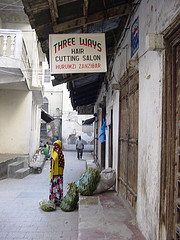
Three Ways Salon by Al Stevens
Some linguists consider the use of gender in many European languages, as a type of Noun Class.  I don't really understand what the difference is and it's worth noting that, whilst we usually think of Gender as meaning masculine, feminine or (in languages like German) neuter, actually gender comes from the Latin word genus meaning 'type' or 'class', unrelated to male/female aspects of the noun.  If you've ever studied French, I'm sure you'll have wondered why some words are considered to be masculine and others feminine!  In Russian, many of the nouns describing men use the feminine gender and I think there is enough evidence around to understand that the use of this term has been corrupted by the male/female dichotomy.

Perhaps then gender, in European languages, is a vestige of earlier, more complex, noun classes?  English has almost completely got rid of gender, each phase of 'modernisation' of the language has used gender distinctions less and less.  Perhaps the trend in language development is away from the use of noun classes?  There are certainly more nouns (or things) to talk about these days, than there were in the eras of our grand-parents and ancestors and, perhaps, this makes the categorisation of nouns too complex to even bother with?  I wonder how Swahili deals with modern inventions, such as computers or iPhones?

I'm going to leave you with a video from YouTube, which was posted by www.bookbox.com - a project which helps children learn languages through story-telling.  The story is called The First Well and is spoken in the Kenyan dialect of Kiswahili.

Image credits:

For this blogpost I wanted to highlight the work of flickrmember almacaw aka Al Stevens, who lives in a small village in Sussex.  You can see more of Al's images at his photostream and find out more about his approach to web design on his website.  

Thanks Al for sharing these images of Zanzibar using the Creative Commons license. 

Saturday, 8 October 2011

Zanzibar - Memoirs of an Arabian Princess

One of my favourite things about writing this blog is finding out more about the lives of some of the people who have lived in the places I blog about.  One of the most famous records of life in 19th-century Zanzibar, Memoirs of an Arabian Princess from Zanzibar was written by a woman called Emily Ruete. This was the name that she adopted after she had eloped with a German merchant, but her birth name was Salamah bint Said and she was the daughter of the 19th-century ruler of Zanzibar and Oman, the Sultan Seyyid Said. Hers is a fascinating story and reminded me a little bit on another book I've read about Gayatri Devi, the last Maharani of Jaipur (see my previous blog post about Gayatri Devi).

Although she was born and brought up in Zanzibar, Salamah bint Said was eventually forced to leave the islands.  She'd become somewhat of a persona non grata in the eyes of most of her family, as she had, rather foolishly, got caught up in a plot against her eldest brother, Majid and then, in an effort to make amends had offended his successor and rival, Bargash, which meant that both sides of the feud turned against her.

Book cover
No wonder then that she sought comfort in the arms of her neighbour, a German merchant, and it caused no small degree of scandal when she turned up pregnant in Aden, where she converted to Christianity and married Herr Ruete before moving back to Germany with her new husband.  She bore him another two children before he was tragically killed in a tram accident and she found herself alone, in a strange land, struggling to bring up three small children all by herself, with little hope of ever returning to Zanzibar. 

She did eventually return to Zanzibar, many years later, but couldn't settle there and made her way back north to Lebanon and Germany again.  As well as telling the fascinating story of her life, Memoirs of an Arabian Princess from Zanzibar also describes Zanzibari life in great detail and deals with a range of themes that touch on culture and society.  I've picked out a few of them below:

Race

To the modern reader, Frau Ruete's opinions come across as being terribly racist.  Her description of the Africans who worked for the Sultan in the chapter entitled On the idleness of the Negro, show a common 19th-century view of black people as being work-shy and in need of constant instruction.  Perhaps I should have titled this paragraph, On the idleness of Concubines and their children, as a more accurate (and 21st century) appraisal of life in the Sultan's harem!  She also alludes to the racial tension between some of the Sultan's wives.  Her own mother was Circassian (originating in the Caucasus region of, what is now, southern Russia) and Emily refers to the tension that existed between the Sultan's Circassian and Abyssinian wives, with the Circassian women looking down on the Abyssinians as darker skinned and therefore inferior.

She seems to reserve most of her vitriol for the Hindu merchants who managed a lot of the trade on Zanzibar and she refers to a horrific incident when a Hindu was tricked into entering a courtyard where an animal was being slaughtered, his horror being the subject of ridicule and abuse by the Hindu's Muslim neighbours.

Education and Work

Racism aside, I'm always interested to see how 'the West' is perceived in the eyes of other cultures and Emily's stay in Germany gave her the perfect opportunity to compare life in the North with life in the South.  She talks a bit about the different approaches to work in Europe and in East Africa and points out the influence of the weather on the European's v the African's approach to work.  She struggled to survive the harsh winters in Germany and generally believed that Europeans had a tougher life, as survival itself was a constant struggle.

She also makes an interesting point about Education and how European schools so closely resemble prisons!  She criticised the tendency in Europe to teach children lots of useless facts that they will never use in their adult lives.  I think it was an astute observation and I was also interested in her views on giving children homework, something that wouldn't have happened in Zanzibar, because it would have disrupted family life.

Attitudes towards Child care

Emily with her husband and two of her children
She also compares life in Europe rather unfavourably, with regard to child care and how children are raised.  She felt that European children didn't spend enough time with their parents, particularly their mothers and she couldn't understand how English children would be sent off to boarding schools, where they might not see their parents from one end of the year until the next.  This was a stark contrast to Zanzibar, where children were more or less constantly in contact with their mothers and, at least once a day, with their fathers.

I was interested to learn about the tradition of 'swaddling' that existed in Zanzibar and in many parts of the world in the 19th century.  According to Islamic custom, children were bound for the first forty days of their lives.  I guess swaddling was believed to prevent Sudden Infant Death Syndrome (also called Cot or Crib Death).  

The position of women in Zanzibari society

She also talks about the position of women in Zanzibari society.  Whilst some of her observations regarding the limitations of being a woman might be expected of an Islamic society, she also talks a lot about the rights that women had, such as rights to property and the right to marry above or below your social standing.  On one hand, she talks about the enclosed life of the harem, where the Sultan's wives are not allowed to see daylight for fourth months after his death.  On the other hand, she tells us about her great Aunt Assha, a fiercely independent woman, who ruled Oman and fought battles to protect the regency of the Sultan, Emily's father.  Frau Ruete herself challenges many of the preconceptions we have about a woman in the 19th century and this book was the first autobiography ever written by an Arabian woman.

An apple a day

The medieval practice of cupping
One part of European life that she really respected was the modern approach to medicine that she experienced in Germany.  This time Zanzibar compares unfavourably with Europe and she regrets that her homeland remained behind the times and antiquated in its approach to medical science.  She refers to old-fashioned practices such as 'cupping' (ie. applying hot cups to the skin) and blood-letting, which was commonly practised in Zanzibar when she was growing up.  She also mentions remedies that involved boiling pages containing verses from the Qu'ran and then drinking these in a kind of tea.  There seems to have been no recognition of mental health issues in 19th-century Zanzibar and depression was seen as a kind of 'demon' that took possession of the person's body.  The best cure was . . . well, cupping and bleeding!

Her mother died when she was fifteen, in a cholera epidemic that swept across Zanzibar. Without her mother around, she lacked appropriate guidance during the turbulent time after the Sultan's death, when different family members took sides with different heirs to the throne.

Torch-lit parades through Stone Town

There is a lot more to this story than I have time to write about in this blog post and the book is well-worth a read, if you fancy getting out of your cultural comfort zone!  She went to great lengths to explain the nature of Islamic traditions and festivals, such as Ramadan and I couldn't help observing that, what is quite familiar to most Europeans today, needed a more detailed explanation for the benefit of the 19th century European reader.  Perhaps we have moved forward and embraced other cultures after all?

My abiding memory of the book is the scene of rich Zanzibari women paying visits to each other, in the early morning hours before sunrise, with a retinue of servants carrying massive lanterns to light their way through the huddled streets of Stone Town.

Image credits:

The image of Emily Ruete with her husband and two of their children is taken from Wikimedia Commons - this image is in the public domain, as its copyright has expired and you can see more information at the image's description page.

The image of cupping is also from Wikimedia Commons and is originally from a 15th century English manuscript, which is kept at the British Library.  This image is also in the public domain and you can also see more information at the descrition page on Wikimedia Commons.

Sunday, 2 October 2011

Zanzibar - how I cooked Octopus!

My search for a traditional Zanzibari dish brought up a few options, including the Portuguese Goan dish Sorpotel but, in the end, I couldn't resist the temptation of the Swahili dish Pweza wa nazi or Octopus in a coconut soup

I've seldom eaten Octopus before, never mind cooked it, so it was a real challenge for me.  Whilst it's relatively common in Mediterranean cuisine, I don't know many people in the UK or Ireland who eat octopus on a regular basis.  The islands of Zanzibar have ready access to the fruits of the ocean and octopus is a tasty example of traditional Swahili cooking. 

Where does one buy octopus in London?

Frozen octopus from Moxon's
My first quest was to find somewhere to buy octopus in London.  Most octopus here seems to come from Portugal and is usually frozen, as octopus doesn't travel well over long distances.  I looked at some online options, but with minimum orders of £35 and more, this wasn't really an affordable option for me.  Luckily, a work colleague pointed me in the direction of Moxon's, a posh fishmongers in South Kensington.  I've learned that octopus isn't cheap(!), £12.95 Sterling per kilo (that's 34,121 Tanzanian Shillings).  My next question was . . . how the hell do I cook it?

How does one cook an octopus?

Like a scene from Alien
Octopus bathes in milk
A trawl through the Internet brought up all kinds of options - beat it with a hammer first, smash it against some rocks (like I have rocks lying around in my kitchen!), don't overcook it (then another website said stew it for a very long time), boil it in its own ink and, one of my favourites, chuck it in the bin, who the hell eats octopus anyway? 

I settled for the advice of an Italian website, which has a recipe for Pweza wa nazi (they've incorrectly called it Pwewa, but the Swahili word for octopus should be pweza).  I'm providing a link to the original recipe for those of you who speak Italian.  I must admit that I improvised a lot this time and did things in a different order than the Italian recipe recommended.  I also used coconut milk from a tin. 

The Ingredients

1 octopus (pweza)
4/5 medium sized potatoes (viazi)
1 onion (kitunguu)
1 lime (ndimu)
coconut milk (maji ya dafu)
tomato puree (nyanya)
garam masala
cardamon (iliki)
cinnamon (dalasini)
2 pieces of garlic (saumu)

Preparing the octopus

First I had to defrost the octopus.  The portion I bought was almost two kilos, so I cut it in half and left it to defrost for about four hours, a process resembling a scene from the hit movie Alien.  Another work colleague recommended that I marinate the octopus in milk, which was a really good tip and helped to tenderise it.  The Italian recipe recommended boiling it for 30 minutes only (ie. not overcooking it, which is a mistake lots of people make, apparently).  This seemed to work quite well and when I tasted the octopus after 30 minutes of boiling, it was really succulent. 

At first when I was boiling it, the octopus seemed to swell up mightily, like a true creature of the deep, threatening to escape the pot.  Then it quickly shrank to a shadow of its former self and turned from a murky brownish colour to an exciting purplish red.

Creature of the deep

After 30 minutes of boiling

A succulent piece of octopus


Preparing the Pweza wa nazi

Once you've boiled octopus, you can add it to dishes, either freshly boiled in a salad or, as I did, as part of a curry/soup.  To make the coconut soup I fried the chopped onion and garlic.  Then I added the spices and tomato puree.  Once everything had softened and fried a bit, I added the octopus, which I had sliced up into bite-sized pieces.  I stir-fried the octopus for a bit, before adding the coconut milk.  Once this had come to the boil, I added pieces of potato that I parboiled so they would cook quickly.

Fry the onion, garlic and spices

Add the tomato puree and pieces of octopus

Add the coconut milk

Add the parboiled potato
Pweza wa nazi
I was worried about losing the tenderness of the octopus, so I only simmered the mixture for 30 minutes and this was enough to keep the octopus from getting hard or rubbery.

You can see the end result for yourself - easy pwezy!


Image credits:

All photos were taken by me.  Please feel free to re-use according to the Creative Commons license:

Attribution (especially to this blog post)
Non-commercial
Share alike